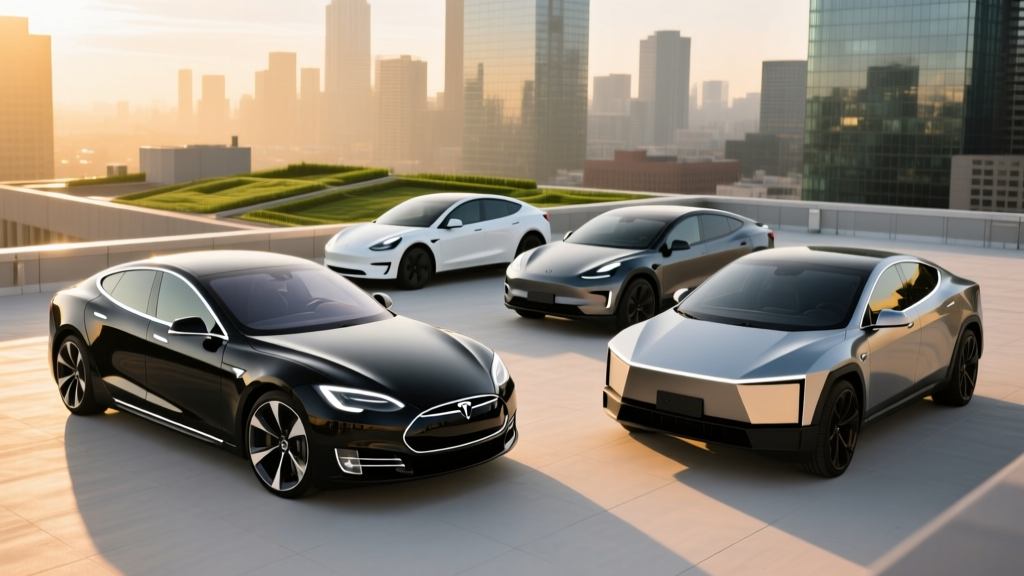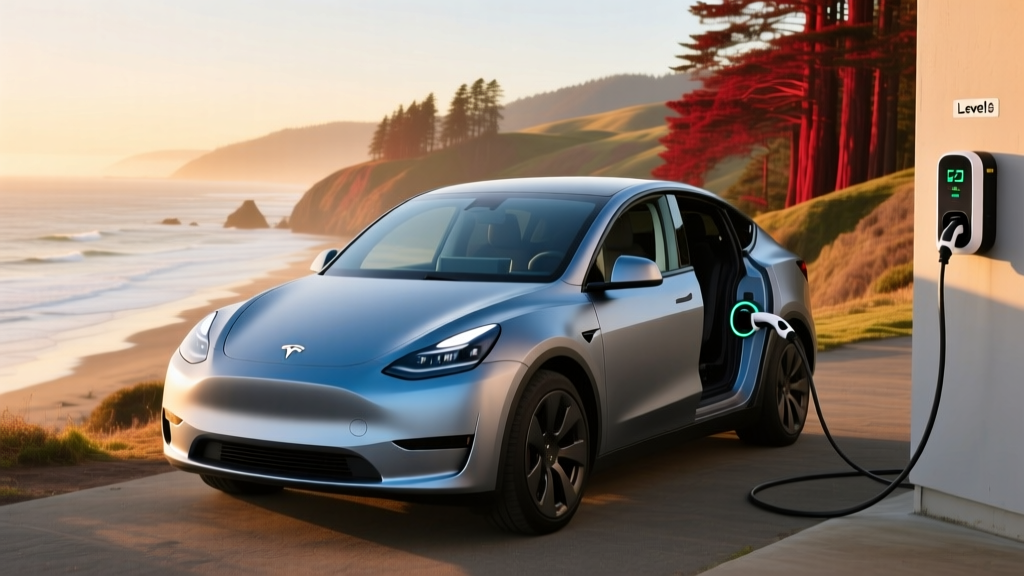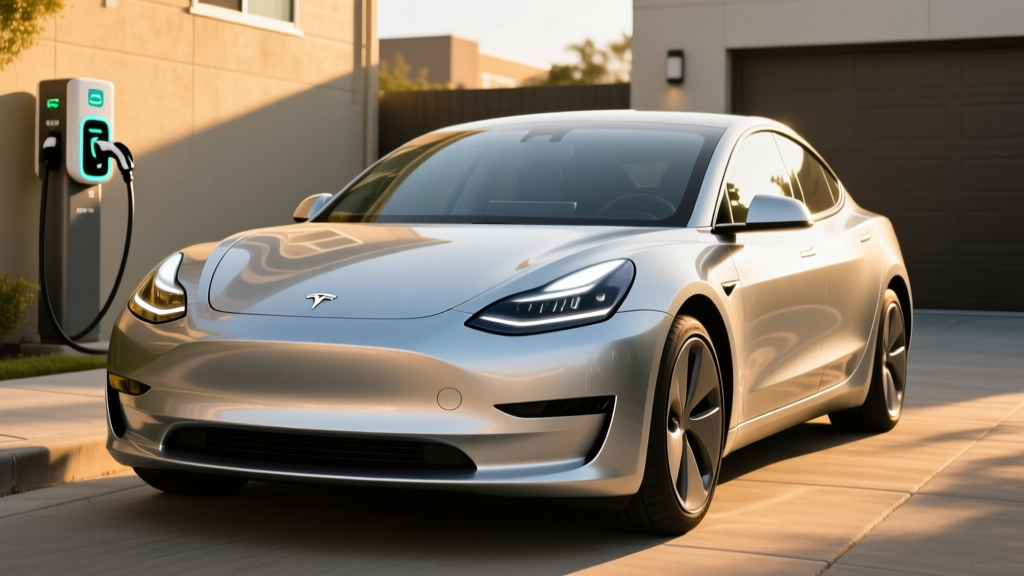
Tesla's permanent-magnet synchronous and AC induction motor combinations remain the benchmark for electric drivetrain efficiency in 2026. The current Model 3 lineup leverages these alternating current motors to deliver class-leading range, rapid DC fast charging, and strong performance — all while keeping the entry price competitive in a crowded midsize EV sedan segment. This review breaks down every number buyers need: real-world range, charging curves, tax-credit eligibility, and how the Model 3 stacks up against the Hyundai Ioniq 6 and BMW i4.
2026 Tesla Model 3: Quick Verdict
The Model 3 remains the default recommendation for buyers who want proven Supercharger network access, strong efficiency, and over-the-air updates. The alternating current motor architecture — a permanent-magnet synchronous reluctance motor on the rear axle and an AC induction motor on the front axle of dual-motor variants — gives Tesla a distinct edge in both highway efficiency and cold-weather traction management. The 2026 refresh carries over the "Highland" cabin improvements introduced in late 2023, including ventilated front seats, ambient lighting, rear-seat touchscreen, and significantly improved NVH (noise, vibration, harshness). The biggest trade-offs remain the minimalist interior, reliance on touchscreen controls, and the absence of Apple CarPlay/Android Auto.
| Spec | RWD (Standard) | Long Range AWD | Performance |
|---|---|---|---|
| EPA Range | 272 mi | 363 mi | 315 mi |
| Battery (usable) | ~60 kWh (LFP) | ~79 kWh (NMC) | ~79 kWh (NMC) |
| Motor Type | Rear: PM synchronous (AC) | Rear: PM sync / Front: AC induction | Rear: PM sync / Front: AC induction |
| Horsepower | 271 hp | 346 hp | 510 hp |
| 0–60 mph | 5.8 sec | 4.2 sec | 2.9 sec |
| Drivetrain | RWD | Dual-Motor AWD | Dual-Motor AWD |
| Peak DC Charge | 170 kW | 250 kW | 250 kW |
| 10–80% DC Time | ~25 min | ~18 min | ~18 min |
| MPGe (combined) | 132 MPGe | 130 MPGe | 115 MPGe |
| Efficiency | 25 kWh/100mi | 26 kWh/100mi | 29 kWh/100mi |
| Base MSRP | $38,990 | $45,740 | $52,490 |
Range & Efficiency: Real-World Expectations
The EPA sticker tells only part of the story. Tesla's alternating motor technology excels at part-load efficiency — the permanent-magnet rear motor handles cruising while the front AC induction motor can decouple entirely under light loads, reducing drag losses. This is why the Model 3 Long Range achieves 130 MPGe combined despite offering dual-motor AWD.
- EPA Sticker: 363 miles (Long Range AWD)
- Highway (70 mph, 75°F): Expect ~290–310 miles
- City/Commuting: Near-EPA or slightly above, ~350–370 miles (regen-heavy driving)
- Cold Weather (20°F, highway): ~230–260 miles without preconditioning; ~280–300 miles with preconditioning and seat heaters
- RWD (LFP): EPA 272 mi; expect ~220–240 mi highway, ~180–200 mi in deep cold
The LFP (lithium iron phosphate) battery in the RWD model is heavier and less energy-dense than the NMC (nickel manganese cobalt) pack in the Long Range, which explains the range gap despite similar exterior dimensions. However, LFP chemistry tolerates regular 100% charging without accelerated degradation — a significant daily-use advantage. Tesla recommends charging LFP packs to 100% at least weekly for accurate state-of-charge calibration.
Efficiency measured in kWh per 100 miles is where the Model 3 shines. At 25–26 kWh/100mi for the RWD and Long Range trims, it undercuts the Hyundai Ioniq 6 (27 kWh/100mi for the SEL AWD) and decisively beats the BMW i4 xDrive40 (31 kWh/100mi). The permanent-magnet synchronous motor's reluctance design — using both magnetic reluctance torque and permanent-magnet torque — is a key reason for this efficiency advantage, especially at the partial-load conditions typical of highway cruising.
Understanding Tesla's Alternating Current Motor Architecture
The term "alternating current motor" in Tesla's drivetrain refers to the fact that both motor types used — the permanent-magnet synchronous motor (PMSM) and the AC induction motor — operate on alternating current supplied by the inverter from the DC battery pack. Here's how the dual-motor system works in practice:
- Rear Motor (PMSM): This is the primary drive motor on all Model 3 variants. It uses a rotor with embedded permanent magnets and a stator powered by AC from the inverter. It delivers high torque at low RPMs and exceptional efficiency at cruising speeds. The reluctance component of the torque (from the rotor's salient geometry) supplements the magnetic torque, reducing the amount of rare-earth magnet material needed.
- Front Motor (AC Induction): Found only on dual-motor AWD trims. An AC induction motor uses electromagnetic induction to create rotor current — no permanent magnets required. Its key advantage is that it can be completely de-energized (zero magnetic drag) when not needed, improving highway efficiency. It also provides robust torque at low speeds for AWD traction in slippery conditions.
- Inverter: Converts DC from the battery to precisely controlled AC waveforms. Tesla's inverter uses silicon carbide (SiC) MOSFETs for high switching efficiency, which directly contributes to the Model 3's class-leading MPGe.
This combination is why the Model 3 Long Range AWD achieves nearly the same efficiency as single-motor competitors despite powering all four wheels. The front induction motor simply freewheels during steady-state highway driving, adding negligible losses.
Charging Speed: DC Fast Charge & Home Level 2
Charging speed is where Tesla's Supercharger network and the Model 3's battery thermal management system combine for a decisive real-world advantage. The Long Range and Performance trims support up to 250 kW peak DC fast charging on V3 and V4 Superchargers, while the RWD (with its smaller LFP pack) peaks at approximately 170 kW.
| Charging Method | Power / Rate | Miles Added per Hour | Notes |
|---|---|---|---|
| Level 1 (120V household) | ~1.4 kW | ~5 mi/hr | Emergency/trickle only |
| Level 2 (240V, 48A / Mobile Connector) | ~11.5 kW | ~44 mi/hr | Standard home setup, NEMA 14-50 or Wall Connector |
| Level 2 (240V, 32A) | ~7.7 kW | ~30 mi/hr | Dryer outlet or lower-amp circuit |
| DC Fast (V3/V4 Supercharger) | Up to 250 kW (LR/Perf) Up to 170 kW (RWD) | ~1,000+ mi/hr peak | 10–80% in ~18 min (LR), ~25 min (RWD) |
| DC Fast (CCS adapter, 3rd-party) | Up to 250 kW | Varies by station | Tesla now ships with NACS; CCS adapter available |
Charging curve reality: The 250 kW peak on Long Range and Performance trims is sustained from roughly 10–30% state of charge, then tapers progressively. Expect ~150 kW average from 30–60%, ~90 kW from 60–75%, and under 50 kW above 80%. This is why the 10–80% metric matters far more than the peak number. On a road trip, you'll typically charge from 10–50% (about 8–10 minutes) and move on — Tesla's trip planner optimizes for this.
Preconditioning is critical. Navigate to a Supercharger using the car's built-in navigation and the battery will automatically warm to optimal charging temperature. Arriving at a Supercharger without preconditioning (e.g., using a third-party app or driving to a station manually) can add 5–10 minutes to your session in cold weather, as the battery must heat before accepting peak power.
For home charging, the Tesla Wall Connector ($475) on a 60A circuit (48A continuous) delivers 11.5 kW, adding roughly 44 miles of range per hour. An overnight charge from 20–80% takes about 4 hours on the Long Range. Most owners will need a 240V/60A circuit installed; expect $800–$2,000 for a professional installation depending on panel proximity and local permitting, per HomeAdvisor data. If your electrical panel is at capacity, a panel upgrade to 200A may add $1,500–$3,000.
Performance, Cargo, and Interior
The Model 3's alternating current motor setup delivers instant torque with no gear shifts — the single-speed reduction gear transfers power directly. The Performance trim's 2.9-second 0–60 mph time places it in supercar territory, while the RWD's 5.8 seconds is more than adequate for highway merging and daily driving.
Cargo and dimensions:
- Rear trunk: 23 cu ft (including under-floor storage)
- Front trunk (frunk): 3.1 cu ft
- Total cargo: 26.1 cu ft
- Rear legroom: 35.2 inches
- Front headroom: 39.6 inches
- Wheelbase: 113.2 inches
The cargo volume is competitive with the segment, though the Ioniq 6's fastback trunk opening is wider for loading bulky items. Rear-seat legroom is adequate for adults on shorter trips but tight for taller passengers on long journeys — a common complaint versus the BMW i4, which offers slightly more rear space thanks to a longer wheelbase.
Tech and driver assistance:
- 15.4-inch center touchscreen (no instrument cluster; speed/navigation displayed on left third of main screen)
- 8.0-inch rear-seat touchscreen for climate and media
- Standard Autopilot (SAE Level 2): adaptive cruise, lane centering, automatic emergency braking
- Optional FSD (Supervised) — $8,000 or $99/mo: adds traffic-light/stop-sign recognition, city-street autosteer, and parking features. This is SAE Level 2 and requires full driver attention at all times.
- No Apple CarPlay or Android Auto — Tesla's proprietary infotainment only
Pricing, Tax Credits, and Ownership Cost
The 2026 Model 3 pricing structure remains straightforward, though federal tax credit eligibility requires careful attention to IRS §30D rules.
| Trim | Base MSRP | As-Tested (typical) | §30D Credit Eligibility | Effective Price (est.) |
|---|---|---|---|---|
| RWD (LFP) | $38,990 | $39,990 (w/ paint) | Up to $3,750 (partial — battery sourcing) | ~$35,240–$36,240 |
| Long Range AWD | $45,740 | $47,740 (w/ paint + wheels) | Up to $7,500 (if sourcing requirements met) | ~$38,240–$40,240 |
| Performance | $52,490 | $54,490 | Up to $7,500 (if sourcing requirements met) | ~$45,490–$47,490 |
IRS §30D eligibility rules for 2026 (per irs.gov):
- MSRP cap: Sedans must be under $55,000 — all Model 3 trims qualify.
- Buyer income cap: Modified AGI ≤ $150,000 (single), $225,000 (head of household), $300,000 (joint).
- Battery sourcing: The $7,500 credit splits into two halves — $3,750 for critical-minerals sourcing and $3,750 for battery-component manufacturing. The RWD's LFP battery (largely sourced from CATL in China) typically qualifies for only the component half ($3,750). The Long Range and Performance NMC packs may qualify for the full $7,500 depending on current supply-chain compliance — verify at purchase via the dealer's point-of-sale transfer system.
- Point-of-sale transfer: As of 2024+, buyers can transfer the credit to the dealer at purchase, reducing the out-of-pocket price immediately rather than waiting for a tax refund.
5-Year Total Cost of Ownership (Long Range AWD, 15,000 mi/yr, national avg. electricity at $0.16/kWh):
- Purchase (after credit): ~$38,240
- Electricity (5 yrs, 75,000 mi at 26 kWh/100mi): ~$3,120
- Insurance (5 yrs, national avg.): ~$10,500 (Tesla insurance premiums run 15–25% above segment average)
- Maintenance (5 yrs): ~$1,500 (no oil changes; tire rotation, cabin filter, wiper fluid)
- Estimated 5-yr depreciation: ~$14,000 (Tesla resale values have stabilized but remain volatile based on price cuts)
- 5-Year TCO: ~$67,360
Pros, Cons, and Who Should Buy
- Class-leading efficiency (25–26 kWh/100mi) translates to lower charging costs and longer real-world range
- Supercharger network — the most reliable and extensive DC fast-charging network in North America
- Over-the-air updates continuously add features and improve performance
- LFP battery (RWD) allows routine 100% charging without degradation concerns
- Strong resale value relative to most EVs
- Excellent safety ratings (IIHS Top Safety Pick+, NHTSA 5-star)
- No Apple CarPlay or Android Auto — a dealbreaker for some buyers
- Minimalist interior: no physical buttons for climate, mirrors, or glovebox — all touchscreen
- Rear-seat space is tight for tall adults on long trips
- FSD (Supervised) is expensive ($8,000) and still requires full driver attention (SAE Level 2)
- Insurance premiums are higher than segment average
- RWD LFP range drops significantly in cold weather (~180–200 mi highway in deep cold)
- Choose the RWD if: You commute under 60 miles daily, can charge at home, live in a mild climate, and want the lowest entry price with LFP longevity.
- Choose the Long Range AWD if: You take regular road trips (300+ miles), live in a cold-weather state, or need AWD traction. This is the best all-around trim.
- Choose the Performance if: Track capability and sub-3-second acceleration matter to you, and you accept the range and price trade-offs.
- Look elsewhere if: You need Apple CarPlay, prefer physical buttons, need a spacious rear seat for adults, or want a luxury badge (consider the BMW i4 or Genesis Electrified G80).
Model 3 vs. Key Competitors
| Spec | Tesla Model 3 LR AWD | Hyundai Ioniq 6 SEL AWD | BMW i4 xDrive40 |
|---|---|---|---|
| EPA Range | 363 mi | 316 mi | 282 mi |
| Battery | 79 kWh (NMC) | 77.4 kWh (NMC) | 81.5 kWh (NMC) |
| Peak DC Charge | 250 kW | 240 kW | 205 kW |
| 10–80% Time | ~18 min | ~18 min | ~31 min |
| MPGe (combined) | 130 | 111 | 98 |
| 0–60 mph | 4.2 sec | 5.1 sec | 4.7 sec |
| Base MSRP | $45,740 | $46,700 | $57,900 |
| §30D Credit | Up to $7,500 | Up to $7,500 | Up to $7,500 |
| Apple CarPlay | No | Yes | Yes |
The Model 3 wins on range, efficiency, and charging-network access. The Ioniq 6 matches its DC charging speed and offers CarPlay plus more rear-seat room, though at a slightly higher price and lower efficiency. The BMW i4 justifies its premium with build quality, driving dynamics, and dealer service infrastructure, but trails on range and charging speed. See fueleconomy.gov side-by-side data for official EPA comparisons.
Warranty & Long-Term Ownership
- Basic Vehicle: 4 years / 50,000 miles
- Battery & Drive Unit: 8 years / 120,000 miles (Long Range & Performance); 8 years / 100,000 miles (RWD)
- Battery warranty threshold: Tesla guarantees 70% minimum capacity retention during the warranty period. If your battery drops below 70% state of health within the time/mileage limits, Tesla will repair or replace it.
- Real-world degradation: Tesla's 2024 Impact Report cited average battery degradation of ~12% at 200,000 miles for Model 3/Y packs. LFP packs in the RWD trim are expected to show even lower degradation, though long-term fleet data is still accumulating.
Frequently Asked Questions
What is the real-world range of the 2026 Tesla Model 3?
The Long Range AWD is EPA-rated at 363 miles, but expect 290–310 miles on a highway trip at 70 mph in moderate temperatures. In city driving with regenerative braking, you may match or slightly exceed the EPA number. In cold weather (below 30°F), highway range drops to approximately 230–260 miles unless you precondition the battery. The RWD (LFP) is EPA-rated at 272 miles with a real-world highway expectation of 220–240 miles.
How fast does the Model 3 charge at home and on the road?
On a home Level 2 charger (240V, 48A), the Model 3 adds roughly 44 miles of range per hour — a full overnight session replenishes 200+ miles. On a V3/V4 Supercharger, the Long Range and Performance trims peak at 250 kW, charging from 10–80% in about 18 minutes. The RWD peaks at 170 kW with a 10–80% time of approximately 25 minutes. Always precondition the battery by navigating to the charger via the car's navigation for optimal speed.
How much does the 2026 Model 3 cost after tax credits?
The Long Range AWD starts at $45,740 MSRP. If you qualify for the full $7,500 federal tax credit (income under $150K single / $300K joint, and battery-sourcing requirements are met), the effective price drops to approximately $38,240. The RWD starts at $38,990 and typically qualifies for $3,750 due to LFP battery-sourcing limitations, bringing it to roughly $35,240. Always verify current eligibility at irs.gov before purchase.
Does the 2026 Model 3 qualify for the federal EV tax credit?
Yes, all trims fall under the $55,000 MSRP cap for sedans. However, the actual credit amount depends on battery critical-mineral sourcing and component manufacturing requirements under IRS §30D, plus your modified adjusted gross income. The Long Range and Performance trims are more likely to qualify for the full $7,500, while the RWD (LFP) typically qualifies for $3,750. The credit can be transferred to the dealer at point of sale as an immediate price reduction.
Is the Model 3 worth buying vs. the Ioniq 6 or BMW i4?
The Model 3 Long Range AWD is the best choice if range, efficiency, and Supercharger access are your top priorities. Choose the Ioniq 6 if you want Apple CarPlay, more rear-seat space, and comparable DC charging speed at a similar price. Choose the BMW i4 if build quality, driving dynamics, and luxury-badge prestige justify the $12,000+ price premium and lower range. For most buyers, the Model 3's combination of 363-mile EPA range, 250 kW charging, and the lowest TCO in the segment makes it the strongest overall value — provided you can accept the touchscreen-only interior.
What type of motor does the Tesla Model 3 use?
The 2026 Model 3 uses alternating current (AC) motors exclusively. The rear motor is a permanent-magnet synchronous reluctance motor (PMSM), which operates on AC supplied by the inverter. Dual-motor trims (Long Range and Performance) add a front AC induction motor. This combination provides high efficiency at cruising speeds (the front induction motor can freewheel with zero drag) and strong AWD traction when needed. Both motor types are powered by AC current generated from the DC battery pack via Tesla's silicon-carbide inverter.