Why Does My Tesla Air Conditioner Smell? The Quick Diagnosis
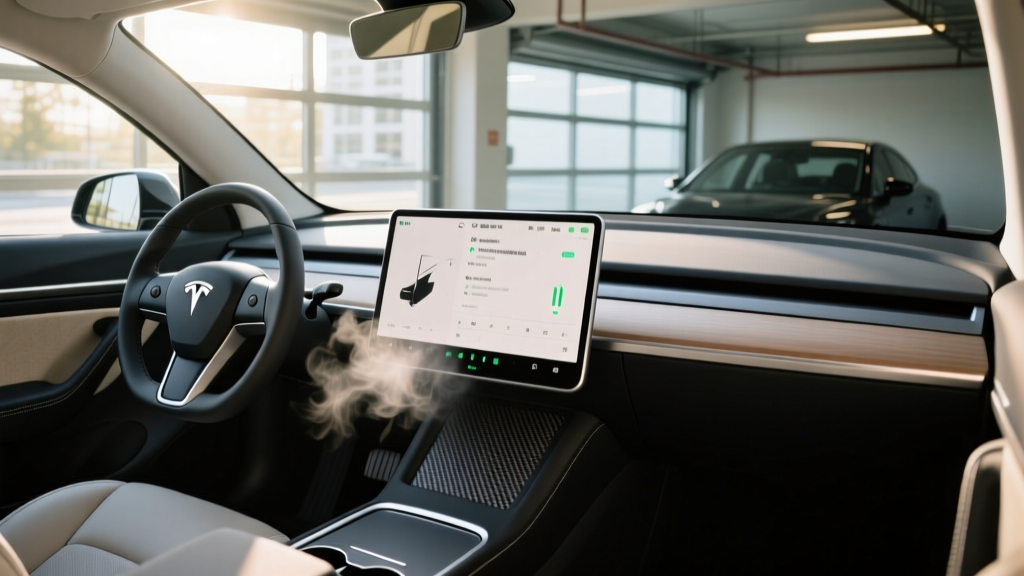
If you've noticed a musty, sour, or "wet sock" odor blasting from your Tesla's vents when you turn on the climate control, you're not alone. The Tesla air conditioner smell is one of the most widely reported comfort complaints across Model Y and Model 3 owner forums. The good news: it's almost never a mechanical failure — it's a biological one.
The root cause is microbial growth (mold, mildew, and bacteria) on the HVAC evaporator coil, located behind the dashboard. When humid air passes over the cold evaporator, condensation forms. If that moisture doesn't fully drain or dry, it becomes a breeding ground for organisms that produce the odor you smell when the fan kicks on.
Teslas are particularly prone to this for a few design-specific reasons:
- Cabin air filter placement and type: Tesla's factory filters are basic particulate filters that don't always trap the organic matter feeding microbial growth. Unlike some competitors, Tesla didn't historically include an activated charcoal layer as standard.
- Heat pump efficiency (Octovalve): The 2021+ Model Y and refreshed Model 3 use an advanced heat pump system that recycles thermal energy aggressively. This can leave the evaporator damp for longer periods between drive cycles.
- Recirculation defaults: Tesla's climate system often defaults to recirculated air, which traps humidity inside the cabin rather than pulling in drier outside air.
- No dedicated "evaporator dry" cycle: Some legacy automakers program the HVAC to run the fan on low for several minutes after shutdown to dry the coil. Tesla's software does not consistently do this.
Proven Fixes for the Tesla AC Smell
1. Replace the Cabin Air Filters (Most Effective First Step)
Tesla recommends replacing cabin air filters every 2 years (or annually in high-pollution/high-pollen areas). However, many owners find that upgrading to a HEPA-grade or activated-charcoal aftermarket filter (such as those from Bosch, Fram, or EV-specific brands like Tesmanian or Taptes) dramatically reduces or eliminates the odor. The Model Y has two cabin filters stacked vertically behind the glovebox — replace both.
Cost: $25–$55 for a pair of aftermarket filters. DIY replacement takes 15–20 minutes with a Torx T20 driver.
2. Run an HVAC Evaporator Cleaner
Products like Kool-It Evaporator Cleaner or Dorman HVAC Cleaner are foaming treatments you spray directly onto the evaporator coil (accessible through the drain tube or filter housing). These kill existing mold and bacteria colonies. Follow with a distilled-water rinse per product instructions.
3. Change Your Climate Habits
- Turn off AC 2–3 minutes before arriving: Switch to fan-only mode (tap the snowflake icon off, leave fan on) for the last few minutes of your drive. This dries the evaporator before you park.
- Use outside air mode periodically: Avoid permanent recirculation. Let fresh, drier air cycle through the system.
- Precondition while plugged in: Running preconditioning while on shore power dries the system using grid electricity rather than leaving condensation to sit.
4. Ozone Generator Treatment (Last Resort)
For persistent smell that survives filter changes and evaporator cleaning, a 30-minute ozone generator treatment inside the cabin (with the car sealed and HVAC on recirculate) kills deep-seated organisms. This is a dealer-service option (~$100–$150) or available via portable ozone units (~$40). Never occupy the vehicle during ozone treatment.
2026 Tesla Model Y: Full Review & Specs
Since the AC smell issue is most prevalent in the Model Y (Tesla's highest-volume vehicle and the one most affected by the heat pump design), let's evaluate the 2026 Model Y as a complete package — beyond the HVAC quirks.
| Spec | Long Range AWD | Performance AWD | Rear-Wheel Drive |
|---|---|---|---|
| EPA Range | 320 miles | 293 miles | 260 miles |
| Battery (usable) | ~75 kWh (NMC) | ~75 kWh (NMC) | ~60 kWh (LFP) |
| Drivetrain | Dual Motor AWD | Dual Motor AWD | Single Motor RWD |
| Horsepower | 384 hp | 456 hp | 295 hp |
| 0–60 mph | 4.8 sec | 3.5 sec | 6.6 sec |
| Peak DC Charge Rate | 250 kW | 250 kW | 175 kW |
| 10–80% DC Charge | ~27 min | ~27 min | ~30 min |
| Level 2 Home Charging | 11.5 kW (~37 mi/hr) | 11.5 kW (~37 mi/hr) | 7.6 kW (~30 mi/hr) |
| EPA Efficiency | 122 MPGe (28 kWh/100mi) | 111 MPGe (30 kWh/100mi) | 128 MPGe (26 kWh/100mi) |
| Base MSRP | $47,990 | $54,490 | $39,990 |
| Battery Warranty | 8 years / 120,000 miles (min 70% retention) | ||
Sources: fueleconomy.gov, Tesla Model Y Design Studio. Specs reflect 2026 model year.
The EPA-rated 320 miles on the Long Range AWD assumes mixed driving at moderate temperatures. Expect ~250–275 miles on sustained highway driving at 70–80 mph, and as low as ~210–230 miles in sub-30°F winter conditions without preconditioning. The LFP battery in the RWD trim is more tolerant of daily 100% charging, which partially offsets its shorter rated range in practice.
Charging Speed & Network Access
The Model Y's NACS (North American Charging Standard) port gives it native access to the Tesla Supercharger network — currently the most reliable and expansive DC fast-charging network in the US, with over 6,500 stations and 30,000+ stalls as of early 2026.
| Charging Level | Power | Miles Added per Hour | Best Use Case |
|---|---|---|---|
| Level 1 (120V outlet) | 1.4 kW | ~4–5 mi/hr | Emergency / overnight trickle |
| Level 2 (240V, 48A Wall Connector) | 11.5 kW | ~37 mi/hr | Daily home charging (full in ~7 hrs) |
| Level 2 (240V, 32A Mobile Connector) | 7.6 kW | ~25 mi/hr | Budget home install / dryer outlet |
| DC Fast Charge (Supercharger V3) | Peak 250 kW | ~180 mi in 15 min | Road trips, 10–80% in ~27 min |
Charging curve reality: The 250 kW peak is sustained only between roughly 10–35% State of Charge. From 35–60%, expect ~150 kW; from 60–80%, it tapers to ~60–90 kW. Charging above 80% is significantly slower — plan your road-trip stops around 10–80% increments for optimal time efficiency.
Home charging cost: At the US average electricity rate of ~$0.16/kWh, a full 75 kWh charge (Long Range) costs roughly $12.00 — equivalent to about $0.04 per mile, compared to ~$0.12–$0.15/mile for a 28 MPG gas crossover at $3.50/gallon.
Interior, Cargo & Daily Practicality
The 2026 Model Y (post-refresh) features a quieter cabin with acoustic glass, ventilated front seats, and a rear-seat entertainment screen. The minimalist interior is polarizing but functionally efficient.
- Cargo volume: 30.2 cu ft behind rear seats / 72.1 cu ft with rear seats folded (includes front trunk/frunk)
- Front headroom: 40.3 in | Rear headroom: 38.0 in
- Front legroom: 41.8 in | Rear legroom: 37.7 in
- Towing capacity: 3,500 lbs (Long Range & Performance with tow package)
- Frunk: 4.1 cu ft — useful for charging cables and groceries
Compared to the Hyundai Ioniq 5 (35.7 cu ft rear cargo) or Ford Mustang Mach-E (29.7 cu ft), the Model Y offers class-leading total cargo volume when seats are folded, though its rear seat legroom trails the Ioniq 5 by about 2 inches.
Tech, Driver Assistance & Safety
Every Model Y ships with Tesla Autopilot (SAE Level 2), which includes Traffic-Aware Cruise Control and Autosteer (lane centering). The optional Full Self-Driving (Supervised) package ($8,000 or $99/month) adds automatic lane changes, Navigate on Autopilot, and city street driving — but remains a Level 2 system requiring continuous driver supervision.
Tesla Autopilot and FSD (Supervised) are Level 2 driver-assistance systems. You must keep your hands on the wheel and eyes on the road at all times. The vehicle does not handle all driving scenarios. Only Level 4 services like Waymo operate without a human driver — and those are geofenced to specific cities.
Standout tech:
- 15.4-inch center touchscreen with excellent responsiveness and regular OTA updates
- Sentry Mode (360° parking surveillance using external cameras)
- Dog Mode / Camp Mode / Keep Climate On — useful for pet owners and campers
- Phone-as-key with automatic walk-up unlock
- Over-the-air updates that add features post-purchase
Safety ratings: The Model Y earned a 5-star overall rating from NHTSA and was an IIHS Top Safety Pick+ (when equipped with the latest headlight package). See NHTSA Model Y page for full crash-test data.
Pricing, Tax Credits & Total Cost
| Trim | Base MSRP | Destination | Est. After §30D Credit* |
|---|---|---|---|
| Rear-Wheel Drive | $39,990 | $1,390 | ~$33,880 |
| Long Range AWD | $47,990 | $1,390 | ~$41,880 |
| Performance AWD | $54,490 | $1,390 | ~$48,380 |
*Federal §30D tax credit of up to $7,500 is subject to strict requirements. Check current rules at IRS.gov Clean Vehicle Credits.
Eligibility requirements for the $7,500 §30D credit (2026 rules):
- MSRP cap: Vehicle must be under $80,000 (SUVs/vans) — all Model Y trims qualify.
- Buyer income cap: AGI must not exceed $150,000 (single) / $300,000 (married filing jointly).
- Battery sourcing: The $7,500 credit is split into two halves — $3,750 for critical-minerals sourcing and $3,750 for battery-component manufacturing. Tesla's US-built LFP and NMC batteries have varying compliance; the RWD (LFP, CATL cells) may qualify for only $3,750 or $0 depending on current-year sourcing rules. The Long Range/Performance (NMC, Panasonic cells from Nevada) typically qualifies for the full $7,500.
- Point-of-sale transfer: As of 2024+, you can transfer the credit to the dealer at purchase for an immediate price reduction (rather than waiting to claim it on your tax return).
Who Should Buy the 2026 Model Y?
- You want access to the Supercharger network (best road-trip charging experience)
- You need cargo versatility (72 cu ft with seats down + frunk)
- You value OTA updates and a strong software ecosystem
- You live in a region with good Supercharger density
- You want strong resale value (Tesla retains better than most EVs)
- You're sensitive to the AC smell issue and don't want to deal with aftermarket fixes
- You prefer physical buttons and knobs (everything is touchscreen-controlled)
- You need more than 37.7 inches of rear legroom (tall passengers)
- You want Apple CarPlay / Android Auto (not supported)
- You're in a rural area far from Superchargers and need CCS-compatible networks
Model Y vs. Key Competitors
The Model Y competes directly with the Hyundai Ioniq 5, Ford Mustang Mach-E, and Kia EV6. The Model Y wins on cargo space, Supercharger access, and efficiency (kWh/mile). The Ioniq 5 wins on rear-seat comfort, 800V charging architecture (10–80% in 18 min on 350 kW chargers), and physical climate controls. The Mach-E offers a more traditional driving feel but trails in efficiency and charging speed.
Frequently Asked Questions
Does the Tesla air conditioner smell indicate a defect?
No. The musty AC smell is caused by microbial growth on the evaporator coil — a common issue across many car brands, though Tesla's heat pump design and default recirculation settings make it more noticeable. It's not covered under warranty as a "defect," but Tesla service centers will often perform an evaporator cleaning for $100–$175.
How often should I replace Tesla cabin air filters?
Tesla's official interval is every 2 years. However, if you experience the AC smell, drive in humid climates, or have allergies, replace them annually with activated-charcoal or HEPA-grade aftermarket filters (~$30–$55 for a pair).
Does the 2026 Model Y qualify for the full $7,500 federal tax credit?
The Long Range AWD and Performance trims (with US-sourced NMC/Panasonic batteries) typically qualify for the full $7,500 under §30D, subject to your income limits. The RWD trim with LFP (CATL) cells may qualify for a reduced credit. Always verify at the point of sale and with your tax advisor.
What is the real-world highway range of the Model Y Long Range?
The EPA rates it at 320 miles. In real-world highway driving at 70–80 mph, expect 250–275 miles. In winter conditions below 30°F without preconditioning, range can drop to 210–230 miles.
Is the Model Y's FSD actually self-driving?
No. Full Self-Driving (Supervised) is an SAE Level 2 system. It assists with steering, acceleration, and lane changes on highways and some city streets, but requires continuous driver attention and intervention. You are legally responsible for the vehicle at all times.
Can I fix the Tesla AC smell myself without going to the service center?
Yes. The most effective DIY protocol is: (1) replace both cabin filters with charcoal-activated units, (2) apply a foaming evaporator cleaner through the filter housing, and (3) adopt the habit of turning off the AC compressor 2–3 minutes before arriving at your destination. Total cost: under $60.