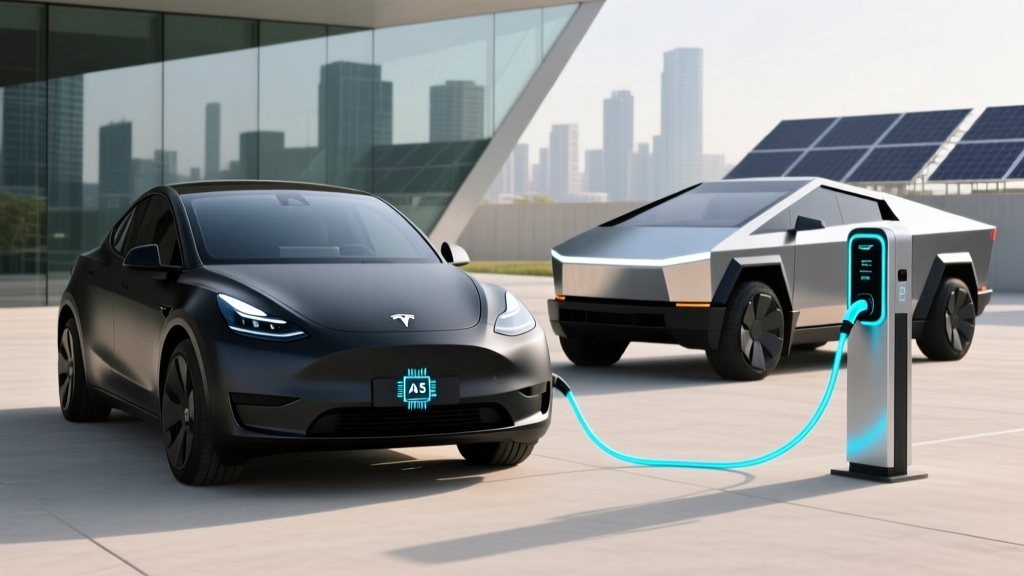
If you've been tracking Tesla's hardware roadmap, you've likely encountered the chatter around the Tesla AI5 chip delay and what it means for the company's next-generation vehicles and Full Self-Driving (Supervised) capabilities. Originally slated for broader deployment across the 2026 lineup, Tesla's custom AI5 inference chip — designed to power the next leap in neural-network-based driver assistance and autonomous features — has faced production and integration timeline slips that are now rippling through vehicle delivery estimates and feature availability.
Rather than speculate, this guide examines the concrete impact on vehicles currently on sale or in the ordering pipeline for 2026, with hard specs on range, charging, pricing, and what buyers should actually expect when configuring a Tesla today.
What Is the Tesla AI5 Chip and Why the Delay Matters
The AI5 chip is Tesla's next-generation custom silicon designed to replace the current Hardware 4 (HW4) computer found in 2025 and early 2026 vehicles. It promises roughly 4-5x the inference performance of HW4 while consuming comparable power, enabling denser neural networks for FSD (Supervised) and future SAE Level 3+ capabilities.
The delay stems from a combination of advanced packaging constraints at TSMC (the AI5 uses a cutting-edge node) and Tesla's own integration challenges fitting the new thermal management requirements into existing vehicle architectures. As of mid-2026, Tesla has not officially confirmed a revised mass-production date, though industry analysts and supply-chain reports point to late 2026 or early 2027 for meaningful volume.
For buyers, this means: current 2026 Teslas ship with HW4, and any vehicle ordered today will not include AI5 hardware. The question becomes whether waiting makes sense or whether HW4-equipped vehicles remain the pragmatic choice.
Current 2026 Tesla Lineup: Specs Without AI5
Since the AI5 delay pushes that hardware into the future, here's what you can actually buy or order right now. These specs reflect the HW4-equipped 2026 models.
| Spec | Model Y LR AWD | Model 3 LR AWD | Cybertruck AWD |
|---|---|---|---|
| EPA Range | 320 mi | 341 mi | 340 mi |
| Battery (usable) | ~75 kWh, NMC | ~75 kWh, NMC | ~123 kWh, NMC |
| 0-60 mph | 4.8 sec | 4.2 sec | 4.1 sec |
| Horsepower | 384 hp | 346 hp | 600 hp |
| Drivetrain | Dual-motor AWD | Dual-motor AWD | Dual-motor AWD |
| MPGe (combined) | 111 MPGe | 132 MPGe | 78 MPGe |
| Base MSRP | $44,990 | $42,490 | $79,990 |
| Cargo (rear seats up) | 30.2 cu ft | 23.0 cu ft | ~35 cu ft (bed) |
Sources: fueleconomy.gov, Tesla.com order pages (2026 model year).
Real-World Range: What the EPA Sticker Doesn't Tell You
- Model Y LR AWD: EPA 320 mi — expect ~260-280 mi on sustained highway driving at 70+ mph; ~220-240 mi in sub-freezing winter conditions.
- Model 3 LR AWD: EPA 341 mi — expect ~280-300 mi highway; ~240-260 mi in cold weather.
- Cybertruck AWD: EPA 340 mi — expect ~270-290 mi highway (aerodynamic drag is significant above 65 mph); ~220-250 mi cold.
The EPA test cycle blends city and highway driving with climate off. In practice, highway efficiency drops because electric motors are less efficient at sustained high speeds than in stop-and-go regen-heavy city driving. Tesla's trip planner in the navigation system accounts for elevation, temperature, and speed — and is generally accurate within 5-10% if you trust its estimates.
Charging Speed: DC Fast and Home Level 2
Charging infrastructure remains one of Tesla's strongest advantages. The Supercharger network in 2026 includes over 6,500 V4 stalls in North America, many capable of 250-350 kW peak delivery (though vehicle acceptance rate is the limiting factor).
| Charge Level | Model Y / Model 3 | Cybertruck | Miles Added per Hour |
|---|---|---|---|
| Level 1 (120V, 12A) | 1.4 kW | 1.4 kW | ~3-5 mi/hr |
| Level 2 (240V, 48A) | 11.5 kW | 11.5 kW | ~37-44 mi/hr |
| DC Fast (peak) | 250 kW | 250 kW | ~1,000+ mi/hr (peak) |
| 10-80% DCFC Time | ~25 min | ~30 min | — |
Charge curve reality check: The 250 kW peak is only sustained between roughly 10-30% State of Charge (SoC). Above 50%, the rate tapers significantly — expect ~100-120 kW in the 50-70% range, and ~50 kW or less above 80%. This is why Tesla's navigation routes you to arrive at Superchargers at low SoC: preconditioning the battery and starting at a low charge state maximizes time in the peak-power window.
All 2026 Teslas use the NACS (North American Charging Standard) connector natively. This is now the dominant standard in North America, with Ford, GM, Rivian, Hyundai, and most other manufacturers having adopted it. At non-Tesla DC chargers using NACS, you'll find Electrify America, EVgo, and others adding NACS cables throughout 2025-2026.
Pricing, Tax Credits, and Total Cost
| Model / Trim | Base MSRP | As-Tested (typical config) | §30D Credit Eligible? |
|---|---|---|---|
| Model Y Long Range AWD | $44,990 | $48,000-$52,000 | Yes (if income/sourcing met) |
| Model 3 Long Range AWD | $42,490 | $45,000-$49,000 | Yes (if income/sourcing met) |
| Cybertruck AWD | $79,990 | $85,000-$100,000+ | No — exceeds $80K SUV/truck cap |
- MSRP Cap: Vans, SUVs, and pickup trucks must be under $80,000; sedans under $55,000.
- Buyer Income Cap: Modified AGI must not exceed $150,000 (single), $225,000 (head of household), or $300,000 (joint).
- Battery Sourcing: Increasing percentages of critical minerals and battery components must be sourced from the US or FTA partners — rules tighten annually.
- Point-of-Sale Transfer: Eligible buyers can transfer the credit to the dealer at purchase, reducing the out-of-pocket price immediately rather than waiting for a tax refund.
- FEOC Restriction: Vehicles with battery components from a Foreign Entity of Concern (e.g., certain Chinese suppliers) are disqualified.
The Model Y and Model 3 generally qualify for the full $7,500 credit for eligible buyers, and Tesla offers point-of-sale transfer at delivery. The Cybertruck, at $79,990 base, sits right at the truck MSRP cap — however, most configurations push above $80,000, making credit eligibility trim-dependent. Always confirm the exact VIN's eligibility before ordering.
FSD (Supervised) and the AI5 Question
Tesla's FSD (Supervised) package costs $8,000 as a one-time purchase or $99/month as a subscription in 2026. It operates on HW4 hardware today and delivers:
- Automatic lane changes on highways
- Traffic-light and stop-sign recognition and response
- City-street navigation with turns
- Smart Summon (low-speed parking lot navigation)
- It does not drive you door-to-door without supervision. You must monitor the road at all times.
- It does not handle all weather conditions — heavy rain, fog, and snow degrade performance significantly.
- It is not "approved" for hands-off or eyes-off operation in any US jurisdiction.
- It will not improve retroactively to AI5-level capability on HW4 hardware. The neural networks are optimized for the silicon they run on.
The AI5 chip delay means that the next major leap in FSD capability — running denser models with potentially better edge-case handling — will not be available on vehicles purchased today. Tesla has not announced a hardware retrofit program for AI5, and given the architectural differences (thermal, power delivery, board layout), a swap is unlikely to be offered at reasonable cost.
Practical implication: If you buy a 2026 Tesla with HW4, you'll receive continued software improvements within HW4's compute envelope. Those improvements will be meaningful but incremental. The transformative gains that AI5's 4-5x inference boost could enable — potentially smoother interventions, better prediction, denser scene understanding — will require the new hardware.
Warranty and Ownership Considerations
| Coverage | Model Y / Model 3 | Cybertruck |
|---|---|---|
| Basic Vehicle | 4 years / 50,000 mi | 4 years / 50,000 mi |
| Battery & Drive Unit | 8 years / 120,000 mi | 8 years / 120,000 mi |
| Battery Retention Threshold | 70% capacity | 70% capacity |
Tesla's 8-year/120,000-mile battery warranty with a 70% retention threshold is competitive with the industry. Real-world data from long-term owners and fleet operators suggests NMC packs in Model 3/Y typically retain 88-92% capacity at 100,000 miles when charged primarily to 80-90% daily. The Cybertruck's larger pack has less long-term public data given its 2024 launch, but the chemistry and thermal management are similar.
Pros, Cons, and the Wait-or-Buy Decision
- Class-leading Supercharger network access (NACS native)
- Strong efficiency — Model 3 at 132 MPGe combined
- Over-the-air updates continuously add features
- Excellent performance per dollar (Model 3 LR: 4.2s 0-60 at $42,490)
- Heat pump standard on all models (cold-weather efficiency)
- Strong resale value relative to most EVs
- AI5 chip delay means no next-gen FSD hardware until late 2026/2027
- No hardware retrofit path likely for AI5
- Build quality inconsistency still reported by some owners
- Cybertruck pricing has climbed well past initial announcements
- FSD subscription/purchase is expensive for a Level 2 system
- Minimal physical controls — everything through the touchscreen
- Buy now if: You need a vehicle in the next 3-6 months, you're primarily buying for the car itself (range, efficiency, Supercharger access), and you view FSD as a supplementary feature rather than a primary purchase reason.
- Wait if: Your purchase timeline is flexible into mid-2027, FSD capability is a top-3 purchase factor, and you want the longest possible hardware runway for future software improvements.
- Don't wait if: You're buying a Cybertruck — AI5 integration in that platform may lag even further due to its unique architecture, and the current HW4 truck is already capable.
How the 2026 Tesla Lineup Compares to Key Rivals
The Tesla AI5 chip delay doesn't happen in a vacuum. Competitors are closing gaps:
- Hyundai Ioniq 5 (2026): 310 mi EPA, 800V architecture enabling 10-80% in ~18 min at 350 kW chargers, NACS adapter included. Stronger DC charging speed than Tesla's 250 kW peak.
- Ford Mustang Mach-E (2026): NACS native, 320 mi extended-range, BlueCruise hands-free on mapped highways (still Level 2, but allows eyes-off in approved zones).
- Chevrolet Equinox EV (2026): Starting under $35,000, 319 mi EPA — undercutting Tesla on price significantly for budget-conscious buyers.
Tesla's advantages remain the Supercharger network, software ecosystem, and efficiency. But the AI5 delay narrows the tech-leadership narrative that has long justified Tesla's premium positioning.
Frequently Asked Questions
What is the real-world range of current 2026 Teslas?
For the Model Y LR AWD (EPA 320 mi), expect 260-280 miles on highway road trips and 220-240 in cold weather. The Model 3 LR AWD (EPA 341 mi) delivers 280-300 highway, 240-260 cold. The Cybertruck (EPA 340 mi) manages 270-290 highway. All figures assume moderate climate use and typical driving patterns.
How fast does a 2026 Tesla charge at home and on the road?
At home on a 240V/48A Level 2 circuit, all 2026 Teslas accept 11.5 kW, adding roughly 37-44 miles of range per hour — enough to fully replenish overnight. On DC fast chargers, they peak at 250 kW and charge 10-80% in approximately 25 minutes (Model Y/3) or 30 minutes (Cybertruck), though the charge curve tapers significantly above 50% SoC.
How much does a 2026 Tesla cost after the federal tax credit?
A Model Y LR AWD at $44,990 drops to roughly $37,490 after the full $7,500 §30D credit (if you meet income, sourcing, and MSRP requirements). A Model 3 LR AWD at $42,490 drops to ~$34,990. The Cybertruck generally does not qualify due to its MSRP exceeding the $80,000 truck cap in most configurations. Always verify eligibility at irs.gov.
Is a 2026 Tesla worth buying vs. competitors?
Yes, if Supercharger access, software quality, and efficiency are priorities. The Model 3 remains one of the most efficient EVs on sale (132 MPGe), and the Supercharger network is the most reliable DC charging infrastructure in North America. However, if fastest DC charging speed is paramount, the Hyundai Ioniq 5's 800V system charges faster. If price is the top concern, the Chevy Equinox EV undercuts Tesla by $10,000+.
Will Tesla offer an AI5 retrofit for HW4 vehicles?
Tesla has not announced any retrofit program, and the engineering challenges (different thermal requirements, board form factor, power delivery) make a cost-effective swap unlikely. If AI5 capability is essential to your purchase decision, waiting for factory-installed AI5 vehicles is the only reliable path.
Does the Tesla AI5 chip delay affect vehicle delivery timelines?
Not directly for current orders — 2026 vehicles are being built and delivered with HW4. The delay affects when next-generation vehicles with AI5 will enter production, currently estimated at late 2026 to early 2027 based on supply-chain reporting. Tesla has not confirmed an official date.
For the latest Tesla specifications and ordering information, visit tesla.com. For EPA range and efficiency data, see fueleconomy.gov. For federal tax credit rules, consult irs.gov §30D guidance.