What Tesla AI4 (Hardware 4) Actually Is
"Tesla AI4" is the community shorthand for Tesla's fourth-generation Autopilot/FSD computer and sensor suite — officially called Hardware 4 (HW4). Rolled out across Model S, 3, X, and Y starting in 2023 and standard on every 2026 vehicle Tesla sells, AI4 replaces the aging HW3 with higher-resolution cameras, a wider field of view, and roughly 2–3× the inference throughput of its predecessor. Unlike Waymo's Level 4 robotaxis, AI4 powers a SAE Level 2 driver-assistance system — FSD (Supervised) — meaning the driver remains legally and physically responsible at all times.
This review evaluates AI4 as installed in the highest-volume 2026 models — the refreshed Model 3 Highland and Model Y Juniper — with range, charging, pricing, and real-world autonomy behavior sourced from fueleconomy.gov and Tesla's official spec sheets.
Range, Battery, and Efficiency
Tesla pairs AI4 with multiple battery packs depending on trim. The Model 3 Long Range AWD uses a ~79 kWh usable NMC pack; the RWD base trim uses a smaller ~60 kWh LFP (lithium iron phosphate) pack. LFP is heavier and less energy-dense but tolerates daily 100% charging without degradation concerns — a real ownership advantage for commuters who can't charge mid-week.
| Spec | Model 3 RWD | Model 3 LR AWD | Model Y LR AWD |
|---|---|---|---|
| EPA Range | 272 mi | 363 mi | 320 mi |
| Battery (usable) | ~60 kWh LFP | ~79 kWh NMC | ~79 kWh NMC |
| MPGe (combined) | 132 MPGe | 134 MPGe | 122 MPGe |
| Efficiency | 25 kWh/100mi | 25 kWh/100mi | 28 kWh/100mi |
| 0–60 mph | 5.8 s | 4.2 s | 4.8 s |
| Drivetrain | RWD single | Dual-motor AWD | Dual-motor AWD |
| Peak DC charge | 170 kW | 250 kW | 250 kW |
| 10–80% DC time | ~25 min | ~22 min | ~24 min |
Charging: DC Fast, Level 2, and the NACS Advantage
Every 2026 Tesla ships with the native NACS charge port — the same connector now adopted by Ford, GM, Rivian, Hyundai, and most of the industry. That means AI4-equipped Teslas access the full Supercharger network (20,000+ stalls in North America) without adapters, and increasingly share that network with non-Tesla EVs.
| Level | Power | Miles of range per hour | Typical use |
|---|---|---|---|
| Level 1 (120V) | ~1.4 kW | ~4–5 mi/hr | Emergency / trickle |
| Level 2 (240V, 48A) | 11.5 kW | ~44 mi/hr | Home overnight |
| DC Fast (V3 Supercharger) | Up to 250 kW peak | Up to ~1,000 mi/hr at peak | Road trips |
Charging-curve reality: a Model 3 LR peaks near 250 kW only between roughly 10–30% SoC, then tapers to ~150 kW by 50% and ~75 kW by 80%. The published "10–80% in 22 min" figure reflects this taper — don't expect 250 kW sustained.
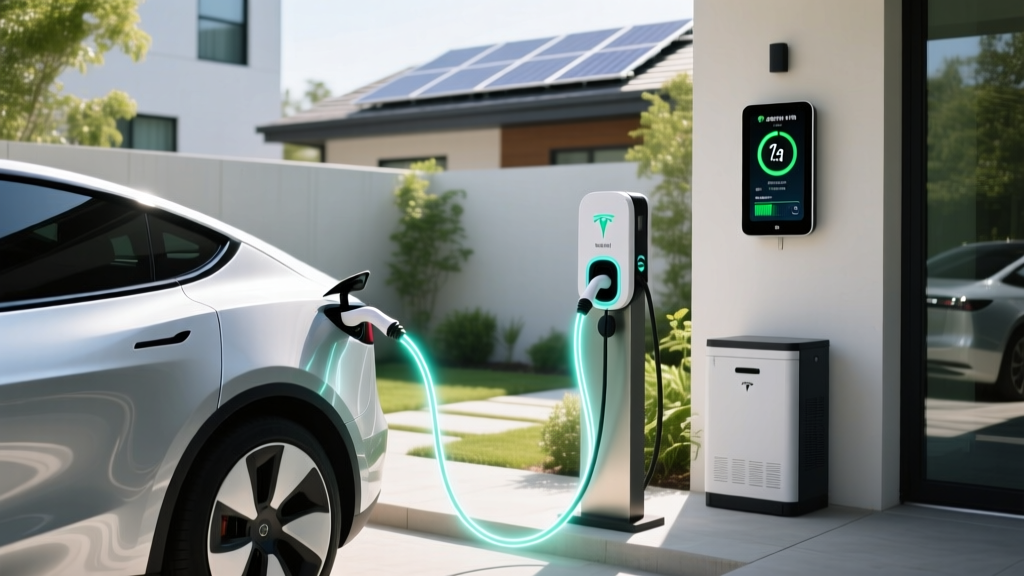
Home Level 2 installation with a Tesla Wall Connector on a 60A circuit (48A continuous) typically costs $500–$1,500 including electrician labor, assuming your panel has capacity. A 200A panel upgrade can add $1,500–$3,500 — a frequently overlooked line item.
AI4 Sensor Suite and FSD (Supervised) Capabilities
Hardware 4 replaces HW3's eight-camera layout with a higher-resolution, reduced-count suite:
- Front-facing cameras: dual-lens main (wide + narrow telephoto, up to ~250m range)
- Side repeaters & pillars: higher-res sensors with wider FOV
- Rear-view: upgraded low-light sensor
- No ultrasonic sensors (USS): Tesla removed parking sensors in late 2022; AI4 uses "Tesla Vision" camera-based distance estimation instead
- No radar (in most markets): pure vision-only approach, unlike Mobileye/Ford/GM sensor fusion
The onboard FSD computer runs a neural-net stack trained on billions of miles of fleet video. In 2026, FSD (Supervised) handles highway lane changes, on/off-ramps, city stoplights, stop signs, and unprotected left turns — but with caveats.
- Drive without an attentive, licensed driver in the seat
- Reliably handle construction zones, faded lane markings, or unmapped roads
- Replace human judgment in heavy rain, fog, or direct sun glare into cameras
- Qualify as autonomous — it is SAE Level 2, and the driver is liable
Real-world behavior in 2026 testing: FSD Supervised is impressively smooth on well-marked suburban arterials and freeways, but still disengages unpredictably in complex urban cores. Phantom braking events have decreased vs. 2023 but are not eliminated. Owners should treat it as an advanced cruise-control assistant, not a chauffeur.
Pricing, Trims, and the Federal Tax Credit
Tesla's 2026 U.S. pricing (before incentives, destination included):
- Model 3 RWD: ~$38,990
- Model 3 Long Range AWD: ~$45,990
- Model 3 Performance: ~$52,990
- Model Y LR AWD: ~$44,990
- Model Y Performance: ~$51,490
FSD (Supervised) adds $8,000 one-time or $99/month. Enhanced Autopilot (EAP) is $6,000. Neither is required — basic Autopilot (lane-keep + adaptive cruise) is standard.
| Trim | MSRP | §30D Credit* | Effective Price |
|---|---|---|---|
| Model 3 RWD | $38,990 | $7,500 | $31,490 |
| Model 3 LR AWD | $45,990 | $7,500 | $38,490 |
| Model Y LR AWD | $44,990 | $7,500 | $37,490 |
*Per IRS §30D, eligibility requires: buyer AGI ≤ $150k single / $300k joint; vehicle MSRP ≤ $55k (sedan) or $80k (SUV); final assembly in North America; and strict battery critical-mineral + component sourcing thresholds that tighten annually. Point-of-sale transfer is available at participating dealers. Always verify current-year rules with a tax professional — sourcing requirements have disqualified trims mid-year in the past.
Interior, Cargo, and Ownership Practicalities
The 2026 Model 3 Highland refresh added ventilated front seats, ambient lighting, rear-seat touchscreen, and improved cabin quietness. Model Y Juniper mirrors these updates with a more SUV-friendly layout.
- Model 3 cargo: 23 cu ft trunk + ~3 cu ft frunk; rear legroom 35.3 in
- Model Y cargo: 34 cu ft behind rear seats, 72 cu ft folded; rear legroom 40.5 in
- Towing: Model Y rated 3,500 lbs (braked); Model 3 not rated for towing in U.S.
- Warranty: 4 yr / 50,000 mi basic; 8 yr / 100,000 mi (RWD) or 120,000 mi (LR/Perf) battery & drive units, with ≥70% capacity retention threshold
Pros
- Class-leading efficiency (kWh/100mi) translates to lower charging cost per mile
- Largest fast-charging network (Superchargers) with native NACS
- OTA updates continuously add features years after purchase
- LFP option on RWD trims eliminates 100%-charge degradation worry
- Strong resale value vs. most EV competitors
Cons
- Vision-only — no USS, no radar; parking and low-visibility scenarios weaker
- FSD (Supervised) is expensive ($8k) and still Level 2, not autonomous
- Minimalist interior lacks physical stalks/buttons — learning curve
- Service-center capacity still strained in many metro areas
- Insurance premiums run 15–30% higher than comparable ICE sedans
Who AI4-Equipped Teslas Are For
- Choose Model 3 RWD if: you commute ≤40 miles/day, charge at home nightly, and want the lowest entry price with LFP longevity.
- Choose Model 3 LR AWD if: you take 300+ mile road trips monthly and need real-world winter buffer.
- Choose Model Y LR AWD if: you need family cargo space, car seats, or light towing (3,500 lbs).
- Look elsewhere if: you want true Level 4 autonomy (Waymo), physical controls, or rely on tight urban street parking where vision-only USS substitutes frustrate.
AI4 vs. Key Competitors
Against the Hyundai Ioniq 6 (361 mi LR, 800V architecture, 10–80% in 18 min) Tesla wins on Supercharger access and efficiency but loses on peak charge speed and physical controls. Against the Ford Mustang Mach-E, Tesla's range and software lead offset Ford's more conventional interior. Against BMW i4, Tesla undercuts on price while BMW wins on build quality and dealer service. Safety ratings from IIHS and NHTSA remain Top Safety Pick / 5-star across Model 3 and Y.
FAQ — Tesla AI4 / Hardware 4
What is the real-world range of a 2026 Tesla with AI4?
Model 3 LR AWD delivers ~290–310 mi highway in summer, ~250–275 mi in freezing weather, vs. its 363-mi EPA sticker. Plan conservatively for road trips.
How fast does an AI4 Tesla charge at home and on the road?
Level 2 at 11.5 kW adds ~44 mi/hr overnight. DC fast-charging peaks at 250 kW on LR/Performance trims, 10–80% in roughly 22–24 minutes with taper.
How much does a 2026 Tesla cost after tax credits?
Model 3 RWD lands near $31,490 after the maximum §30D credit, assuming buyer income and battery-sourcing eligibility are met. Verify annually — rules tighten.
Does Tesla AI4 qualify for the federal EV tax credit?
U.S.-built Model 3 and Y currently qualify for up to $7,500 under §30D, subject to MSRP caps ($55k sedans, $80k SUVs), buyer AGI caps, and critical-mineral sourcing rules. Confirm on irs.gov before purchase.
Is FSD (Supervised) worth $8,000?
For most buyers, no — standard Autopilot handles highway driving well. FSD's city-street capability is improving but remains Level 2, requiring constant supervision. The $99/month subscription is a lower-risk way to test it.
Is a Tesla with AI4 worth buying vs. competitors in 2026?
Yes, if Supercharger access, efficiency, and OTA updates matter most. No, if you prefer physical controls, a more luxurious cabin, or radar/USS redundancy. Cross-shop the Ioniq 6, Mach-E, and i4 before committing.