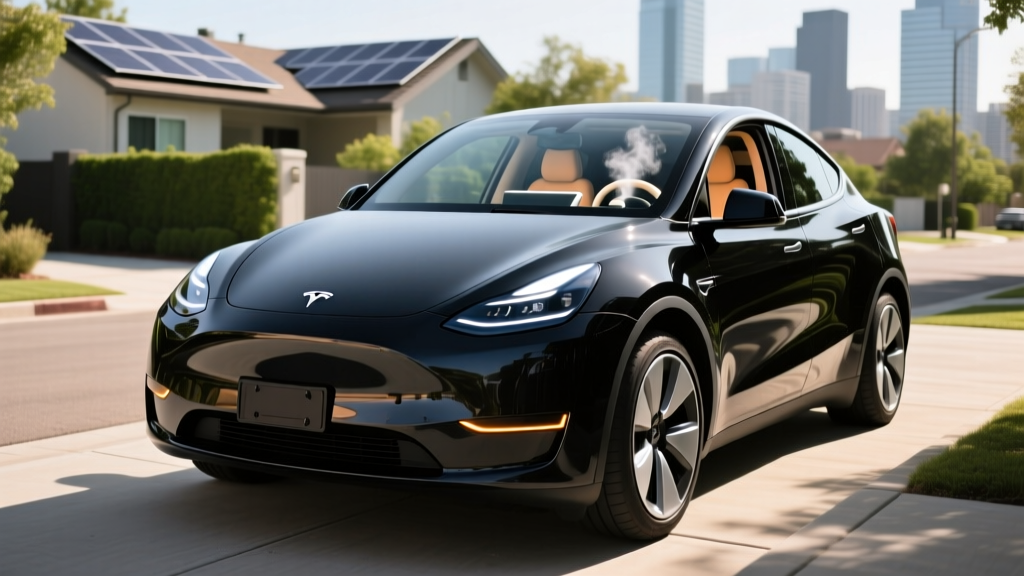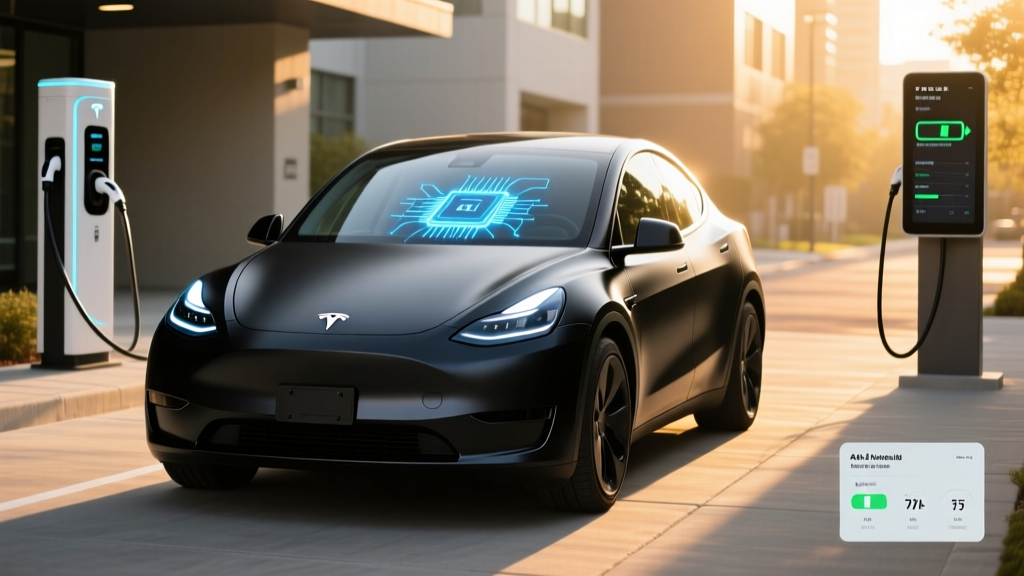
The phrase Tesla AI chips gets tossed around in forums and earnings calls alike, but for buyers, the question is practical: what does the silicon actually do for you on the road? In the 2026 Tesla Model Y, the answer lives in Hardware 4 (HW4) — Tesla's second-generation full self-driving computer. It processes up to 300 trillion operations per second, feeds an eight-camera vision suite, and underpins every driver-assistance feature the car offers. But an AI chip is only as useful as the vehicle wrapped around it. This review evaluates the 2026 Model Y as a complete package — range, charging, pricing, tax-credit reality, and whether HW4 makes a tangible difference versus the competition.
2026 Tesla Model Y: Core Specifications at a Glance
| Attribute | Long Range AWD | Performance AWD |
|---|---|---|
| EPA Range | 320 miles | 295 miles |
| Usable Battery | ~75 kWh (NMC) | ~75 kWh (NMC) |
| Drivetrain | Dual-Motor AWD | Dual-Motor AWD |
| Horsepower | 384 hp | 456 hp |
| 0–60 mph | 4.8 sec | 3.5 sec |
| Max DC Fast Charge | 250 kW | 250 kW |
| 10–80% DC Time | ~22 min | ~22 min |
| Level 2 Home Rate | 11.5 kW (~44 mi/hr) | 11.5 kW (~44 mi/hr) |
| MPGe (Combined) | 111 MPGe | 102 MPGe |
| Efficiency | 28 kWh/100 mi | 30 kWh/100 mi |
| Cargo (rear seats up) | 30.2 cu ft | 30.2 cu ft |
| Cargo (rear seats down) | 72.0 cu ft | 72.0 cu ft |
| Rear Legroom | 41.6 in | 41.6 in |
| Base MSRP | $44,990 | $51,490 |
| Battery Warranty | 8 yr / 120,000 mi | 8 yr / 120,000 mi |
What Tesla AI Chips (Hardware 4) Actually Do
Hardware 4 is not a single chip but a redundant computing platform built around Tesla's custom-designed FSD silicon. Two identical AI processors run in parallel on the same board, each capable of processing the full camera suite independently. If one fails, the other maintains full functionality — a safety architecture borrowed from aerospace.
Compared to the older HW3 computer, HW4 offers roughly double the processing throughput, higher-resolution camera inputs (5 megapixel vs. 1.2 megapixel), and a wider field of view from the forward-facing cameras. In practice, this means the system detects smaller objects at greater distances and handles edge cases — construction cones, partially obscured lane markings, emergency vehicles — with fewer disengagements.
The AI chips also power Tesla's cabin-facing driver-monitoring camera, Sentry Mode processing, and the neural-net-based dashcam event detection. They do not affect range, charging speed, or ride comfort — those are functions of the battery, motors, and suspension.
Real-World Range: Beyond the EPA Sticker
Real-World Highway (70 mph, 68°F): ~270–285 miles
Real-World Cold Weather (30°F, mixed driving): ~220–250 miles
Real-World City (regenerative braking optimized): ~290–310 miles
Tesla's EPA figures are measured under controlled laboratory conditions per EPA test cycles. The Model Y Long Range's 320-mile rating is competitive for the segment, but sustained highway speeds above 70 mph increase aerodynamic drag substantially — EVs lose efficiency faster than gas cars at high speed because there are no gears to optimize. Expect 270–285 miles on a flat, temperate interstate run.
Cold weather is the bigger variable. Lithium-ion NMC chemistry loses roughly 15–25% of usable capacity in freezing temperatures due to increased internal resistance and cabin-heating demand. Tesla's heat pump (standard on all 2026 Model Y trims) mitigates this by scavenging waste heat from the drivetrain, but a 30°F morning commute will still cost you 40–70 miles versus the sticker. Preconditioning the battery while plugged in — a feature the Tesla app enables with a scheduled departure time — recovers some of that loss by warming the pack before you drive.
Charging Speed: Supercharger Network Advantage
| Charging Method | Power | Speed (mi/hr added) | Notes |
|---|---|---|---|
| Level 1 (120V household) | ~1.4 kW | ~4 mi/hr | Emergency/trickle only |
| Level 2 (240V, Wall Connector) | 11.5 kW | ~44 mi/hr | Full overnight charge in ~8 hr |
| DC Fast (Tesla Supercharger V3) | Peak 250 kW | Up to 1,000 mi/hr | 10–80% in ~22 min |
| DC Fast (CCS adapter, EA/Ionity) | Peak 250 kW | Up to 1,000 mi/hr | Requires CCS adapter (included) |
The Model Y's charge curve is front-loaded: it sustains near-peak 250 kW from roughly 10% to 35% State of Charge, then tapers progressively. From 80% to 100%, the rate drops below 40 kW — a physics limitation of NMC chemistry, not a Tesla-specific flaw. For road trips, plan stops around the 10–80% window; charging from 80% to 100% at a Supercharger adds 25+ minutes for only ~60 miles of range.
At home, Tesla's Wall Connector on a 60-amp circuit delivers 11.5 kW (48 amps continuous). A typical overnight session from 30% to 80% takes about 4 hours. If your home has a 200-amp electrical panel with spare capacity, installation runs $500–$1,500 depending on conduit length. Homes requiring a panel upgrade to 200A should budget an additional $1,500–$3,000. Always get a quote from a licensed electrician before committing.
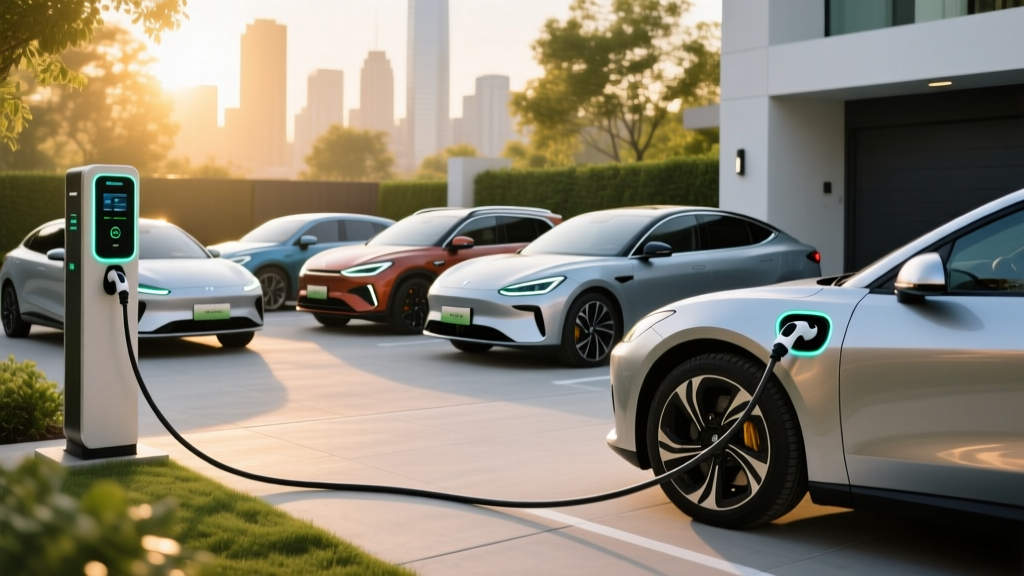
Tesla's NACS (North American Charging Standard) connector is now the de facto industry standard, with Ford, GM, Rivian, and others adopting it through 2025–2026. The Model Y uses NACS natively — no adapter needed at Superchargers. A CCS1 adapter ships with the vehicle for compatibility with Electrify America and other legacy networks.
Pricing, Trims, and Federal Tax Credit Reality
| Trim | Base MSRP | Destination | Total Before Credit | Est. After §30D Credit |
|---|---|---|---|---|
| Long Range AWD | $44,990 | $1,390 | $46,380 | ~$38,880* |
| Performance AWD | $51,490 | $1,390 | $52,880 | ~$45,380* |
*Tax credit estimates assume full $7,500 eligibility. Actual credit depends on individual circumstances.
The IRS §30D federal tax credit offers up to $7,500, split into two halves: $3,750 for meeting critical-mineral sourcing requirements and $3,750 for battery-component sourcing. As of 2026, the Model Y assembled at Giga Texas has historically qualified for the full credit, but eligibility depends on three buyer-side conditions:
- MSRP Cap: SUVs must be ≤ $80,000 (Model Y qualifies at all trims)
- Income Cap: Modified AGI ≤ $300,000 (joint) / $225,000 (head of household) / $150,000 (single)
- Battery Sourcing: Critical minerals and components must meet escalating domestic/free-trade-partner thresholds — Tesla's supply chain has generally complied, but verify at purchase
- Point-of-Sale Transfer: As of 2024+, buyers can transfer the credit to the dealer at purchase, reducing the out-of-pocket price immediately rather than waiting for tax filing
Consult a tax professional before relying on credit eligibility. Battery sourcing requirements tighten annually, and a vehicle that qualifies in January may not in December if supply chains shift.
Interior, Cargo, and Daily Livability
The 2026 Model Y's interior follows Tesla's minimalist ethos: a single 15.4-inch touchscreen handles climate, navigation, media, and vehicle settings. There is no instrument cluster — speed and navigation appear on the main screen, positioned within the driver's sightline but requiring a slight head turn. The 2025 refresh (carried into 2026) added ventilated front seats, ambient lighting, power-folding second-row seats, and a rear-seat touchscreen for climate and media control.
Cargo space is a genuine strength. With 30.2 cubic feet behind the second row and 72.0 cubic feet with seats folded, the Model Y rivals midsize SUVs like the Honda Passport. The rear hatch opens wide, and the load floor is flat. The front trunk (frunk) adds roughly 4.1 cubic feet for charging cables or a soft bag — useful but smaller than the Hyundai Ioniq 5's 2.0 cu ft frunk because the Model Y's 12V lithium auxiliary battery and HVAC components occupy more front volume.
Rear legroom at 41.6 inches is generous for adults on longer trips, though the sloping roofline cuts headroom for passengers over 6'2". The panoramic glass roof lets in light but can make the cabin warm in direct summer sun — Tesla includes a removable shade panel for the rear section.
Driving Dynamics and Performance
The Long Range AWD's 384 hp and 4.8-second 0–60 time are brisk by any measure, but the Performance trim's 3.5-second sprint puts it in sports-car territory. Both trims use Tesla's dual-motor setup with independent front and rear motors for torque-vectoring AWD. The Performance adds adaptive dampers, larger 21-inch wheels, and higher-performance brakes.
Ride quality on the Long Range is firm but controlled — the 2025 refresh improved isolation over sharp impacts with revised bushings and damper tuning. Road noise remains higher than in the Hyundai Ioniq 5 or Ford Mustang Mach-E at highway speeds, a trade-off of the frameless door glass and large wheel options. Regenerative braking is strong enough for one-pedal driving in most conditions, though Tesla removed the user-adjustable regen setting in recent model years — it's always set to maximum.
Pros and Cons
Pros
- Supercharger network: 60,000+ stalls globally, best-in-class reliability and plug-and-charge billing
- HW4 AI computing platform with redundant processors and higher-resolution vision
- Class-leading efficiency at 28 kWh/100 mi (Long Range)
- Over-the-air updates add features post-purchase
- Strong resale value relative to EV segment average
- Spacious cargo area with flat load floor and hatch versatility
Cons
- FSD (Supervised) costs $8,000 extra or $99/mo and remains Level 2 — not autonomous
- No physical buttons for climate, wipers, or glovebox — all screen-dependent
- Highway road noise is noticeable above 70 mph
- Rear headroom limited for tall passengers due to coupe-like roofline
- Insurance premiums run 15–30% higher than comparable gas SUVs in most states
- Charge curve tapers significantly above 80% SoC
Who the 2026 Model Y Suits Best
Choose the Model Y Long Range if: You want the best efficiency and range in the lineup, commute 30–60 miles daily with home charging, take 2–4 road trips per year and value Supercharger access, and need cargo flexibility for a young family or active lifestyle.
Choose the Model Y Performance if: You want sub-4-second acceleration, prefer the adaptive suspension and larger brakes, and don't mind sacrificing 25 miles of EPA range for the driving dynamics.
Look elsewhere if: You want physical dashboard controls (try the Ioniq 5 or Mach-E), need three-row seating (Kia EV9), want the longest possible range (Lucid Gravity), or require off-road capability (Rivian R1S).
How It Stacks Up Against Key Competitors
The Model Y's most direct competitors in 2026 are the Hyundai Ioniq 5, Ford Mustang Mach-E, and Kia EV6. The Ioniq 5 offers 800V architecture for faster peak charging (~350 kW capable, though limited by station availability), a more conventional interior with physical climate controls, and a slightly lower starting price. The Mach-E provides a more traditional driving feel and Ford's BlueCruise hands-free highway system. The EV6 shares the Ioniq 5's platform but with sportier styling.
Where the Model Y still leads: Supercharger network access remains the most seamless public-charging experience in North America. Over-the-air update frequency is higher than any competitor. And the HW4 computing platform's processing headroom positions the vehicle for future software improvements in ways that competitors' fixed-architecture ADAS systems cannot match.
Where it trails: The Ioniq 5 charges faster when connected to a 350 kW-capable station. The Mach-E and EV6 offer more intuitive interior controls. Insurance costs for the Model Y remain elevated due to Tesla's proprietary repair network and parts pricing.
Frequently Asked Questions
What is the real-world range of the 2026 Tesla Model Y?
The EPA rates the Long Range AWD at 320 miles. In real-world highway driving at 70 mph in moderate temperatures, expect 270–285 miles. In cold weather (30°F), mixed driving yields roughly 220–250 miles. City driving with regenerative braking can approach the EPA figure.
How fast does the Model Y charge at home and on the road?
At home on a 240V Level 2 Wall Connector (11.5 kW), the Model Y adds about 44 miles per hour — a full charge overnight in roughly 8 hours. On a Tesla Supercharger V3, it peaks at 250 kW and charges from 10–80% in approximately 22 minutes. Above 80%, the charge rate tapers significantly.
How much does the 2026 Model Y cost after the federal tax credit?
The Long Range AWD starts at $46,380 including destination. If you qualify for the full $7,500 §30D credit (income ≤ $300K joint, vehicle MSRP under the $80K SUV cap, and battery sourcing requirements met), the effective price drops to approximately $38,880. Verify eligibility with a tax professional and confirm sourcing compliance at the time of purchase.
Is the Model Y worth buying versus the Ioniq 5 or Mach-E?
It depends on your priorities. The Model Y wins on Supercharger network access, efficiency, cargo space, and software update cadence. The Ioniq 5 wins on charging speed (when 350 kW stations are available) and interior ergonomics. The Mach-E wins on traditional driving feel and hands-free highway driving with BlueCruise. All three are strong choices — test-drive each before deciding.
Does the 2026 Model Y qualify for the federal EV tax credit?
The Model Y assembled at Giga Texas has historically qualified for the full $7,500 under IRS §30D. However, eligibility depends on your income (≤ $300K joint / $150K single), the vehicle's MSRP (under $80K for SUVs — all trims qualify), and current battery-sourcing compliance. The credit can now be transferred at point of sale, reducing your purchase price directly. Always confirm with your dealer and tax advisor at the time of purchase, as sourcing rules tighten annually.
What Tesla AI chip does the 2026 Model Y use?
The 2026 Model Y uses Hardware 4 (HW4), Tesla's second-generation FSD computer featuring dual redundant AI processors capable of ~300 trillion operations per second combined. It supports eight cameras at up to 5-megapixel resolution and powers all Autopilot and FSD (Supervised) features, Sentry Mode, and driver-monitoring systems.
Is Tesla's FSD actually self-driving?
No. FSD (Supervised) is an SAE Level 2 driver-assistance system. The driver must remain fully attentive with hands available to take over at any moment. Tesla's cabin camera monitors engagement and issues warnings — and eventually locks out Autopilot — if inattention is detected. True self-driving (Level 4) is currently only available through robotaxi services like Waymo in limited geofenced areas.
Sources: EPA Fuel Economy, IRS §30D Clean Vehicle Credit, NHTSA Safety Ratings, Tesla.com specifications. Pricing and credit eligibility reflect 2026 model-year data and are subject to change. Confirm all figures with your dealer and tax professional before purchasing.