The question "do Teslas record accidents" surfaces constantly among prospective EV buyers — and it deserves a precise, data-driven answer rather than a polarized take. Tesla publishes quarterly safety data, the National Highway Traffic Safety Administration (NHTSA) tracks crash statistics across all automakers, and independent bodies like the Insurance Institute for Highway Safety (IIHS) conduct their own evaluations. In this review, we unpack the actual numbers behind Tesla's accident record, examine how Autopilot and Full Self-Driving (Supervised) factor in, and deliver a comprehensive profile of the 2026 Tesla Model Y — the brand's best-selling vehicle and a common entry point for EV shoppers concerned about safety.
Tesla Accident Data: What the Numbers Actually Show
Tesla's quarterly Vehicle Safety Report is the most transparent crash-data disclosure in the auto industry. For Q4 2025, Tesla reported that vehicles operating with Autopilot engaged recorded one crash for every 5.94 million miles driven, compared to one crash per 1.53 million miles for Tesla vehicles with active safety features but without Autopilot, and one crash per 0.85 million miles for Tesla vehicles with no active safety features enabled. For context, the NHTSA national average sits at roughly one crash per 670,000 miles driven across all vehicle types and ages.
However, these figures require careful interpretation:
- Selection bias: Tesla's fleet skews newer (average age under 4 years) versus the national fleet average of ~12.6 years. Newer vehicles have more advanced passive safety structures.
- Driving environment: A significant portion of Autopilot miles are logged on divided highways at steady speeds — inherently lower-risk scenarios than urban intersections.
- Reporting methodology: Tesla defines "crash" as an event where airbags or other active restraints deployed, which typically occurs at impacts above ~12 mph. Minor fender-benders may not register.
- Not peer-reviewed: Unlike NHTSA's FARS (Fatality Analysis Reporting System) database, Tesla's self-reported figures are not independently audited.
2026 Tesla Model Y: Full Safety & Spec Profile
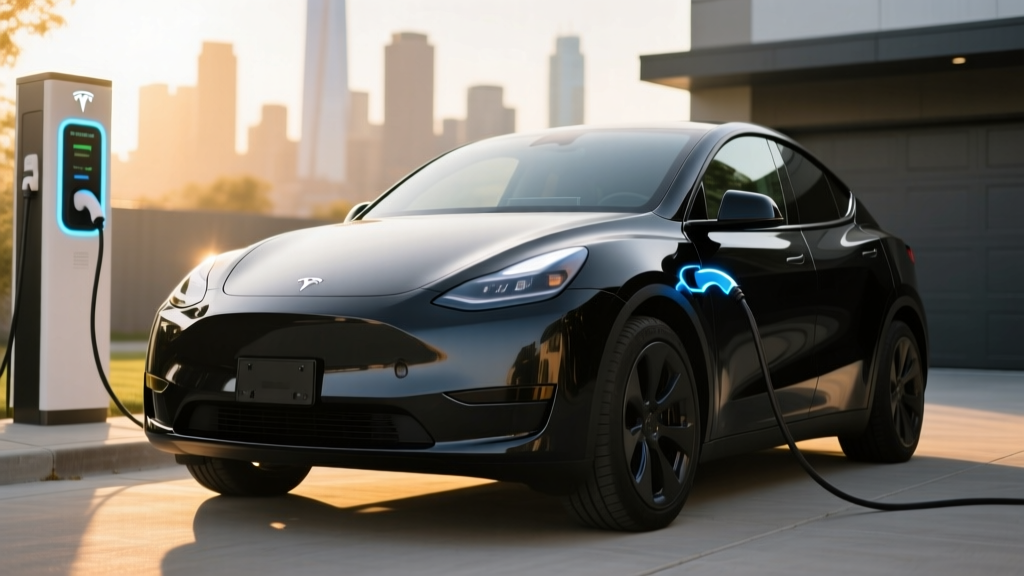
The 2026 Tesla Model Y received a significant refresh (internally called "Juniper") that brought structural improvements, updated crumple zones, and revised restraint systems. It remains one of the safest vehicles in its class, earning a 5-Star Overall Safety Rating from NHTSA and a Top Safety Pick+ designation from IIHS when equipped with specific headlight trims.
| Attribute | Long Range AWD | Performance |
|---|---|---|
| EPA Range | 320 miles | 295 miles |
| Battery (usable) | ~75 kWh, NMC | ~75 kWh, NMC |
| Drivetrain | Dual-motor AWD | Dual-motor AWD |
| Horsepower | 384 hp | 456 hp |
| 0–60 mph | 4.8 sec | 3.5 sec |
| Max DC Fast Charge | 250 kW | 250 kW |
| 10–80% DC Time | ~25 min | ~25 min |
| Level 2 Charge Rate | 11.5 kW (~44 mi/hr) | 11.5 kW (~44 mi/hr) |
| MPGe (combined) | 111 MPGe | 103 MPGe |
| Efficiency | 28 kWh/100mi | 30 kWh/100mi |
| Cargo (rear seats up) | 34.3 cu ft | 34.3 cu ft |
| Cargo (seats folded) | 72.1 cu ft | 72.1 cu ft |
| Rear Legroom | 40.5 in | 40.5 in |
| Base MSRP | $46,630 | $52,130 |
| Battery Warranty | 8 yr / 120,000 mi | 8 yr / 120,000 mi |
Charging: Home, Supercharger, and the Charge-Curve Reality
Tesla's charging ecosystem remains the most robust in North America. The Supercharger network now exceeds 30,000 stalls globally, and with the NACS connector becoming the industry standard, non-Tesla EVs are increasingly sharing the network.
| Level | Power | Miles Added per Hour | Best For |
|---|---|---|---|
| Level 1 (120V) | ~1.4 kW | ~4 mi/hr | Emergency top-up |
| Level 2 (240V, 48A) | 11.5 kW | ~44 mi/hr | Daily home charging |
| DC Fast (V3 Supercharger) | 250 kW peak | ~200 mi in 15 min | Road trips |
Charge-curve reality check: The 250 kW peak rate is only sustained between approximately 10–30% State of Charge (SoC). Above 50%, the rate tapers to ~150 kW, and above 80% it drops to under 50 kW. This is why the 10–80% time of ~25 minutes is a more useful metric than peak kW. Always enable battery preconditioning (automatic when a Supercharger is set as your navigation destination) to reach peak charge rates — skipping preconditioning can add 10+ minutes to your session, especially in cold weather.
Pricing, Tax Credit Eligibility, and Total Cost
| Trim | MSRP | Est. After §30D Credit | Credit Eligible? |
|---|---|---|---|
| Long Range AWD | $46,630 | ~$39,130* | Yes (if buyer qualifies) |
| Performance | $52,130 | ~$44,630* | Yes (if buyer qualifies) |
*Federal tax credit eligibility under IRS §30D depends on multiple requirements that change periodically:
- Buyer income cap: Modified AGI must not exceed $150,000 (single), $225,000 (head of household), or $300,000 (joint filing).
- MSRP cap: SUVs/vans/pickups must be under $80,000. The Model Y qualifies as an SUV under IRS classification.
- Battery sourcing: Critical minerals and battery components must meet escalating North American sourcing thresholds. Tesla's domestic battery production (4680 cells from Giga Texas) has generally kept the Model Y eligible, but verify current status at purchase.
- Point-of-sale transfer: As of 2024+, the credit can be transferred to the dealer at purchase, reducing the upfront price rather than requiring a tax-filing claim.
Always confirm eligibility with your tax professional before purchasing. Rules shift annually, and battery-sourcing compliance can change with supply-chain adjustments.
Driver-Assist Safety: Autopilot, FSD, and Active Features
Every 2026 Model Y includes Tesla's basic Autopilot suite as standard: Traffic-Aware Cruise Control and Autosteer (lane-centering). Full Self-Driving (Supervised) remains an $8,000 add-on (or $99/month subscription) and adds Navigate on Autopilot, Auto Lane Change, Autopark, and Smart Summon.
- It does not make the Model Y self-driving. You are the driver and liable for all vehicle actions.
- It does not reliably handle construction zones, unmapped roads, or severe weather.
- It does not eliminate the need for constant visual supervision and hands-on readiness.
- NHTSA's Standing General Order data shows Teslas are involved in a disproportionate share of reported Level 2 ADAS incidents — partly because Tesla reports more thoroughly than other automakers, and partly because of the system's wide deployment scale.
The Model Y's active safety hardware includes 8 cameras, 12 ultrasonic sensors (restored in the Juniper refresh after a brief removal), and a front radar. Standard active features include Automatic Emergency Braking, Forward Collision Warning, Lane Departure Avoidance, and Blind Spot Monitoring. The IIHS has rated the 2026 Model Y's crash avoidance as "Superior" in vehicle-to-vehicle and vehicle-to-pedestrian tests.
How the Model Y Compares on Safety vs. Rivals
Safety-conscious EV shoppers often cross-shop the Model Y against the Hyundai Ioniq 5, Ford Mustang Mach-E, and Kia EV6. Here's how they stack up:
| Metric | 2026 Tesla Model Y LR | 2026 Hyundai Ioniq 5 Limited | 2026 Ford Mach-E Premium |
|---|---|---|---|
| NHTSA Overall | 5 Stars | 5 Stars | 5 Stars |
| IIHS Rating | Top Safety Pick+ | Top Safety Pick+ | Top Safety Pick |
| EPA Range | 320 mi | 310 mi | 320 mi |
| Max DC Charge | 250 kW | 350 kW | 150 kW |
| 10–80% Time | ~25 min | ~18 min | ~35 min |
| Base MSRP | $46,630 | $49,250 | $47,500 |
| ADAS Level | Level 2 (Autopilot) | Level 2 (HDA 2) | Level 2 (BlueCruise) |
All three earn top safety marks. The Model Y's advantages are its Supercharger network access and lower starting price. The Ioniq 5 charges significantly faster (350 kW capability vs. 250 kW). The Mach-E offers a more traditional dealership experience for buyers wary of Tesla's direct-sales model.
Pros, Cons, and Who Should Buy
Pros
- Top-tier crash ratings (NHTSA 5-Star, IIHS TSP+)
- Class-leading Supercharger network reliability
- 320-mile EPA range covers most road trips comfortably
- Spacious cargo area (72.1 cu ft with seats folded)
- Continuous OTA safety and feature updates
- Strong §30D tax credit eligibility (verify at purchase)
Cons
- FSD (Supervised) is expensive ($8,000) and still Level 2
- No physical instrument cluster — all info on center screen
- 250 kW peak charge rate trails Hyundai/Kia's 350 kW
- Insurance costs run 20–35% above segment average
- Build quality improvements in Juniper, but panel gaps still reported
- Service center wait times remain long in some metro areas
Choose a rival if: You need the fastest DC charging available (Ioniq 5/EV6), prefer a traditional dealer for service (Mach-E), or want a physical gauge cluster and conventional controls.
Frequently Asked Questions
Do Teslas record accidents more than other cars?
Tesla self-reports crash data more transparently than other automakers, which can make its numbers appear higher in NHTSA's Standing General Order filings. However, NHTSA's FARS database shows Tesla's fatality rate per 100 million vehicle-miles is competitive with or better than the industry average. The higher incident-reporting count reflects Tesla's larger ADAS deployment base and more thorough self-reporting, not necessarily a higher crash rate.
What is the real-world range of the 2026 Model Y?
The EPA rates the Long Range AWD at 320 miles. In real-world highway driving at 75 mph and 70°F, expect 260–280 miles. In sub-freezing conditions, range drops to roughly 220–255 miles unless you precondition the battery. City driving with regenerative braking can actually exceed the EPA figure, sometimes reaching 330+ miles.
How fast does the Model Y charge at home and on the road?
At home on a 240V/48A Level 2 circuit, the Model Y adds approximately 44 miles of range per hour (11.5 kW), fully replenishing overnight. On a V3 Supercharger, it peaks at 250 kW and charges from 10–80% in about 25 minutes. Always precondition before fast-charging to achieve peak rates.
Does the 2026 Model Y qualify for the federal EV tax credit?
The Model Y has generally qualified for the full $7,500 §30D credit, but eligibility depends on your income (under $300K joint / $150K single), the vehicle's MSRP (under $80K for SUVs — both trims qualify), and current battery-sourcing compliance. The credit can now be applied as a point-of-sale discount. Always verify with IRS.gov and your tax professional before purchase.
Is Autopilot safe, and does it prevent accidents?
Tesla's data shows lower crash rates per million miles when Autopilot is engaged versus not engaged. However, this data is self-reported and reflects highway-heavy usage. Autopilot is a Level 2 assist system — it reduces fatigue and can help prevent certain collision types, but it does not eliminate the risk of accidents. The driver remains fully responsible.
How does Model Y insurance cost compare to gas SUVs?
Model Y insurance premiums typically run 20–35% higher than comparable gas-powered compact SUVs (like the Toyota RAV4 or Honda CR-V), averaging $2,200–$3,100 annually depending on your state, driving record, and coverage level. Tesla's own insurance product (available in select states) uses real-time driving data and can be competitive for safe drivers.