Tesla Accident Fire Risk: What the Data Actually Shows
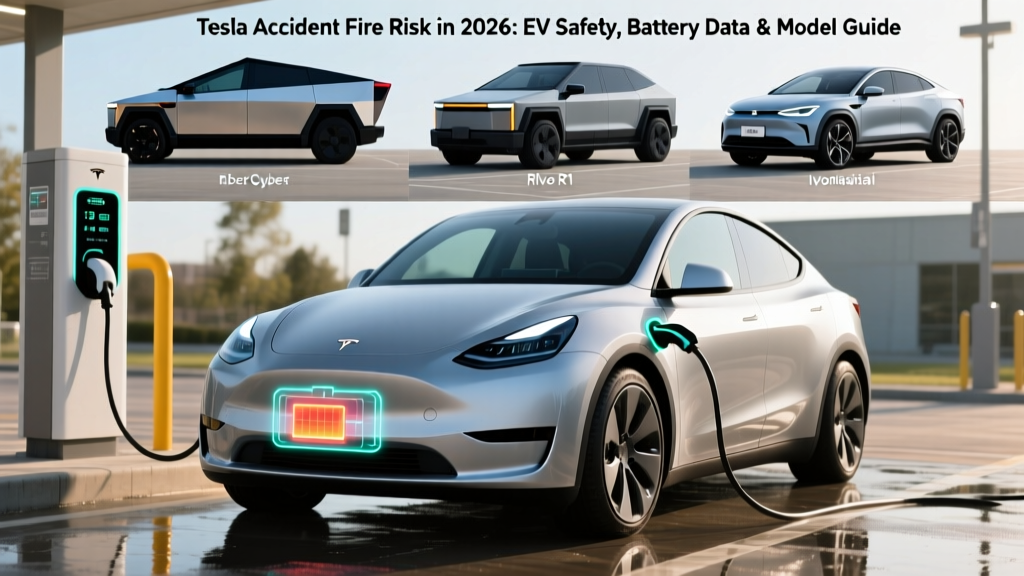
Searches for "Tesla accident fire" spike every time a viral crash video circulates. The imagery is dramatic — lithium-ion battery packs can produce intense, hard-to-extinguish fires when cells are punctured or crushed. But how does Tesla's real-world fire risk compare to gas vehicles and other EVs? And what do battery chemistry, crash-test engineering, and NHTSA data tell us about actual ownership risk in 2026?
This guide examines the hard data behind Tesla fire incidents, contextualizes the risk against internal combustion vehicles, and provides a full ownership profile of Tesla's current lineup — because understanding battery safety means understanding the battery itself.
Why EV Battery Fires Are Different (Not Necessarily More Common)
Lithium-ion battery fires involve thermal runaway — a chain reaction where one overheated cell ignites adjacent cells, producing a self-sustaining fire that can reignite hours after initial suppression. This is fundamentally different from a gasoline fire, which firefighters extinguish with standard foam and water techniques.
Tesla's structural approach has evolved significantly. The current 2026 Model Y and refreshed Model 3 use a structural battery pack where the cells are bonded into the vehicle's frame, surrounded by fire-resistant barriers and venting channels designed to direct hot gases away from the cabin. The NHTSA has awarded the Model 3 and Model Y 5-star overall safety ratings across multiple model years.
Battery Chemistry Matters: LFP vs NMC Fire Characteristics
| Attribute | LFP (Lithium Iron Phosphate) | NMC (Nickel Manganese Cobalt) |
|---|---|---|
| Thermal Runaway Threshold | ~518°F (270°C) — higher resistance | ~410°F (210°C) — lower threshold |
| Oxygen Release | Minimal — phosphate cathode is stable | Higher — nickel-rich cathodes release oxygen |
| Energy Density | Lower (~160 Wh/kg) | Higher (~250 Wh/kg) |
| Used In | Model 3 RWD, Model Y RWD (Standard Range) | Long Range & Performance trims |
| Cycle Life | 3,000+ cycles | 1,000–2,000 cycles |
The takeaway: LFP-equipped Teslas (Standard Range trims) are inherently more resistant to thermal runaway than NMC Long Range and Performance variants. If fire safety is a primary concern, the LFP chemistry in base trims offers a measurable advantage — at the cost of roughly 40–50 miles of EPA range.
2026 Tesla Model 3: Range, Charging & Full Specs
| Spec | RWD (Standard Range) | Long Range AWD | Performance |
|---|---|---|---|
| EPA Range | 272 mi | 341 mi | 315 mi |
| Battery (usable) | ~57.5 kWh (LFP) | ~75 kWh (NMC) | ~75 kWh (NMC) |
| Max DC Fast Charge | 170 kW | 250 kW | 250 kW |
| 10–80% DC Time | ~30 min | ~25 min | ~25 min |
| Level 2 Home Rate | 11.5 kW (~44 mi/hr) | 11.5 kW (~44 mi/hr) | 11.5 kW (~44 mi/hr) |
| 0–60 mph | 5.8 sec | 4.2 sec | 2.9 sec |
| Horsepower | 271 hp | 346 hp | 510 hp |
| Drivetrain | RWD | AWD (Dual Motor) | AWD (Dual Motor) |
| MPGe (combined) | 132 MPGe | 119 MPGe | 115 MPGe |
| Efficiency (kWh/100mi) | 25 | 28 | 29 |
| Base MSRP | $38,990 | $45,740 | $52,990 |
2026 Tesla Model Y: The Family SUV Profile
| Spec | RWD (Standard Range) | Long Range AWD | Performance |
|---|---|---|---|
| EPA Range | 260 mi | 320 mi | 293 mi |
| Battery (usable) | ~57.5 kWh (LFP) | ~75 kWh (NMC) | ~75 kWh (NMC) |
| Max DC Fast Charge | 170 kW | 250 kW | 250 kW |
| 10–80% DC Time | ~32 min | ~27 min | ~27 min |
| 0–60 mph | 6.6 sec | 4.8 sec | 3.5 sec |
| Horsepower | 295 hp | 384 hp | 456 hp |
| Cargo Volume | 72 cu ft (rear seats folded) | 72 cu ft | 72 cu ft |
| Base MSRP | $41,990 | $47,740 | $52,490 |
The Model Y remains the best-selling EV in the US for good reason: crossover practicality, Supercharger network access, and competitive efficiency. The Juniper refresh (introduced for 2025) brought a quieter cabin, ventilated front seats, ambient lighting, and a rear touchscreen — addressing the most common complaints from pre-2025 owners.
Charging Infrastructure: Supercharger Advantage
| Level | Power | Miles Added Per Hour | Typical Use |
|---|---|---|---|
| Level 1 (120V) | ~1.4 kW | 3–5 mi/hr | Emergency / overnight trickle |
| Level 2 (240V home) | 11.5 kW | ~44 mi/hr | Daily home charging |
| DC Fast (V3 Supercharger) | Up to 250 kW | ~1,000 mi/hr (peak) | Road trips |
| DC Fast (V4 Supercharger) | Up to 350 kW* | ~1,200 mi/hr (peak)* | Newer deployments |
*V4 350 kW peak requires compatible vehicle architecture; current Model 3/Y peak at ~250 kW on V4 posts.
Tesla's Supercharger network — now open to NACS-equipped vehicles from Ford, GM, Rivian, and others — remains the most reliable DC fast-charging network in North America, with uptime consistently above 99%. For road-trip charging, Tesla owners still enjoy the lowest friction: plug in, walk away, billing is automatic.
Federal Tax Credit & 2026 Pricing
Under IRS §30D rules, the federal EV tax credit provides up to $7,500 for qualifying new EVs. However, eligibility depends on three factors that change annually:
- MSRP Cap: Sedans (Model 3) must be under $55,000; SUVs/trucks (Model Y) under $80,000.
- Buyer Income Cap: AGI ≤ $150,000 (single), $225,000 (head of household), $300,000 (joint).
- Battery Sourcing: Critical minerals and battery components must meet escalating domestic-content thresholds. For 2026, the sourcing requirements are stringent — and have disqualified some trims in prior years.
| Model & Trim | MSRP | Est. Credit | Effective Price* |
|---|---|---|---|
| Model 3 RWD | $38,990 | $7,500 | ~$31,490 |
| Model 3 Long Range | $45,740 | $7,500 | ~$38,240 |
| Model Y RWD | $41,990 | $7,500 | ~$34,490 |
| Model Y Long Range | $47,740 | $7,500 | ~$40,240 |
*Effective price assumes full credit eligibility. Point-of-sale transfer is available — the $7,500 can be applied as a down-payment reduction at the dealer. Verify current sourcing compliance on fueleconomy.gov before purchasing.
Safety Ratings, Crash Performance & Fire Response
Both the Model 3 and Model Y have earned IIHS Top Safety Pick+ awards and 5-star NHTSA ratings across all crash-test categories. The low center of gravity from the floor-mounted battery pack gives Teslas exceptional rollover resistance — among the lowest in any vehicle class.
When a Tesla battery is compromised in a severe collision, first responders follow specific protocols: the high-voltage system automatically disconnects via pyrotechnic fuses within milliseconds of airbag deployment. Tesla publishes emergency response guides for every model, detailing cut points, high-voltage cable routing, and battery suppression procedures.
The reality of EV fire incidents is that they are rare but resource-intensive. A single Tesla battery fire may require 20,000+ gallons of water and hours of monitoring for re-ignition — compared to minutes for a typical gas-car fire. This operational burden on fire departments drives perception more than frequency.
Who Should Buy a Tesla in 2026?
Choose Tesla Model 3 If:
- You commute 30–80 miles daily and can charge at home
- You want the most efficient sedan in its price class (132 MPGe RWD)
- You value Supercharger access for road trips
- Minimalist interior design appeals to you
Choose Tesla Model Y If:
- You need 72 cu ft of cargo space for family gear
- You want crossover ride height with EV efficiency
- Optional 7-seat configuration is useful (small children only)
- You tow occasionally (up to 3,500 lbs on AWD trims)
Consider competitors if: You prefer physical buttons (Hyundai Ioniq 6, BMW i4), need longer range without upgrading to Long Range (Chevrolet Blazer EV at 324 mi base), or want a more traditional dealership experience with service centers nationwide.
Pros, Cons & Verdict
Pros
- Class-leading Supercharger network reliability
- LFP battery option resists thermal runaway better than NMC
- 5-star NHTSA + IIHS Top Safety Pick+ ratings
- Over-the-air updates add features post-purchase
- Strong resale value relative to most EVs
- Lowest per-mile charging cost with home solar
Cons
- No physical stalks or buttons — everything via touchscreen
- Repair costs and insurance premiums above segment average
- Panel gaps and paint quality still inconsistent on some units
- FSD (Supervised) remains SAE Level 2 — not autonomous
- NACS port now shared with competitors, reducing exclusivity
- Limited service center availability in rural areas
Frequently Asked Questions
How common are Tesla fires compared to gas cars?
Statistically rare. NHTSA and NFPA data indicate EVs catch fire at roughly 1/60th the rate of internal combustion vehicles. However, EV battery fires burn hotter, last longer, and are more difficult to extinguish — which generates disproportionate news coverage.
Does the LFP battery in the Model 3 RWD reduce fire risk?
Yes, measurably. LFP (lithium iron phosphate) chemistry has a higher thermal runaway threshold (~270°C vs ~210°C for NMC) and does not release oxygen during decomposition, making it inherently more stable. The trade-off is lower energy density and ~70 fewer miles of EPA range.
What happens to a Tesla battery in a serious crash?
Pyrotechnic disconnects sever the high-voltage circuit within milliseconds of airbag deployment. The structural pack is surrounded by fire-resistant barriers. In most collisions, the battery remains intact. In severe underbody impacts, thermal runaway is possible but venting systems direct hot gases away from the cabin.
Is Autopilot / FSD related to Tesla accident fires?
NHTSA has investigated multiple Tesla crashes involving Autopilot and FSD (Supervised). These are SAE Level 2 driver-assist systems — the driver must remain fully engaged. Some high-speed collisions where the driver was not attentive have resulted in battery-compromising impacts. Tesla's driver-monitoring camera has improved but is not foolproof.
Does the 2026 Model 3 or Model Y qualify for the $7,500 federal tax credit?
Most trims qualify, but eligibility depends on your AGI (income cap), the vehicle's MSRP (sedan ≤ $55K, SUV ≤ $80K), and current battery-sourcing compliance. The point-of-sale transfer option lets you apply the credit as an instant discount. Always verify current eligibility on fueleconomy.gov and consult a tax professional.
What's the real-world range of a Tesla in winter?
Expect 25–35% range loss in sustained sub-freezing temperatures. A Model 3 Long Range rated at 341 EPA miles may deliver 220–250 miles in cold highway driving. Preconditioning the battery while plugged in mitigates some loss. LFP trims see proportionally larger cold-weather reductions.