Quick Verdict: A Bargain Performance Unlock
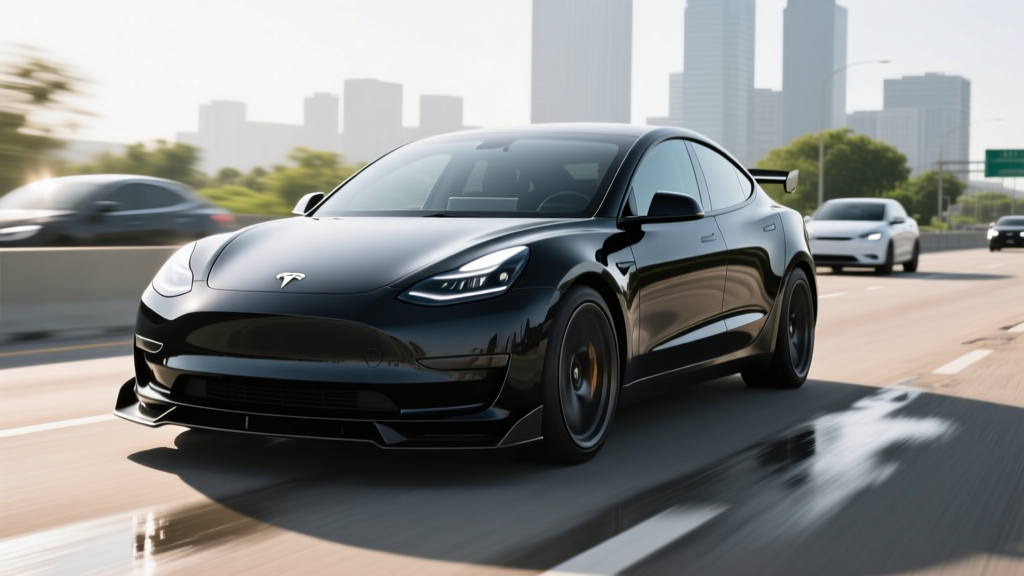
The Tesla Acceleration Boost for the Model 3 Long Range All-Wheel Drive is a software-only upgrade that shaves roughly half a second off the 0–60 mph time, dropping it from the stock 4.2 seconds to an estimated 3.9 seconds. Priced at $2,000 (available as an over-the-air purchase at any time after delivery), it's one of the cheapest ways to put a sub-4-second sedan in your garage. But does it affect range? Does it change the driving character enough to justify the spend? And how does the boosted Model 3 stack up against the Performance trim and key rivals like the Hyundai Ioniq 6 and BMW i4?
This review breaks down every spec that matters — EPA range, real-world highway and cold-weather expectations, charging curves, battery chemistry, cargo dimensions, and 2026 federal tax credit eligibility — so you can decide whether the Acceleration Boost is a smart buy or a skip.
Model 3 Long Range AWD: Full Spec Sheet
| Specification | Stock Long Range AWD | With Acceleration Boost |
|---|---|---|
| EPA Range | 363 miles | 363 miles (est.)* |
| Battery (usable) | ~79 kWh, NMC | ~79 kWh, NMC |
| Drivetrain | Dual-Motor AWD | Dual-Motor AWD |
| Horsepower | ~384 hp | ~430 hp (est.) |
| 0–60 mph | 4.2 sec | ~3.9 sec |
| Top Speed | 125 mph | 125 mph |
| Peak DC Fast Charge | 250 kW | 250 kW |
| 10–80% DCFC Time | ~25 min | ~25 min |
| Level 2 Home Charging | 11.5 kW (~44 mi/hr) | 11.5 kW (~44 mi/hr) |
| MPGe (combined) | 134 MPGe | ~131 MPGe (est.) |
| kWh/100 mi | 25 kWh/100 mi | ~26 kWh/100 mi (est.) |
| Cargo Volume | 23 cu ft (rear + frunk) | 23 cu ft |
| Rear Legroom | 35.2 in | 35.2 in |
| Base MSRP | $47,740 | $49,740 (with Boost) |
| Battery Warranty | 8 yr / 120,000 mi | 8 yr / 120,000 mi |
*Tesla does not publish an official EPA re-rating for the Acceleration Boost package. Range is expected to remain rated at 363 miles, though aggressive driving will consume more energy per mile.
Real-World Range: What the EPA Number Doesn't Tell You
EPA Sticker: 363 miles
Real-world highway (70–75 mph, mild weather): ~300–320 miles
Real-world mixed driving (city + highway): ~320–340 miles
Cold weather (below 32°F, highway): ~240–280 miles
The Model 3 Long Range AWD carries an EPA-estimated 363 miles of range, one of the highest figures in its segment. That number reflects a mix of city and highway driving at moderate temperatures with climate control in a comfortable setting.
In practice, sustained highway driving at 75 mph pushes energy consumption higher — expect around 28–30 kWh/100 mi rather than the EPA-rated 25 kWh/100 mi. That translates to roughly 300–320 miles before the battery reaches zero in warm conditions.
Cold weather is the bigger range killer. Lithium-ion NMC batteries lose efficiency below freezing due to increased internal resistance and the energy demand of cabin and battery heating. On a 20°F winter highway run with the heat pump running, plan for 240–280 miles of usable range. Tesla's heat pump (standard on the refreshed Model 3) mitigates this better than resistive heating, but physics still wins in deep cold.
The Acceleration Boost itself does not change the rated range — it's a software torque/power map change, not a hardware modification. However, owners who exploit the extra acceleration will burn more energy per mile. If you drive the Boost the way it's intended, expect your real-world efficiency to drop by 1–3 kWh/100 mi, which could trim 10–20 miles off a full-charge road trip.
Charging Speed: DC Fast, Level 2, and the Charge Curve
| Charging Level | Power / Rate | Miles Added per Hour | Notes |
|---|---|---|---|
| Level 1 (120V household) | ~1.4 kW | ~5 mi/hr | Emergency/trickle only |
| Level 2 (240V, 48A) | 11.5 kW | ~44 mi/hr | Full charge in ~7.5 hours |
| DC Fast Charge (peak) | 250 kW | ~750+ mi/hr (peak) | Sustained only to ~50% SoC |
| DC Fast Charge (10–80%) | ~25 min average | — | Tapers significantly above 60% |
The Model 3 Long Range AWD supports up to 250 kW peak DC fast charging on V3 Tesla Superchargers. That peak rate holds roughly from 10% to 50% State of Charge (SoC), after which the charge curve tapers progressively. By 60% SoC, you're likely seeing ~150 kW; by 80%, it drops to around 70–90 kW. This is normal lithium-ion NMC behavior — the battery management system protects cell health by reducing current as voltage rises.
The practical result: a 10–80% session takes approximately 25 minutes at a V3 Supercharger (350 kW-capable station, shared or unshared). If you arrive at a V2 Supercharger (150 kW max), expect 35–40 minutes for the same session.
For home charging, the onboard charger accepts up to 11.5 kW on a 240V/48A circuit (typically a 60A breaker). A full overnight charge from 20% to 100% takes roughly 8 hours. Tesla recommends installing a Tesla Wall Connector or equivalent Level 2 EVSE on a dedicated circuit. Most owners charge from 20–80% overnight in about 4–5 hours, which is more than sufficient for daily driving.
Preconditioning matters. If you navigate to a Supercharger using the Tesla navigation system, the car automatically warms or cools the battery to optimal temperature for fast charging. Without preconditioning (e.g., arriving at a non-Tesla charger or starting a charge in cold weather without navigation routing), peak charge rates can be 30–50% lower until the battery reaches temperature.
Performance: What the Acceleration Boost Actually Does
The Acceleration Boost is a $2,000 over-the-air software upgrade available exclusively for the Model 3 Long Range AWD. It does not change the motors, inverter, or battery hardware. Instead, it remaps the power delivery curve, allowing the dual motors to draw more peak power from the same ~79 kWh NMC battery pack.
The result: 0–60 mph drops from 4.2 seconds to approximately 3.9 seconds. That's a meaningful difference you'll feel in highway merges, passing maneuvers, and stoplight launches. The quarter-mile time also improves by roughly 0.3–0.5 seconds.
What the Boost does not change:
- Top speed remains 125 mph (electronically limited)
- Suspension and handling — identical to the standard Long Range AWD (no adaptive dampers or sport tuning)
- Braking hardware — same regenerative and friction brake setup
- Range rating — stays at 363 miles EPA
- Warranty — no impact on battery or powertrain coverage
If you want the full performance package — upgraded brakes, sport suspension, track mode, and a 3.1-second 0–60 — you need the Model 3 Performance at a significantly higher MSRP. The Acceleration Boost is strictly a straight-line speed upgrade, and that's exactly its appeal: surgical value for the specific metric most enthusiasts care about.
Pricing, Trims, and Federal Tax Credit Eligibility
| Trim | Base MSRP | Destination | Total Before Credit | Est. After §30D Credit |
|---|---|---|---|---|
| Model 3 RWD | $40,240 | $1,390 | $41,630 | ~$34,130* |
| Model 3 Long Range AWD | $47,740 | $1,390 | $49,130 | ~$41,630* |
| Model 3 LR AWD + Accel. Boost | $49,740 | $1,390 | $51,130 | ~$43,630* |
| Model 3 Performance | $54,990 | $1,390 | $56,380 | ~$48,880* |
*Estimated after federal credit. Actual eligibility depends on buyer income, battery sourcing, and MSRP caps. See details below.
The Model 3 Long Range AWD sits under the $55,000 MSRP cap for sedans under the IRS §30D Clean Vehicle Credit. This means it can qualify for up to $7,500 in federal tax credits, provided the buyer meets all requirements:
- ✅ MSRP cap: Sedan must be ≤$55,000 (Model 3 qualifies at all trims)
- ⚠️ Income cap: AGI ≤$150,000 (single) / ≤$300,000 (joint) / ≤$225,000 (head of household)
- ⚠️ Battery sourcing: Must meet critical minerals + battery component requirements (phased thresholds increase annually — verify current-year compliance on IRS.gov)
- ✅ Point-of-sale transfer: Eligible buyers can apply the credit at purchase, reducing out-of-pocket cost immediately
- ⚠️ Final assembly: Must be assembled in North America (Model 3 is built in Fremont, CA and Austin, TX — qualifies)
Battery sourcing rules tighten each year. Consult a tax professional and check IRS.gov for the current-year critical minerals and component percentages before purchasing.
If the full $7,500 applies, the Long Range AWD with Acceleration Boost effectively costs around $43,630 — a sub-4-second AWD sedan with 363 miles of range. That's a compelling value proposition.
Interior, Cargo, and Technology
The refreshed Model 3 ("Highland" generation, continuing into 2026) features a minimalist cabin anchored by a 15.4-inch central touchscreen. There is no instrument cluster — all driving information displays on the center screen. A rear 8-inch screen for passengers was added with the refresh.
Cargo dimensions:
- Rear trunk: 21 cu ft (including under-floor storage)
- Front trunk (frunk): 2 cu ft (small — fits a charging cable bag or laptop)
- Total cargo: 23 cu ft
- Rear legroom: 35.2 inches
- Front headroom: 40.3 inches
The Model 3's cargo space trails the Model Y (30+ cu ft behind the second row) but matches or beats most sport sedans in its class. The frunk is notably small compared to rivals like the Hyundai Ioniq 6 (which offers a larger front trunk).
Standout technology:
- Autopilot (standard): Adaptive cruise + lane centering — SAE Level 2 driver assist, requires hands-on-wheel supervision
- Full Self-Driving (Supervised) ($8,000 option or $99/mo subscription): Adds automated lane changes, traffic light/stop sign recognition, and city street navigation — still Level 2, driver must remain fully attentive
- Ambient lighting, ventilated front seats, power-folding mirrors (all standard on Long Range)
- Sentry Mode and Dashcam with USB storage
- Over-the-air updates continuously add features
Notable drawbacks:
- No physical stalks — turn signals are steering-wheel buttons (controversial, takes adaptation)
- Gear selector is on the touchscreen (backup buttons on overhead console)
- No Apple CarPlay or Android Auto — Tesla's proprietary infotainment only
- Rear visibility is limited by the sloping roofline
Warranty and Long-Term Ownership
Tesla's warranty coverage for the Model 3 Long Range AWD:
- Basic vehicle: 4 years / 50,000 miles
- Battery & drive unit: 8 years / 120,000 miles (whichever comes first)
- Battery degradation guarantee: Tesla warrants that the battery will retain at least 70% of its original capacity during the warranty period
The NMC battery in the Long Range is liquid-cooled with an active thermal management system, which helps minimize degradation. Real-world data from Tesla's fleet suggests typical degradation of 5–8% over the first 50,000 miles, with the curve flattening significantly afterward. Most owners report 10–12% total degradation at 100,000 miles — well within the 70% warranty threshold.
The Acceleration Boost does not void or alter any warranty terms. It's a Tesla-sanctioned software option, treated identically to any other factory feature.
Pros, Cons, and Who Should Buy
✅ Pros
- Sub-4-second 0–60 for $2,000 — best bang-for-buck in EVs
- 363-mile EPA range — class-leading
- Access to Tesla Supercharger network (17,000+ stalls in North America)
- 250 kW peak DC fast charging
- Strong resale value relative to most EVs
- OTA updates keep the car current
- Qualifies for up to $7,500 federal tax credit
❌ Cons
- No suspension or brake upgrades with the Boost — straight-line only
- Turn-signal buttons on the wheel frustrate many drivers
- No Apple CarPlay / Android Auto
- Small frunk (2 cu ft)
- Build quality inconsistency still reported by some owners
- FSD subscription is expensive for a Level 2 system
- Insurance premiums above segment average
🎯 Who This EV Suits Best
- Daily commuters who want effortless highway merging and passing power
- Enthusiasts on a budget who want sports-car acceleration without the sports-car price
- Tech-forward buyers who value OTA updates and Tesla's Supercharger ecosystem
- Couples and small families who need 4 doors and 363 miles of range but don't need SUV cargo space
Not ideal for: Buyers who need maximum cargo room (look at Model Y or Ioniq 5), track-day drivers (get the Model 3 Performance), or those who prefer traditional controls and CarPlay (consider BMW i4 or Hyundai Ioniq 6).
Acceleration Boost vs. Model 3 Performance vs. Rivals
| Spec | Model 3 LR + Boost | Model 3 Performance | Hyundai Ioniq 6 SE AWD | BMW i4 M50 |
|---|---|---|---|---|
| 0–60 mph | ~3.9 sec | 3.1 sec | 4.5 sec | 3.7 sec |
| EPA Range | 363 mi | 315 mi | 316 mi | 269 mi |
| Peak DCFC | 250 kW | 250 kW | 240 kW | 205 kW |
| MSRP (before credit) | ~$51,130 | ~$56,380 | ~$48,500 | ~$68,000 |
| Sport Suspension | No | Yes (adaptive) | No | Yes (adaptive) |
| Track Mode | No | Yes | No | No |
The Acceleration Boost occupies a unique niche: it delivers near-Performance acceleration while retaining the Long Range's superior range and lower price. You sacrifice the adaptive suspension, upgraded brakes, and track mode of the Performance trim, but you gain 48 additional miles of EPA range and save roughly $5,250.
Against the Hyundai Ioniq 6, the boosted Model 3 is quicker and has longer range, though the Ioniq 6 offers a more conventional interior with physical controls and standard CarPlay. The BMW i4 M50 is faster and more luxurious but costs $17,000+ more and has significantly less range.
Frequently Asked Questions
What is the real-world range of the Model 3 Long Range with Acceleration Boost?
The EPA rates it at 363 miles. In real-world highway driving at 70–75 mph, expect 300–320 miles in mild weather and 240–280 miles in freezing conditions. Aggressive driving that uses the extra acceleration will push consumption higher — plan conservatively for road trips.
How fast does the Model 3 Long Range charge at home and on the road?
On a 240V Level 2 home charger at 48 amps, it charges at 11.5 kW, adding about 44 miles of range per hour (full charge in ~7.5 hours). On a Tesla V3 Supercharger, it peaks at 250 kW and charges from 10–80% in approximately 25 minutes.
How much does the Model 3 Long Range with Acceleration Boost cost after tax credits?
The MSRP with destination is approximately $51,130. If you qualify for the full $7,500 federal §30D credit (meeting income, sourcing, and MSRP requirements), the effective price drops to around $43,630. Check current battery-sourcing requirements on IRS.gov, as thresholds tighten annually.
Is the Acceleration Boost worth buying vs. the Model 3 Performance?
If your priority is straight-line speed at the lowest cost, yes — it's a $2,000 upgrade that gets you to 3.9 seconds. If you want track capability, adaptive suspension, bigger brakes, and a 3.1-second 0–60, the Performance trim is the better choice at ~$5,250 more.
Can I add the Acceleration Boost after purchasing the car?
Yes. The Boost is an over-the-air software purchase available through the Tesla app at any time after delivery. It activates within minutes of purchase. The price has historically been $2,000, though Tesla occasionally adjusts pricing.
Does the Acceleration Boost affect the battery warranty?
No. The 8-year/120,000-mile battery and drive unit warranty remains fully intact. The Boost is a Tesla-approved option that does not alter warranty terms.
Does the Model 3 qualify for the full $7,500 federal EV tax credit?
The Model 3 is assembled in the US and falls under the $55,000 sedan MSRP cap, so it meets the vehicle requirements. Whether you receive the full $7,500, a partial credit, or nothing depends on your adjusted gross income and the current-year battery critical-minerals and component sourcing percentages. Always verify on IRS.gov and consult a tax professional before relying on the credit in your purchase decision.