Quick Verdict: Is Acceleration Boost Worth It?
Tesla's Acceleration Boost is an over-the-air software upgrade that unlocks faster 0-60 mph times on Long Range variants of the Model 3 and Model Y. For the 2026 Model 3 Long Range AWD, the $2,000 add-on drops the 0-60 time from 4.2 seconds to approximately 3.6 seconds — essentially giving you near-Performance-model thrust without the stiffer suspension, larger wheels, or track-oriented hardware of the full Model 3 Performance.
But raw speed isn't the whole story. Below, we break down the complete 2026 Model 3 Long Range AWD package — with and without Acceleration Boost — covering real-world range, charging speeds, efficiency, interior space, tax credit eligibility, and whether this software upgrade actually makes financial sense compared to stepping up to the Performance trim.
What Exactly Is Tesla Acceleration Boost?
Acceleration Boost is a post-purchase, over-the-air (OTA) software upgrade available through the Tesla app or your vehicle's touchscreen. It modifies the motor controller's torque delivery curve and power output mapping to extract more aggressive acceleration from the same dual-motor powertrain already installed in Long Range AWD vehicles.
Key facts about the upgrade:
- Cost: $2,000 (one-time purchase, tied to the vehicle VIN)
- Availability: Model 3 Long Range AWD and Model Y Long Range AWD
- Installation: OTA download — no service center visit required
- Warranty impact: Tesla states the upgrade does not void the battery or drive unit warranty
- Transferability: Tied to the VIN; transfers if you sell the car
The hardware in a Long Range AWD Model 3 — the front and rear permanent-magnet synchronous motors, the inverter, and the battery pack — already has the physical capability to deliver higher torque. Tesla software-locks a portion of that capability at the factory to create product differentiation between the Long Range and Performance trims. Acceleration Boost partially unlocks it.
2026 Model 3 Long Range AWD: Full Spec Sheet
| Specification | Value |
|---|---|
| EPA Range | 363 miles |
| Battery Capacity (usable) | ~79 kWh (NMC chemistry) |
| Drivetrain | Dual-motor AWD |
| Horsepower (combined) | ~384 hp (stock) / ~440 hp (w/ Boost) |
| 0-60 mph (stock) | 4.2 seconds |
| 0-60 mph (w/ Acceleration Boost) | ~3.6 seconds |
| Top Speed | 125 mph |
| Max DC Fast Charge Rate | 250 kW (peak) |
| 10-80% DC Fast Charge | ~25 minutes |
| Level 2 Home Charge Rate | 11.5 kW (~44 mi/hr) |
| EPA Efficiency | 132 MPGe combined / 25 kWh/100mi |
| Cargo Volume | 23 cu ft (rear trunk + frunk) |
| Rear Legroom | 35.2 inches |
| Curb Weight | ~4,034 lbs |
| Base MSRP | $47,740 (incl. destination) |
| Price w/ Acceleration Boost | $49,740 |
| Battery/Drive Unit Warranty | 8 years / 120,000 miles |
| Basic Vehicle Warranty | 4 years / 50,000 miles |
Range and Efficiency: EPA vs. the Real World
Real-world expectation: Expect 290–320 miles on sustained highway driving at 70-80 mph. In cold weather (below 32°F), range can drop to 240–280 miles depending on cabin heating use and battery preconditioning.
The 2026 Model 3 Long Range AWD carries an EPA-estimated 363 miles of range on its ~79 kWh usable NMC (nickel-manganese-cobalt) battery pack. That's among the highest range figures in the segment, and Tesla's industry-leading efficiency — roughly 25 kWh per 100 miles — is the reason.
However, EPA testing cycles include generous low-speed city driving and mild temperatures. In our experience and consistent with third-party highway tests:
- City/suburban mixed driving (65°F): 330–360 miles achievable
- Highway at 75 mph (65°F): 290–320 miles
- Highway at 75 mph (30°F): 240–280 miles
- Cold city driving (20°F): 260–300 miles
Tesla's heat pump, standard on the refreshed Model 3, significantly reduces cold-weather HVAC energy draw compared to resistive heating. Battery preconditioning — which the car activates automatically when a Supercharger is set as your navigation destination — also helps preserve range and charging speed in cold conditions.
Does Acceleration Boost affect range? Marginally, yes. The upgrade doesn't change battery capacity, but the more aggressive torque delivery can tempt drivers into heavier throttle use. In practice, expect a 5–10 mile range reduction if your driving habits change post-upgrade. If you drive the same way, the efficiency delta is negligible.
Charging Speed: DC Fast, Level 2, and Level 1
| Charging Level | Power (kW) | Miles Added Per Hour | Notes |
|---|---|---|---|
| Level 1 (120V household) | ~1.2 kW | ~4-5 mi/hr | Emergency/trickle only |
| Level 2 (240V home, 48A) | 11.5 kW | ~44 mi/hr | Full overnight charge in ~7-8 hours |
| DC Fast Charge (V3 Supercharger) | 250 kW peak | ~170 mi in 15 min | 10-80% in ~25 minutes |
| DC Fast Charge (V4 Supercharger) | 250 kW peak | Similar to V3 | Wider cable, easier handling |
The Model 3 Long Range AWD peaks at 250 kW on DC fast chargers, which is Tesla's V3 and V4 Supercharger standard. The charge curve is aggressive in the low state-of-charge (SoC) range — you'll see close to peak power from roughly 5% to 30% SoC — but it tapers progressively above 50%, and significantly above 80%.
This means the widely cited "10-80% in ~25 minutes" figure assumes you arrive at the charger with a low battery and the pack is preconditioned. Show up at a Supercharger with a cold, un-preconditioned battery in winter, and that 10-80% session could stretch to 35-40 minutes.
At home on a Level 2 wall connector (48 amps / 11.5 kW), the Model 3 adds roughly 44 miles of range per hour of charging. A depleted-to-full charge takes about 7-8 hours, making overnight charging trivial for virtually any daily commute. The NACS (North American Charging Standard) connector is native, and Tesla's Supercharger network — now exceeding 30,000 stalls in North America — remains the most reliable public DC fast-charging ecosystem available.
Acceleration Boost vs. Model 3 Performance: The Math
Here's where the value calculation gets interesting. The 2026 Model 3 Performance starts at approximately $54,740 (including destination) and delivers:
- 0-60 mph in 2.9 seconds
- ~510 hp combined
- Adaptive damping suspension
- Track Mode
- Performance brakes and 20-inch wheels
- EPA range: 315 miles
Compare that to a Long Range AWD with Acceleration Boost at $49,740:
- 0-60 mph in ~3.6 seconds
- ~440 hp combined
- Standard suspension (softer, more compliant ride)
- No Track Mode
- 18- or 19-inch wheels (better ride quality, lower tire replacement cost)
- EPA range: 363 miles (48 more miles than Performance)
The trade-off is clear: You give up 0.7 seconds in the 0-60 sprint, adaptive suspension, and Track Mode. You gain $5,000 in savings, 48 miles of additional EPA range, a noticeably more comfortable ride, and lower tire costs. For 90% of buyers who aren't tracking their sedan, the Long Range + Acceleration Boost combination is the smarter performance-per-dollar play.
Pricing, Tax Credits, and Total Cost
| Trim / Configuration | MSRP (incl. destination) | Est. After §30D Credit |
|---|---|---|
| Model 3 RWD | $39,740 | ~$32,240* |
| Model 3 Long Range AWD | $47,740 | ~$40,240* |
| Model 3 LR AWD + Accel. Boost | $49,740 | ~$42,240* |
| Model 3 Performance | $54,740 | ~$47,240* |
*Federal tax credit estimates assume buyer eligibility under IRS §30D rules. Eligibility depends on multiple factors — see checklist below.
- MSRP cap: Vehicle must be under $55,000 (sedans). All Model 3 trims qualify. ✓
- Buyer income cap: Modified AGI must not exceed $150,000 (single) / $300,000 (joint). Check your tax situation.
- Battery sourcing: Critical minerals and battery components must meet phased-in domestic/free-trade sourcing thresholds. Tesla's Austin-built Model 3 has generally qualified for the full $7,500, but sourcing requirements tighten annually. Verify current eligibility at the time of purchase.
- Point-of-sale transfer: As of 2024+, you can transfer the credit to the dealer at purchase for an immediate price reduction rather than waiting for a tax refund.
- One vehicle per VIN, one credit per taxpayer per year.
Consult a tax professional or the IRS Clean Vehicle Credits page for your specific eligibility.
Interior, Tech, and Daily Livability
The refreshed Model 3 (internally called "Highland") brought meaningful improvements over the pre-2024 interior:
- Ventilated front seats (standard on Long Range and above)
- Rear 8-inch touchscreen for rear-seat climate and entertainment control
- Ambient lighting and upgraded materials throughout the cabin
- Improved sound insulation — road and wind noise are noticeably reduced
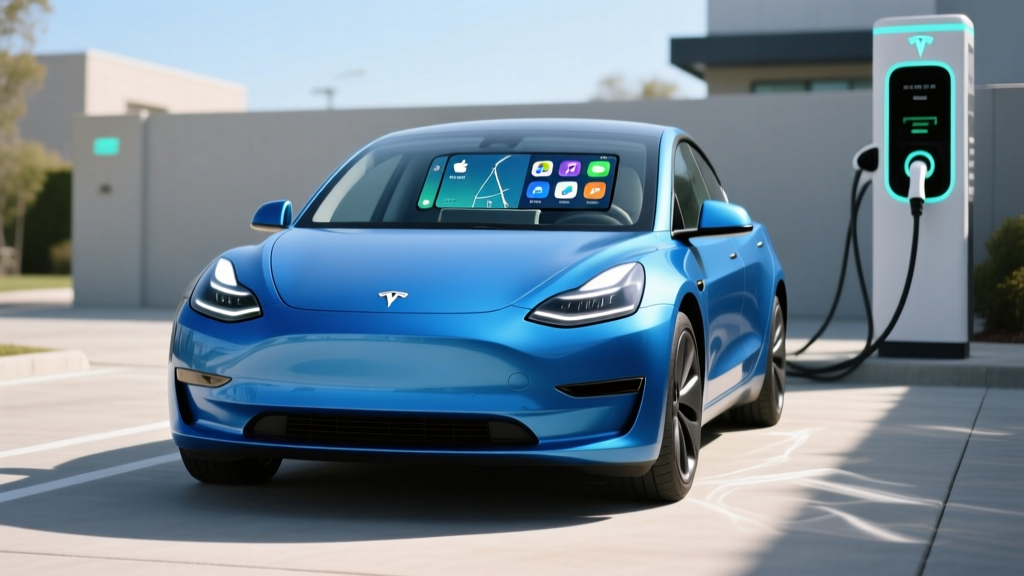
- 15.4-inch front touchscreen running Tesla's latest UI — responsive, but still no Apple CarPlay or Android Auto
Cargo space totals 23 cubic feet across the rear trunk (including under-floor storage) and the front trunk (frunk). Rear legroom is 35.2 inches — adequate for adults on shorter trips, but taller passengers will find it snug compared to a Hyundai Ioniq 6 or BMW i4.
Driver assistance: Tesla's basic Autopilot (traffic-aware cruise control and lane centering) is standard. Full Self-Driving (Supervised) remains an $8,000 option or $99/month subscription. Crucially, FSD is an SAE Level 2 system — it requires continuous driver supervision and is not autonomous driving. Tesla's naming convention is misleading; the driver must remain engaged at all times.
Pros and Cons
- Class-leading efficiency (132 MPGe combined)
- 363-mile EPA range — top of segment
- Acceleration Boost offers Performance-like speed for $5,000 less
- Access to Tesla Supercharger network
- OTA updates continuously improve the vehicle
- Strong resale value relative to EV competitors
- Heat pump standard for cold-weather efficiency
- No Apple CarPlay or Android Auto
- Rear seat space is tighter than competitors
- Turn signal buttons on steering wheel (no stalk) take adjustment
- Panel gaps and build consistency still vary
- FSD (Supervised) is expensive and still Level 2
- Insurance premiums run 15-30% above segment average
- Acceleration Boost is non-refundable if you change your mind
Who Should Buy the Model 3 Long Range + Acceleration Boost?
Choose the Long Range AWD + Acceleration Boost if:
- You want sub-4-second 0-60 performance without paying the Performance trim premium
- Maximum range (363 mi EPA) is a higher priority than track hardware
- You prefer a softer, more compliant ride for daily commuting and road trips
- You regularly use Tesla's Supercharger network for long-distance travel
- You can charge at home and want an EV that excels as a one-car solution
Choose the Model 3 Performance instead if:
- You plan to attend track days and want Track Mode + performance brakes
- Adaptive damping suspension is important for your driving style
- You want the quickest possible 0-60 (2.9 seconds) and don't mind sacrificing 48 miles of range
Look elsewhere if:
- You need generous rear-seat room for car seats or tall adults (consider Ioniq 6 or BMW i4)
- Apple CarPlay/Android Auto is a must-have
- You cannot charge at home and your area has limited public charging infrastructure
Frequently Asked Questions
Can I add Acceleration Boost after buying the car?
Yes. Acceleration Boost is available as a post-purchase over-the-air upgrade through the Tesla app or your car's touchscreen. You can buy it at any point during ownership, and it installs wirelessly — no service center visit is needed.
Does Acceleration Boost reduce my battery range or lifespan?
The upgrade doesn't change battery capacity or chemistry. If your driving habits don't change, the range impact is negligible (under 5 miles). Tesla states the upgrade does not affect the 8-year/120,000-mile battery and drive unit warranty. However, consistently driving with aggressive acceleration will increase energy consumption and could slightly accelerate battery degradation over time — this applies to any EV, not just boosted ones.
How fast does the 2026 Model 3 Long Range charge at home?
On a Level 2 Tesla Wall Connector at 48 amps (11.5 kW), the Model 3 Long Range adds approximately 44 miles of range per hour. A full charge from near-empty takes about 7-8 hours, making it easy to replenish overnight on a standard 240V circuit (NEMA 14-50 or hardwired). Home charger installation typically costs $800-$2,000 depending on your electrical panel's capacity and the run distance.
Is the Tesla Model 3 still eligible for the $7,500 federal tax credit in 2026?
As of early 2026, the Model 3 generally qualifies for the full $7,500 federal tax credit under IRS §30D, provided the buyer meets income caps ($150K single / $300K joint modified AGI) and the vehicle's battery sourcing meets current-year critical mineral and component thresholds. All Model 3 trims fall under the $55,000 MSRP cap for sedans. Sourcing rules tighten periodically, so confirm eligibility at the time of purchase. The credit can now be transferred to the dealer at point of sale for an immediate price reduction.
How does the Model 3 Long Range compare to the Hyundai Ioniq 6 or BMW i4?
The Model 3 Long Range leads on range (363 mi vs. Ioniq 6's 361 mi and i4 eDrive40's 307 mi) and charging infrastructure access. The Ioniq 6 offers more rear-seat space and 800V ultra-fast charging capability. The BMW i4 provides a more traditional luxury interior and Apple CarPlay but less range and no DC fast charging above 200 kW. The Model 3's efficiency, Supercharger network access, and software ecosystem remain its strongest competitive advantages.