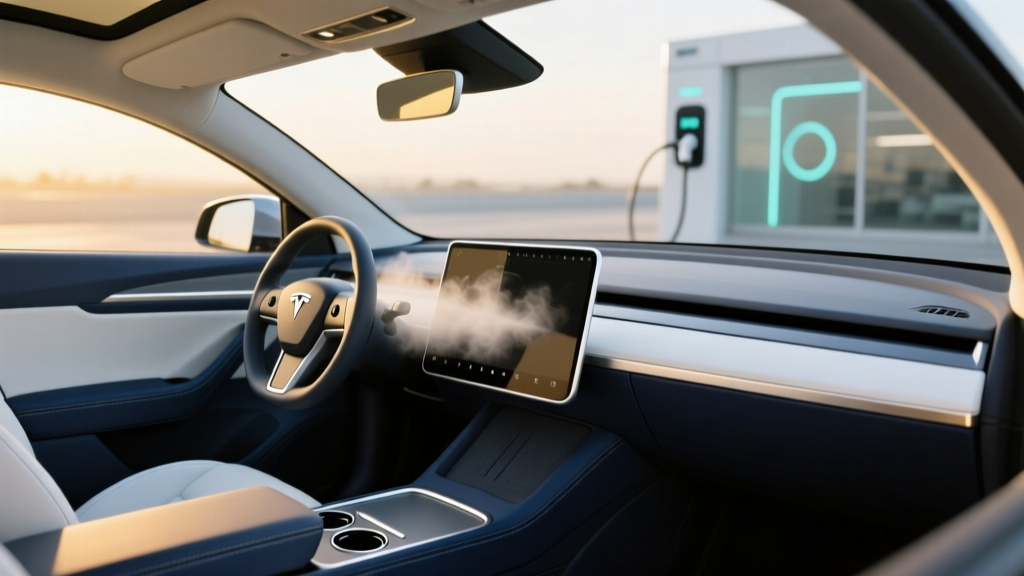
If you've ever turned on your Tesla's climate control and been greeted by a sour, musty, or "wet dog" odor, you're not alone. The infamous Tesla AC smell is one of the most frequently reported comfort complaints across Model 3, Model Y, Model S, and Model X owner forums. The good news: it's almost always fixable, usually preventable, and rooted in straightforward physics — not a defect in the HVAC system itself.
This guide breaks down exactly why the smell develops, how to eliminate it, and what Tesla has changed in the 2025–2026 cabin air filtration systems to address it. We'll also use the 2026 Tesla Model Y Long Range AWD as our reference vehicle, giving you a complete spec-by-spec profile so you can evaluate the car holistically — not just on its cabin-air quirks.
Why Does My Tesla AC Smell? The Root Cause
The musty or vinegar-like odor from a Tesla's vents is caused by microbial growth (mold, mildew, bacteria) on the evaporator coil and cabin air filter. Here's the mechanism:
- Condensation forms on the evaporator coil whenever the AC compressor runs — this is normal in every car with air conditioning.
- When you turn the car off, that moisture lingers on the coil and in the filter housing. Unlike ICE vehicles that generate engine-heat residual drying, Tesla's cabin sits at ambient temperature with no passive airflow.
- Organic particles — pollen, dust, skin cells — trapped in the cabin air filter serve as food for microbial colonies.
- Within 24–72 hours in humid climates, those colonies produce volatile organic compounds (VOCs) that you smell as sour, musty, or "dirty sock" odors when you next turn on the system.
This is not unique to Tesla — it happens in many EVs and ICE vehicles — but Tesla owners notice it more because:
- The cabin is extremely quiet, so any olfactory intrusion is more perceptible.
- Tesla's default "Camp Mode" and cabin overheat protection can run the HVAC intermittently, creating repeated condensation cycles.
- The cabin air filter housing design on pre-2025 Model 3/Y makes filter removal and inspection less obvious than in most legacy-brand vehicles.
How to Fix Tesla AC Smell: Step-by-Step
There are three tiers of intervention, from quick to thorough:
Tier 1: Immediate Relief (10 minutes, ~$0)
- Set the climate control to "Defrost" mode at maximum fan speed with the temperature set to maximum heat. Run for 10–15 minutes while parked. This dries the evaporator coil.
- Disable recirculation mode temporarily to pull in fresh outside air.
Tier 2: Filter Replacement (20 minutes, ~$25–$45)
The single most effective fix. Tesla recommends cabin air filter replacement every 2 years for Model 3/Y (or annually if you drive in high-pollen or high-humidity areas). The 2025–2026 Model Y uses a HEPA-grade filter with activated carbon layer.
- Order an OEM filter (Tesla part #1499357-00-A for Model Y) or a high-quality aftermarket equivalent from BOSCH or K&N.
- Access the filter housing behind the glovebox (Model Y) or under the frunk cowl (Model 3 pre-refresh).
- Spray the evaporator coil visible through the filter slot with an EPA-registered HVAC antimicrobial foaming cleaner (e.g., Kool-It or Nu-Calgon). Let sit 10 minutes, then reinsert the new filter.
Tier 3: Professional Evaporator Treatment (1–2 hours, ~$80–$150)
If the smell persists after filter replacement, a mobile detailer or Tesla Service Center can perform a full evaporator flush using an endoscopic spray tool. This is rarely necessary unless the filter was neglected for 3+ years in a humid climate.
2026 Tesla Model Y Long Range AWD: Full Spec Profile
With the AC-smell question resolved, let's look at the vehicle itself. The 2026 Model Y Long Range AWD received the "Juniper" refresh (introduced early 2025), bringing updated styling, a ventilated-seat option, ambient lighting, rear-seat entertainment screen, and a revised suspension tune.
| Specification | Value |
|---|---|
| EPA Estimated Range | 320 miles |
| Battery Capacity (Usable) | 78.1 kWh |
| Battery Chemistry | NMC (Nickel Manganese Cobalt) |
| Drivetrain | Dual-Motor AWD |
| Horsepower | 384 hp (combined) |
| 0–60 mph | 4.8 seconds |
| Top Speed | 125 mph |
| MPGe (City / Hwy / Combined) | 123 / 111 / 117 MPGe |
| Energy Consumption | 28 kWh / 100 mi |
| Max DC Fast Charge Rate | 250 kW (peak) |
| 10–80% DC Fast Charge Time | ~25 minutes |
| Level 2 Home Charge Rate | 11.5 kW (~44 mi/hr) |
| Charging Port | NACS (native Tesla / Supercharger) |
| Cargo Volume (rear seats up / folded) | 30.2 / 72.1 cu ft |
| Rear Legroom | 41.6 in |
| Front Headroom | 41.0 in |
| Curb Weight | 4,398 lbs |
| Towing Capacity | 3,500 lbs |
| Battery & Drive Unit Warranty | 8 years / 120,000 miles |
| Basic Vehicle Warranty | 4 years / 50,000 miles |
Source: EPA fueleconomy.gov and Tesla.com Model Y specs.
Charging Speed Breakdown: DC Fast, Level 2, and Level 1
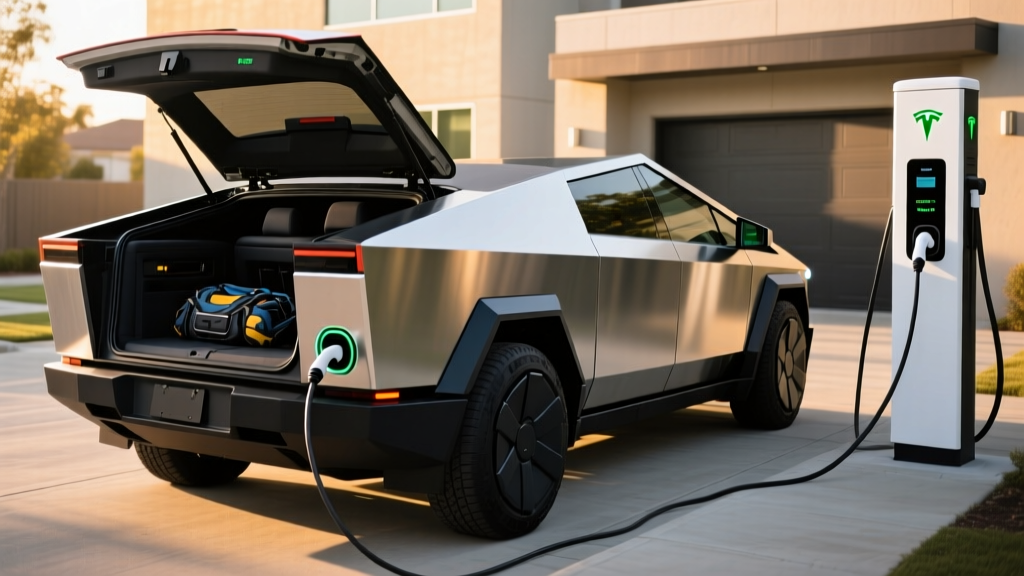
The Model Y Long Range uses Tesla's NACS connector natively, giving it seamless access to the Tesla Supercharger network — widely regarded as the most reliable DC fast-charging network in North America. With the opening of Superchargers to non-Tesla EVs, the network has expanded further, but Tesla owners still benefit from native plug-and-charge integration (no app or RFID card required).
| Charging Level | Power | Connector | Speed (Miles Added) | Notes |
|---|---|---|---|---|
| Level 1 (120V outlet) | ~1.4 kW | NACS (mobile connector) | ~5 mi/hr | Emergency/trickle only; 60+ hrs for full charge |
| Level 2 (240V, 48A) | 11.5 kW | NACS (Wall Connector) | ~44 mi/hr | Full charge in ~7 hrs; ideal home setup |
| DC Fast (Supercharger V3) | 250 kW peak | NACS | ~162 mi in 15 min | Peak rate at 10–30% SoC; tapers significantly above 60% |
| DC Fast (Supercharger V4) | 250 kW (current max for Model Y) | NACS | Same as V3 for this vehicle | V4 cabinets support higher rates for future architectures |
Charging-curve reality: The "250 kW peak" figure is achieved only between roughly 10–30% State of Charge (SoC) with a preconditioned battery. Above 60% SoC, the rate drops to ~100 kW, and above 80%, it falls to ~40 kW. This is why the 10–80% time is ~25 minutes, but 10–100% would take ~50+ minutes. Always precondition your battery by entering a Supercharger as your navigation destination — the car will warm the pack en route for optimal charge acceptance.
Pricing, Trims, and Federal Tax Credit Eligibility (2026)
The 2026 Model Y is offered in three main configurations:
| Trim | Base MSRP | Est. Price After §30D Credit |
|---|---|---|
| Long Range RWD | $44,990 | $37,490* |
| Long Range AWD | $47,990 | $40,490* |
| Performance AWD | $51,490 | $43,990* |
*Assumes full $7,500 federal tax credit under IRS §30D. Actual eligibility depends on buyer income, battery sourcing, and MSRP caps. See details below.
- Credit amount: Up to $7,500, split into two halves — $3,750 for battery components manufactured in North America, and $3,750 for critical minerals sourced from the U.S. or FTA-partner countries.
- MSRP cap: The Model Y qualifies as an SUV (per IRS VIN classification), so the cap is $80,000. All current trims fall well below this.
- Buyer income cap: Modified AGI must not exceed $150,000 (single), $225,000 (head of household), or $300,000 (joint).
- Point-of-sale transfer: As of 2024+, you can transfer the credit to the dealer at purchase, receiving the $7,500 as an immediate price reduction rather than waiting for a tax refund. Tesla supports this at checkout.
- Battery sourcing: Tesla's U.S.-built Model Y (Fremont and Austin factories) has progressively increased North American battery-component content. As of the 2026 model year, the Long Range AWD qualifies for the full $7,500 per the IRS eligible-vehicle list. Verify at purchase — sourcing rules are updated quarterly.
Tech, Driver Assistance, and Interior Highlights
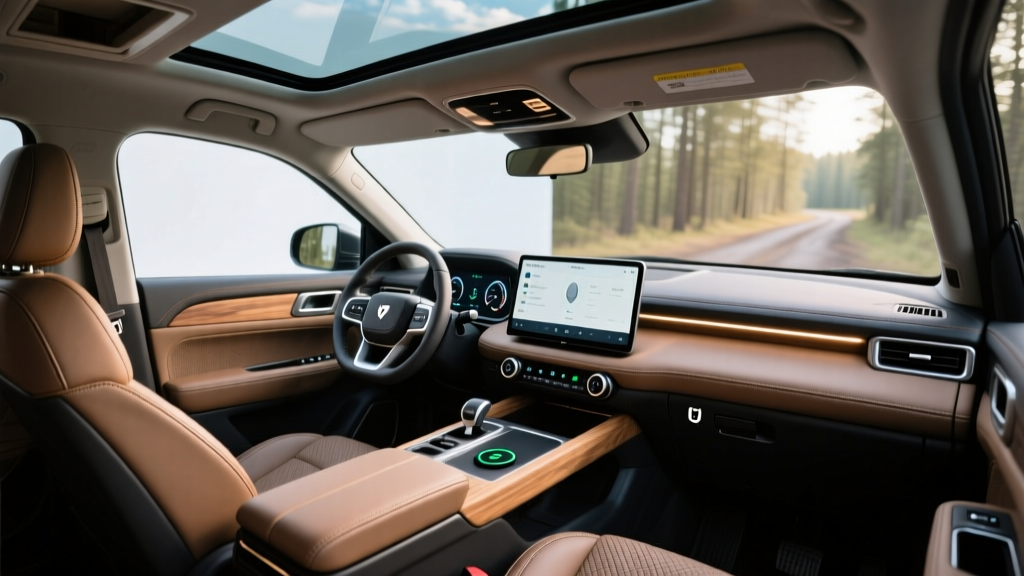
The 2026 Model Y "Juniper" interior is a meaningful step up from the pre-2025 cabin. Key updates include:
- 15.4-inch front touchscreen (slightly larger than the outgoing 15.0-inch) with faster processor and ventilated seat controls integrated into the UI.
- 8.0-inch rear-seat touchscreen for climate, media, and streaming — a first for Model Y.
- Ambient lighting strip across the dashboard and door panels (previously Model S/X exclusive).
- Ventilated front seats (standard on Long Range and Performance trims) — a direct response to owner feedback and a competitor check-box for Hyundai Ioniq 5 and Ford Mustang Mach-E.
- HEPA cabin air filtration with "Bioweapon Defense Mode" — the upgraded filter media helps reduce the AC-smell issue by capturing finer particulates before they reach the evaporator.
Autopilot and FSD (Supervised):
Standard Autopilot includes Traffic-Aware Cruise Control and Autosteer (lane centering on marked highways). FSD Supervised adds Navigate on Autopilot (highway interchanges), Auto Lane Change, Autopark, Summon, and Traffic Light/Stop Sign Control. The system uses Tesla's vision-only approach (no LiDAR or radar on 2023+ vehicles) with the HW4 computer.
Pros, Cons, and Who Should Buy the 2026 Model Y
✅ Pros
- Class-leading Supercharger network access (native NACS, plug-and-charge)
- 320-mile EPA range covers most road trips with a single 15–20 min stop
- Spacious 72.1 cu ft cargo area (seats folded) beats most compact SUVs
- OTA updates continuously add features post-purchase
- Strong resale value relative to EV segment average
- HEPA filtration + Bioweapon Defense Mode improves cabin air quality
- Performance trim does 0–60 in 3.5 sec — sports-car territory
❌ Cons
- No physical buttons — all controls via touchscreen (wipers, glovebox, mirrors)
- Cabin AC smell can develop if filter is neglected (fixable but requires owner diligence)
- FSD Supervised costs $8,000 extra and remains Level 2 — not autonomous
- Ride quality on Performance trim is firm; not ideal for rough roads
- No Apple CarPlay or Android Auto — Tesla's native UI only
- Rear visibility is limited; relies heavily on backup camera
- Insurance premiums run 15–30% higher than comparable ICE SUVs
Who this EV suits best:
- Commuters (20–80 mi round trip): Home Level 2 charging makes daily driving effortless; 320-mile range means charging only 2–3 times per week.
- Small families (2 adults + 2–3 kids): Adequate rear legroom (41.6 in), excellent safety ratings from NHTSA, and generous cargo space.
- Road-trip enthusiasts: Supercharger density along interstate corridors means 15–25 minute stops every 200–250 miles.
- Not ideal for: Buyers who want physical controls, Apple CarPlay, or Level 4 autonomy. Also less suited for heavy towing (3,500-lb limit) compared to the Rivian R1S or Ford F-150 Lightning.
Frequently Asked Questions
What is the real-world range of the 2026 Tesla Model Y Long Range AWD?
The EPA rates it at 320 miles. In real-world highway driving (70–75 mph, moderate temps), expect 270–290 miles. In sub-freezing weather, plan for 230–260 miles. These figures assume the battery is preconditioned and you're not towing.
How fast does the Model Y charge at home and on the road?
At home on a Level 2 Tesla Wall Connector (240V, 48A), you'll add ~44 miles per hour — a full overnight charge in about 7 hours. On a V3 Supercharger, you can go from 10% to 80% in approximately 25 minutes, with a peak rate of 250 kW in the 10–30% SoC window.
How much does the 2026 Model Y cost after tax credits?
The Long Range AWD starts at $47,990. If you qualify for the full $7,500 §30D federal credit (income under $300k joint, vehicle meets sourcing requirements), the effective price drops to $40,490. You can apply this as a point-of-sale reduction at Tesla checkout. Always verify current eligibility on the IRS eligible vehicles page before purchasing.
Is the Model Y worth buying vs. the Hyundai Ioniq 5 or Ford Mustang Mach-E?
The Model Y wins on Supercharger network reliability, range efficiency (117 MPGe combined vs. Ioniq 5's 110 MPGe), and cargo volume. The Ioniq 5 offers faster 10–80% charging (~18 min on 350 kW chargers via its 800V architecture), physical buttons, and Apple CarPlay. The Mach-E offers a more traditional interior layout and available BlueCruise hands-free driving on mapped highways. If Supercharger access and software ecosystem are your priorities, the Model Y leads. If you want 800V charging speed or physical controls, look at Hyundai.
Does the Tesla AC smell mean the HVAC system is defective?
No. The smell is caused by microbial growth on the evaporator coil and cabin filter — a maintenance issue, not a mechanical defect. Replacing the cabin air filter ($25–$45) and treating the evaporator with an antimicrobial foam resolves it in over 90% of cases. Tesla's 2025+ HEPA filter upgrade with activated carbon layer helps prevent recurrence.
What is the battery warranty on the 2026 Model Y?
Tesla covers the battery pack and drive units for 8 years or 120,000 miles (whichever comes first), with a guaranteed minimum 70% capacity retention over that period. The basic vehicle limited warranty is 4 years or 50,000 miles.