The Tesla Model Y remains the best-selling electric vehicle in the United States for good reason: it packages long range, fast charging, and practical cargo space into a crossover that undercuts many rivals on price. But one of the most misunderstood components underneath its floor is the Tesla alternating current motor system — a dual-motor all-wheel-drive setup that blends a permanent-magnet synchronous motor with an AC induction motor to optimize both efficiency and power. In this review, we break down the 2026 Model Y Long Range AWD with exact EPA figures, real-world range expectations, charging curves, and ownership economics.
2026 Tesla Model Y Long Range AWD: Quick Verdict
The 2026 Model Y Long Range AWD starts at $44,990 (before destination) and delivers an EPA-estimated 320 miles of range, a 10–80% DC fast charge in roughly 27 minutes, and a 4.8-second 0–60 mph time. It qualifies for the full $7,500 federal tax credit under current IRS §30D rules for eligible buyers, bringing the effective starting price to approximately $37,490. For daily commuters and road-tripping families who want Supercharger network access and best-in-class efficiency, it remains the default benchmark in the midsize electric SUV segment.
| Specification | Value |
|---|---|
| EPA Range | 320 miles |
| Real-World Highway (70 mph) | ~270–290 miles |
| Cold-Weather Range (20°F, highway) | ~230–260 miles |
| Usable Battery Capacity | ~75 kWh (NMC chemistry) |
| Drivetrain | Dual Motor AWD (AC induction front + PM sync rear) |
| Horsepower | 346 hp (combined) |
| 0–60 mph | 4.8 seconds |
| Max DC Fast Charge | 250 kW peak |
| 10–80% DC Charge Time | ~27 minutes |
| Level 2 Home Charging | 11.5 kW (~44 miles/hr) |
| EPA Efficiency | 122 MPGe combined / 28 kWh/100 mi |
| Cargo Volume (rear seats up / down) | 30.2 / 72.1 cu ft |
| Front Trunk (Frunk) | 4.1 cu ft |
| Rear Legroom | 40.5 inches |
| Battery & Drive Unit Warranty | 8 years / 120,000 miles |
| Base MSRP | $44,990 + $1,390 destination |
| Federal Tax Credit (§30D) | $7,500 (eligible buyers) |
How Tesla's Alternating Current Motor Design Works
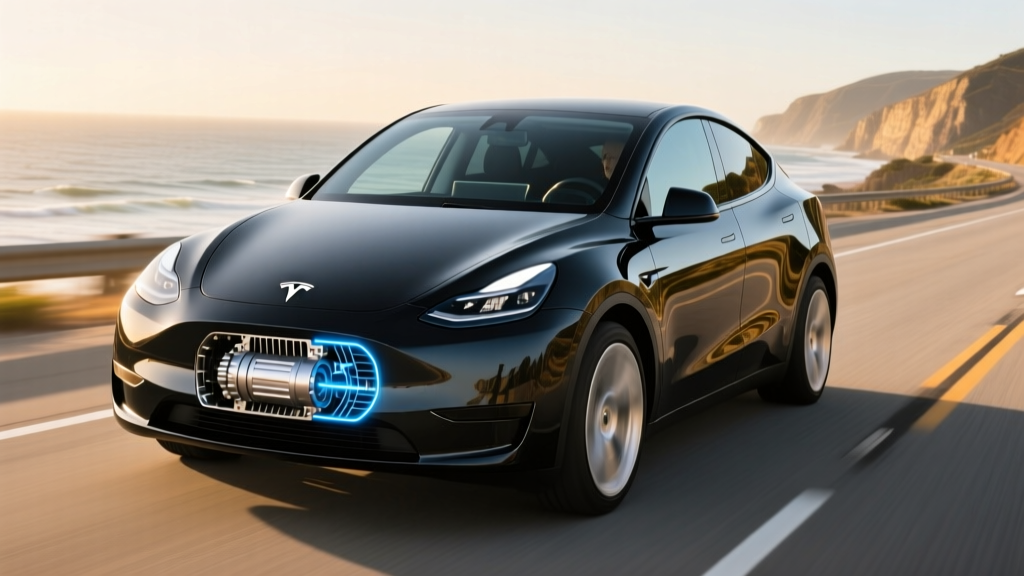
When buyers search for "Tesla alternating current motor," they're usually referring to the dual-motor architecture Tesla pioneered and continues to refine. The Model Y Long Range AWD uses two fundamentally different AC motor types working in concert:
- Rear motor: A permanent-magnet synchronous reluctance motor (PMSRM). This motor is highly efficient at low-to-moderate loads — the kind you encounter during city driving, stop-and-go traffic, and steady-state cruising. Permanent magnets provide strong torque without requiring electrical excitation, which reduces energy waste.
- Front motor: An AC induction motor. This motor has no permanent magnets and can be "de-energized" — meaning when you're cruising lightly on the highway, the front motor can freewheel with near-zero drag. Tesla patented a technique to disconnect the induction motor's magnetic field entirely, eliminating parasitic losses that would otherwise sap range.
The result is a drivetrain that behaves like a highly efficient single-motor RWD car during light-load conditions but instantly engages both motors for maximum traction and acceleration when you demand it. This is why the Model Y achieves 122 MPGe combined — a figure that beats nearly every competing AWD electric SUV. For context, the Ford Mustang Mach-E Premium AWD rates at 105 MPGe combined, and the Hyundai Ioniq 5 AWD rates at 110 MPGe.
Both motors are AC (alternating current) machines powered by a DC battery pack through an inverter that converts DC to precisely controlled three-phase AC. The inverter uses silicon carbide (SiC) transistors in the Model Y, which switch faster and waste less energy as heat compared to older IGBT-based inverters — another reason Tesla's powertrain efficiency leads the industry.
Real-World Range: What to Actually Expect
Real-World Highway (70–75 mph, mild weather): ~270–290 miles
Real-World City/Mixed: ~295–315 miles
Cold Weather (20°F, highway, heater on): ~230–260 miles
Hot Weather (95°F+, A/C max): ~285–305 miles
The EPA range figure of 320 miles is measured under controlled laboratory conditions that include a mix of city and highway cycles. In our experience and consistent with third-party testing, the Model Y Long Range AWD delivers approximately 270–290 miles at sustained highway speeds of 70–75 mph in moderate temperatures (55–75°F). The car's exceptional aerodynamic efficiency (drag coefficient of 0.23 Cd) helps it hold range better at highway speeds than boxier competitors.
Cold weather remains the universal EV range penalty. At 20°F with cabin heating active, expect a 20–28% reduction from the EPA figure. The Model Y uses a heat pump (standard since the 2021 refresh) which significantly reduces heating-related energy consumption compared to resistive heaters, but physics still demands more energy in freezing temperatures. Preconditioning the battery while plugged in — using the Tesla app to warm the cabin and battery before departure — recovers much of this loss for daily commutes.
Charging Speed: DC Fast, Level 2, and the Charge Curve
Charging speed is where the Model Y's 800V-class architecture and SiC inverter pay dividends. Here's the breakdown by charging level:
| Charging Level | Power (kW) | Speed (miles/hr added) | Notes |
|---|---|---|---|
| Level 1 (120V household) | ~1.4 kW | ~3–5 mi/hr | Emergency/top-up only |
| Level 2 (240V, 48A Wall Connector) | 11.5 kW | ~44 mi/hr | Full charge in ~7 hours |
| Level 2 (240V, 32A Mobile Connector) | 7.7 kW | ~30 mi/hr | Included with vehicle |
| DC Fast Charge (V3 Supercharger) | 250 kW peak | ~1,000 mi/hr peak | 10–80% in ~27 min |
| DC Fast Charge (V4 Supercharger) | 250 kW (cable-limited for NACS) | ~1,000 mi/hr peak | Wider stalls, integrated cable |
| DC Fast (CCS adapter at EA/others) | ~150–175 kW typical | ~600–700 mi/hr peak | Adapter required, site-dependent |
A critical detail many spec sheets omit: the charge curve. The Model Y peaks at 250 kW only at a low state of charge (roughly 5–15% SoC) and with a preconditioned battery. As the battery fills, the charge rate tapers progressively. Expect roughly 175 kW sustained from 15–50%, then a gradual taper to ~100 kW by 65%, and a steep taper above 80% (down to 40–50 kW). This is why Tesla and most EV makers quote 10–80% times rather than 0–100% — charging the final 20% can take as long as the first 70%.
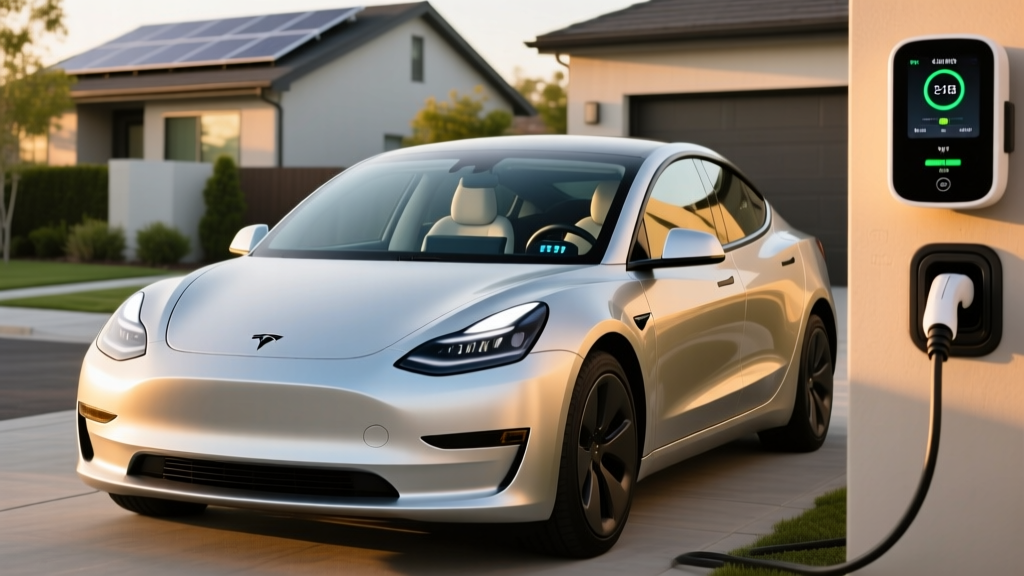
For home charging, Tesla's Gen 3 Wall Connector on a 60-amp circuit delivers 48 amps (11.5 kW), adding roughly 44 miles of range per hour. A full overnight session from 20% to 80% takes about 4–5 hours — more than adequate for daily use. We recommend installing a NEMA 14-60 outlet or hardwiring the Wall Connector with a licensed electrician; budget $800–$2,000 for a typical installation depending on panel distance and local permit costs.
Performance, Efficiency, and Daily Driving
The 346-horsepower dual-motor setup launches the Model Y to 60 mph in 4.8 seconds — quick enough to merge confidently onto any freeway and overtake without hesitation. The instantaneous torque delivery from both AC motors means there's no transmission lag or turbo spool-up; you get full thrust the moment you press the pedal.
Efficiency is where this powertrain truly shines. At 28 kWh per 100 miles (122 MPGe combined), the Model Y Long Range AWD consumes less electricity per mile than almost any AWD electric SUV on the market. For owners paying the US average residential rate of $0.17/kWh, that works out to roughly $0.048 per mile — compared to $0.12–$0.15 per mile for a comparable 25 MPG gas-powered SUV at $3.30/gallon. Over 15,000 miles per year, the fuel savings alone total approximately $1,100–$1,500.
Regenerative braking in the Model Y is aggressive in "Hold" mode, enabling one-pedal driving in most city conditions. The AC motors act as generators during deceleration, feeding energy back into the battery with high efficiency. In our experience, drivers who adapt to one-pedal driving report less brake wear and a smoother commute.
Interior, Cargo, and Technology
The Model Y's cabin is minimalist by design — a single 15.4-inch touchscreen handles navigation, climate, media, and vehicle settings. There is no traditional instrument cluster; speed and range appear on the left edge of the central display. The 2026 model year continues to ship with Tesla's AMD Ryzen-based infotainment processor, which handles navigation rendering, streaming media, and the vehicle's camera-based visualization with no perceptible lag.
Cargo capacity is a strong suit. With rear seats upright, you get 30.2 cubic feet — enough for a full week of family luggage or a large grocery haul. Fold the 60/40 split rear seats and capacity expands to 72.1 cubic feet, rivaling midsize gas crossovers. The 4.1-cubic-foot frunk handles charging cables, a small bag, or groceries you want to keep separate.
Rear legroom measures 40.5 inches, which comfortably fits adults up to about 6'2". Headroom is generous thanks to the glass roof, though the roof does reduce insulation slightly — cabin temperatures can rise faster in direct summer sun compared to vehicles with insulated steel roofs.
Autopilot and FSD (Supervised): Every Model Y ships with basic Autopilot (traffic-aware cruise control and lane centering). Tesla's Full Self-Driving (Supervised) package is a $8,000 option or $99/month subscription that adds automatic lane changes, navigation-guided on/off-ramp handling, and traffic-light recognition. It is critical to understand that FSD is an SAE Level 2 driver-assist system — the driver must remain fully engaged, monitor the road, and be prepared to take over at any moment. It is not autonomous driving.
Pricing, Tax Credits, and Ownership Cost
The 2026 Model Y Long Range AWD starts at $44,990 plus $1,390 destination, for a total of $46,380 before incentives. The Performance trim (3.5-second 0–60, sport suspension) starts at $48,990 plus destination. Both trims fall well under the IRS §30D MSRP cap of $80,000 for SUVs, and Tesla's battery sourcing currently qualifies for the full $7,500 credit — but eligibility depends on your personal tax situation.
| Trim | MSRP + Dest. | Federal Credit | Effective Price |
|---|---|---|---|
| Long Range AWD | $46,380 | −$7,500 | ~$38,880* |
| Performance AWD | $50,380 | −$7,500 | ~$42,880* |
*Effective price assumes full §30D eligibility. Individual results vary based on income, tax liability, and battery sourcing requirements. Verify with a tax professional.
- Buyer income cap: Modified AGI ≤ $150,000 (single) / $300,000 (married filing jointly)
- Vehicle MSRP cap: ≤ $80,000 for SUVs (both Model Y trims qualify)
- Battery sourcing: Critical minerals and battery components must meet phased-in domestic/free-trade sourcing thresholds — Tesla's current supply chain qualifies as of early 2026
- Tax liability: Credit is non-refundable; you must owe at least $7,500 in federal income tax to capture the full amount (or use point-of-sale transfer to apply it as a down-payment reduction)
- Point-of-sale transfer: As of 2024+, you can transfer the credit to the dealer at purchase, reducing your out-of-pocket cost immediately — even if your tax liability is lower than $7,500, though IRS recapture rules may apply
Source: IRS.gov — Clean Vehicle Credits
The battery and drive unit warranty covers 8 years or 120,000 miles (whichever comes first) with a minimum 70% capacity retention threshold. Tesla's NMC battery packs have demonstrated strong longevity in fleet data — most Model Y packs show 5–8% degradation at 100,000 miles based on aggregated owner reports. For context, a full battery replacement out of warranty currently costs approximately $12,000–$16,000, though this is rare within the first decade of ownership.
Pros and Cons
Pros
- Class-leading efficiency: 122 MPGe / 28 kWh/100mi
- 250 kW peak DC fast charging; 10–80% in ~27 min
- Access to Tesla Supercharger network (20,000+ stalls in North America)
- 320 miles EPA range — strong real-world usability
- 72.1 cu ft cargo with seats folded; practical for families
- Over-the-air updates continuously add features
- $7,500 federal tax credit eligible (with point-of-sale transfer)
- Dual AC motor design eliminates front-motor drag for superior efficiency
Cons
- Minimalist interior lacks physical buttons — climate/media all on-screen
- No Apple CarPlay or Android Auto integration
- FSD (Supervised) is expensive ($8,000) and still Level 2 — not autonomous
- Glass roof increases cabin heat soak in hot climates
- Ride quality is firm on rough roads (sport-tuned suspension)
- Rear visibility is limited; relies heavily on backup camera
- Insurance premiums 20–40% higher than comparable gas SUVs in many states
Who the Model Y Suits Best
The 2026 Model Y Long Range AWD is ideal for:
- Daily commuters driving 30–80 miles round-trip who can charge at home overnight and rarely visit a gas station equivalent
- Families of 4–5 who need cargo versatility and road-trip capability with reliable DC fast charging along major highways
- Tech-forward buyers who value OTA updates, app-based preconditioning, and integrated navigation with real-time Supercharger routing
- Cost-conscious EV shoppers who want the lowest cost-per-mile in the AWD SUV segment after the $7,500 federal credit
It is less suited for buyers who prioritize physical controls, luxury interior materials, or Apple CarPlay — the Hyundai Ioniq 5 or Kia EV6 offer more conventional interfaces with comparable range and charging, though with slightly lower efficiency and less charging infrastructure access.
Frequently Asked Questions
What is the real-world range of the 2026 Tesla Model Y Long Range?
The EPA rates it at 320 miles. In real-world highway driving at 70–75 mph in mild weather, expect 270–290 miles. In freezing temperatures with the heater running, that drops to roughly 230–260 miles. City and mixed driving with regenerative braking typically yields 295–315 miles.
How fast does the Model Y charge at home and on the road?
On a Tesla Wall Connector (Level 2, 11.5 kW), it adds about 44 miles of range per hour — a full overnight charge. On a V3 or V4 Supercharger (DC fast charge at up to 250 kW), it charges from 10% to 80% in approximately 27 minutes, adding up to 200 miles in 15 minutes under ideal conditions.
Does the 2026 Model Y qualify for the $7,500 federal EV tax credit?
Yes — as of early 2026, the Model Y qualifies for the full $7,500 under IRS §30D, provided you meet income requirements (≤$150K single / ≤$300K joint) and have sufficient tax liability. The credit can be transferred to the dealer at point of sale to reduce your purchase price directly. Always verify current eligibility on IRS.gov and consult a tax professional.
Is the Tesla Model Y worth buying over the Ford Mustang Mach-E or Hyundai Ioniq 5?
The Model Y wins on efficiency (122 MPGe vs 105–110 MPGe for rivals), real-world Supercharger network reliability, and cargo space. The Mach-E offers a more traditional interior with physical controls and Apple CarPlay. The Ioniq 5 charges slightly faster on 800V-compatible CCS chargers (10–80% in ~18 minutes) and has a more distinctive design. If Supercharger access and efficiency are your priorities, the Model Y remains the strongest choice.
What type of motors does the Tesla Model Y use?
The Model Y Long Range AWD uses two AC (alternating current) motors: a permanent-magnet synchronous reluctance motor on the rear axle for maximum efficiency, and an AC induction motor on the front axle that can de-energize to eliminate drag during light-load cruising. Both are powered through a silicon carbide inverter that converts DC battery power to three-phase AC.
How long will the Model Y battery last?
Tesla warranties the battery for 8 years or 120,000 miles with a minimum 70% capacity retention. Real-world fleet data suggests most NMC packs retain 90–95% capacity at 100,000 miles with normal charging habits (avoiding frequent 100% charges and deep discharges). A full out-of-warranty replacement costs approximately $12,000–$16,000 but is uncommon within the first 10–12 years.
Sources: EPA Fueleconomy.gov, IRS Clean Vehicle Credits, Tesla.com Model Y