The Tesla AC Motor Story: What Actually Spins the Wheels
Search "tesla ac motor" and you'll find forum debates, patent diagrams, and a fair amount of confusion. Here's the precise answer: Tesla uses two distinct types of AC (alternating current) electric motors across its lineup, and understanding which one sits in your axle matters for efficiency, range, performance, and long-term ownership. This review anchors that technical deep-dive to the vehicle where most buyers will encounter these motors — the 2026 Tesla Model 3 — with full EPA data, charging benchmarks, and pricing you can take to the dealership.
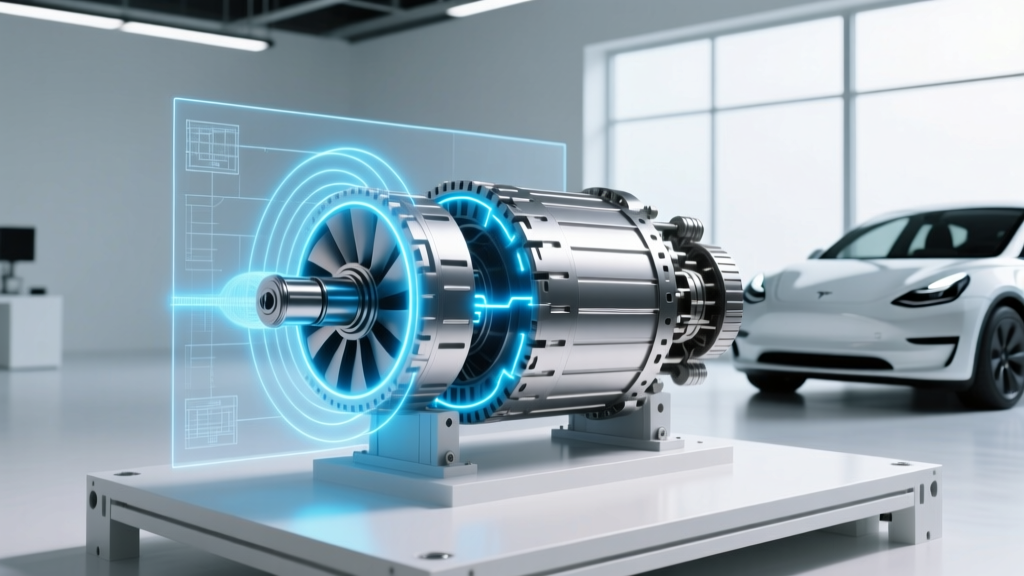
Tesla's dual-motor AWD vehicles pair a permanent-magnet synchronous reluctance motor (PMSRM) on one axle with an AC induction motor on the other. Rear-wheel-drive trims use a single PMSRM. The induction motor's key trick: it can freewheel with near-zero drag when not energized, which is why dual-motor Teslas coast so efficiently. The permanent-magnet motor delivers higher torque density and better low-speed efficiency. Together, they give Tesla a drivetrain that's both punchy and parseful.
| Spec | Model 3 RWD | Model 3 Long Range AWD | Model 3 Performance |
|---|---|---|---|
| EPA Range | 272 mi | 341 mi | 315 mi |
| Battery (usable) | ~57.5 kWh (LFP) | ~75 kWh (NMC) | ~75 kWh (NMC) |
| Motor Config | Single PMSRM (rear) | Induction (front) + PMSRM (rear) | Induction (front) + PMSRM (rear) |
| Horsepower | 271 hp | 346 hp | 510 hp |
| 0-60 mph | 5.8 sec | 4.2 sec | 2.9 sec |
| Drivetrain | RWD | AWD (Dual Motor) | AWD (Dual Motor) |
| MPGe (combined) | 132 MPGe | 134 MPGe | 115 MPGe |
| Efficiency | 25 kWh/100mi | 25 kWh/100mi | 29 kWh/100mi |
| Base MSRP | $38,990 | $44,990 | $52,990 |
Source: fueleconomy.gov and Tesla's official specifications. Pricing reflects 2026 model year MSRP before destination fees.
Real-World Range: What the EPA Sticker Doesn't Tell You
EPA sticker: 341 miles. Real-world expectation: ~280-310 miles at sustained highway speeds (70-80 mph) in moderate temperatures. In sub-30°F winter conditions without preconditioning, expect ~230-260 miles due to battery resistance and cabin heating load. City driving with heavy regenerative braking can match or slightly exceed the EPA number.
The Model 3's efficiency — roughly 25 kWh per 100 miles on the Long Range — is among the best in the segment. Tesla's thermal management system, which includes a heat pump standard on all trims, recovers waste heat from the AC motors and inverter to warm the cabin and battery. That heat pump is a major reason Tesla's cold-weather range loss (~20-25%) is less severe than some competitors that rely on resistive heating.
One nuance the spec sheet hides: the LFP battery in the RWD trim has a slightly different discharge curve than the NMC packs in Long Range and Performance models. LFP maintains voltage more steadily through the mid-range of its state of charge, which means range delivery feels linear. However, LFP cells are heavier per kWh, contributing to the RWD's lower total range despite a similar physical pack size.
Charging Speed: DC Fast Charge and Home Level 2
The AC motor doesn't charge the car — the onboard charger and DC fast-charge architecture do — but motor efficiency directly affects how far each kWh takes you once you're back on the road. Here's what you'll see at the plug:
| Charging Level | Max Power | Rate / Time | Connector |
|---|---|---|---|
| Level 1 (120V household) | ~1.4 kW | ~3-4 mi/hr | NACS (native) |
| Level 2 (240V home/work) | 11.5 kW (48A) | ~44 mi/hr | NACS (native) |
| DC Fast Charge (V3 Supercharger) | 250 kW peak | 10-80% in ~25 min | NACS (native) |
| DC Fast Charge (V4 Supercharger) | Up to 250 kW* | 10-80% in ~25 min | NACS (native) |
*Model 3 architecture caps at ~250 kW; higher V4 rates apply to Cybertruck and future 800V vehicles. Sustained rate tapers significantly above 60% SoC — expect ~50 kW average from 80-100%.
Tesla's NACS (North American Charging Standard) connector is now the industry standard adopted by Ford, GM, Rivian, Hyundai, and most other automakers. For Model 3 owners, this means native access to the Tesla Supercharger network — over 6,500 stations and 30,000+ stalls in North America as of early 2026 — without any adapter. This remains the single largest practical advantage Tesla retains: plug-in reliability at Superchargers consistently outpaces third-party CCS networks in uptime studies.
For home charging, a Tesla Wall Connector on a 60-amp circuit delivers the full 11.5 kW (48 amps continuous). That translates to roughly 44 miles of range per hour of charging — enough to replenish a full day's driving in about 2-3 hours. A typical Wall Connector installation (unit + electrician + permit) runs $800-$1,500 depending on panel proximity and local code. If your home has a 200-amp electrical panel with spare capacity, expect the lower end. Older 100-amp panels may require a $1,500-$3,000 service upgrade.
Performance: Where the AC Motor Earns Its Reputation
The dual-motor Model 3 Performance hits 60 mph in 2.9 seconds — supercar territory from a four-door sedan that seats five and starts under $53,000. That acceleration comes from the PMSRM on the rear axle, which delivers peak torque from 0 RPM, while the front induction motor adds all-wheel-drive traction and fills in the power band at higher speeds.
But the more impressive daily metric is the Long Range AWD's 4.2-second 0-60, which is faster than most V6 sport sedans and delivered with zero drivetrain lag. The AC induction front motor can disconnect magnetically when cruising, eliminating parasitic drag — this is why dual-motor Teslas often achieve better highway efficiency than you'd expect from an AWD vehicle.
Tesla's regenerative braking system, managed through the motor controllers, provides strong one-pedal driving in most conditions. The 2026 Model 3 offers adjustable regen strength through the touchscreen, and the system recovers energy back through the inverter to the battery at rates up to ~100 kW during aggressive deceleration.
Pricing, Tax Credits, and Total Cost
| Trim | Base MSRP | Destination | Est. Total | Federal Credit | Effective Price |
|---|---|---|---|---|---|
| RWD | $38,990 | $1,390 | $40,380 | Up to $7,500* | ~$32,880 |
| Long Range AWD | $44,990 | $1,390 | $46,380 | Up to $7,500* | ~$38,880 |
| Performance | $52,990 | $1,390 | $54,380 | Up to $7,500* | ~$46,880 |
*IRS §30D credit eligibility requires: buyer AGI ≤ $150K (single) / $300K (joint); vehicle MSRP ≤ $55,000 (sedans); battery critical-mineral and component sourcing thresholds met. Credit may be applied at point of sale as a down-payment reduction. Verify current-year rules at irs.gov. The Performance trim exceeds the $55K sedan MSRP cap and does NOT qualify for the new-vehicle credit as of 2026.
A critical detail often missed: the Model 3 Performance trim exceeds the $55,000 MSRP cap for sedans under §30D, making it ineligible for the new-vehicle federal credit. The RWD and Long Range trims fall under the cap. All trims may qualify for state and utility incentives, which vary by jurisdiction — check AFDC's state incentive database for your location.
The point-of-sale transfer option, available since 2024, lets you apply the federal credit directly as a purchase-price reduction at the dealer rather than waiting to claim it on your tax return. This effectively lowers your financed amount and monthly payment.
Interior, Cargo, and Daily Livability
The 2026 Model 3 "Highland" refresh (introduced late 2023, refined through 2025-2026) addressed the most common complaints of earlier models: cabin noise, ride harshness, and material quality. The current car is noticeably quieter at highway speed thanks to acoustic glass and improved door seals.
Cargo volume: 23 cu ft trunk (including under-floor storage) plus a 3.1 cu ft frunk. Total: ~26 cu ft. That's competitive with compact luxury sedans but less than a Model Y or Ioniq 5 hatchback.
Passenger space: Front legroom is generous at 42.3 inches. Rear legroom measures 35.3 inches — adequate for adults under 6 feet but tighter than a Hyundai Ioniq 6 or BMW i4. The panoramic glass roof creates an airy feel but offers no shade panel; aftermarket sunshades are a common $40 accessory in hot climates.
Infotainment: All controls route through a 15.4-inch center touchscreen — no physical instrument cluster, no stalk-mounted turn signals (they're on the steering wheel rim in the 2026 model, a change from the 2024 button-based design that drew widespread criticism). Navigation, media, climate, and vehicle settings are all screen-driven. Wireless phone mirroring is not supported; Tesla uses its own native apps for Spotify, Apple Music, and podcasts.
Driver Assistance: Autopilot and FSD Supervised
Tesla Autopilot and Full Self-Driving (Supervised) are Level 2 driver-assistance systems, not autonomous driving. The driver must remain attentive, keep hands on the wheel (or demonstrate attentiveness via cabin camera monitoring), and be prepared to take over instantly. Only Level 4 systems like Waymo's robotaxi operate without a human driver.
Standard Autopilot includes Traffic-Aware Cruise Control and Autosteer (lane-centering on divided highways). The optional FSD (Supervised) package — currently $8,000 or $99/month — adds automated lane changes, navigation-guided on/off-ramp handling, traffic light and stop sign recognition, and low-speed parking lot maneuvering.
In practice, FSD Supervised handles well-marked suburban and highway driving competently but requires active monitoring. Construction zones, faded lane markings, and complex unprotected left turns still demand frequent intervention. Tesla's vision-only approach (no lidar or radar) performs well in clear weather but can struggle in heavy rain, fog, or direct sun glare. NHTSA continues to monitor Tesla's ADAS through its standing general order on crash reporting.
- Drive you to a destination without supervision — you are the driver at all times
- Handle all weather conditions — heavy rain, snow, and fog degrade performance
- Replace attentive driving — NHTSA data shows ADAS misuse contributes to preventable crashes
- Transfer between owners at full value — the $8,000 FSD purchase is tied to the vehicle, not your account
Battery Chemistry, Warranty, and Longevity
The Model 3 RWD uses a lithium iron phosphate (LFP) battery — heavier than NMC but with a longer cycle life, lower fire risk, and no cobalt or nickel. Tesla recommends charging LFP to 100% at least weekly, which simplifies daily use compared to NMC's 80% daily recommendation.
The Long Range and Performance trims use NMC (nickel manganese cobalt) chemistry for higher energy density. These packs deliver more range in a similar physical footprint but degrade slightly faster over high-mileage, high-charge-cycle use.
Battery warranty: 8 years / 100,000 miles (RWD) or 8 years / 120,000 miles (Long Range/Performance), whichever comes first, with a guaranteed minimum 70% capacity retention. In practice, Tesla fleet data shows most Model 3 packs retain ~90% capacity at 100,000 miles, with degradation leveling off after the initial 10-15% loss in the first 20,000-30,000 miles.
Out-of-warranty battery replacement for a Model 3 runs approximately $12,000-$16,000 at a Tesla Service Center, based on current remanufactured pack pricing. This is a real but low-probability cost — the vast majority of packs outlast the vehicle's useful life.
Pros and Cons: The Honest Scorecard
Pros
- Class-leading efficiency (25 kWh/100mi) translates to lower charging costs
- Supercharger network access — best public charging reliability in the US
- Dual-motor AC induction + PMSRM combo delivers efficiency AND performance
- LFP battery option (RWD) offers long cycle life and 100% daily charging
- Over-the-air updates continuously add features and improve performance
- Strong resale value relative to most EV competitors
- Heat pump standard — better cold-weather range retention
Cons
- Turn signal buttons on steering wheel rim remain polarizing vs traditional stalks
- No Apple CarPlay or Android Auto — Tesla-only infotainment ecosystem
- Rear seat legroom (35.3 in) is tight for tall adults on long trips
- FSD (Supervised) is expensive ($8K) and still requires full driver attention
- Performance trim loses federal tax credit eligibility (MSRP cap)
- Service center wait times can stretch to weeks in some metro areas
- Glass roof with no built-in shade — hot in summer sun
Who Should Buy the 2026 Model 3?
Choose the Model 3 Long Range AWD if: You take regular road trips over 200 miles, live in a cold-weather state where the heat pump and AWD matter, and want the best balance of range, efficiency, and tax-credit eligibility.
Choose the Model 3 Performance if: You prioritize acceleration and handling above all else, accept the higher price without a federal credit, and want a daily-driver that embarrasses sports cars at stoplights.
Look elsewhere if: You need maximum rear-seat space (consider Model Y or Ioniq 5), want Apple CarPlay (consider Hyundai/Kia/BMW), or need a sub-$30K price point (consider the used EV market with the §25E credit).
Frequently Asked Questions
What type of AC motor does Tesla use?
Tesla uses two AC motor types: a permanent-magnet synchronous reluctance motor (PMSRM) for the rear axle, and an AC induction motor for the front axle in dual-motor configurations. Single-motor RWD models use only the PMSRM. Both are AC motors powered by a DC battery through an inverter.
Why does Tesla use an induction motor on the front axle?
An AC induction motor can spin freely with near-zero electromagnetic drag when not powered. This means during highway cruising, the front motor disengages completely, eliminating parasitic losses. A permanent-magnet motor, by contrast, always generates some cogging torque. The induction motor's freewheel capability is a key reason Tesla's dual-motor AWD vehicles achieve such strong highway efficiency.
What is the real-world range of the 2026 Model 3?
The EPA rates the Long Range AWD at 341 miles. In real-world highway driving at 70-80 mph in moderate temperatures, expect 280-310 miles. In winter (below 30°F), plan for 230-260 miles without preconditioning. City driving with regen braking can approach or slightly exceed the EPA figure.
How fast does the Model 3 charge at home and on the road?
At home on a 240V Level 2 charger (48A), the Model 3 adds ~44 miles of range per hour at 11.5 kW. On a V3 Supercharger, it peaks at 250 kW and charges from 10-80% in approximately 25 minutes. Expect a full charge (10-100%) to take ~35-40 minutes due to taper above 80%.
Does the 2026 Model 3 qualify for the federal EV tax credit?
The RWD ($38,990) and Long Range AWD ($44,990) qualify for up to $7,500 under IRS §30D, provided the buyer meets income caps ($150K single / $300K joint AGI) and the battery meets critical-mineral and component sourcing requirements. The Performance trim ($52,990 + destination) exceeds the $55,000 sedan MSRP cap and does not qualify. Always verify current rules at irs.gov.
Is the Model 3 worth buying vs. competitors like the Ioniq 6 or BMW i4?
The Model 3 Long Range offers the best efficiency-to-price ratio in its segment and unmatched Supercharger access. The Hyundai Ioniq 6 offers more rear-seat room, Apple CarPlay, and faster 800V charging (~18 min 10-80%). The BMW i4 delivers a more traditional luxury interior and driving dynamics but at a higher price and with less range. If Supercharger reliability and efficiency top your priorities, the Model 3 remains the benchmark.
How long will the Tesla Model 3 battery last?
Tesla warranties the battery for 8 years / 100,000-120,000 miles (depending on trim) with a minimum 70% capacity retention guarantee. Fleet data suggests most Model 3 batteries retain ~90% capacity at 100,000 miles. LFP packs (RWD trim) are expected to outlast NMC packs in total cycle life. Out-of-warranty replacement costs $12,000-$16,000 but is rarely needed within typical ownership periods.