If you need three rows of seating from Tesla in 2026, you have exactly two options: the refreshed Model Y with an optional third row, and the flagship Model X. Both carry the "Tesla 7 seater" label, but they serve very different buyers — one is a compact crossover stretching to fit occasional extra passengers, the other is a full-size SUV built around seven-adult capacity. This guide breaks down every number that matters: EPA range, real-world highway and cold-weather expectations, DC fast-charging curves, interior dimensions, and the actual out-of-pocket cost after federal tax credits.
At a Glance: Tesla 7 Seater Specs Compared
| Spec | Model Y Long Range AWD (7-seat) | Model X Long Range (7-seat) |
|---|---|---|
| EPA Range | 300 mi (est. with 3rd row) | 335 mi |
| Battery (usable) | ~75 kWh, NMC | ~95 kWh, NMC |
| Drivetrain | Dual-Motor AWD | Dual-Motor AWD |
| Horsepower | 384 hp | 670 hp |
| 0–60 mph | 4.8 sec | 3.8 sec |
| Peak DC Charge | 250 kW | 250 kW |
| 10–80% DC Time | ~25 min | ~32 min |
| Level 2 Rate | 11.5 kW (~44 mi/hr) | 11.5 kW (~34 mi/hr) |
| Efficiency | 122 MPGe / 28 kWh/100mi | 102 MPGe / 33 kWh/100mi |
| Cargo (behind 3rd row) | ~12 cu ft | ~15 cu ft |
| Cargo (max, seats folded) | ~72 cu ft | ~82 cu ft |
| Base MSRP (7-seat) | ~$50,490 | ~$81,630 |
| Battery Warranty | 8 yr / 120,000 mi | 8 yr / 150,000 mi |
Real-World Range: What the EPA Sticker Doesn't Tell You
Model Y Long Range AWD (7-seat): EPA 300 mi (est.). Expect ~255–275 mi on highway road trips at 70+ mph; ~220–240 mi in sub-freezing winter conditions with cabin heat.
Model X Long Range: EPA 335 mi. Expect ~280–300 mi highway; ~240–265 mi in cold weather.
The 7-seat option in the Model Y adds ~50 lbs and slightly reduces range vs. the 5-seat configuration. Aerodynamic drag from a loaded roof rack or trailer will further reduce range by 10–20%.
Tesla's EPA range figures assume a mix of city and highway driving at moderate temperatures. In sustained highway use — the most common road-trip scenario — both vehicles consume more energy per mile than their stickers suggest. The Model Y's smaller 75 kWh battery means fewer total electrons, but its lighter curb weight and lower drag coefficient help it punch above its capacity. The Model X carries a larger 95 kWh pack, giving it a buffer advantage on long, cold drives where battery preconditioning and cabin heating draw significant power.
For context, a 300-mile highway drive in a Model Y 7-seater at 75 mph in 40°F weather will likely require one DC fast-charging stop. The Model X can stretch that same trip without stopping, but only if you leave with a full charge and drive conservatively.
Charging Speed: DC Fast, Level 2, and the Curve Reality
| Charge Level | Model Y LR AWD | Model X LR |
|---|---|---|
| Level 1 (120V / 12A) | ~1.4 kW — ~4 mi/hr | ~1.4 kW — ~3 mi/hr |
| Level 2 (240V / 48A) | 11.5 kW — ~44 mi/hr | 11.5 kW — ~34 mi/hr |
| DC Fast (peak) | 250 kW | 250 kW |
| DC Fast 10–80% | ~25 min | ~32 min |
| DC Fast 10–50% | ~12 min | ~15 min |
Both Teslas peak at 250 kW on V3 Superchargers, but peak is not sustained. The charge curve tapers significantly above 50% state of charge. The Model Y's smaller battery reaches 80% faster in absolute minutes, but the Model X adds more miles per minute of charging due to its higher efficiency at low state of charge. On a road trip, plan your stops around the 10–50% window — that's where you'll gain 100–130 miles in roughly 12–15 minutes.
At home on a 48-amp Level 2 circuit (requiring a 60-amp breaker), the Model Y adds roughly 44 miles of range per hour of charging, while the Model X adds about 34 miles per hour. Both will fully recharge overnight in 7–9 hours. If your home electrical panel only supports a 40-amp circuit (32A continuous), expect roughly 30 mi/hr for the Model Y and 23 mi/hr for the Model X — still sufficient for most daily driving.
Interior Space: Third-Row Reality and Cargo Trade-Offs
The Model Y's optional third row is best understood as a 5+2 configuration: two small, rear-facing seats suitable for children or short-trip passengers under about 5'4". Third-row legroom measures roughly 26.5 inches — tight even by compact-crossover standards. With the third row upright, cargo space behind it drops to approximately 12 cubic feet, enough for a couple of grocery bags or a small stroller but not much more. Fold the third row flat and you recover a useful cargo floor; fold both rear rows and you get up to 72 cubic feet.
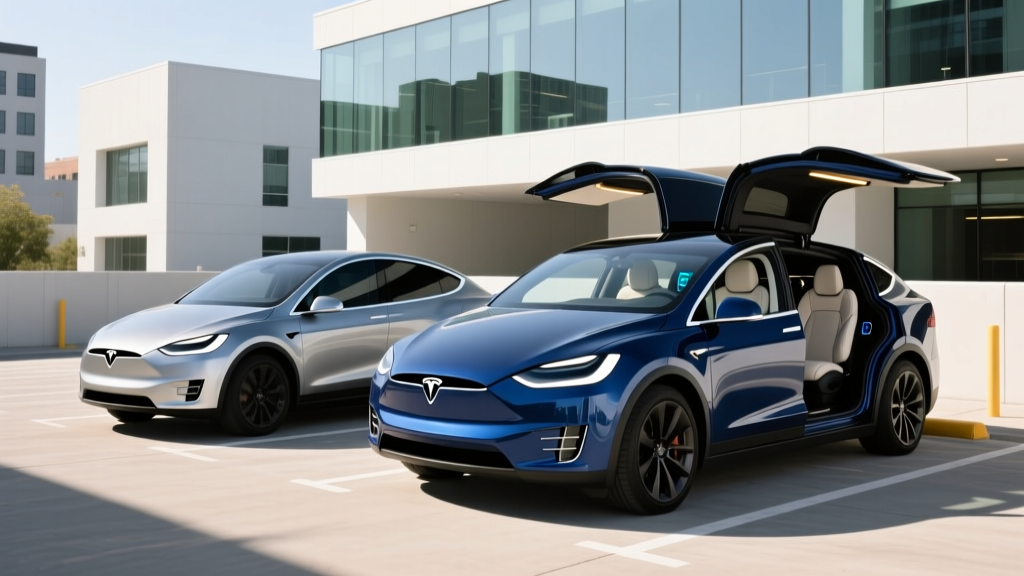
The Model X is a genuinely different proposition. Its third row offers approximately 32.7 inches of legroom — enough for average-height adults on moderate-length trips. The second row features three individual captain's-style seats with fore/aft adjustment, a significant advantage for car-seat installation and passenger comfort. Cargo behind the third row is roughly 15 cubic feet, expanding to 82 cubic feet with all rear seats folded. The Model X also includes a front trunk (frunk) of about 6.7 cubic feet, adding practical storage the Model Y's 7-seat configuration largely sacrifices.
For families regularly hauling more than five people, the Model X is the only Tesla 7 seater that doesn't compromise daily usability. The Model Y's third row works best as an occasional overflow option for carpools or visiting relatives.
Pricing, Trims, and Federal Tax Credit Eligibility
| Model Y LR AWD (7-seat) | Model X LR (7-seat) | |
|---|---|---|
| Base MSRP | ~$49,990 + $2,500 3rd-row = ~$52,490 | ~$81,630 (3rd row std on some configs; +$4,000 on others) |
| As-Tested (typical w/ FSD, wheels) | ~$58,000–$62,000 | ~$92,000–$100,000 |
| Federal §30D Credit Eligible? | Yes (up to $7,500) | No — exceeds MSRP cap |
| Effective Price After Max Credit | ~$44,990 | ~$81,630 (no credit) |
The IRS §30D clean vehicle credit offers up to $7,500 for qualifying new EVs, but it comes with strict requirements: the vehicle MSRP must not exceed $80,000 for SUVs, the buyer's modified adjusted gross income must fall below $300,000 (joint) / $225,000 (head of household) / $150,000 (individual), and the battery must meet critical-mineral and battery-component sourcing thresholds that tighten each year. The Model Y comfortably clears the MSRP cap and has historically qualified for the full credit when sourcing requirements are met. The Model X, with an MSRP above $80,000 in virtually every 7-seat configuration, does not qualify for the federal credit. This creates a price gap far wider than the sticker numbers suggest.
The credit can now be transferred to the dealer at point of sale, reducing your out-of-pocket cost at purchase rather than waiting for a tax refund. Always verify current-year eligibility on the fueleconomy.gov credit lookup tool before committing, as battery-sourcing rules change annually and can disqualify a previously eligible vehicle mid-year.
Performance, Efficiency, and Daily Driving
The Model Y Long Range AWD produces 384 horsepower from its dual-motor setup, reaching 60 mph in 4.8 seconds. That's brisk by any family-vehicle standard and more than adequate for highway merging and passing. Efficiency is rated at approximately 122 MPGe combined (28 kWh/100 miles), making it one of the most efficient 7-seat vehicles on the market regardless of powertrain type.
The Model X Long Range delivers 670 horsepower and a 3.8-second 0–60 time — supercar-rivaling acceleration in a three-row SUV. The trade-off is efficiency: 102 MPGe combined (33 kWh/100 miles). Over 15,000 annual miles, that difference translates to roughly 750 additional kWh consumed per year in the Model X, or about $100–$150 in extra electricity costs depending on your local rates.
Both vehicles include Tesla's heat pump as standard, which significantly reduces cold-weather range loss compared to resistive heating. Both also feature regenerative braking with one-pedal driving capability, reducing brake wear in stop-and-go commuting.
Technology, Driver Assistance, and Drawbacks
Both vehicles ship with Tesla's 15.4-inch (Model Y) or 17-inch (Model X) central touchscreen running Tesla's proprietary infotainment OS. Features include built-in navigation with real-time Supercharger routing, streaming media, a phone-as-key system, and over-the-air software updates that regularly add functionality. The Model X adds a rear-seat 8-inch touchscreen for climate and entertainment control — a meaningful upgrade for third-row passengers.
Tesla's Autopilot driver-assistance suite (Traffic-Aware Cruise Control and Autosteer) is standard. Full Self-Driving (Supervised) — which adds automated lane changes, city-street navigation, and traffic-light recognition — remains an expensive add-on (approximately $8,000 or $99/month) and is classified as SAE Level 2. The driver must remain fully engaged, hands on the wheel, eyes on the road. This is not autonomous driving.
- Model Y 3rd row: Extremely tight legroom; no dedicated climate vents for third-row passengers; cargo space nearly eliminated when seats are up.
- Model X: High purchase price with no federal tax credit; Falcon Wing rear doors can be slow to open in tight parking spaces and have historically been a reliability concern.
- Both: No Apple CarPlay or Android Auto; no physical instrument cluster (all info on central screen); panel-gap quality varies between vehicles; insurance premiums run 15–30% higher than comparable non-Tesla EVs.
Who Should Buy a Tesla 7 Seater?
- You primarily carry 5 or fewer passengers and need a third row only occasionally (carpool, visiting family)
- Budget is a priority — the post-tax-credit price is roughly $35,000–$40,000 less than a Model X
- You value efficiency and lower charging costs
- Your daily commute is under 60 miles round-trip
Choose the Model X 7-seat if:
- You regularly transport 6–7 adults or older children
- You need usable cargo space behind the third row simultaneously
- You want the performance, towing capacity (5,000 lbs vs. 3,500 lbs), and prestige of a flagship SUV
- The $80,000+ price and lack of federal tax credit fit your budget
How Does It Compare to Key Competitors?
Against the Kia EV9 (3-row, 300 mi EPA, starting ~$56,000, §30D eligible), the Model Y 7-seat wins on efficiency and Supercharger network access but loses on third-row comfort and interior material quality. The EV9's third row is meaningfully more spacious and practical for regular use.
Against the Rivian R1S (3-row, ~340 mi EPA with Max Pack, starting ~$80,000, §30D eligible on certain trims), the Model X competes on performance and software but the R1S offers superior off-road capability, more traditional interior ergonomics, and a more usable third row. Rivian's build quality and customer satisfaction scores have been strong.
Against plug-in hybrid alternatives like the Toyota Grand Highlander Hybrid (~36 MPG combined, 3 rows, ~$45,000), the Tesla 7-seaters offer lower per-mile fuel costs and zero tailpipe emissions but at a higher purchase price and with charging-infrastructure dependency. For families without reliable home charging access, the PHEV remains a compelling middle ground.
Frequently Asked Questions
What is the real-world range of the Tesla Model Y 7 seater?
The EPA rates the 2026 Model Y Long Range AWD at approximately 300 miles (est. with the third-row option). In real-world highway driving at 70–75 mph, expect 255–275 miles. In cold weather (below 32°F), plan for 220–240 miles due to increased cabin heating demand and reduced battery efficiency. Preconditioning the battery while plugged in before departure recovers some of this loss.
How fast does the Tesla 7 seater charge at home and on the road?
On a V3 Supercharger (250 kW peak), both the Model Y and Model X charge from 10–80% in approximately 25 and 32 minutes, respectively. At home on a 48-amp Level 2 charger, the Model Y gains ~44 miles of range per hour and the Model X gains ~34 miles per hour. Both fully recharge overnight in 7–9 hours.
Does the Tesla 7 seater qualify for the $7,500 federal tax credit?
The Model Y qualifies for up to $7,500 under IRS §30D, provided the buyer meets income thresholds (under $300,000 joint / $150,000 individual) and the vehicle meets current-year battery-sourcing requirements. The Model X does not qualify because its MSRP exceeds the $80,000 SUV cap. Always verify eligibility on fueleconomy.gov and consult a tax professional before relying on the credit.
Is the Model Y third row practical for adults?
No. The Model Y's third row is designed for children or very short adults on brief trips. Legroom is approximately 26.5 inches, and headroom is limited by the sloping roofline. For regular adult passengers in the third row, the Model X or a competitor like the Kia EV9 is a far better choice.
What is the battery warranty on Tesla 7 seater models?
Tesla covers the Model Y battery and drive unit for 8 years or 120,000 miles, whichever comes first, with a minimum 70% capacity retention guarantee. The Model X battery and drive unit are covered for 8 years or 150,000 miles under the same terms. Real-world degradation data from Tesla's fleet suggests most packs retain 85–90% capacity after 100,000 miles.
Is Tesla Autopilot or FSD self-driving?
No. Both Autopilot and Full Self-Driving (Supervised) are SAE Level 2 driver-assistance systems. The driver must remain fully attentive, with hands on the steering wheel and eyes on the road, at all times. The system can assist with steering, acceleration, and braking but cannot handle all driving scenarios independently.