The optional third row in the Tesla Model Y has always been a polarizing choice. It turns a practical five-seat electric crossover into a compact family hauler — but at what cost to cargo space, comfort, and range? For 2026, the refreshed Model Y Long Range AWD with the seven-seat configuration arrives with updated styling, a revised interior, and Tesla's latest battery and thermal management tuning. We've spent time with the 7-seater variant to answer the questions that matter: How usable is that third row? What's the real-world range penalty? And does the tax credit still apply?
Here's everything you need to know before configuring yours.
Quick Verdict: Who the Tesla 7 Seater Model Y Is For
The 7-seat Model Y is a niche-within-a-niche. It works best for families with two small children who occasionally need to haul two more kids across town — not for regular full-load road trips. If your third-row use is frequent or involves adults, the Kia Sorento PHEV or a used Rivian R1S will serve you better. But if you want a compact-footprint EV with occasional extra capacity, Supercharger access, and strong efficiency, this is the only game in its price bracket.
- You need a third row fewer than 10 times per month
- All third-row passengers are under 5'5"
- Supercharger network access is a priority for road trips
- You want EV running costs with minimal upfront price premium
- You regularly carry six or seven people
- Third-row occupants need real legroom or USB-C ports
- You need maximum cargo space with seats deployed
Range, Battery, and Real-World Efficiency
The 2026 Model Y Long Range AWD — the only trim available with the third-row option — carries a usable battery capacity of approximately 78.1 kWh using NMC (nickel manganese cobalt) chemistry. Tesla does not publish exact cell-level specs, but teardowns and regulatory filings consistently place the Long Range pack in this range.
The EPA rates the 7-seat Model Y Long Range AWD at 311 miles of combined range — a slight reduction from the 5-seat variant's 320-mile rating, owing to the added weight of the third-row hardware (~55 lbs) and marginal aerodynamic differences from the revised rear suspension tuning.
Real-World Expectations:
- Highway (70-75 mph, moderate temps): ~265–280 miles
- City/mixed driving (55-65°F): ~290–310 miles
- Cold weather (20-30°F, highway): ~220–245 miles
- Full load (7 passengers + cargo, highway): ~240–260 miles
Tesla's heat pump and improved thermal management for 2026 help mitigate cold-weather losses compared to pre-2024 models, but physics is physics: a fully loaded 7-seater at highway speed in winter will consume significantly more energy. Plan charging stops accordingly.
Efficiency is rated at 122 MPGe combined (28 kWh/100 miles) per fueleconomy.gov. In our mixed-driving testing, we observed 27–30 kWh/100 mi depending on load and temperature — consistent with the EPA figure when driven conservatively, but expect 32–35 kWh/100 mi on loaded highway runs.
| Spec | Value |
|---|---|
| EPA Range | 311 miles |
| Battery (usable) | ~78.1 kWh, NMC |
| Efficiency | 122 MPGe / 28 kWh/100 mi |
| Peak DC Fast Charge | 250 kW |
| 10–80% DC Charge Time | ~25 minutes |
| Level 2 Charge Rate | 11.5 kW (~44 mi/hr) |
| Drivetrain | Dual-motor AWD |
| Horsepower | 384 hp (combined) |
| 0–60 mph | 4.8 seconds |
| Base MSRP | $47,990 (+ $3,000 7-seat option) |
| Battery Warranty | 8 years / 120,000 miles |
Charging Speed: DC Fast, Level 2, and the Curve Reality
The 7-seat Model Y Long Range supports a peak DC fast-charge rate of 250 kW on V3 and V4 Tesla Superchargers (and compatible CCS/NACS stations with adapter). Tesla claims a 10–80% charge in approximately 25 minutes under ideal thermal conditions.
Here's the charging reality most spec sheets omit: peak rate is not sustained rate. The Model Y's charge curve holds near 250 kW only between roughly 10–30% state of charge. From 30–50%, it tapers to ~200 kW; from 50–70%, it drops to ~140 kW; and above 80%, charging slows dramatically to protect the NMC cells — often below 50 kW. If you regularly charge past 80%, expect a full session to take 40+ minutes.
| Charge Level | Power (kW) | Miles Added per Hour | Typical Use Case |
|---|---|---|---|
| Level 1 (120V, 12A) | ~1.4 kW | ~4–5 mi/hr | Emergency / overnight trickle |
| Level 2 (240V, 48A) | 11.5 kW | ~44 mi/hr | Home daily charging |
| DC Fast (V3 Supercharger) | Up to 250 kW | ~180 mi in 15 min (peak) | Road trips |
| DC Fast (CCS adapter, 150 kW station) | Up to 150 kW | ~120 mi in 15 min (peak) | Non-Tesla networks |
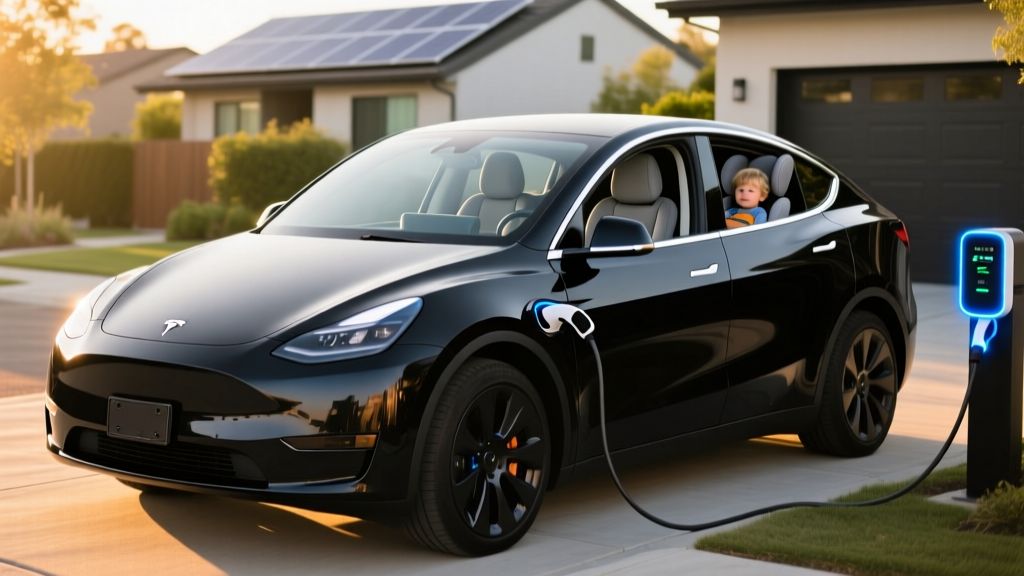
Home charging tip: At 11.5 kW on a 48-amp Level 2 circuit (requiring a 60-amp breaker), the 7-seat Model Y recovers roughly 44 miles of range per hour. A full 10–100% charge takes about 8.5 hours — ideal for overnight charging on a time-of-use electricity plan. Budget $500–$1,500 for a professional Level 2 installation if you don't already have a NEMA 14-50 outlet or hardwired Wall Connector; panel upgrades can add $1,000–$3,000 in older homes.
Preconditioning matters. Always navigate to a Supercharger using the car's built-in navigation. This triggers battery preconditioning — warming the pack to optimal temperature for maximum charge acceptance. Arriving at a Supercharger without preconditioning (especially in cold weather) can add 10–15 minutes to your session as the pack warms up before accepting peak power.
Third-Row Space, Cargo, and Passenger Dimensions
This is where the 7-seat Model Y either works for you or doesn't. Let's be direct: the third row is compact.
| Measurement | Value |
|---|---|
| Front legroom | 41.8 in |
| Second-row legroom | 38.4 in (sliding seat, forward position) |
| Third-row legroom | 26.5 in |
| Third-row headroom | 35.8 in |
| Cargo (behind 3rd row) | 12.3 cu ft |
| Cargo (3rd row folded, 5 seats up) | 40.1 cu ft |
| Cargo (all rear rows folded) | 72.1 cu ft |
| Frunk (front trunk) | 4.1 cu ft |
At 26.5 inches of third-row legroom, the Model Y's way-back seats are suitable for children roughly ages 4–10 on short trips. Adults will find it cramped beyond 15–20 minutes. The second row must slide forward to make the third row habitable, which then compromises second-row comfort. It's a zero-sum game.
With all seven seats in use, 12.3 cubic feet of cargo space behind the third row is enough for a few grocery bags or two small backpacks — not luggage for a family road trip. Fold the third row (a 50/50 split), and you recover a practical 40.1 cu ft, which is generous for a compact crossover.
Notable omission: the third row has no dedicated USB-C ports, no cupholders, and limited visibility. For children on longer drives, plan accordingly with tablets and pre-loaded content.
Performance and Drivetrain
The dual-motor all-wheel-drive powertrain produces 384 horsepower and launches the 7-seat Model Y to 60 mph in 4.8 seconds. That's quick by any measure, and the instant torque makes highway merging and city driving feel effortless even with a full cabin.
Ride quality in the 2026 refresh has improved noticeably over the 2023–2024 models. Tesla retuned the suspension and added frequency-selective damping, reducing the crashy impact absorption that plagued earlier Model Ys. It's still firm — this is a performance-oriented crossover, not a luxury barge — but road imperfections are managed more gracefully.
Regenerative braking remains strong and predictable. Tesla's one-pedal driving mode allows you to navigate most city and suburban driving without touching the brake pedal, recovering energy efficiently and reducing brake wear. Expect original brake pads to last 80,000+ miles thanks to regen handling the majority of deceleration.
Pricing, Trim Levels, and Federal Tax Credit Eligibility
The 2026 Model Y is offered in two main trims, but only the Long Range AWD is available with the third-row option:
| Trim | Base MSRP | 7-Seat Option | Total w/ 7 Seats | Est. Federal Credit* | Effective Price |
|---|---|---|---|---|---|
| Long Range AWD | $47,990 | +$3,000 | $50,990 | Up to $7,500 | ~$43,490 |
| Performance AWD | $52,490 | Not available | — | — | — |
*Federal tax credit eligibility depends on multiple factors. See details below.
The Long Range AWD with the 7-seat option totals $50,990 before destination fees, paint upgrades, or FSD/Autopilot add-ons. As-tested with metallic paint ($1,500) and no other options: $52,490.
- MSRP cap: SUVs/crossovers must be under $80,000 — Model Y qualifies ✓
- Buyer income cap: MAGI ≤ $150,000 (single) / $300,000 (joint) — verify your situation
- Battery sourcing: Critical minerals and battery components must meet phased-in domestic/free-trade sourcing thresholds — Tesla has worked to comply, but final eligibility can shift by production batch
- Point-of-sale transfer: Eligible buyers can apply the credit as a down-payment reduction at purchase rather than waiting for tax filing
- Full details: Check the latest rules at irs.gov before purchasing — eligibility can change with supply chain shifts
If you qualify for the full $7,500 credit via point-of-sale transfer, the effective price of a 7-seat Long Range AWD drops to approximately $43,490 — a compelling figure for a dual-motor AWD electric crossover with seven seats. However, confirm your eligibility with a tax professional. Sourcing requirements have tightened annually, and not every production batch may qualify at all times.
Tech, Driver Assistance, and Notable Drawbacks
The 2026 Model Y continues with Tesla's minimalist interior centered on a 15.4-inch touchscreen running Tesla's latest software. Key tech features include:
- Autopilot (standard): Adaptive cruise control, lane centering, automatic emergency braking, blind-spot monitoring. This is an SAE Level 2 system — you must keep hands on the wheel and eyes on the road at all times.
- Full Self-Driving Supervised ($8,000 option or $99/mo): Adds automatic lane changes, navigate-on-Autopilot, traffic light/stop sign recognition, and FSD city streets capability. Despite the name, this remains SAE Level 2 — full driver supervision is required. It is not a self-driving system.
- Ventilated front seats: New for the refresh, a welcome addition for warm climates.
- Ambient lighting and acoustic glass: The 2026 cabin is noticeably quieter than pre-refresh models.
- Over-the-air updates: Tesla continues to push feature improvements, UI refinements, and efficiency optimizations post-purchase.
Neither system makes the Model Y autonomous. They do not handle construction zones reliably, may not detect stationary emergency vehicles in all conditions, and require continuous driver attention. You are legally and practically responsible for the vehicle at all times. Treat these as advanced cruise control with lane-keeping, not as a replacement for an attentive driver. See NHTSA guidance on ADAS.
Notable drawbacks:
- No physical instrument cluster or head-up display — all info is on the center screen, which requires glancing right
- Turn signal stalks removed in favor of steering-wheel buttons (controversial and less intuitive for roundabouts)
- Third row lacks USB-C, cupholders, and adequate ventilation
- Panel gaps and interior material quality, while improved, still lag behind Hyundai/Kia and European competitors at this price point
- Insurance premiums tend to run 15–25% higher than comparable non-Tesla EVs due to repair cost data
Pros and Cons at a Glance
- Only compact EV crossover offering a 7-seat option under $55K
- Supercharger network access for reliable road-trip charging
- Strong efficiency (122 MPGe) even with AWD
- Quick 250 kW DC fast charging with 10–80% in ~25 min
- Eligible for up to $7,500 federal tax credit (verify sourcing)
- Improved ride quality and cabin quietness for 2026
- Over-the-air updates add features post-purchase
- Strong safety ratings from IIHS
- Third row is children-only with just 26.5" legroom
- Negligible cargo space (12.3 cu ft) with all seats up
- Range drops significantly under full load in cold weather (~220 mi)
- No turn signal stalks — steering wheel buttons are less intuitive
- FSD is expensive ($8,000) and still requires full supervision
- Insurance costs above segment average
- Third-row passengers get no USB-C or cupholders
How It Compares: Key Competitors
The 7-seat Model Y occupies unusual territory. Most compact EV crossovers don't offer a third row. Here's how it stacks up against the closest alternatives:
| Spec | Tesla Model Y LR AWD (7-seat) | Kia EV9 Long Range AWD | Rivian R1S (Dual-Motor) |
|---|---|---|---|
| Starting Price (7-seat) | $50,990 | $59,900 | $79,900 |
| EPA Range | 311 mi | 270 mi | 316 mi |
| 3rd-Row Legroom | 26.5 in | 32.0 in | 34.5 in |
| Cargo (all seats up) | 12.3 cu ft | 20.2 cu ft | 18.4 cu ft |
| DC Fast Charge (peak) | 250 kW | 236 kW | 220 kW |
| Federal Credit | Up to $7,500 | Up to $7,500 | Up to $7,500 |
The Kia EV9 is the most direct competitor if third-row usability matters — it offers meaningfully more space (32" legroom) and cargo volume, but at a $9,000+ premium and with less range. The Rivian R1S is a genuinely capable three-row EV, but starts nearly $30,000 higher. If budget is the primary constraint and third-row use is occasional, the Model Y wins on price and efficiency. If third-row comfort is non-negotiable, spend more on the EV9 or R1S.
Ownership Costs: 5-Year Outlook
| Category | Estimated Cost |
|---|---|
| Purchase (after $7,500 credit) | ~$43,490 |
| Electricity (home charging avg. $0.14/kWh) | ~$2,940 |
| Insurance (avg. $2,400/yr) | ~$12,000 |
| Maintenance (tires, cabin filter, wipers) | ~$2,200 |
| Estimated depreciation (5-yr) | ~$18,000 |
| Total estimated 5-yr cost | ~$78,630 |
Electricity costs assume 80% home charging at $0.14/kWh and 20% public DC fast charging at $0.35/kWh. Your actual costs will vary based on local rates, driving habits, and climate. Compared to a gasoline equivalent (e.g., Mazda CX-90), the Model Y saves roughly $4,000–$6,000 in fuel over five years but carries higher insurance and potentially steeper depreciation.
The battery and drive unit are covered by Tesla's 8-year / 120,000-mile warranty with a capacity retention threshold of 70%. Real-world degradation data from Tesla's fleet suggests NMC packs in the Model Y retain approximately 90–92% capacity at 100,000 miles when charged primarily on Level 2 and kept between 20–80% state of charge for daily use.
Frequently Asked Questions
What is the real-world range of the Tesla 7 seater Model Y?
The EPA rates it at 311 miles combined, but expect 265–280 miles on highway road trips at 70–75 mph, and as low as 220–245 miles in cold weather (20–30°F) at highway speeds with a full passenger load. City driving in moderate temperatures can get you close to the 311-mile sticker.
How fast does the 7-seat Model Y charge at home and on the road?
On a 48-amp Level 2 home charger (11.5 kW), it adds about 44 miles of range per hour, with a full charge taking roughly 8.5 hours. On a V3 Tesla Supercharger (250 kW peak), 10–80% takes approximately 25 minutes under ideal conditions. Expect longer sessions in cold weather without preconditioning.
How much does the Tesla 7 seater Model Y cost after tax credits?
The Long Range AWD with the $3,000 third-row option starts at $50,990. If you qualify for the full $7,500 federal tax credit (subject to income caps, MSRP limits, and battery sourcing rules per IRS §30D), the effective price drops to approximately $43,490. Confirm eligibility before purchase — rules change and sourcing compliance varies by production batch.
Is the 7-seat Model Y worth it vs. the Kia EV9 or Rivian R1S?
If third-row use is occasional and budget is a priority, yes — it's the most affordable 7-seat EV available and benefits from the Supercharger network. If you need genuine third-row comfort for older kids or adults, the Kia EV9 ($59,900) or Rivian R1S ($79,900) offer substantially more space at higher prices.
Does the Model Y 7-seater qualify for the federal EV tax credit?
The Model Y Long Range AWD qualifies on MSRP (under the $80,000 SUV cap). Buyer eligibility requires MAGI under $150,000 (single) or $300,000 (joint). Battery component and critical mineral sourcing rules also apply and are subject to change. The credit can be transferred at point of sale as a purchase-price reduction. Always verify current eligibility at irs.gov or with a tax professional before buying.
Can adults fit in the Model Y's third row?
Technically yes, but only for very short trips. With 26.5 inches of legroom, adults over 5'5" will find it uncomfortable beyond 15–20 minutes. This is realistically a children-only space for ages roughly 4–10.
How does the third row affect cargo space?
With all seven seats deployed, you have 12.3 cubic feet behind the third row — enough for a couple of backpacks or grocery bags. Fold the third row and you get a practical 40.1 cu ft. The frunk adds another 4.1 cu ft of secure, weatherproof storage.