The Tesla 7-Passenger Landscape in 2026
If you need three rows from Tesla, you have exactly two options: the compact Model Y Long Range with its optional third-row seat ($3,000 add-on), or the full-size Model X, which offers standard seating for up to seven. Both are compelling family haulers, but they serve fundamentally different budgets and use cases. The Model Y 7-seat config maxes out at tight third-row space best suited for kids, while the Model X delivers genuine adult-capable rear seating and falcon-wing doors that make car-seat loading dramatically easier. Below, we break down everything a family buyer needs to know — from real-world range and charging curves to cargo dimensions and 2026 federal tax credit eligibility under IRS §30D.
Side-by-Side Specs: Model Y 7-Seat vs Model X
| Spec | 2026 Model Y Long Range AWD (7-seat) | 2026 Model X Long Range |
|---|---|---|
| EPA Range | 311 miles | 335 miles |
| Battery (usable) | ~75 kWh, NMC | ~95 kWh, NMC |
| Drivetrain | Dual-Motor AWD | Dual-Motor AWD |
| Horsepower | 384 hp | 670 hp |
| 0-60 mph | 4.8 seconds | 3.8 seconds |
| Max DC Fast Charge | 250 kW peak | 250 kW peak |
| 10-80% DC Time | ~27 minutes | ~32 minutes |
| Level 2 (11.5 kW) | ~44 miles/hr | ~44 miles/hr |
| EPA Efficiency | 122 MPGe (28 kWh/100mi) | 104 MPGe (32 kWh/100mi) |
| Cargo (all rows up) | 12.8 cu ft | 15.8 cu ft |
| Cargo (3rd row down) | 34.3 cu ft | 40.2 cu ft |
| Cargo (max) | 72.0 cu ft | 81.5 cu ft |
| 3rd-Row Legroom | 26.5 inches | 32.7 inches |
| Base MSRP | $49,990 + $3,000 3rd-row = $52,990 | $79,990 |
| Warranty (Battery) | 8 yr / 120,000 mi | 8 yr / 150,000 mi |
| Warranty (Vehicle) | 4 yr / 50,000 mi | 4 yr / 50,000 mi |
Sources: fueleconomy.gov, Tesla spec sheets (2026 model year). Real-world figures may vary based on driving conditions.
Real-World Range: What the EPA Sticker Doesn't Tell You
Model Y Long Range (7-seat): EPA 311 miles. Expect ~250-270 miles on sustained highway driving at 70-75 mph. In freezing temperatures (below 32°F), plan for 20-30% range loss, dropping effective range to ~200-220 miles.
Model X Long Range: EPA 335 miles. Highway real-world: ~265-285 miles. Cold-weather effective range: ~220-250 miles.
Tesla's thermal management system is among the best in the industry — the onboard heat pump (standard on both models) significantly reduces cabin-heating energy draw compared to resistive heaters. However, the larger, heavier Model X sacrifices efficiency (32 kWh/100mi vs the Y's 28 kWh/100mi), and the falcon-wing doors, while practical, add weight. On a 300-mile road trip with the family, the Model Y 7-seat will likely require a brief Supercharger stop, while the Model X can squeak through without charging if driven conservatively in moderate weather.
Cold-weather tip: Always precondition the battery while still plugged in. Tesla's navigation-based preconditioning warms the battery pack to optimal temperature before you arrive at a Supercharger, which can shave 5-10 minutes off your charging session and improve charge-curve sustainment.
Charging Speed: DC Fast and Home Level 2
| Charging Level | Power | Model Y 7-Seat (mi/hr) | Model X (mi/hr) |
|---|---|---|---|
| Level 1 (120V) | ~1.4 kW | ~3-4 mi/hr | ~3 mi/hr |
| Level 2 (240V, 48A) | 11.5 kW | ~44 mi/hr | ~44 mi/hr |
| DC Fast (V3 Supercharger) | 250 kW peak | ~162 mi in 15 min | ~150 mi in 15 min |
| DC Fast (10-80%) | — | ~27 minutes | ~32 minutes |
Understanding kW vs kWh: kW (kilowatts) measures the rate of energy delivery — how fast you charge. kWh (kilowatt-hours) measures total energy capacity — how big the battery is. Think of kW as the width of a hose and kWh as the size of the bucket.
Charging curve reality: Both vehicles peak at 250 kW on V3 Superchargers, but neither sustains that rate. The Model Y typically holds 200+ kW from 10-40% SoC before tapering to ~120 kW by 60% and ~60 kW by 80%. The Model X, with its larger battery, sustains higher absolute kW longer but takes more total time due to the bigger pack. Charging past 80% slows dramatically on both — plan your road-trip stops to arrive at chargers near 10-15% and leave around 80% for optimal time efficiency.
Home charging note: At 11.5 kW on a 48-amp Level 2 circuit (requires a 60-amp breaker), both Teslas add roughly 44 miles of range per hour. An overnight charge from 20% to 80% takes approximately 6-7 hours. A standard NACS (Tesla) connector is native — no adapter needed at Tesla Wall Connectors or Superchargers. For home installation, budget $500-$2,000 for the Tesla Wall Connector unit and $800-$3,000 for electrician labor and potential panel upgrades. Consult a licensed electrician for your specific setup.
Interior, Cargo, and Family Practicality
The Model Y 7-seat is best understood as a 5+2 configuration. The third row accommodates children or smaller adults for short trips — at 26.5 inches of legroom, it's tighter than a Toyota RAV4's second row. Cargo space with all three rows up drops to just 12.8 cu ft, enough for a couple of grocery bags or a stroller, not a full family road-trip loadout. Fold the third row, and you regain a useful 34.3 cu ft. The frunk (front trunk) adds ~4.1 cu ft for charging cables or a small cooler.
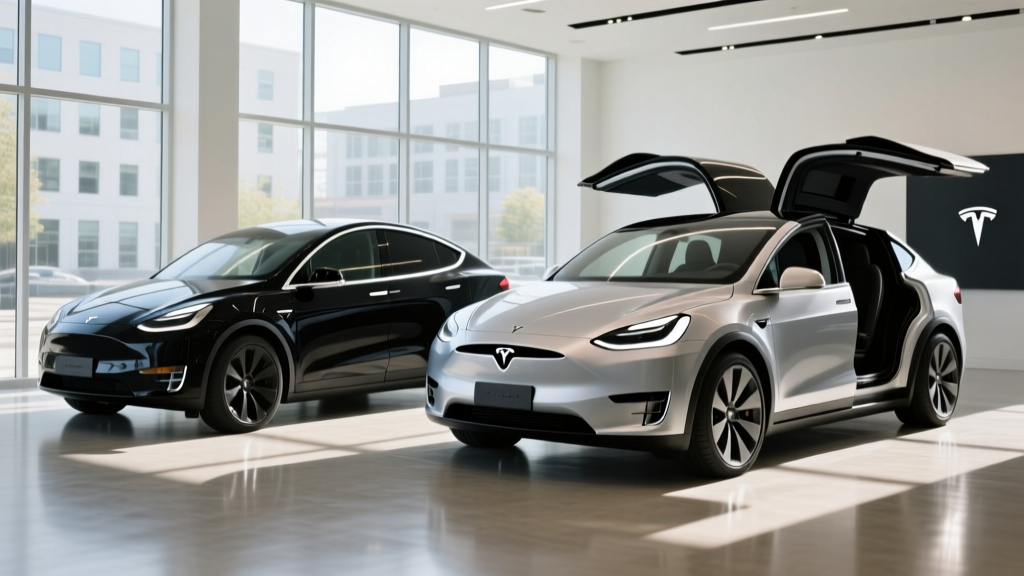
The Model X is a fundamentally different proposition. Its 32.7 inches of third-row legroom can accommodate adults on longer drives. The falcon-wing rear doors open vertically, creating an enormous opening that makes loading child car seats and buckling toddlers dramatically easier — this alone justifies the upgrade for many parents. Cargo space behind all three rows is 15.8 cu ft, and max cargo reaches 81.5 cu ft with both rear rows folded.
Towing: The Model Y is rated for 3,500 lbs; the Model X for 5,000 lbs. If you're pulling a small camping trailer or boat, the Model X is the clear choice. Towing significantly reduces range — expect a 30-50% hit depending on trailer weight and aerodynamics.
Pricing, Trims, and 2026 Federal Tax Credit Eligibility
| Configuration | MSRP | Est. Tax Credit | Effective Price |
|---|---|---|---|
| Model Y LR AWD (5-seat) | $49,990 | Up to $7,500* | ~$42,490 |
| Model Y LR AWD (7-seat) | $52,990 | Up to $7,500* | ~$45,490 |
| Model Y Performance (5-seat only) | $54,990 | Up to $7,500* | ~$47,490 |
| Model X Long Range (7-seat) | $79,990 | $0 (exceeds MSRP cap) | $79,990 |
| Model X Plaid (6/7-seat) | $94,990 | $0 (exceeds MSRP cap) | $94,990 |
*IRS §30D Federal Tax Credit Rules (2026): The up-to-$7,500 credit is NOT guaranteed. Eligibility requires:
- MSRP cap: SUVs/vans/pickups must be under $80,000; sedans under $55,000. The Model Y qualifies; the Model X does not.
- Buyer income cap: AGI must not exceed $150,000 (single), $225,000 (head of household), or $300,000 (joint filers).
- Battery sourcing: Increasingly strict critical-mineral and battery-component sourcing requirements must be met. Verify current eligibility on IRS.gov before purchase.
- Point-of-sale transfer: As of 2024, eligible buyers can transfer the credit to the dealer at purchase, reducing the out-of-pocket price immediately rather than waiting for tax filing.
Consult a tax professional for your specific situation. State and local incentives vary — check AFDC's incentive database for your jurisdiction.
Standout Tech and Notable Drawbacks
Tech highlights on both models:
- 15.4-inch (Model Y) or 17-inch (Model X) center touchscreen with Tesla's latest UI
- Over-the-air software updates that add features over time
- Standard Autopilot (SAE Level 2 driver-assist) with adaptive cruise, lane-keeping, and automatic emergency braking
- Optional Full Self-Driving Supervised ($8,000) — still requires active driver supervision and is NOT autonomous driving
- Access to the Tesla Supercharger network (17,000+ stalls in North America)
- Sentry Mode dashcam security and remote climate preconditioning via app
Important: Tesla Autopilot and FSD (Supervised) are SAE Level 2 driver-assistance systems. You must keep your hands on the wheel and eyes on the road at all times. These are NOT self-driving systems. Only Level 4 services like Waymo operate without a human driver — and those are limited to specific geo-fenced areas.
Notable drawbacks:
- Model Y 7-seat: Third row is cramped; cargo space severely limited with all seats up; no air suspension
- Model X: High price; panel-gap and build-quality inconsistencies persist; falcon-wing door sensors can be slow in tight garages
- Both: Tesla's service-center wait times remain longer than legacy automakers in many metro areas; insurance premiums tend to be higher than segment averages
- No Apple CarPlay or Android Auto — Tesla's native infotainment is the only option
Pros
- Access to Tesla Supercharger network — the most reliable DC fast-charging infrastructure in the US
- Class-leading efficiency (Model Y) and performance (Model X) for their respective sizes
- Strong over-the-air update cadence adds features post-purchase
- Excellent safety ratings (NHTSA 5-star for both)
- Model Y 7-seat is the most affordable 3-row EV available
Cons
- Model Y third row is impractical for adults and eats cargo space
- Model X price is steep with no federal tax credit offset
- No Apple CarPlay/Android Auto
- Insurance costs higher than competitors
- Service availability varies widely by region
Competitors: How Do They Compare?
The Kia EV9 (3-row, EPA 304 mi, starting ~$54,900) is the Model Y 7-seat's closest rival. It offers a genuinely usable third row with 32 inches of legroom, more cargo space with all seats up, and qualifies for the federal tax credit. However, its charging speed (210 kW peak, ~25 min 10-80%) and efficiency (89 MPGe) lag behind the Model Y, and access to non-Tesla DC networks means more variable charging reliability on road trips.
The Rivian R1S (EPA 352 mi dual-motor, starting ~$79,900) competes with the Model X on price and surpasses it on off-road capability and interior material quality. However, it lacks the Supercharger network advantage and has a smaller service footprint.
The Hyundai Ioniq 9 (2026 launch, preliminary specs: ~310 mi EPA, ~$55,000 starting) is another emerging 3-row contender worth watching, though final pricing and availability should be confirmed before purchase decisions.
Who Should Buy the Tesla 7-Passenger?
Choose the Model Y 7-seat if:
- Your third-row passengers are primarily children (car seats or kids under ~5'5")
- You want the most affordable 3-row EV on the market
- You rely on the Supercharger network for frequent road trips
- You can accept reduced cargo space with all seats deployed
- You qualify for the §30D tax credit, bringing the effective price to ~$45,490
Choose the Model X if:
- You need adult-capable third-row seating regularly
- The falcon-wing doors' car-seat-loading advantage is important to your family
- You want 5,000-lb towing capacity
- You need maximum cargo volume and don't mind the $80,000+ price tag
- Federal tax credit ineligibility doesn't affect your budget calculus
Look elsewhere if:
- You need genuine adult third-row space at a sub-$60,000 price — consider the Kia EV9
- You want Apple CarPlay or more traditional dealership service — consider the EV9, Ioniq 9, or Rivian R1S
Frequently Asked Questions
What is the real-world range of the Tesla Model Y 7-passenger?
The EPA rates the 2026 Model Y Long Range AWD at 311 miles. In real-world highway driving at 70-75 mph, expect 250-270 miles. In cold weather (below freezing), effective range drops to approximately 200-220 miles. Preconditioning and seat-heater use (instead of cabin heat) can recover some of this loss.
How fast does the Tesla 7-passenger charge?
Both the Model Y and Model X peak at 250 kW on Tesla V3 Superchargers. The Model Y charges 10-80% in approximately 27 minutes; the Model X in about 32 minutes. On a home Level 2 charger (11.5 kW, 48-amp), both add roughly 44 miles of range per hour, fully replenishing overnight.
How much does a 7-passenger Tesla cost after tax credits?
The Model Y Long Range with the $3,000 third-row option starts at $52,990. If you qualify for the full $7,500 federal tax credit (meeting MSRP, income, and battery-sourcing requirements), the effective price drops to approximately $45,490. The Model X starts at $79,990 and does not qualify for the federal credit due to the $80,000 SUV MSRP cap.
Does the Tesla Model Y 7-passenger qualify for the federal EV tax credit?
Yes — the Model Y Long Range (under the $80,000 SUV MSRP cap) is eligible for up to $7,500 under IRS §30D, provided the buyer meets income caps ($300,000 joint / $150,000 single) and the vehicle's battery meets current-year critical-mineral and component-sourcing requirements. Always verify on IRS.gov before purchasing. The Model X exceeds the MSRP cap and does not qualify.
Is the Tesla Model Y third row practical for adults?
Not for extended trips. With 26.5 inches of legroom, the Model Y's third row fits children and smaller adults for short rides. For regular adult third-row use, the Model X (32.7 inches) or competitors like the Kia EV9 (32 inches) are far more practical.
Can I tow with a 7-passenger Tesla?
Yes. The Model Y is rated for 3,500 lbs and the Model X for 5,000 lbs. However, towing significantly reduces range — expect 30-50% range reduction depending on trailer weight, aerodynamics, and terrain. Plan charging stops accordingly.