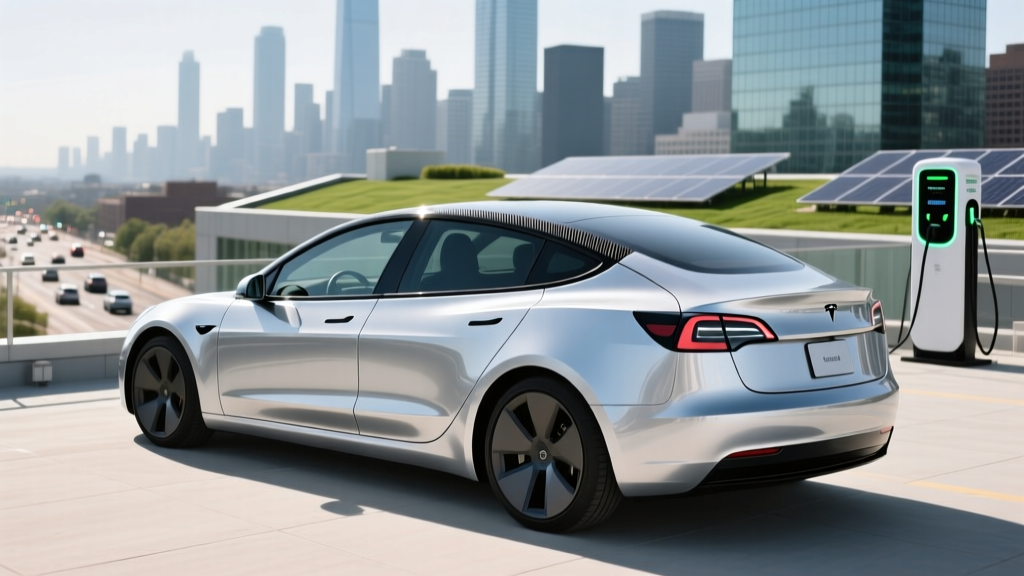
In late 2019, Tesla secured approximately $5.8 billion in loans from Chinese banks — a financial lifeline that funded the construction and ramp-up of Gigafactory Shanghai. That single deal didn't just save Tesla from a cash crunch; it fundamentally reshaped the Model 3's battery chemistry, pricing structure, and global supply chain. If you're shopping for a 2026 Tesla Model 3 today, the fingerprints of that $5.8 billion China loan are on every spec sheet, every price tag, and every LFP battery pack under the floor.
This review examines the 2026 Tesla Model 3 — the vehicle most directly born from that Chinese financing — while unpacking how Gigafactory Shanghai's output continues to influence what you pay, what battery chemistry you get, and whether this sedan still competes against a field that has caught up fast.
The Loan That Built the Model 3 You Can Actually Afford
Tesla's $5.8 billion China loan came in two tranches: roughly $1.4 billion for factory construction and $4.4 billion for production operations. The terms were favorable — interest rates below what Tesla could access in US markets at the time — and the result was a factory that began producing vehicles within 12 months of groundbreaking. By 2026, Gigafactory Shanghai is Tesla's highest-volume plant globally, producing both Model 3 and Model Y vehicles for China, Europe, and select export markets.
The strategic payoff for buyers: Shanghai-sourced Model 3 vehicles introduced the lithium iron phosphate (LFP) battery chemistry to Tesla's lineup. LFP cells, primarily sourced from CATL in China, cost significantly less per kWh than the nickel-manganese-cobalt (NMC) cells used in Long Range and Performance variants. That cost advantage is why the base Model 3 RWD remains Tesla's most affordable vehicle in 2026.
2026 Tesla Model 3: Core Specifications at a Glance
| Spec | RWD (Base) | Long Range AWD | Performance AWD |
|---|---|---|---|
| EPA Range | 363 mi | 341 mi | 315 mi |
| Battery Capacity (usable) | ~60 kWh (LFP) | ~75 kWh (NMC) | ~75 kWh (NMC) |
| Drivetrain | Rear-Wheel Drive | Dual-Motor AWD | Dual-Motor AWD |
| Horsepower | 271 hp | 346 hp | 510 hp |
| 0–60 mph | 5.8 sec | 4.2 sec | 2.9 sec |
| MPGe (combined) | 132 MPGe | 125 MPGe | 115 MPGe |
| Efficiency | 25 kWh/100 mi | 27 kWh/100 mi | 29 kWh/100 mi |
| Base MSRP | $38,990 | $45,990 | $53,990 |
| Battery Warranty | 8 yr / 100,000 mi | 8 yr / 120,000 mi | 8 yr / 120,000 mi |
Source: fueleconomy.gov and Tesla official specifications. MSRPs exclude destination charge.
Real-World Range: What the EPA Sticker Doesn't Tell You
EPA sticker: 363 miles
Real-world highway (70–80 mph, 72°F): ~290–310 miles
Real-world mixed city/highway: ~320–340 miles
Cold weather (below 32°F, highway): ~220–260 miles
The LFP chemistry in the RWD model has a flatter voltage curve, which helps maintain usable range at low state-of-charge — but LFP cells lose more capacity in freezing temps than NMC. Plan conservatively in winter.
The Model 3 RWD's 363-mile EPA figure is impressive on paper, but real-world efficiency depends heavily on driving style and ambient temperature. On flat highway at 75 mph in moderate weather, expect roughly 80–85% of the EPA number — consistent with most EVs. Where the Model 3 shines is city driving, where regenerative braking recaptures energy and the sedan's low drag coefficient (Cd 0.219) matters less.
The LFP battery also has a unique characteristic: Tesla recommends charging to 100% regularly for optimal battery calibration, unlike the NMC Long Range where daily charging to 80% preserves longevity. This means RWD owners effectively get the full 60 kWh more often, partially offsetting the smaller pack.
Charging Speed: DC Fast Charge and Home Level 2
| Method | Max Power | 10–80% Time | Miles per Hour |
|---|---|---|---|
| Level 1 (120V household) | ~1.4 kW | N/A (days) | ~3–4 mi/hr |
| Level 2 (240V, 48A Wall Connector) | 11.5 kW | ~5.5 hours (0–100%) | ~44 mi/hr |
| DC Fast Charge (NACS) | 170 kW (RWD) / 250 kW (LR/Perf) | ~25 min (RWD) / ~18 min (LR) | Up to ~200 mi added in 15 min (LR) |
The RWD Model 3's LFP battery peaks at approximately 170 kW on DC fast charging — lower than the Long Range's 250 kW peak. However, LFP cells sustain their peak charge rate longer before tapering, meaning the gap narrows in practice. On a Tesla V4 Supercharger, the RWD typically adds 10–80% in about 25 minutes, while the Long Range accomplishes the same in roughly 18 minutes.
At home on a Tesla Wall Connector (hardwired, 60A circuit), the onboard charger maxes at 11.5 kW, delivering roughly 44 miles of range per hour of charging. Most owners who plug in overnight start every morning with a full battery — the single biggest ownership advantage over public charging reliance.
Charge curve reality check: Peak kW is not sustained kW. Both LFP and NMC packs taper significantly above 80% state-of-charge. If you're road-tripping, plan Supercharger stops at 10–80% rather than topping to 100% — the last 20% can take as long as the first 80%.
Performance, Ride Quality, and Daily Driving
The 2026 Model 3 "Highland" refresh (introduced for the 2024 model year and carried forward) brought meaningful improvements to ride quality, cabin noise isolation, and interior materials. The rear subframe now uses frequency-selective dampers, and acoustic glass replaces the previous single-pane setup at all four windows.
Performance varies dramatically by trim:
- RWD (271 hp, 5.8 sec 0–60): Adequate for commuting and merging. Single-motor simplicity means lower maintenance and fewer failure points.
- Long Range AWD (346 hp, 4.2 sec 0–60): The sweet spot for buyers who want dual-motor traction in snow and confident highway passing without stepping to the Performance price.
- Performance (510 hp, 2.9 sec 0–60): Track-capable with adaptive dampers and larger brakes, but the ride firmness and 20" wheel/tire costs make it a niche pick.
All trims feature Tesla's latest interior: a 15.4" center touchscreen, ambient lighting, ventilated front seats, rear-seat ventilation (a Highland addition), and a rear 8" touchscreen for climate and media control. The turn-signal stalks have been removed — signals are now on the steering wheel, which remains the Model 3's most polarizing design choice.
Autopilot, FSD, and Driver Assistance
Tesla's Autopilot and Full Self-Driving (Supervised) are SAE Level 2 driver-assistance systems. The driver must remain fully engaged, hands on the wheel, and eyes on the road at all times. These systems do not make the vehicle self-driving. Only Level 4 services like Waymo operate without a human driver — and those are geofenced to specific cities.
Every Model 3 ships with basic Autopilot (traffic-aware cruise control and lane centering). Full Self-Driving (Supervised) remains a $8,000 add-on or $99/month subscription as of early 2026. FSD has improved substantially in city-street navigation, but it still makes errors at construction zones, unprotected left turns, and complex intersections that require immediate driver takeover.
Standard active safety — automatic emergency braking, blind-spot monitoring, lane departure warning — is included on all trims. The Model 3 earned the IIHS Top Safety Pick+ designation and a 5-star overall NHTSA rating.
Pricing, Tax Credits, and What You Actually Pay
| Trim | Base MSRP | Est. §30D Credit | Effective Price* |
|---|---|---|---|
| RWD | $38,990 | $3,750–$7,500 | $31,490–$35,240 |
| Long Range AWD | $45,990 | $3,750–$7,500 | $38,490–$42,240 |
| Performance AWD | $53,990 | $3,750–$7,500 | $46,490–$50,240 |
*Effective price assumes full credit eligibility. Actual credit depends on battery sourcing compliance, buyer income, and current IRS rules. See IRS §30D guidance.
- ✅ MSRP cap: Sedans must be ≤ $55,000 (RWD and LR qualify; Performance may exceed depending on options)
- ✅ Buyer income cap: AGI ≤ $150,000 (single) / $300,000 (joint)
- ⚠️ Battery sourcing: Critical minerals and battery component requirements phase in annually — the RWD's CATL-sourced LFP pack faces scrutiny under foreign-entity-of-concern (FEOC) rules, which may reduce the credit to $3,750 instead of the full $7,500
- ✅ Point-of-sale transfer: Eligible buyers can apply the credit at purchase, reducing the out-of-pocket price immediately
- ⚠️ Final assembly: Must be in North America — Model 3 for the US market is assembled at Gigafactory Texas
Tax credit rules change frequently. Consult a tax professional and check the latest IRS guidance before purchasing.
The connection back to the $5.8 billion China loan is direct: without Shanghai's LFP supply chain, Tesla could not offer a sub-$39,000 sedan. But the FEOC battery-sourcing rules now complicate that same supply chain, potentially limiting the RWD's credit to $3,750 — a nuance most buyers miss until they reach the dealership.
Cargo, Passenger Space, and Practicality
The Model 3 remains a compact executive sedan, and its dimensions reflect that:
- Cargo (trunk): 23 cu ft
- Frunk (front trunk): ~3.1 cu ft — enough for a charging cable bag and small items
- Rear legroom: 35.2 inches
- Front headroom: 40.3 inches
Compared to the Hyundai Ioniq 6 (which offers similar efficiency but a more traditional interior layout), the Model 3's rear seat is tighter for tall passengers. The glass roof creates an airy feel but reduces headroom margin. If rear-seat space is a priority, the Model Y crossover offers substantially more room on a similar platform.
Who Should Buy the 2026 Model 3?
Choose the Model 3 RWD if: You commute under 60 miles daily, have reliable home charging, want the lowest entry price, and value the Supercharger network for occasional road trips.
Choose the Model 3 Long Range AWD if: You live in a cold/snowy climate, need dual-motor traction, regularly drive 200+ miles between charges, or want faster DC charging.
Choose the Model 3 Performance if: Track capability matters, you want adaptive dampers, and you accept higher tire costs and a firmer ride.
Look elsewhere if: You need spacious rear seating (consider Model Y or Ioniq 5), prefer physical buttons and stalks, or want Apple CarPlay/Android Auto integration.
Model 3 vs. Key Competitors: How It Stacks Up in 2026
| Spec | Tesla Model 3 LR | Hyundai Ioniq 6 SE LR | BMW i4 eDrive40 |
|---|---|---|---|
| EPA Range | 341 mi | 361 mi | 307 mi |
| Max DC Charge | 250 kW | 240 kW | 205 kW |
| 10–80% DC Time | ~18 min | ~18 min | ~31 min |
| Base MSRP | $45,990 | $46,500 | $57,900 |
| Charging Network | Supercharger (NACS) | NACS (2025+ adapter) | CCS → NACS adapter |
The Ioniq 6 matches or beats the Model 3 on range and charging speed, with a more traditional interior and physical controls. The BMW i4 commands a premium but delivers luxury build quality the Tesla can't match. The Model 3's enduring advantages are the Supercharger network's reliability, Tesla's software update cadence, and lower starting prices on the RWD trim.
Pros and Cons
- Class-leading efficiency (25 kWh/100 mi RWD)
- Supercharger network remains the most reliable DC charging option
- LFP battery can be charged to 100% daily without degradation concerns
- Over-the-air updates continually add features
- Sub-$39K entry price before credits
- Strong resale value relative to most EVs
- No turn-signal stalks — steering-wheel buttons are unintuitive for many
- No Apple CarPlay or Android Auto
- Rear seat is tight for adults over 6' tall
- RWD DC charging peaks at 170 kW (slower than LR)
- FSD ($8K) remains Level 2, not autonomous — buyer beware
- Panel gaps and paint quality still trail legacy automakers
Frequently Asked Questions
What is the real-world range of the 2026 Tesla Model 3?
The EPA rates the RWD at 363 miles and the Long Range at 341 miles. In real-world highway driving at 75 mph, expect roughly 290–310 miles from the RWD and 275–295 miles from the Long Range. Cold weather (below freezing) can reduce range by 25–35%, especially on the LFP-equipped RWD.
How fast does the Model 3 charge at home and on the road?
At home on a 240V Tesla Wall Connector (48A), the Model 3 charges at up to 11.5 kW, adding about 44 miles per hour — a full overnight charge is trivial. On DC fast charging, the RWD peaks at 170 kW (10–80% in ~25 minutes) while the Long Range peaks at 250 kW (10–80% in ~18 minutes). Remember: peak kW is not sustained — charging slows significantly above 80%.
Does the Tesla Model 3 qualify for the $7,500 federal tax credit?
It depends on the trim and your circumstances. All trims are under the $55,000 sedan MSRP cap (unless heavily optioned), and US assembly at Gigafactory Texas satisfies the final-assembly requirement. However, the RWD's CATL-sourced LFP battery may only qualify for $3,750 (half credit) under 2026 FEOC battery-sourcing rules. Buyer income must be ≤ $150K single / $300K joint. Always verify current rules at IRS.gov.
Is the Model 3 still worth buying vs. the Hyundai Ioniq 6 or BMW i4?
For value and charging infrastructure, yes. The Model 3 RWD undercuts both competitors on price and has access to the Supercharger network natively. The Ioniq 6 offers comparable range and charging with a more conventional interior. The BMW i4 wins on build quality and driving refinement but costs $12K+ more. Your priorities — price, network, interior feel — determine the winner.
How did Tesla's $5.8 billion China loan affect the Model 3 I can buy today?
The loan funded Gigafactory Shanghai, which established Tesla's LFP battery supply chain with CATL. That supply chain is why the base Model 3 RWD exists at its current price point — LFP cells from Chinese suppliers are significantly cheaper per kWh than NMC cells. The loan also gave Tesla the production volume and cash flow to invest in the Highland redesign and expand US production.
What is the battery warranty on the 2026 Model 3?
The RWD carries an 8-year/100,000-mile battery and drive unit warranty. The Long Range and Performance extend that to 8 years/120,000 miles. Tesla guarantees the battery will retain at least 70% of its original capacity during the warranty period. LFP batteries historically show slower degradation than NMC, often retaining 90%+ capacity after 100,000 miles based on fleet data.
The Bottom Line
The 2026 Tesla Model 3 remains the EV sedan benchmark — not because it's flawless, but because no competitor matches its combination of price, efficiency, and charging infrastructure. The $5.8 billion China loan from 2019 set in motion the LFP supply chain that makes the sub-$39K RWD possible, and that financial bet continues to pay dividends for buyers seven years later.
If you have home charging, commute under 60 miles, and value the Supercharger network for road trips, the Model 3 RWD at ~$31,500–$35,000 after credits is the best value in electric sedans. If you need AWD, more rear-seat room, or a more traditional cabin, look at the Long Range — or cross-shop the Ioniq 6. Either way, you're driving a car that exists at this price because of a single $5.8 billion bet made in Shanghai in 2019.