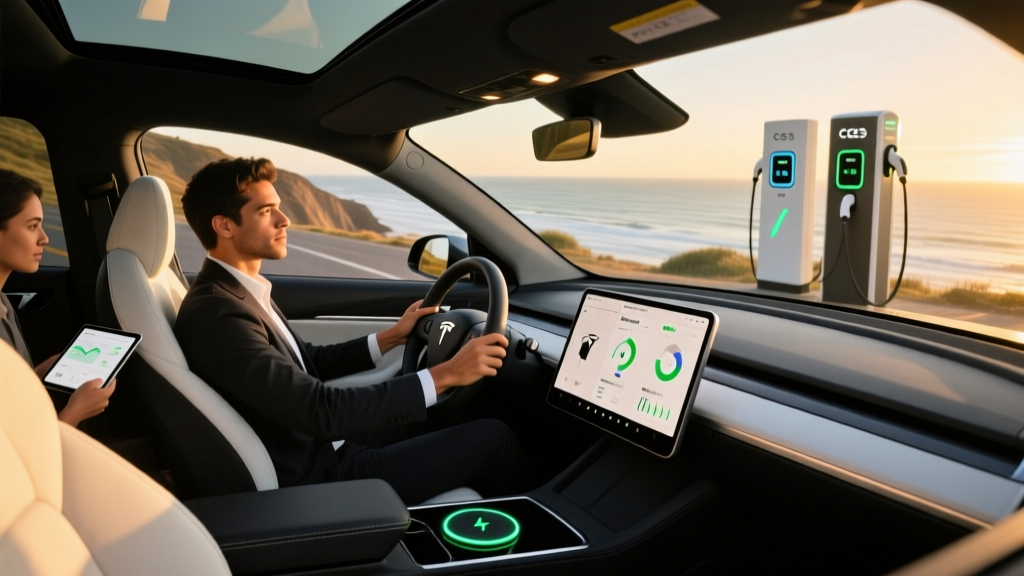
Buying a Tesla sight-unseen is common, but nothing replaces living with the car for a weekend. Tesla's extended demo program — often arranged through local showrooms or referral-driven events — lets you take a vehicle home for up to 48 hours. That window is just long enough to test real-world range on your commute, evaluate home-charging feasibility, and decide whether the ecosystem fits your life. This guide walks you through exactly what to test, what numbers to expect, and how to interpret the data before signing.
Why 48 Hours Beats a 15-Minute Test Drive
A short loop around the block tells you nothing about regenerative-braking behavior, highway efficiency, or how the car handles your garage and driveway. A 48-hour demo drive lets you:
- Measure actual kWh/mile on your specific commute route (elevation, traffic, climate)
- Test Level 2 home charging on your existing electrical panel (or discover you need an upgrade)
- Experience cold-start or hot-soak efficiency in your local climate
- Load car seats, groceries, or luggage to assess real cargo practicality
- Live with the touchscreen-only interface through multiple trips and passengers
Tesla doesn't advertise a universal 48-hour program on its website, but many showrooms will arrange an extended loaner or demo when you're close to purchasing. Call your local store, express serious intent, and ask about availability. Some service centers also loan vehicles during multi-day repairs — another way to sample the car.
Vehicle Focus: 2026 Tesla Model Y Long Range AWD
The Model Y remains Tesla's volume seller and the most likely demo candidate. Here's the spec sheet for the 2026 Long Range AWD, the sweet spot for most buyers:
| Spec | Value |
|---|---|
| EPA Estimated Range | 330 miles |
| Battery Capacity | 78.1 kWh usable (NMC chemistry) |
| Drivetrain | Dual-motor AWD |
| Horsepower | 384 hp combined |
| 0–60 mph | 4.8 seconds |
| MPGe (combined) | 111 MPGe |
| Efficiency | 28 kWh/100 mi |
| Max DC Fast Charge | 250 kW peak |
| 10–80% DC Charge Time | ~27 minutes |
| Level 2 Charge Rate | 11.5 kW (44 mi/hr) |
| Cargo Volume (rear seats up) | 30.2 cu ft |
| Cargo Volume (rear seats folded) | 72.1 cu ft |
| Rear Legroom | 38.5 inches |
| Battery Warranty | 8 years / 120,000 miles (70% retention) |
| Base MSRP | $48,990 (before destination) |
Sources: EPA Fuel Economy, Tesla Model Y specs.
Real-World Range: What the EPA Number Doesn't Tell You
During your 48-hour demo, reset the trip meter and drive your normal routes. The Tesla energy app shows instantaneous and average Wh/mile. For reference:
- City/suburban (35–55 mph): 240–260 Wh/mile → 300–325 miles range
- Highway (70–75 mph, flat): 280–300 Wh/mile → 260–280 miles range
- Cold weather (20°F, highway, heat on): 320–360 Wh/mile → 215–245 miles range
If your round-trip commute is under 60 miles, you'll charge every 4–5 days on Level 2. If you regularly drive 200+ miles in winter, you'll want DC fast-charging access or a home charger.
Charging Speed: Home vs. DC Fast
Charging speed is the top buyer concern, and the Model Y's 250 kW peak rate is competitive but not class-leading. Here's what to expect:
| Charging Level | Power | Miles Added per Hour | Notes |
|---|---|---|---|
| Level 1 (120V outlet) | 1.4 kW | 3–5 mi/hr | Emergency/trickle only |
| Level 2 (240V, 48A) | 11.5 kW | 44 mi/hr | Full charge in ~7 hours |
| Level 2 (240V, 32A) | 7.7 kW | 30 mi/hr | Common with NEMA 14-50 |
| DC Fast (Tesla Supercharger V3) | 250 kW peak | Up to 162 mi in 15 min | 10–80% in ~27 min |
| DC Fast (CCS adapter, 150 kW station) | 150 kW peak | ~90 mi in 15 min | Slower taper above 80% |
Charging curve reality: The 250 kW peak only holds from roughly 10–30% state of charge. Above 50%, the rate tapers to ~100 kW, and above 80% it drops to ~40 kW. A 10–80% session takes ~27 minutes; 10–100% takes ~55 minutes. Plan road-trip stops around 80% to minimize total travel time.
For home charging, Tesla's Wall Connector ($450) delivers 11.5 kW on a 60-amp circuit. Most buyers install a NEMA 14-50 outlet ($500–$1,500 depending on panel proximity) and use the Mobile Connector ($200) at 32A / 7.7 kW. During your demo, ask to borrow a Mobile Connector and test your garage outlet — you'll know immediately if your electrical panel needs an upgrade.
Pricing, Tax Credits & Total Cost
The 2026 Model Y Long Range AWD starts at $48,990 plus $1,390 destination, totaling $50,380 before incentives. Here's the current federal tax credit landscape under IRS §30D:
| Item | Amount |
|---|---|
| Base MSRP (Long Range AWD) | $48,990 |
| Destination Fee | $1,390 |
| Total Before Incentives | $50,380 |
| Federal Tax Credit (§30D) | Up to $7,500 (if eligible) |
| Effective Price After Credit | ~$42,880 |
Critical eligibility rules (2026): The $7,500 credit requires meeting both battery-component and critical-minerals sourcing thresholds, which phase in yearly. The Model Y's battery sourcing has historically qualified, but verify current-year status on fueleconomy.gov before purchasing. Additional constraints:
- MSRP cap: SUVs/trucks must be under $80,000 (Model Y qualifies)
- Income cap: AGI ≤ $150,000 (single), $225,000 (head of household), $300,000 (joint)
- Point-of-sale transfer: You can apply the credit at purchase, reducing the upfront cost immediately
State incentives vary widely — check IRS.gov and your state energy office for local rebates.
Performance, Tech & Daily Livability
The Model Y's 384 hp and 4.8-second 0–60 time feel brisk in daily driving. Dual-motor AWD provides confident traction in rain and light snow. The low center of gravity (battery pack under the floor) minimizes body roll, though the ride is firm over broken pavement.
Standout tech:
- 15.4-inch center touchscreen controls nearly everything (no physical buttons except steering-wheel scroll wheels)
- Over-the-air updates add features quarterly
- Tesla app provides remote climate control, charging status, and location tracking
- Supercharger network (17,000+ stalls in North America) remains the most reliable DC fast-charging ecosystem
- Autopilot (standard) provides adaptive cruise and lane-keeping; FSD Supervised ($8,000 or $99/mo) adds city-street navigation but requires full driver attention (SAE Level 2, not self-driving)
Notable drawbacks:
- No physical buttons for climate, volume, or glovebox — everything is touchscreen
- Rear visibility is limited (no rear wiper on older models; 2026 refresh adds one)
- Insurance costs run 20–40% higher than comparable gas SUVs
- Build quality has improved but still trails legacy automakers in panel-gap consistency
Who Should Buy the Model Y?
Competitor Comparison
| Spec | Tesla Model Y LR AWD | Ford Mustang Mach-E ER AWD | Hyundai Ioniq 5 AWD |
|---|---|---|---|
| EPA Range | 330 mi | 312 mi | 290 mi |
| Max DC Charge | 250 kW | 150 kW | 240 kW |
| 10–80% Time | 27 min | 45 min | 18 min |
| 0–60 mph | 4.8 sec | 5.1 sec | 5.0 sec |
| Cargo (rear up) | 30.2 cu ft | 29.7 cu ft | 27.2 cu ft |
| Base MSRP | $48,990 | $51,995 | $52,600 |
| Charging Network | Supercharger (native) | BlueOval (CCS) | E-GMP (CCS/NACS) |
The Model Y wins on range, cargo, and Supercharger access. The Ioniq 5 charges faster (18-min 10–80%) thanks to 800V architecture. The Mach-E offers a more traditional interior with physical buttons but charges slower and costs more.
FAQ: Your 48-Hour Demo Questions Answered
How do I arrange a 48-hour Tesla demo drive?
Call or visit your local Tesla showroom, express purchase intent, and ask about extended demo availability. Some stores loan vehicles for 24–48 hours to serious buyers. Alternatively, Tesla service centers sometimes loan vehicles during multi-day repairs.
What's the real-world range of the 2026 Model Y?
EPA rates it at 330 miles. Expect 280–300 miles highway, 220–260 miles in freezing weather, and 340+ miles in city driving with regen braking. Your demo is the perfect time to measure your specific routes.
How fast does it charge at home and on the road?
Level 2 home charging (11.5 kW) adds 44 miles per hour, fully charging in ~7 hours. DC fast charging peaks at 250 kW, delivering 10–80% in ~27 minutes at a Tesla Supercharger V3.
Does the 2026 Model Y qualify for the $7,500 federal tax credit?
Likely yes, but eligibility depends on battery-sourcing rules (which tighten yearly), your income (AGI caps apply), and the vehicle's MSRP (under $80,000 for SUVs). Verify current-year status on fueleconomy.gov and consult a tax professional.
Is the Model Y worth buying vs. competitors?
If you prioritize range, Supercharger access, and cargo space, yes. If you want faster DC charging, consider the Ioniq 5. If you prefer physical buttons and dealership service, test the Mach-E or EV6.
What are the biggest pros and cons?
- Class-leading 330-mile range
- Supercharger network reliability
- Spacious cargo area (30.2 cu ft)
- OTA updates add features over time
- Low running costs (electricity vs. gas)
- Touchscreen-only interface (no buttons)
- Firm ride on rough roads
- Higher insurance costs
- Limited rear visibility
- Service-center wait times in some regions
What should I test during the 48-hour demo?
Drive your commute at normal speeds and note Wh/mile. Test home charging on your garage outlet. Load car seats or luggage to check cargo fit. Use Autopilot on the highway. Precondition the car via the app before driving. Experience cold-start or hot-soak efficiency if weather permits.
Your 48-hour demo is the best purchase-research tool available. Use it to gather real data, not impressions. If the numbers work for your commute, charging setup, and budget, the Model Y remains one of the most capable electric SUVs on the market.