When Tesla introduced its 4680 battery cell format, the promise was straightforward: lower manufacturing cost, higher energy density, and faster charging. By the 2026 model year, these cylindrical cells have moved from early-adopter curiosity to mainstream production across the Model Y lineup built at Gigafactory Texas. But what does that actually mean for buyers weighing a Tesla against competitors using conventional 2170 cells or prismatic LFP packs?
This profile breaks down exactly how Tesla cells — specifically the 4680 format with its tabless electrode design and structural battery pack integration — translate into real-world range, charging behavior, and long-term ownership value. We'll focus on the 2026 Tesla Model Y Long Range AWD as the primary vehicle carrying this technology, with notes on how the cell architecture differs from the Model 3 and RWD Model Y variants using other chemistries.
2026 Tesla Model Y Long Range AWD: Core Specifications
| Attribute | Specification |
|---|---|
| EPA Estimated Range | 320 miles |
| Battery Capacity (Usable) | ~78 kWh (NMC-based 4680 cells) |
| Battery Chemistry | Nickel Manganese Cobalt (NMC) — 4680 format |
| Peak DC Fast Charge Rate | 250 kW |
| 10–80% DC Fast Charge Time | ~25 minutes |
| Level 2 Home Charge Rate | 11.5 kW (~44 miles per hour) |
| 0–60 mph | 4.8 seconds |
| Horsepower | 384 hp (dual motor) |
| Drivetrain | Dual Motor AWD |
| Efficiency (Combined) | 122 MPGe / 28 kWh per 100 miles |
| Cargo Volume (rear seats up) | 30.2 cu ft |
| Cargo Volume (rear seats folded) | 72.1 cu ft |
| Rear Legroom | 41.6 inches |
| Base MSRP | $48,990 (before destination) |
| As-Tested Price (with FSD) | $56,990 (includes $8,000 FSD option) |
| Battery & Drive Unit Warranty | 8 years / 120,000 miles (70% capacity retention) |
| Basic Vehicle Warranty | 4 years / 50,000 miles |
Sources: EPA Fuel Economy, Tesla official specifications.
What Are Tesla 4680 Cells and Why Do They Matter?
The 4680 designation refers to the cell's physical dimensions: 46 mm in diameter and 80 mm tall — substantially larger than the 2170 cells (21 mm × 70 mm) still used in the Model 3 and some Model Y variants. The larger format allows Tesla to pack more active electrode material into each cell while reducing the total number of cells in the pack, simplifying manufacturing and reducing welding points that can introduce failure modes.
The more significant innovation is the tabless electrode design (marketed as "tabless" though technically using a multi-tab laser-patterned edge). Conventional cylindrical cells use a single tab connecting the electrode jelly roll to the terminal cap, creating a bottleneck for electron flow. The 4680's laser-scored edge creates continuous contact along the full height of the electrode, dramatically reducing internal electrical resistance. This means:
- Lower heat generation during fast charging — the cell can accept higher sustained power without thermal throttling
- Shorter electron path length — reducing impedance by roughly 5× compared to single-tab designs
- Improved power density — enabling stronger acceleration and regenerative braking capture
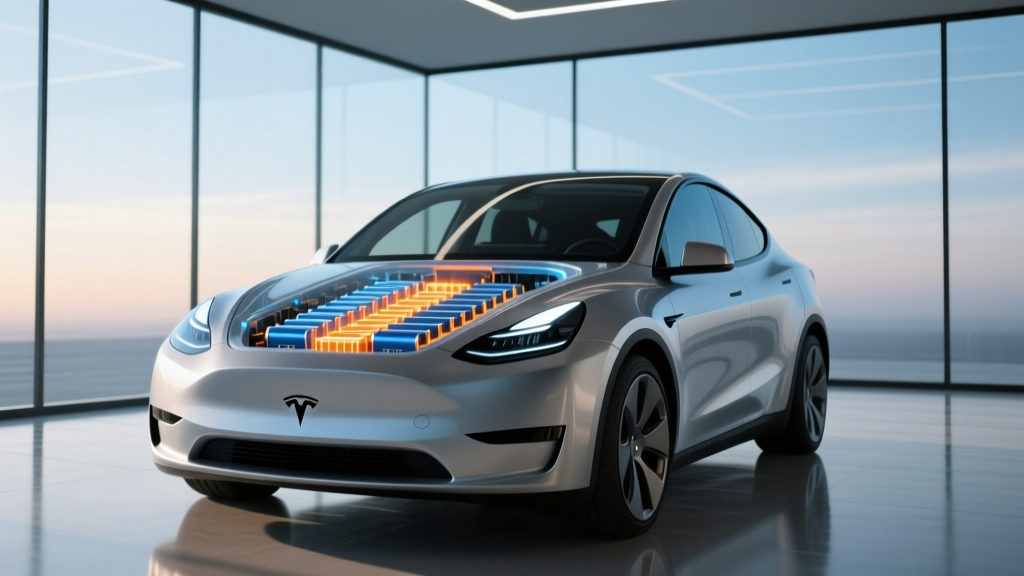
In the 2026 Model Y, these cells are integrated into a structural battery pack where the cell module itself serves as a load-bearing element of the vehicle chassis. This eliminates redundant structural material, reducing overall vehicle weight by an estimated 10–15% compared to a conventional pack-in-box design. The weight savings directly improve efficiency and handling.
4680 vs. 2170 vs. LFP Prismatic: Chemistry Trade-offs
| Attribute | 4680 (NMC) | 2170 (NMC/NCA) | Prismatic (LFP) |
|---|---|---|---|
| Used In | Model Y LR AWD (TX-built) | Model 3 LR, Model Y (CA-built) | Model 3 RWD, Model Y RWD |
| Energy Density | Highest (~244 Wh/kg cell-level) | High (~260 Wh/kg cell-level) | Moderate (~170 Wh/kg) |
| Fast Charge Tolerance | Excellent (low impedance) | Good | Good (but lower peak kW) |
| Cycle Life | ~1,500 cycles to 80% SoH | ~1,200 cycles to 80% SoH | ~3,000+ cycles to 80% SoH |
| Cold Weather Performance | Good (heat pump standard) | Good | Reduced (LFP more sensitive to cold) |
| Recommended Daily SoC | 80–90% | 80–90% | 100% (LFP prefers full charge) |
| Cost per kWh (est.) | ~$100–110 | ~$110–120 | ~$80–90 |
The LFP (lithium iron phosphate) prismatic cells used in base RWD trades energy density for dramatically longer cycle life and lower raw material cost — which is why Tesla recommends charging LFP vehicles to 100% daily, while NMC-based 4680 and 2170 packs benefit from staying below 90% for daily use to minimize calendar degradation.
Real-World Range: What the EPA Sticker Doesn't Tell You
EPA vs. Real-World Range Expectations
EPA Estimated Range: 320 miles (combined city/highway)
Real-World Highway (70 mph, mild weather): ~265–285 miles
Real-World City/Suburban: ~290–310 miles
Cold Weather (below 32°F, highway): ~210–240 miles
Cold Weather + Cabin Heating (city): ~250–275 miles
The EPA combined cycle includes substantial low-speed city driving where regenerative braking recaptures energy, inflating the range figure relative to sustained highway travel. At 70 mph on flat terrain in 65°F conditions, the Model Y LR AWD with 4680 cells typically delivers 265–285 miles before reaching 10% state of charge — approximately 80–89% of the EPA sticker.
Cold weather introduces two penalties: reduced lithium-ion diffusion rates (limiting available capacity) and cabin heating energy draw. Tesla's standard heat pump mitigates this significantly compared to resistive heating, but expect 25–35% range reduction in sustained sub-freezing highway driving. Preconditioning the battery while plugged in — using the scheduled departure feature — recovers a meaningful portion of this loss by warming the cells before you drive.
Efficiency in Context
At 28 kWh per 100 miles combined, the Model Y LR AWD is among the most efficient vehicles in its class. For comparison, the Ford Mustang Mach-E Extended Range AWD achieves 101 MPGe (33 kWh/100 mi), and the Hyundai Ioniq 5 AWD lands at 110 MPGe (30 kWh/100 mi). The 4680 pack's structural integration and lower mass contribute directly to this efficiency advantage — fewer kWh consumed per mile means faster charging times and lower electricity costs per trip.
Charging Performance: DC Fast and Home Level 2
| Charging Level | Max Power (kW) | Miles Added per Hour | Typical Use Case |
|---|---|---|---|
| Level 1 (120V, 12A) | 1.4 kW | ~4 mi/hr | Emergency / overnight trickle |
| Level 2 (240V, 48A) | 11.5 kW | ~44 mi/hr | Home Wall Connector / destination |
| DC Fast (Tesla Supercharger V3) | 250 kW (peak) | ~200+ mi in 15 min | Road trips, highway corridors |
| DC Fast (CCS adapter, non-Tesla) | ~150–175 kW (typical) | ~120–150 mi in 15 min | Electrify America, EVgo, etc. |
The Charge Curve Reality: Peak vs. Sustained kW
The 250 kW peak charge rate is achievable only under specific conditions: battery preconditioned to optimal temperature (typically via navigation to a Supercharger), and starting from a low state of charge (below 20%). The 4680's tabless design genuinely improves sustained charge acceptance compared to 2170 cells — where a typical charge session might hold peak rate for 5–8 minutes before thermal throttling, the 4680 pack sustains near-peak rates for 10–12 minutes under ideal conditions.
A typical 10–80% session at a V3 Supercharger takes approximately 25 minutes. Above 80% SoC, the charge rate tapers sharply to protect cell longevity — expect 80–90% to add another 8–10 minutes, and 90–100% to require 20+ minutes. For road trips, the optimal strategy remains charging to 80% and departing; the time penalty for charging past 80% rarely justifies the added range.
Using a CCS adapter (included with newer vehicles, available as an accessory for older NACS-equipped Teslas) at non-Tesla DC fast chargers, expect lower peak rates. Most Electrify America and EVgo stations deliver 150–175 kW to the Model Y due to communication protocol differences and station-side current limits. This adds roughly 3–5 minutes to a 10–80% session compared to a V3 Supercharger.
Home Charging Setup
At 11.5 kW on a 48-amp Level 2 circuit (requiring a 60-amp breaker), the Tesla Wall Connector adds approximately 44 miles of range per hour of charging. An overnight session of 8 hours delivers roughly 350 miles — more than sufficient to replenish any daily driving. Installation costs for a dedicated 60A circuit typically range from $800–$2,000 depending on panel proximity and local permitting, with the Wall Connector hardware itself priced at $475.
If your electrical panel is at capacity, a panel upgrade to 200A service can add $1,500–$3,000 to the installation. Consult a licensed electrician for a site-specific assessment — never attempt to oversubscribe an existing panel.
Performance and Drivetrain
The dual-motor AWD configuration pairs a permanent magnet synchronous motor on the rear axle with an induction motor up front. Total system output is 384 horsepower and an estimated 375 lb-ft of torque, delivered with the instant response characteristic of electric drivetrains. The 0–60 mph time of 4.8 seconds places the Model Y LR comfortably ahead of most gas-powered compact SUVs and competitive with performance-oriented EVs in its price range.
The 4680 structural pack contributes to handling dynamics: by integrating the battery as a stressed chassis member, torsional rigidity increases while center of gravity remains low. The result is flatter cornering and more precise steering response than the prior-generation Model Y with a conventional pack-in-box design. Regenerative braking capture is also marginally improved — the lower internal resistance of the tabless cells allows more aggressive regen without excessive heat buildup, contributing to one-pedal driving feel that Tesla owners expect.
Towing Capacity
The 2026 Model Y LR AWD is rated for 3,500 pounds of towing capacity when equipped with the factory tow hitch ($1,000 option). Towing significantly impacts range — expect a 40–50% reduction at highway speeds with a loaded trailer, bringing effective range to approximately 140–170 miles. For frequent towing, a larger vehicle like the Ford F-150 Lightning or Rivian R1S is a more practical choice.
Pricing, Trims, and Federal Tax Credit Eligibility
| Trim | Base MSRP | Federal Credit (§30D) | Effective Price |
|---|---|---|---|
| Long Range AWD (4680) | $48,990 | $3,750 (partial)* | $45,240 |
| Performance | $52,490 | $3,750 (partial)* | $48,740 |
| RWD (LFP prismatic) | $44,990 | $3,750 (partial)* | $41,240 |
*Federal tax credit amounts reflect 2026 IRS §30D rules. The Model Y qualifies for a partial credit due to battery component and critical mineral sourcing requirements that phase in annually. Full $7,500 credit availability depends on specific build month and sourcing compliance. Point-of-sale transfer is available, reducing the purchase price at delivery rather than requiring a tax-time claim. Buyer income caps apply: $150,000 single / $300,000 joint modified AGI. See IRS §30D guidance for current eligibility rules.
Tax Credit Eligibility Checklist
- MSRP Cap: Vehicle MSRP must not exceed $80,000 for SUVs/pickups (Model Y qualifies)
- Buyer Income Cap: Modified AGI ≤ $150,000 (single) or ≤ $300,000 (married filing jointly)
- Battery Component Sourcing: Percentage of battery components manufactured in North America must meet annual thresholds (75% for 2026)
- Critical Mineral Sourcing: Percentage of critical minerals sourced from US or FTA partners must meet thresholds (80% for 2026)
- Final Assembly: Vehicle must undergo final assembly in North America (all US-market Model Y qualify)
- Point-of-Sale Transfer: Credit can be transferred to the dealer at purchase, reducing upfront cost
The partial credit situation for Tesla vehicles in 2026 reflects the increasingly stringent sourcing requirements. Tesla has made significant progress in North American battery supply chain localization, but some critical mineral inputs still fall short of the 80% threshold for full credit eligibility. This is a fluid situation — Tesla periodically updates sourcing, and credit amounts can change by build month. Always verify current eligibility with your tax professional before purchase.
Interior, Cargo, and Technology
The 2026 Model Y interior carries forward the minimalist design language with a single 15.4-inch center touchscreen controlling all vehicle functions. Build quality on Texas-built vehicles has improved measurably over early Fremont production, with tighter panel gaps and more consistent material finishing. The cabin seats five adults comfortably, with 41.6 inches of rear legroom — competitive with the Hyundai Ioniq 5 and Ford Mach-E.
Cargo volume is a strong point: 30.2 cubic feet behind the rear seats and 72.1 cubic feet with seats folded, plus a modest front trunk (frunk) of approximately 2.1 cubic feet suitable for charging cables and small items. The powered liftgate and flat load floor make the cargo area highly usable for family gear, groceries, or camping equipment.
Infotainment and Driver Assistance
Tesla's proprietary infotainment system remains one of the most responsive in the industry, with integrated navigation, streaming media, and over-the-air updates that continuously add features. The vehicle includes:
- Navigation with real-time Supercharger routing and battery preconditioning
- Tesla Premium Connectivity (included first year, then $9.99/month) for satellite maps, streaming, and remote features
- Dashcam and Sentry Mode recording using the vehicle's external cameras
- Phone-as-key via Bluetooth, with optional key card backup
- Full Self-Driving (Supervised) capability as an $8,000 option — note this is SAE Level 2 driver assistance, requiring continuous driver attention and hands-on-wheel supervision
Important: FSD Is Not Self-Driving
Tesla's Full Self-Driving (Supervised) is classified as SAE Level 2 automation. The driver must remain fully engaged, monitor the road continuously, and be prepared to take over immediately. It does not permit sleeping, phone use, or inattention. True driverless operation (SAE Level 4) is currently available only in limited commercial robotaxi services like Waymo in specific geofenced areas.
Who Should Buy the 2026 Model Y with 4680 Cells?
Choose the Model Y LR AWD (4680) If:
- You prioritize access to the Supercharger network for frequent road trips
- You want the longest range and fastest charging in the Tesla SUV lineup
- AWD capability is important for your climate or terrain
- You value OTA updates and Tesla's software ecosystem
- Your daily driving is under 80 miles (home charging covers 95% of needs)
Consider Alternatives If:
- You want a more traditional interior with physical controls (Hyundai Ioniq 5, Ford Mach-E)
- You prefer longer battery cycle life over peak energy density (Model Y RWD with LFP)
- You need third-row seating (Kia EV9, Rivian R1S)
- You want to maximize federal tax credit (some competitors qualify for full $7,500)
- Dealer service infrastructure matters more than Tesla's mobile ranger model
Primary Use Cases
Daily Commuter: Excellent. The 320-mile EPA range means most commuters charge once or twice per week at home. Efficiency of 28 kWh/100 mi translates to approximately $4–$5 per 100 miles at national average electricity rates ($0.16/kWh) — roughly one-third the fuel cost of a comparable gas SUV.
Family Vehicle: Very good. Cargo space, safety ratings (5-star NHTSA overall), and rear-seat comfort meet family needs. The main limitation is the lack of third-row seating for larger families.
Road Trips: Best-in-class. The Supercharger network remains the most reliable and extensive DC fast-charging infrastructure in North America, with V3 and V4 stations strategically placed along major highways. Navigation-integrated route planning with battery preconditioning minimizes charging time.
Towing: Adequate for light duty (3,500 lb rating), but range impact is severe. Not recommended for frequent or heavy towing.
Pros and Cons
Pros
- Class-leading efficiency (122 MPGe combined)
- Supercharger network access with integrated preconditioning
- Structural pack improves handling and reduces weight
- Strong real-world fast-charge sustain rates (4680 advantage)
- Spacious cargo area with flat load floor
- Continuous OTA improvements
- 5-star NHTSA safety rating
Cons
- Partial federal tax credit ($3,750 vs. full $7,500 for some competitors)
- Minimalist interior lacks physical controls (polarizing)
- No third-row option
- Service center access limited in some regions
- FSD option expensive ($8,000) and still requires full driver attention
- Cold-weather range loss significant (25–35% in sub-freezing highway driving)
- CCS adapter required for non-Tesla DC fast charging (slower peak rates)
Competitive Comparison: Model Y LR vs. Key Rivals
| Specification | Tesla Model Y LR AWD | Ford Mach-E Ext. Range AWD | Hyundai Ioniq 5 AWD |
|---|---|---|---|
| EPA Range | 320 mi | 290 mi | 266 mi |
| Battery (Usable) | ~78 kWh (4680 NMC) | 91 kWh (2170 NMC) | 77.4 kWh (pouch NMC) |
| Peak DC Charge | 250 kW | 150 kW | 233 kW |
| 10–80% DC Time | ~25 min | ~45 min | ~18 min |
| 0–60 mph | 4.8 sec | 5.1 sec | 5.2 sec |
| Efficiency (MPGe) | 122 | 101 | 110 |
| Base MSRP | $48,990 | $52,995 | $50,100 |
| Federal Credit | $3,750 | $3,750 | $7,500 |
| Cargo (seats up) | 30.2 cu ft | 29.7 cu ft | 27.2 cu ft |
Sources: fueleconomy.gov, manufacturer specifications.
The Model Y's combination of range, efficiency, and Supercharger access remains compelling. The Ioniq 5 charges faster (800V architecture enables higher sustained rates) and qualifies for the full federal credit, making it cost-competitive after incentives. The Mach-E offers a more conventional interior layout but lags in charging speed and efficiency.
Frequently Asked Questions
What is the real-world range of the Tesla Model Y with 4680 cells?
The EPA estimates 320 miles combined, but real-world highway driving at 70 mph in mild weather typically yields 265–285 miles. City driving is closer to the EPA figure at 290–310 miles. Cold weather (below 32°F) reduces range by 25–35% depending on cabin heating use and driving speed.
How fast does the Model Y with 4680 cells charge?
At a Tesla V3 Supercharger, the 4680 pack charges at up to 250 kW peak, achieving a 10–80% session in approximately 25 minutes. The tabless design allows the pack to sustain near-peak rates longer than 2170 cells, reducing thermal throttling. On a home Level 2 charger at 11.5 kW, expect roughly 44 miles of range added per hour.
How much does the 2026 Model Y cost after tax credits?
The Long Range AWD starts at $48,990 MSRP. With the partial $3,750 federal credit (subject to income and sourcing rules), the effective price is approximately $45,240. The credit can be transferred at point of sale, reducing your upfront payment. State and local incentives may further reduce cost — check your jurisdiction's programs.
Is the Model Y with 4680 cells worth buying vs. competitors?
If Supercharger network access and range are your top priorities, yes — the Model Y LR remains the efficiency and range leader in its class. If you want the full $7,500 federal credit, faster CCS charging without an adapter, or a more traditional interior, the Hyundai Ioniq 5 is a strong alternative. Test-drive both before deciding.
What are the biggest pros and cons?
Pros: class-leading efficiency, Supercharger access, structural pack handling benefits, spacious cargo area, continuous OTA updates. Cons: partial tax credit, minimalist interior polarizes, no third row, cold-weather range loss, FSD requires full attention despite the name.
Does the 2026 Model Y qualify for the federal EV tax credit?
Yes, but only a partial credit of $3,750 as of early 2026, due to battery critical mineral sourcing requirements that haven't yet met the full 80% threshold. Eligibility also requires buyer income below $150,000 (single) or $300,000 (joint), and the vehicle MSRP must be under $80,000 (which it is). Always verify current rules with a tax professional, as sourcing compliance can change by build month. See IRS §30D guidance for details.
How long will the 4680 battery last?
Tesla warranties the battery for 8 years or 120,000 miles with 70% capacity retention guaranteed. Based on NMC chemistry degradation curves and the 4680's lower internal resistance (which reduces heat-induced wear), most owners can expect 85–90% state of health at 100,000 miles with normal charging habits (avoiding frequent 100% charges and deep discharges below 10%). Replacement cost, if needed out of warranty, is estimated at $12,000–$16,000 for the pack — though this is expected to decrease as production scales.
Can I charge a 4680-equipped Model Y at non-Tesla chargers?
Yes, using the included NACS-to-CCS adapter (or the native CCS port on some markets). However, expect lower peak charge rates (150–175 kW) at Electrify America, EVgo, and similar networks compared to Tesla Superchargers. The adapter adds a minor communication overhead. For road trips outside areas with dense Supercharger coverage, plan for slightly longer charging stops.
Final Assessment
The 2026 Tesla Model Y Long Range AWD with 4680 cells delivers on the technology's core promises: improved structural efficiency, strong fast-charge sustain rates, and competitive range in a practical SUV package. The partial federal tax credit is a real cost disadvantage versus some rivals, and the minimalist interior continues to divide buyers. But for drivers who prioritize range efficiency, Supercharger network reliability, and Tesla's software ecosystem, the 4680-equipped Model Y remains the benchmark in its class.
For buyers whose daily driving stays under 80 miles and who have home charging access, the Model Y LR is a compelling, low-friction entry into EV ownership. For those who frequently drive in extreme cold, tow regularly, or need third-row seating, alternative vehicles better serve those specific needs.