Quick Verdict: The Benchmark Tesla 4 Wheeler for Families
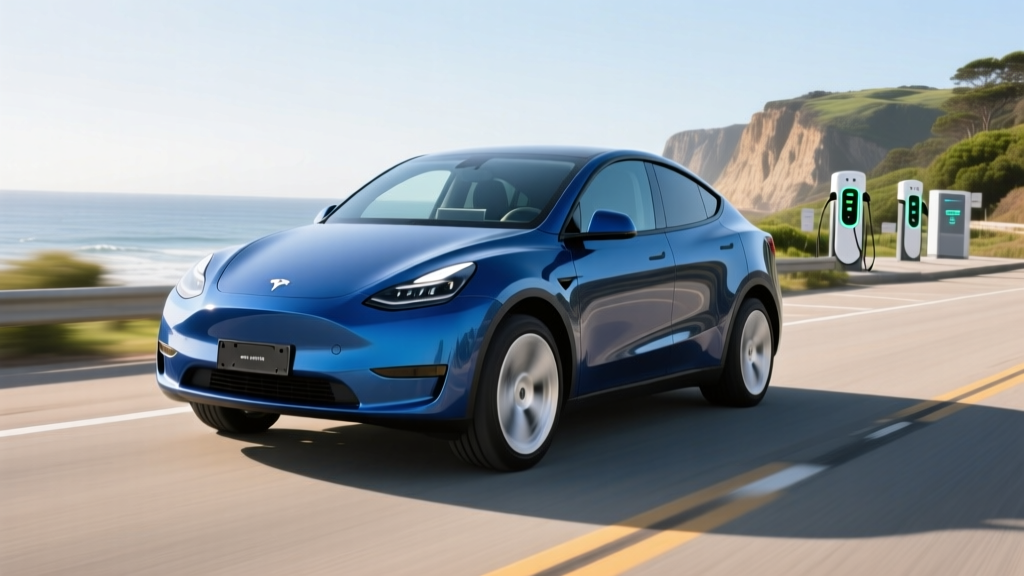
When shoppers search for a "Tesla 4 wheeler," they're almost always looking for the vehicle that defines Tesla's all-wheel-drive lineup for everyday buyers: the Tesla Model Y Long Range AWD. It's the dual-motor crossover that balances range, cargo space, Supercharger access, and pricing better than anything else in Tesla's garage — and it remains the EV to beat in the compact electric SUV segment for 2026.
This review covers the Model Y Long Range AWD (the most popular dual-motor configuration) with real-world range data, charging-curve honesty, §30D tax credit realities, and a direct look at where it wins and where it falls short against the Hyundai Ioniq 5, Ford Mustang Mach-E, and Kia EV6.
| Spec | Value |
|---|---|
| EPA Range | 308 miles |
| Battery (usable) | ~75 kWh, NMC chemistry |
| Drivetrain | Dual-motor AWD |
| Horsepower | 384 hp (combined) |
| 0-60 mph | 4.8 seconds |
| Peak DC Fast Charge | 250 kW (Supercharger V3) |
| 10-80% DC Time | ~27 minutes |
| Level 2 Home Charge | 11.5 kW (~44 mi/hr) |
| Efficiency | 122 MPGe combined / 28 kWh/100 mi |
| Cargo (rear seats up) | 30.2 cu ft |
| Cargo (rear seats folded) | 72.1 cu ft |
| Base MSRP | $48,990 (incl. destination) |
| Battery Warranty | 8 years / 120,000 miles |
Real-World Range: What 308 EPA Miles Actually Means on the Road
The EPA rates the 2026 Model Y Long Range AWD at 308 miles on a full charge. That number is credible for mixed suburban driving in mild weather, but real-world results depend heavily on speed, temperature, and terrain.
- City / suburban (55-65 mph, 60°F): ~295-315 miles — meets or slightly beats EPA
- Highway (75 mph, 60°F): ~255-275 miles — expect a 10-15% drop vs. sticker
- Cold weather (30°F, mixed driving): ~220-250 miles — LFP/NMC batteries lose 15-25% below freezing; the heat pump helps but doesn't eliminate loss
- Mountain / high-speed (80+ mph, elevation): ~210-240 miles — aerodynamic drag and climbing dominate
Tesla's trip planner and in-car energy graph are among the best in the industry for predicting arrival SoC, which mitigates range anxiety on road trips.
According to fueleconomy.gov, the Model Y LR AWD achieves 122 MPGe combined, which translates to roughly 28 kWh per 100 miles. That efficiency figure is a genuine competitive advantage: the Ioniq 5 AWD consumes about 30 kWh/100 mi, and the Mach-E ER AWD around 31 kWh/100 mi. Over 12,000 annual miles, that efficiency gap saves real money at the charger.
Charging Speed: Supercharger Network Is the Real Moat
Charging hardware on the Model Y Long Range AWD is mature and well-matched to Tesla's Supercharger network, which remains the most reliable public DC fast-charging ecosystem in North America.
| Level | Power | Rate | Notes |
|---|---|---|---|
| Level 1 (120V) | ~1.4 kW | ~5 mi/hr | Emergency/trickle only |
| Level 2 (240V, 48A) | 11.5 kW | ~44 mi/hr | Full charge in ~7-8 hours (Wall Connector) |
| DC Fast (V3 Supercharger) | 250 kW peak | 10-80% in ~27 min | Sustained ~150-180 kW through mid-SoC, then taper |
| DC Fast (V4 Supercharger) | Up to 250 kW | Similar curve | Newer stalls with CCS-adapter compatibility |
| Non-Tesla DC (CCS adapter) | Up to ~150-175 kW | Variable | Requires Tesla CCS adapter; Electrify America/EVgo compatible |
Charging-curve reality check: The "250 kW peak" figure applies only between roughly 10-30% SoC. Above 50%, the rate drops to ~120 kW; above 80%, it falls to ~40-60 kW. This is normal lithium-ion behavior, not a Tesla flaw — but it means a 10-90% session takes closer to 40 minutes, not 27. Always precondition the battery (the car does this automatically when you navigate to a Supercharger) to hit peak rates.
Home charging with Tesla's Wall Connector on a 60A circuit delivers the full 11.5 kW (48A continuous), adding roughly 44 miles of range per hour — enough to fully replenish overnight for virtually any daily commute. Installation typically runs $500-$1,500 depending on panel proximity; a 200A panel upgrade can add $1,500-$3,000 if your home is older.
Performance and Drivetrain: Dual-Motor AWD in Practice
The dual-motor AWD powertrain pairs a permanent-magnet rear motor with an induction front motor, producing a combined 384 hp and a 0-60 mph time of 4.8 seconds. That's sports-sedan quick in a crossover that seats five and carries 72 cubic feet of cargo.
The induction front motor is a deliberate engineering choice: it can freewheel with zero drag when not needed, improving highway efficiency versus a dual permanent-magnet setup. In practice, torque delivery is instant and linear, and the AWD system provides genuine traction benefits in rain, snow, and loose surfaces — this is a legitimate all-season "4 wheeler," not a marketing-badge AWD.
Ride quality has improved in the latest Juniper-refresh generation, with revised damper tuning that absorbs sharp pavement impacts better than the pre-2025 model. Road noise remains a weak point relative to the Hyundai Ioniq 5 and Genesis GV60, which use more acoustic insulation.
Pricing, Trims, and the §30D Federal Tax Credit Reality
The 2026 Model Y is offered in three primary trims. Pricing has stabilized after several years of aggressive cuts and adjustments:
| Trim | MSRP | Est. After §30D Credit | Credit Eligibility |
|---|---|---|---|
| Long Range RWD | $44,990 | ~$37,490 | Eligible (partial $3,750 or full $7,500 depending on sourcing) |
| Long Range AWD | $48,990 | ~$41,490 | Eligible (partial or full, per sourcing rules) |
| Performance AWD | $53,990 | ~$46,490 | Eligible (below $80,000 SUV cap) |
Critical tax credit caveats (IRS §30D, 2026 rules):
- MSRP cap: SUVs must be under $80,000 — all Model Y trims qualify.
- Buyer income cap: AGI must not exceed $150,000 (single), $225,000 (head of household), or $300,000 (joint). If you're over these limits, you don't qualify regardless of the vehicle.
- Battery sourcing: The full $7,500 requires meeting both critical-minerals and battery-component requirements. Tesla's shifting supply chain means the Model Y has oscillated between the full $7,500 and a partial $3,750 in recent years. Always verify current eligibility on fueleconomy.gov before purchasing, and confirm with your tax professional.
- Point-of-sale transfer: Since 2024, you can transfer the credit to the dealer at purchase, reducing your out-of-pocket cost immediately rather than waiting for tax filing. Tesla supports this at checkout.
Interior, Cargo, and Tech: Minimalist but Capable
The Model Y interior is defined by Tesla's minimalist ethos: a single 15.4-inch touchscreen handles virtually all controls, with no physical instrument cluster. Build quality in the 2026 Juniper-refresh generation is noticeably better than earlier Fremont-built cars, with tighter panel gaps, ventilated front seats, ambient lighting, and a rear-seat touchscreen for climate and media.
Cargo dimensions:
- Behind rear seats: 30.2 cu ft (more than Ioniq 5's 27.2 cu ft)
- Rear seats folded: 72.1 cu ft — class-leading for the segment
- Front trunk (frunk): 4.1 cu ft — useful for charging cables and small bags
- Rear legroom: 40.5 inches — adequate for adults on longer trips
Standout tech:
- Autopilot (standard): SAE Level 2 lane-keeping and adaptive cruise. Competent for highway driving but requires hands-on-wheel supervision. This is not self-driving.
- Full Self-Driving (Supervised): $8,000 option or $99/mo subscription. Still SAE Level 2 — the driver must remain fully engaged. Impressive in capability but frequently overpromised in marketing.
- Over-the-air updates: Tesla's OTA pipeline remains the industry's most active, adding features incrementally post-purchase.
- Sentry Mode / Dashcam: Built-in camera recording provides security and incident documentation without aftermarket hardware.
- Supercharger navigation: Automatic battery preconditioning when routing to a charger — a meaningful charging-speed advantage competitors are still catching up to.
Ownership Costs, Warranty, and Long-Term Battery Outlook
Tesla's battery and drive unit warranty on the Model Y Long Range AWD is 8 years or 120,000 miles, whichever comes first, with a guaranteed minimum 70% capacity retention over that period. The NMC battery chemistry offers higher energy density than LFP (enabling the 308-mile range in a relatively compact pack) but is more sensitive to sustained high-SoC storage. Best practice: charge to 80% daily, 100% only before road trips.
Estimated 5-year cost of ownership (15,000 mi/year, $0.14/kWh home charging, no tax credit applied):
- Electricity: ~$3,150 (vs. ~$9,000 in gasoline for a comparable AWD gas crossover at 25 MPG and $3.50/gal)
- Maintenance: ~$1,200 (no oil changes, minimal brake wear from regen, cabin filter replacements)
- Insurance: ~$9,500-$12,000 (Tesla premiums run 15-30% higher than segment average — get quotes before buying)
- Depreciation: Moderate — Model Y holds value better than most EVs but has softened since 2023 price cuts reset used values
Model Y AWD vs. Key Competitors: Which Tesla 4 Wheeler Alternative Wins?
The Model Y doesn't exist in a vacuum. Here's how it stacks up against the three most cross-shopped AWD electric crossovers:
| Spec | Tesla Model Y LR AWD | Hyundai Ioniq 5 AWD | Ford Mach-E ER AWD | Kia EV6 GT-Line AWD |
|---|---|---|---|---|
| EPA Range | 308 mi | 290 mi | 290 mi | 282 mi |
| Battery | ~75 kWh NMC | 84 kWh NMC | 91 kWh NMC | 77.4 kWh NMC |
| Peak DC Charge | 250 kW | 350 kW (800V) | 150 kW | 350 kW (800V) |
| 10-80% DC | ~27 min | ~18 min | ~45 min | ~18 min |
| Cargo (rear up) | 30.2 cu ft | 27.2 cu ft | 29.7 cu ft | 24.4 cu ft |
| Base MSRP (AWD) | $48,990 | $52,600 | $52,995 | $54,900 |
| NACS Native? | Yes | Yes (2026+) | Adapter required | Adapter required |
Where Model Y wins: Cargo volume, efficiency (kWh/100 mi), Supercharger network access (though opening to NACS competitors reduces this moat), and base price for AWD range.
Where Model Y loses: DC fast-charge speed (Ioniq 5 and EV6 at 350 kW / 18 min 10-80% significantly outpace Tesla's 27 minutes), interior material quality, and ride refinement. The Mach-E offers a more traditional cockpit layout for buyers who dislike Tesla's screen-only approach.
- Class-leading cargo volume (72.1 cu ft folded)
- Top-tier efficiency (122 MPGe combined)
- Supercharger network reliability
- Strong OTA update pipeline
- Competitive base price for 300+ mi AWD
- Excellent trip-planner / preconditioning integration
- DC charge speed trails 800V rivals (27 min vs. 18 min 10-80%)
- Road noise still above segment average
- Screen-only controls frustrate some drivers
- Insurance premiums 15-30% above average
- FSD (Supervised) costs $8,000 extra and remains Level 2
- Tax credit eligibility fluctuates with sourcing rules
Who Should Buy the Tesla Model Y AWD?
- You need maximum cargo space in a ~$45-50K electric crossover
- You road-trip frequently and value Supercharger reliability
- You prioritize energy efficiency and lowest cost-per-mile
- You're comfortable with a minimalist, screen-centric interface
- Your household income qualifies for the §30D credit
- DC fast-charge speed is your top priority (Ioniq 5 / EV6 win)
- You prefer physical buttons and a traditional instrument cluster (Mach-E)
- You want the quietest, most refined ride (Genesis GV60, Ioniq 5)
- Your AGI exceeds §30D caps, making the price premium harder to justify
Frequently Asked Questions
What is the real-world range of the Tesla Model Y AWD?
The EPA rates it at 308 miles, but expect ~255-275 miles at sustained highway speeds (75 mph) in mild weather, and ~220-250 miles in freezing temperatures. City driving in moderate conditions can match or slightly exceed the EPA number thanks to regenerative braking.
How fast does the Model Y charge at home and on the road?
On a Level 2 Tesla Wall Connector (11.5 kW), it adds ~44 miles of range per hour, fully charging overnight in 7-8 hours. On a V3 Supercharger (250 kW peak), 10-80% takes ~27 minutes, though the charge curve tapers significantly above 80%.
Does the Tesla Model Y qualify for the $7,500 federal EV tax credit?
It can, but eligibility depends on your income (AGI caps: $150K single / $300K joint), the vehicle's current battery-sourcing compliance, and the MSRP cap (SUVs under $80K — Model Y clears this). Verify current status on fueleconomy.gov and consult a tax professional. The credit can be transferred at point of sale to reduce your purchase price immediately.
Is the Model Y worth buying over the Ioniq 5 or Mach-E?
For cargo space, efficiency, and Supercharger access, yes. For DC fast-charge speed and ride refinement, the Ioniq 5 is the stronger pick. For a traditional cockpit layout, the Mach-E appeals. Test-drive all three — the right choice depends on your priorities.
Is Tesla Autopilot or FSD actually self-driving?
No. Both are SAE Level 2 driver-assist systems requiring continuous driver supervision — hands on wheel, eyes on road. They are advanced cruise and lane-keeping aids, not autonomous driving systems. Only Level 4 services like Waymo operate without a human driver, and those are geofenced robotaxis, not consumer vehicles.
How long will the Model Y battery last?
Tesla warranties the battery for 8 years / 120,000 miles with a minimum 70% capacity retention. Real-world data from high-mileage Tesla owners suggests NMC packs typically retain 85-90% capacity at 100,000 miles when charged responsibly (daily 80% limit, 100% only for trips). Full battery replacement out of warranty costs approximately $12,000-$16,000 as of 2026.
What's the biggest drawback of owning a Tesla Model Y?
Higher-than-average insurance premiums, screen-only controls that require a learning curve, and DC fast-charge speeds that now lag behind 800V competitors from Hyundai and Kia. Road noise on coarse pavement is also a persistent complaint relative to the price point.
Sources: fueleconomy.gov (EPA range and efficiency data), IRS §30D Clean Vehicle Credit rules, Tesla official specifications. All pricing and credit figures reflect 2026 model-year data and are subject to change — verify before purchase.