The Reality of Tesla 3rd Row Seating in 2026
Families shopping for a three-row electric SUV inevitably arrive at one question: which Tesla actually offers usable third-row seating, and is it worth the trade-offs? Tesla currently sells two vehicles with an optional third row — the Model Y (compact/midsize crossover) and the Model X (full-size luxury SUV). Both can seat up to seven, but the experience in that back row, the range impact, and the price gap between them could not be more different.
This guide breaks down exactly what you get with Tesla's third-row options in the 2026 model year: EPA range, real-world efficiency, DC fast-charging speeds, interior dimensions, pricing after federal tax credits, and which vehicle actually makes sense for family hauling versus occasional use.
Spec Showdown: Model Y vs Model X at a Glance
| Spec | 2026 Model Y Long Range AWD (7-seat) | 2026 Model X Long Range AWD (7-seat) |
|---|---|---|
| EPA Range | 300 mi (est. with 3rd row) | 335 mi |
| Battery Capacity | ~75 kWh usable (NMC) | ~100 kWh usable (NMC) |
| Max DC Fast Charge | 250 kW (peak) | 250 kW (peak) |
| 10–80% DC Charge Time | ~27 min | ~32 min |
| Level 2 Home Charging | 11.5 kW / ~44 mi/hr | 11.5 kW / ~34 mi/hr |
| 0–60 mph | 4.8 sec | 3.8 sec |
| Horsepower | 384 hp (dual motor) | 670 hp (dual motor) |
| Drivetrain | AWD (dual motor) | AWD (dual motor) |
| MPGe (combined) | 122 MPGe | 102 MPGe |
| Efficiency | 28 kWh/100 mi | 33 kWh/100 mi |
| Cargo (behind 3rd row) | 12.1 cu ft | 15.8 cu ft |
| Cargo (3rd row folded) | 30.2 cu ft | 37.1 cu ft |
| 3rd Row Legroom | 26.5 in | 32.7 in |
| Battery Warranty | 8 yr / 120,000 mi | 8 yr / 150,000 mi |
| Base MSRP (7-seat) | ~$50,490 | ~$81,630 |
| Federal Tax Credit (§30D) | Up to $7,500 | Not eligible (MSRP cap) |
Sources: fueleconomy.gov, Tesla Model S/X specs, Tesla Model Y specs. Pricing reflects estimated 2026 MSRP including the $2,000 seven-seat option.
Third-Row Space: Kids-Only vs Adult-Capable
The single biggest differentiator between these two vehicles is what happens when you fold down into that third row. The Model Y, built on a compact crossover platform, offers 26.5 inches of third-row legroom. That's enough for children up to roughly 12 years old on longer trips, or adults on short around-town drives of 20 minutes or less. The seat cushion sits low to the floor, creating a "knees-up" posture that adults will find fatiguing beyond a quick ride.
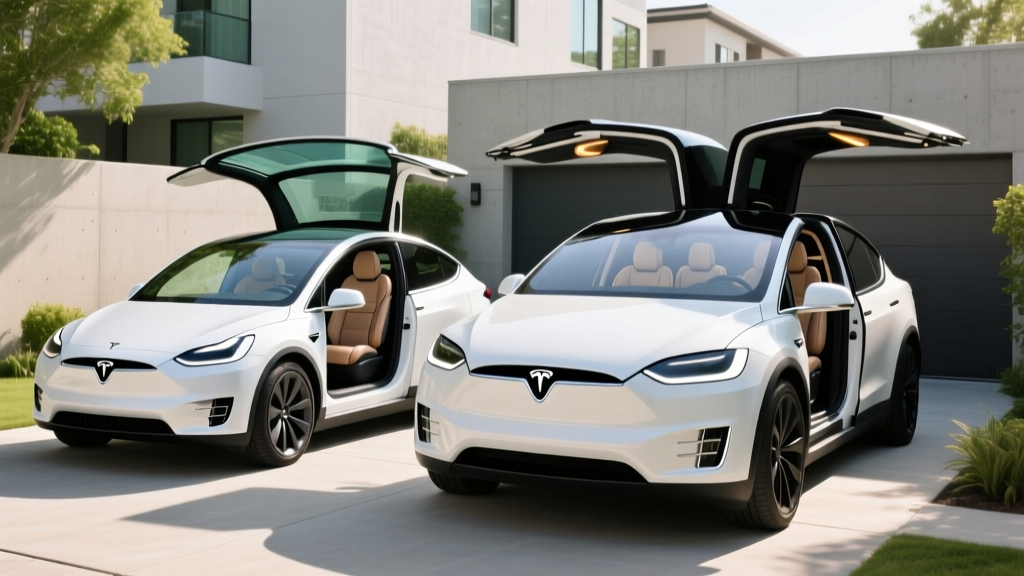
The Model X, by contrast, delivers 32.7 inches of third-row legroom — genuinely enough for average-height adults on multi-hour road trips. The seat cushion is thicker, the headroom is more generous thanks to the taller roofline, and the falcon-wing rear doors make loading children and car seats dramatically easier than the Model Y's conventional swing-out doors in tight parking spots.
Cargo space tells a similar story. With all three rows upright, the Model Y provides 12.1 cubic feet behind the third row — enough for two carry-on suitcases or a week's groceries for a family of four. The Model X gives you 15.8 cubic feet, which accommodates a full Costco run with the third row still in use. Fold the third row, and the gap widens: 30.2 cu ft in the Model Y versus 37.1 cu ft in the Model X.
Real-World Range: What the EPA Sticker Doesn't Tell You
EPA estimates are a starting point, not a guarantee. Here's how these two vehicles perform once you leave the test cycle behind.
Both vehicles use NMC (nickel manganese cobalt) battery chemistry, which offers higher energy density than LFP but follows a recommended 80% daily charge limit for longevity. Tesla's battery management system includes a buffer (roughly 2–3 kWh below the stated usable capacity) to protect against deep discharge degradation. For daily commuting, plan your routes around 80% of the EPA figure to preserve battery health.
Charging Speed: Home and on the Road
Charging speed is where kW (power — how fast energy flows) and kWh (energy — what's stored in the battery) matter most. Both the Model Y and Model X use Tesla's NACS connector natively and access the Supercharger network without adapters.
| Charging Level | Model Y Long Range | Model X Long Range |
|---|---|---|
| Level 1 (120V / 12A) | ~1.4 kW / ~5 mi/hr | ~1.4 kW / ~4 mi/hr |
| Level 2 (240V / 48A) | 11.5 kW / ~44 mi/hr | 11.5 kW / ~34 mi/hr |
| DC Fast Charge (peak) | 250 kW | 250 kW |
| 10–80% DC Time | ~27 minutes | ~32 minutes |
| Sustained Rate (10–50%) | ~180–220 kW avg | ~170–210 kW avg |
| Above 80% Taper | Drops to ~40–60 kW | Drops to ~50–70 kW |
A critical detail many buyers miss: peak kW is not sustained kW. Both vehicles hit 250 kW only at a low state of charge (typically 10–20%) on a V3 Supercharger with battery preconditioning active. As the battery fills, the charge curve tapers significantly. From 80% to 100%, you'll be waiting at dramatically reduced speeds — which is why Tesla (and battery longevity best practices) recommend charging to 80% on road trips and topping off only when necessary.
For home Level 2 charging, a Tesla Wall Connector on a 60-amp circuit delivers the full 48 amps (11.5 kW) to both vehicles. Expect a full overnight charge from 20% to 80% in roughly 4 hours for the Model Y and 5 hours for the Model X. Installation typically costs $800–$2,000 depending on your panel capacity and run length — budget for a potential panel upgrade if your home still has a 100-amp service.
Pricing, Trims, and Federal Tax Credit Eligibility
The price gap between these two vehicles is substantial — and the tax credit picture makes it even wider.
| Cost Factor | Model Y Long Range (7-seat) | Model X Long Range (7-seat) |
|---|---|---|
| Base MSRP (5-seat) | ~$48,490 | ~$79,630 |
| 7-Seat Option | +$2,000 | +$2,000 |
| As-Configured MSRP | ~$50,490 | ~$81,630 |
| Federal §30D Credit | Up to $7,500 | $0 (exceeds MSRP cap) |
| Effective Price (w/ credit) | ~$42,990 | ~$81,630 |
| Destination Fee | +$1,390 | +$1,390 |
Why the Model X doesn't qualify: Under IRS §30D rules, SUVs must have an MSRP at or below $80,000 to be eligible for the federal clean vehicle credit. The Model X Long Range with the seven-seat option exceeds that threshold. The Model Y, classified as an SUV, falls under the same $80,000 cap and comfortably qualifies — assuming the buyer meets income requirements.
- MSRP Cap: SUVs ≤ $80,000; sedans ≤ $55,000
- Buyer Income Cap: AGI ≤ $150,000 (single), $225,000 (head of household), $300,000 (joint)
- Battery Sourcing: Critical minerals and battery components must meet phased-in percentage thresholds from U.S. or FTA partners
- Point-of-Sale Transfer: Eligible buyers can apply the credit as a down-payment reduction at purchase (dealer must be IRS-registered)
- Assembly: Final assembly must occur in North America
Source: IRS.gov §30D Clean Vehicle Credit. Rules are subject to change — verify eligibility with a tax professional before purchase.
Performance, Tech, and Daily Ownership
Both vehicles come standard with dual-motor all-wheel drive, Tesla's 15.4-inch touchscreen infotainment system, and access to the Supercharger network (now exceeding 6,000 V3/V4 stalls in North America). Autopilot — Tesla's Level 2 driver-assistance system — is included on both, with Full Self-Driving (Supervised) available as a $8,000 option or $99/month subscription.
The Model X's additional 286 horsepower shows in its 3.8-second 0–60 time versus the Model Y's 4.8 seconds. For a family SUV, both are more than quick enough. Where the Model X distinguishes itself daily is ride quality: its adaptive air suspension smooths out rough pavement and allows adjustable ride height for loading or snow clearance — a feature the Model Y's coil-spring setup lacks entirely.
On the tech front, both vehicles receive over-the-air updates, but the Model X adds features like the powered falcon-wing doors, a panoramic windshield that extends over the front seats, and a more premium audio system with additional speakers. The Model Y's minimalist interior is efficient but spartan — no instrument cluster, ventilated seats, or ambient lighting unless added through aftermarket modification.
Biggest Pros and Cons
- Qualifies for up to $7,500 federal tax credit — effective price under $43K
- Best-in-class efficiency at 122 MPGe combined
- Supercharger network access with NACS native connector
- Lowest entry price for a 7-seat EV from a major brand
- 44 mi/hr Level 2 home charging gets you back to full overnight
- Third row only practical for children — 26.5" legroom
- Just 12.1 cu ft cargo behind third row
- No air suspension, no ventilated seats, minimal luxury touches
- Real-world highway range drops to ~260 mi with full passenger load
- Insurance premiums run 15–25% higher than comparable non-Tesla SUVs
- Genuine adult-capable third row with 32.7" legroom
- Falcon-wing doors make car-seat loading dramatically easier
- Air suspension, premium interior, panoramic glass roof
- 335 mi EPA range with 100 kWh battery — longest 7-seat EV range available
- 670 hp dual-motor performance with 3.8-sec 0–60
- Does NOT qualify for federal §30D tax credit (MSRP exceeds $80K cap)
- Over $81,000 before options — a $38,000+ premium over the Model Y
- Lower efficiency at 102 MPGe — higher per-mile charging cost
- Falcon-wing doors can be slow to open and problematic in freezing rain
- Historically lower reliability scores vs Model Y (per Consumer Reports)
Who Should Buy Which?
- Your third-row passengers are primarily children under 12
- You need the federal tax credit to make the numbers work
- Efficiency and low cost-per-mile are top priorities
- You'll use the third row 20% of the time or less
- Budget is a primary constraint — you want a 7-seat EV under $45K after incentives
- You regularly carry adults or teenagers in the third row
- You need maximum cargo space with all three rows in use
- Falcon-wing doors are a genuine convenience for car-seat management
- Air suspension and a premium cabin are worth the $38K+ premium
- Tax credit ineligibility doesn't change your purchase decision
How Does Tesla 3rd Row Seating Compare to Rivals?
The three-row EV market has expanded considerably. Key competitors include the Kia EV9 (EPA ~300 mi, starting ~$56K, tax-credit eligible, 29.1" third-row legroom), the Rivian R1S (EPA ~352 mi, starting ~$79,900, borderline on MSRP cap), and the Hyundai Ioniq 9 (EPA ~310 mi est., starting ~$55K). The Kia EV9 offers more third-row space than the Model Y at a similar price point, while the Rivian R1S delivers off-road capability and genuine adult third-row room closer to the Model X — though at a premium.
Tesla's advantage remains the Supercharger network (still the most reliable and expansive DC fast-charging ecosystem in North America) and class-leading efficiency. But if third-row comfort is your primary purchase driver, test-sit in the Model Y before committing — the dimensions don't lie, and 26.5 inches of legroom is tight for anyone over 5 feet tall.
Frequently Asked Questions
What is the real-world range of the Tesla Model Y with the third-row option?
With the seven-seat configuration, expect approximately 260–280 miles in mixed highway driving and 220–240 miles in cold weather (below 30°F). The EPA sticker reads ~300 miles, but real-world conditions — especially highway speeds above 70 mph and winter temperatures — reduce that figure by 10–25%.
How fast do the Model Y and Model X charge at home and on the road?
On a Level 2 home charger (240V/48A), both vehicles accept 11.5 kW — translating to roughly 44 miles of range per hour for the Model Y and 34 mi/hr for the Model X. On a V3 Supercharger, both peak at 250 kW and charge from 10–80% in 27 minutes (Model Y) or 32 minutes (Model X). Actual sustained rates average 180–220 kW in the lower half of the charge curve.
Does the Tesla Model X qualify for the federal EV tax credit?
No. Under current IRS §30D rules, SUVs must have an MSRP at or below $80,000 to qualify. The Model X Long Range with the seven-seat option starts at approximately $81,630, exceeding the cap. The Model Y qualifies for up to $7,500, subject to buyer income limits and battery-sourcing requirements.
Can adults sit comfortably in the Tesla Model Y third row?
For short trips (under 20 minutes), yes. For road trips or daily school runs longer than 15 minutes, adults will find the 26.5 inches of legroom and low seat cushion uncomfortable. The Model Y third row is realistically designed for children up to about 12 years old. If you need adult-capable third-row seating, the Model X (32.7" legroom) or the Kia EV9 (29.1") are better options.
Is Tesla's Autopilot or FSD self-driving?
No. Both Autopilot and Full Self-Driving (Supervised) are SAE Level 2 driver-assistance systems. They can manage steering, acceleration, and braking on highways, but the driver must remain fully attentive with hands on or near the wheel. These are not autonomous systems — Tesla's own naming can be misleading, and the "Supervised" designation in FSD's name reflects this requirement.
What is the battery warranty on both vehicles?
The Model Y Long Range carries an 8-year/120,000-mile battery and drive unit warranty. The Model X Long Range extends that to 8 years/150,000 miles. Both warranties guarantee a minimum 70% battery capacity retention over the warranty period. Tesla uses NMC chemistry in both, which historically degrades 10–15% over the first 100,000 miles before stabilizing.