Quick Verdict: The 3 Row Model Y Compromise
Tesla's optional third-row seat for the Model Y has been available since the vehicle's early production years, and the 2026 refresh (sometimes called the "Juniper" update) carries it forward. The promise is enticing: a compact electric crossover that seats up to seven passengers, undercutting larger electric SUVs on price while tapping into the Supercharger network. But the 3 row Model Y is a vehicle defined by its trade-offs. The third row is best suited for children, cargo space shrinks significantly when all seats are in use, and the starting price now sits higher than many buyers expect after years of aggressive Tesla price cuts.
If you need occasional extra seating for school runs or short family trips and want the lowest-cost entry into a three-row electric vehicle with DC fast-charging capability and a mature charging network, the 3 row Model Y remains a compelling — if imperfect — choice. If you regularly carry adults in the back or need serious cargo volume with all seats up, you'll want to look at larger alternatives.
Range, Battery, and Real-World Efficiency
The 2026 Tesla Model Y Long Range AWD — the trim most buyers pair with the third-row option — carries an EPA-estimated range of 308 miles on its 75 kWh usable battery pack (NMC chemistry). The base rear-wheel-drive model, which previously used an LFP (lithium iron phosphate) battery in some model years, has shifted to NMC chemistry for the Juniper generation to support faster charging and better cold-weather performance across the lineup.
EPA sticker: 308 miles (Long Range AWD). In practice, expect approximately 260–280 miles during sustained highway driving at 70–75 mph, and as low as 220–240 miles in freezing temperatures with cabin heat running. The third-row option adds roughly 50–70 lbs of weight, which trims 2–4 miles off range compared to the five-seat configuration — a negligible difference in daily use but measurable on long road trips.
| Spec | Value |
|---|---|
| EPA Range | 308 miles |
| Battery (Usable) | 75 kWh, NMC |
| Efficiency | 117 MPGe combined / 29 kWh/100 mi |
| Max DC Fast Charge | 250 kW (peak) |
| 10–80% DCFC Time | ~25 minutes |
| Level 2 Home Charge | 11.5 kW / ~44 mi/hr |
| 0–60 mph | 4.8 seconds |
| Horsepower | 384 hp (dual motor) |
| Drivetrain | AWD (dual motor) |
| Battery Warranty | 8 years / 120,000 miles (≥70% retention) |
| Base MSRP | $48,990 (LR AWD) + $2,500 third-row option |
Efficiency is where the Model Y platform continues to shine. At 117 MPGe combined (29 kWh per 100 miles), it remains one of the most efficient electric SUVs on the market, meaning your electricity cost per mile stays low whether you're charging at home or at public DC fast chargers. For context, that translates to roughly $0.04–$0.06 per mile on residential electricity at the national average of ~$0.16/kWh, compared to $0.12–$0.15/mile in a comparable gas-powered three-row SUV at 22 MPG combined.
Charging Speed: DC Fast, Level 2, and the Supercharger Advantage
The 2026 Model Y Long Range AWD supports a peak DC fast-charge rate of 250 kW on V3 and V4 Superchargers, as well as on CCS-compatible third-party networks (using the Tesla-provided CCS adapter or the native NACS port, depending on your vehicle's production date). The charging curve holds near peak power from roughly 10% to 45% State of Charge, then tapers progressively — a characteristic of NMC chemistry and Tesla's thermal management strategy.
| Level | Power | Miles Added/Hour | Notes |
|---|---|---|---|
| Level 1 (120V) | ~1.4 kW | ~4 mi/hr | Emergency/trickle only |
| Level 2 (240V, 48A) | 11.5 kW | ~44 mi/hr | Full overnight charge in ~7 hrs |
| DC Fast (250 kW peak) | 250 kW | ~200+ mi in 15 min | 10–80% in ~25 min |
At home on a Level 2 Wall Connector (or equivalent 48-amp, 240V circuit), the Model Y adds roughly 44 miles of range per hour, meaning a full charge from near-empty takes about 7 hours — easily accomplished overnight. Home installation for a Level 2 circuit typically runs $800–$2,000 if your electrical panel has capacity; a panel upgrade from 100A to 200A can add $1,500–$3,000. Always have a licensed electrician evaluate your panel before committing to equipment.
On the road, the Tesla Supercharger network remains the Model Y's strongest charging asset. With over 6,000 stations and 65,000+ connectors in North America as of early 2026, route planning via the car's built-in navigation is seamless — the vehicle preconditions the battery automatically when a Supercharger is set as your destination, which is critical for achieving peak charge rates. Third-party networks (Electrify America, EVgo, ChargePoint) work via the NACS connector or adapter, though reliability and plug-and-charge payment experiences vary by station.
Third-Row Space, Cargo, and Interior Practicality
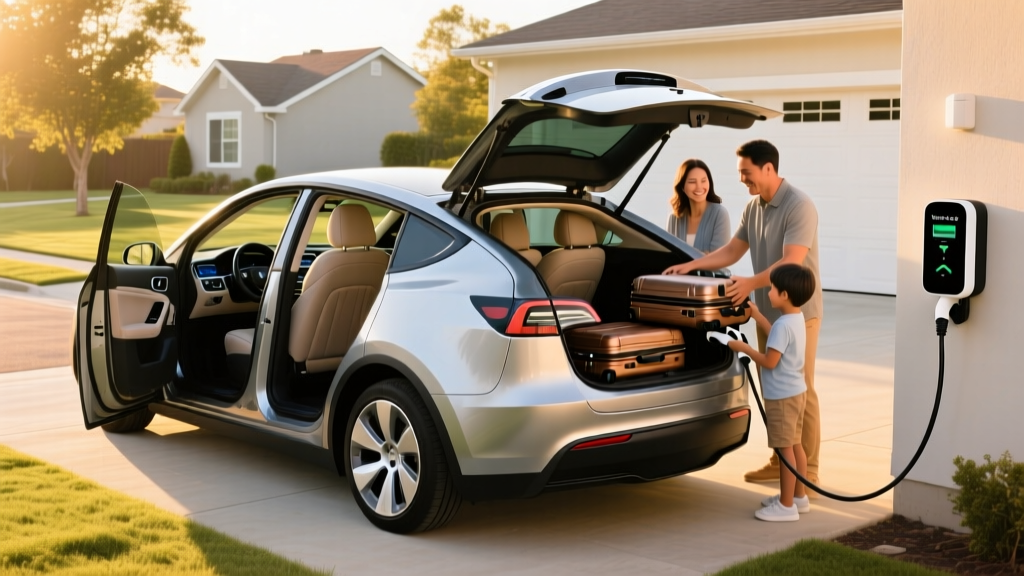
Let's address the core question directly: the third row in the Model Y is not an adult-friendly space for long journeys. Tesla lists third-row legroom at approximately 26.5 inches, which is tight even for children on extended trips. Headroom is also constrained by the sloping roofline. Most families use the third row for children aged 4–10 on short drives — school drop-offs, sports practices, neighborhood errands — and fold it flat for cargo the rest of the time.
Cargo volume tells the real story of the trade-off:
- All three rows up: ~10 cu ft (enough for a few grocery bags or a compact stroller)
- Third row folded, second row up: ~34 cu ft
- All rear rows folded: ~72 cu ft (plus the front trunk/frunk adds ~4 cu ft)
For comparison, the Kia EV9 offers 20 cu ft behind its third row and 81.7 cu ft total, while the Rivian R1S provides 16.5 cu ft behind the third row and up to 104.7 cu ft with seats folded. The Model Y's packaging efficiency is excellent for its footprint, but physics wins — you cannot fit a full-size SUV's worth of space into a compact crossover.
The Juniper-refreshed interior is a marked improvement over earlier Model Y cabins. Tesla has added ventilated front seats, ambient lighting, a rear-seat entertainment screen (8 inches), improved sound insulation, and a more refined material palette. The 15.4-inch front touchscreen remains the command center for everything — navigation, media, climate, and vehicle settings — with no physical buttons to speak of. Love it or not, the interface is fast, responsive, and receives regular over-the-air updates.
Performance, Ride, and Driver Assistance
The dual-motor Long Range AWD Model Y produces 384 horsepower and hits 0–60 mph in 4.8 seconds — genuinely quick for a family vehicle and more than adequate for highway merging and passing. The Performance trim (if available in your market) drops that to 3.5 seconds with 456 hp, but sacrifices some range and ride comfort.
Ride quality on the Juniper refresh has improved noticeably with revised damper tuning and additional acoustic insulation, but the Model Y still rides firmer than competitors like the Hyundai Ioniq 9 or Kia EV9. Road noise is better managed than pre-2025 models but remains present on coarse pavement at highway speeds.
Tesla's Autopilot (standard) and Full Self-Driving Supervised ($8,000 option or $99/month subscription) are SAE Level 2 driver-assistance systems. You must keep your hands on the wheel and eyes on the road at all times. FSD Supervised handles highway lane changes, on-ramps, and some city streets impressively, but it is not autonomous. It makes errors — phantom braking, misread lane markings, unexpected routing — and the driver is legally and practically responsible. Do not confuse this with Level 4 robotaxi services like Waymo.
Tesla's driver-assistance tech is feature-rich but polarizing. Standard Autopilot includes adaptive cruise control and lane-centering on highways, which works reliably on well-marked roads. FSD Supervised extends capability to city streets with traffic light and stop sign recognition, automatic turns, and navigation-guided routing. Real-world performance varies dramatically by geography and road complexity — excellent in Sun Belt suburbs with wide boulevards, less trustworthy in dense Northeast cities or construction zones.
Pricing, Trims, and Federal Tax Credit Eligibility
As of early 2026, the Tesla Model Y lineup is priced as follows (before any incentives):
| Trim | MSRP | + Third Row | Est. After §30D Credit* |
|---|---|---|---|
| Long Range AWD | $48,990 | $51,490 | ~$43,990 |
| Performance AWD | $53,990 | $56,490 | ~$48,990 |
*Estimated prices assume full $7,500 federal tax credit eligibility. Actual eligibility depends on multiple factors — see checklist below.
The third-row option costs $2,500 and is available on both the Long Range and Performance trims. It cannot be added after delivery — you must order it at purchase.
- MSRP cap: SUVs/vans/pickups must be ≤$80,000 — the Model Y qualifies ✓
- Buyer income cap: AGI ≤$150,000 (single), ≤$225,000 (head of household), ≤$300,000 (joint) ✓ for most families
- Battery sourcing: Critical minerals and battery components must meet phased-in domestic/free-trade sourcing thresholds — Tesla has restructured supply chains to largely comply, but confirm at point of sale
- Point-of-sale transfer: You can transfer the credit to the dealer at purchase for an immediate price reduction rather than waiting for tax filing
- Final assembly: Must be in North America — the Model Y is assembled in Austin, TX, and Fremont, CA ✓
Source: IRS §30D Clean Vehicle Credit. Rules are subject to change. Consult a tax professional for your specific situation.
How the 3 Row Model Y Stacks Up Against Competitors
The compact and midsize three-row EV market has expanded considerably. Here's how the Model Y compares on the metrics that matter most to family buyers:
| Vehicle | EPA Range | 3rd-Row Legroom | Cargo (all rows up) | 10–80% DCFC | Starting MSRP |
|---|---|---|---|---|---|
| Tesla Model Y (3-row) | 308 mi | 26.5 in | ~10 cu ft | ~25 min | $51,490 |
| Kia EV9 LR AWD | 280 mi | 32.0 in | 20 cu ft | ~24 min | $59,900 |
| Hyundai Ioniq 9 LR AWD | 311 mi | 31.5 in | 18 cu ft | ~20 min | $56,500 |
| Rivian R1S Dual-Motor | 340 mi | 30.1 in | 16.5 cu ft | ~28 min | $75,900 |
The Model Y's advantage is clear: it is the least expensive three-row EV with 300+ miles of range and access to the Supercharger network. Its disadvantages are equally clear: the smallest third row and the least cargo space with all seats in use. The Kia EV9 and Hyundai Ioniq 9 both offer meaningfully more usable third-row space and cargo volume for $5,000–$8,000 more, while the Rivian R1S dominates on capability and space but at a steep premium.
- Lowest MSRP in the 3-row EV segment
- 308-mile EPA range with strong efficiency
- 250 kW DC fast charging + Supercharger network
- Quick: 0–60 in 4.8 seconds
- OTA updates continuously improve the vehicle
- Low running cost (~$0.05/mi on home charging)
- Third row fits only small children comfortably
- ~10 cu ft cargo with all rows up is very limited
- No Apple CarPlay or Android Auto
- FSD Supervised is expensive and not truly autonomous
- No physical buttons — everything via touchscreen
- Insurance costs run 15–25% above segment average
Who Should Buy the 3 Row Model Y?
- You need a third row only occasionally (2–3 times per week for short trips with kids)
- Budget is a primary concern and you want the lowest entry price for a 3-row EV
- You have reliable home Level 2 charging and want minimal public charging dependency
- You value the Supercharger network for road trips
- You're a tech-forward buyer comfortable with a touchscreen-only interface
- You regularly transport more than 5 passengers, including teens or adults in the third row
- You need substantial cargo space with all seats in use (strollers, sports gear, luggage)
- You prefer physical controls and Apple CarPlay/Android Auto integration
- You want a more comfortable, isolated ride quality over sporty handling
Ownership Costs and Warranty
Tesla covers the Model Y's battery and drive unit for 8 years or 120,000 miles (whichever comes first), with a guaranteed minimum 70% capacity retention over that period. The limited vehicle warranty is 4 years / 50,000 miles. These terms are competitive with the segment — Kia and Hyundai offer 10-year/100,000-mile battery warranties, but Tesla's real-world battery degradation data across millions of vehicles suggests most packs retain 85–90% capacity at 100,000 miles.
Insurance is a genuine cost factor. Model Y insurance premiums average $2,200–$3,000/year depending on your state, driving record, and coverage level — roughly 15–25% higher than comparable internal-combustion SUVs. Get quotes before purchasing. Maintenance costs, however, are minimal: no oil changes, no spark plugs, and regenerative braking extends brake pad life to 100,000+ miles for most drivers. Tesla recommends cabin air filter replacement every 2–3 years and tire rotation every 6,250 miles.
According to fueleconomy.gov, the Model Y Long Range AWD's annual electricity cost is approximately $600 (15,000 miles/year at $0.16/kWh), compared to $2,100–$2,400 in annual fuel costs for a gas-powered three-row SUV averaging 22 MPG at $3.50/gallon. That's a $1,500–$1,800 annual fuel savings that partially offsets the higher purchase price and insurance costs.
Frequently Asked Questions
What is the real-world range of the 3 row Model Y?
The EPA rates the 2026 Model Y Long Range AWD at 308 miles. Expect 260–280 miles in real-world highway driving at 70–75 mph, and 220–240 miles in cold weather (below 32°F) with cabin heating. The third-row option reduces range by approximately 2–4 miles due to added weight — negligible in practice.
How fast does the Model Y charge at home and on the road?
On a home Level 2 charger (240V, 48A), the Model Y charges at 11.5 kW, adding about 44 miles of range per hour — a full charge takes roughly 7 hours. On a 250 kW DC fast charger (Tesla Supercharger V3/V4), it charges from 10–80% in approximately 25 minutes. The charge curve tapers significantly above 80%, so plan to charge to 80% on road trips for the best time efficiency.
Does the 3 row Model Y qualify for the $7,500 federal tax credit?
The Model Y qualifies for up to $7,500 under IRS §30D, provided you meet income limits (≤$300,000 joint / ≤$150,000 single), the vehicle MSRP is under $80,000 (it is), and battery sourcing requirements are met at time of purchase. The credit can be transferred to the dealer at point of sale for an immediate price reduction. Verify current eligibility at irs.gov and with your tax advisor.
Is the third row suitable for adults?
For short trips under 20 minutes, a flexible adult can manage. For anything longer, the 26.5 inches of legroom and constrained headroom make it uncomfortable. The third row is best suited for children aged roughly 4–12. If you regularly carry six or seven adults, the Kia EV9 or Rivian R1S are significantly better choices.
How does the Model Y compare to the Kia EV9 for families?
The Model Y is about $8,000 cheaper to start, has 28 more miles of EPA range, and benefits from the Supercharger network. The EV9 offers substantially more third-row legroom (32.0 vs. 26.5 inches), double the cargo space behind the third row (20 vs. ~10 cu ft), and supports 800V charging architecture. For families that use the third row daily, the EV9 is the more practical vehicle. For budget-conscious buyers who need the third row occasionally, the Model Y wins on value.
What does it cost to maintain a Model Y?
Annual maintenance is minimal — roughly $200–$400 per year for tire rotation, cabin air filter replacement, and windshield washer fluid. There are no oil changes, transmission fluid services, or spark plug replacements. Brake pads last 100,000+ miles thanks to regenerative braking. The largest ownership costs are insurance ($2,200–$3,000/year) and tire replacement ($1,200–$1,800 for a set of four EV-rated tires every 30,000–40,000 miles).
Can I add the third row after purchasing a 5-seat Model Y?
No. The third-row seat must be ordered at the time of purchase as a factory-installed $2,500 option. Tesla does not offer a retrofit kit, and third-party solutions are not available or advisable given safety certification requirements.