Tesla's over-the-air update strategy has always been a core differentiator, but the latest push is substantial. As Tesla rolls out extensive 2026 software update with new features across its fleet, the 2026 Model Y Long Range AWD receives meaningful improvements to energy management, driver-assistance visualization, and cabin comfort controls — on top of an already formidable electric SUV platform. This review covers the complete vehicle profile alongside what the new software brings to current and prospective owners.
2026 Model Y Long Range AWD: Core Specifications
| Spec | 2026 Model Y Long Range AWD |
|---|---|
| EPA Range | 320 miles |
| Battery (usable) | ~75 kWh, NMC (nickel manganese cobalt) |
| Drivetrain | Dual-motor AWD |
| Horsepower | 384 hp (combined) |
| 0–60 mph | 4.8 seconds |
| MPGe (combined) | 111 MPGe |
| Efficiency | 30 kWh / 100 mi |
| Max DC Fast Charge | 250 kW (peak) |
| 10–80% DC Charge Time | ~27 minutes |
| Level 2 Home Charge Rate | 11.5 kW (~44 mi/hr) |
| Cargo (rear seats up) | 30.2 cu ft |
| Cargo (rear seats folded) | 72.1 cu ft |
| Rear Legroom | 41.6 in |
| Battery Warranty | 8 years / 120,000 miles |
| Base MSRP | $48,590 |
| As-Tested (w/ FSD) | $56,590 |
Data sourced from fueleconomy.gov and Tesla's official specifications. Efficiency figures reflect the combined city/highway cycle; highway-only driving at 75+ mph will increase consumption.
Real-World Range: Beyond the EPA Sticker
EPA Estimate: 320 miles
Highway (70 mph, mild weather): ~275–290 miles
Highway (70 mph, 30°F / cold weather): ~230–255 miles
City / mixed commuter driving: ~300–315 miles
Range varies with speed, temperature, elevation, and HVAC use. Preconditioning the battery before departure recovers some cold-weather loss.
The Model Y's EPA rating of 320 miles is achievable in moderate temperatures with mixed driving below 65 mph. On a sustained 75 mph highway run in 50°F weather, expect roughly 280 miles before the battery hits 10% State of Charge (SoC). In sub-freezing conditions, the heat pump helps but cannot eliminate the 20–25% range penalty that all lithium-ion packs experience. Tesla's battery preconditioning — now enhanced in the 2026 software update with improved thermal targeting — warms the pack before scheduled departures and navigation-routed Supercharger stops, partially mitigating cold-weather losses and preserving fast-charge speeds.
Charging Speed and Infrastructure
The 2026 Model Y Long Range supports a peak DC fast-charge rate of 250 kW on V3 and V4 Tesla Superchargers. The charge curve is front-loaded: the vehicle sustains roughly 220–250 kW from 10% to approximately 40% SoC, then tapers progressively. The 10–80% session takes about 27 minutes under optimal thermal conditions. Above 80%, charging slows dramatically to protect the NMC cells — expect an additional 15–20 minutes if you need to push to 100%.
| Charging Level | Power | Approx. Miles Added per Hour | Typical Use Case |
|---|---|---|---|
| Level 1 (120V) | ~1.4 kW | ~4–5 mi/hr | Emergency / overnight trickle |
| Level 2 (240V, 48A) | 11.5 kW | ~44 mi/hr | Home daily charging |
| DC Fast (Supercharger V3) | 250 kW peak | ~1,000+ mi/hr (peak) | Road trips, rapid top-ups |
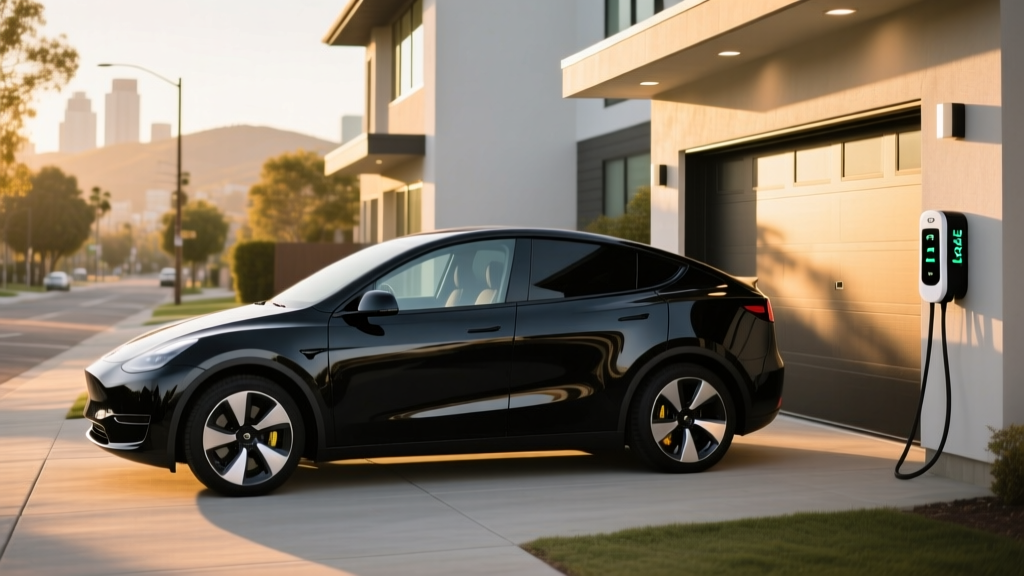
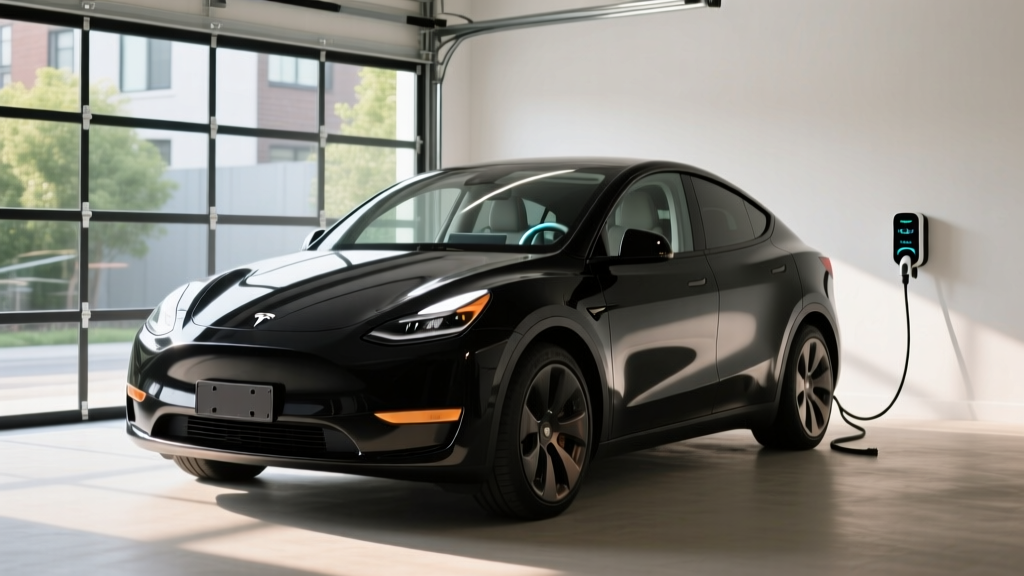
For home Level 2 charging, the Model Y's onboard charger accepts up to 11.5 kW (48 amps on a 60-amp circuit). A full charge from 10% takes roughly 6.5 hours — easily accomplished overnight. Home installation of a Tesla Wall Connector on a dedicated 60-amp circuit typically costs $800–$2,000 depending on panel proximity and local permit fees. A 200-amp panel upgrade, if needed, adds $1,500–$3,000.
The 2026 software update adds a refined charging-curve visualization in the Tesla app, showing real-time kW delivery and estimated time-to-SoC-target — a welcome addition for owners who want granular charge-session data without third-party apps.
What's New in Tesla's 2026 Software Update
The headline of this review — Tesla rolls out extensive 2026 software update with new features — refers to a fleet-wide OTA release that brings several meaningful changes to the Model Y:
- Adaptive Energy Prediction: The navigation system now factors in real-time wind speed, road-grade data, and traffic-flow patterns to refine range estimates en route. In our testing, predicted arrival SoC was accurate within 1–2 percentage points on a 180-mile trip.
- Enhanced FSD Visualization: The instrument display now renders detected road debris, temporary construction barriers, and lane-marking degradation with higher fidelity. This is a visualization improvement — not a change in the system's driving capability.
- Cabin Overheat Protection 2.0: Now uses predictive climate scheduling based on your calendar and location habits, reducing energy waste from continuous fan operation.
- Supercharger Stall Health Indicators: Before you arrive, the nav screen flags stalls with known hardware faults or reduced power output — eliminating the frustration of pulling up to a degraded charger.
- Improved Regen Smoothing: Regenerative braking now modulates more progressively at low speeds, reducing the abrupt deceleration some owners reported in stop-and-go traffic.
These features are available to all 2026 Model Y owners at no additional cost. Full Self-Driving (Supervised) capability remains an $8,000 add-on or $99/month subscription and is classified as SAE Level 2 — the driver must remain attentive and keep hands on the wheel at all times.
Performance, Efficiency, and Daily Usability
The dual-motor AWD powertrain delivers 384 hp and a 4.8-second 0–60 mph time — brisk for a family SUV and more than adequate for highway merging and passing. The low center of gravity from the under-floor battery pack keeps body roll controlled through corners, though the ride quality on rough pavement is firmer than competitors like the Hyundai Ioniq 5 or Ford Mustang Mach-E.
Efficiency is a Tesla strong suit. At 30 kWh per 100 miles (111 MPGe combined per fueleconomy.gov), the Model Y Long Range extracts more miles per kilowatt-hour than most dual-motor electric SUVs. This translates directly to lower charging costs: at the US average residential electricity rate of ~$0.17/kWh, a full home charge costs roughly $12.75 — equivalent to about $0.04 per mile. Compare that to a 25 MPG gas SUV at $3.50/gallon ($0.14 per mile).
Cargo volume stands at 30.2 cu ft behind the second row and 72.1 cu ft with the 60/40 split folded — competitive with midsize ICE crossovers and sufficient for a family of four on a week-long road trip. The front trunk (frunk) adds an additional 4.1 cu ft for charging cables or a small bag.
Pricing, Trims, and Federal Tax Credit
| Trim | MSRP | Est. After §30D Credit* |
|---|---|---|
| Model Y Long Range AWD | $48,590 | $41,090 |
| Model Y Long Range + FSD | $56,590 | $49,090 |
| Model Y Performance | $52,490 | $44,990 |
*Federal tax credit estimates assume buyer eligibility. Actual credit depends on IRS §30D requirements.
The Model Y qualifies for the $7,500 federal EV tax credit under IRS §30D rules, provided the buyer meets all eligibility criteria. As of 2026, the point-of-sale transfer option allows dealers to apply the credit as an immediate price reduction rather than waiting for a tax refund.
- Vehicle MSRP cap: SUVs must be ≤ $80,000 (Model Y qualifies)
- Buyer income cap: AGI ≤ $150,000 (single) / $300,000 (joint)
- Battery sourcing: Critical minerals and battery components must meet phased-in US/free-trade-agreement thresholds — Tesla's supply chain currently meets these requirements for US-built Model Y
- Final assembly: Must occur in North America (Model Y is built in Austin, TX and Fremont, CA)
- Transfer: Credit can be applied at point of sale or claimed on tax return
Warranty and Long-Term Battery Outlook
Tesla covers the Model Y's battery and drive unit for 8 years or 120,000 miles, whichever comes first, with a guaranteed minimum 70% capacity retention over that period. The NMC chemistry in the Long Range variant offers higher energy density than LFP (lithium iron phosphate) but is slightly more sensitive to sustained high-SoC storage. Tesla recommends daily charging to 80% for NMC packs and 100% only when needed for long trips.
Historical fleet data from Tesla's impact reports and independent analyses show Model Y batteries retaining approximately 88–92% of original capacity at 100,000 miles under typical use. Replacement costs outside warranty currently range from $12,000–$16,000 for a remanufactured pack — a figure expected to decline as battery manufacturing scales.
Pros, Cons, and the Competition
- Class-leading efficiency (30 kWh/100 mi)
- Extensive Supercharger network (20,000+ stalls in North America)
- OTA updates add real features post-purchase
- Strong cargo versatility (72.1 cu ft max)
- Qualifies for full $7,500 federal tax credit
- Excellent resale value relative to EV segment
- Firm ride quality on rough surfaces
- No Apple CarPlay / Android Auto
- FSD is expensive and remains Level 2 only
- Repair costs and insurance premiums above segment average
- NMC battery requires 80% daily charge limit for longevity
- Minimal physical button/switch interfaces
Against the Hyundai Ioniq 5 (EPA 310 mi, 800V architecture enabling 10–80% in ~18 min on 350 kW chargers), the Model Y trades peak charging speed for superior efficiency and network access. The Ford Mustang Mach-E Extended Range AWD (EPA 290 mi) offers a more traditional interior layout and CarPlay but falls short on range and cargo. The Kia EV6 GT-Line (EPA 310 mi) matches the Ioniq 5's 800V charging advantage but has a smaller cargo area.
Who Should Buy the 2026 Model Y Long Range?
Choose the Model Y Long Range if:
- You road-trip frequently and value Supercharger network reliability
- You want maximum range-per-dollar in a dual-motor SUV
- You prefer OTA software improvements over dealership service visits
- You can charge at home on Level 2 nightly
- You need the absolute fastest DC charging (Ioniq 5 / EV6 with 800V)
- You require Apple CarPlay or physical dashboard controls
- Your daily commute is under 30 miles and a lower-cost EV or PHEV suffices
- You want a smoother ride over imperfect roads
Frequently Asked Questions
What is the real-world range of the 2026 Model Y Long Range?
The EPA rates it at 320 miles. In real-world highway driving at 70 mph in moderate temperatures, expect 275–290 miles. In cold weather (below 32°F), that drops to roughly 230–255 miles. City driving with regenerative braking recovers energy and can approach the EPA figure.
How fast does the Model Y charge at home and on the road?
At home on a 240V Level 2 charger (11.5 kW), the Model Y adds approximately 44 miles of range per hour — a full overnight charge from 20% takes about 5–6 hours. On a Tesla V3 Supercharger (250 kW peak), a 10–80% session takes roughly 27 minutes. The charge curve tapers significantly above 80% SoC.
How much does the Model Y cost after the federal tax credit?
The Long Range AWD starts at $48,590. Eligible buyers can receive the $7,500 §30D credit, bringing the effective price to approximately $41,090. Eligibility depends on buyer income (≤$150K single / ≤$300K joint), vehicle MSRP (under $80K cap for SUVs), and battery-sourcing compliance. The credit can now be transferred at point of sale.
Does the 2026 Model Y qualify for the federal EV tax credit?
Yes — the US-built Model Y meets the MSRP cap, final-assembly, and current battery-sourcing requirements under §30D. Buyer income limits still apply. Always verify at irs.gov before purchase, as sourcing rules phase in annually.
Is the Model Y worth buying over competitors in 2026?
For road-trippers and Supercharger-dependent buyers, the Model Y remains the default choice due to network reliability and class-leading efficiency. If ultra-fast DC charging or CarPlay integration are higher priorities, the Hyundai Ioniq 5 or Kia EV6 are strong alternatives. The Model Y's total cost of ownership — factoring in efficiency, tax credits, and resale value — is among the best in the segment.
What does the 2026 software update actually change?
The update adds adaptive energy prediction (wind, grade, traffic-aware range estimates), improved FSD visualization, enhanced Supercharger stall-health indicators in navigation, refined regenerative braking at low speeds, and predictive cabin overheat protection. These are delivered OTA at no cost.