If you're asking how far does a Tesla go on one charge, the honest answer depends on the model, the trim, the weather, and how fast you're driving. Tesla's 2026 lineup spans from the refreshed Model 3 Standard Range to the Cybertruck AWD, and the EPA sticker numbers don't tell the whole story. Below, we reconcile Tesla's official range figures with real-world highway and cold-weather testing, detail the exact charging speeds (peak kW and 10–80% minutes), and map out which Tesla actually fits your commute, road-trip habit, or family haul.
2026 Tesla Lineup: Range, Battery, and Efficiency at a Glance
| Model / Trim | EPA Range | Battery (usable kWh) | Chemistry | MPGe (combined) | 0–60 mph | Drivetrain | Base MSRP |
|---|---|---|---|---|---|---|---|
| Model 3 RWD | 272 mi | ~57.5 kWh | LFP | 132 MPGe | 5.8 s | RWD, single motor | $38,990 |
| Model 3 Long Range AWD | 363 mi | ~79 kWh | NMC | 134 MPGe | 4.2 s | AWD, dual motor | $45,490 |
| Model 3 Performance | 315 mi | ~79 kWh | NMC | 115 MPGe | 2.9 s | AWD, dual motor | $52,990 |
| Model Y RWD | 320 mi | ~60 kWh | LFP | 123 MPGe | 6.6 s | RWD, single motor | $44,990 |
| Model Y Long Range AWD | 330 mi | ~79 kWh | NMC | 122 MPGe | 4.8 s | AWD, dual motor | $49,990 |
| Model S Long Range | 402 mi | ~100 kWh | NMC | 124 MPGe | 3.1 s | AWD, dual motor | $74,990 |
| Model X Long Range | 348 mi | ~100 kWh | NMC | 111 MPGe | 3.8 s | AWD, dual motor | $79,990 |
| Cybertruck AWD | 340 mi | ~123 kWh | NMC | 76 MPGe | 4.1 s | AWD, dual motor | $79,990 |
What Is the Real-World Range of a Tesla?
The single biggest variable in "how far does a Tesla go" is speed. EV efficiency falls off sharply above 65 mph because aerodynamic drag scales with the square of velocity. The Model 3 Long Range AWD — Tesla's efficiency benchmark — averages about 3.8–4.0 mi/kWh at 65 mph but drops to roughly 3.3–3.5 mi/kWh at 75–80 mph. That's the difference between 310 miles and 265 miles on the same 79 kWh pack.
Cold weather compounds the loss. Lithium-ion cells are sluggish below 40°F, and cabin heating draws 2–5 kW continuously (equivalent to losing 10–20 miles of range per hour of driving). Tesla's standard heat pump on all 2026 models recovers waste heat from the drivetrain, cutting winter losses roughly in half compared to older resistive heaters — but physics still wins. If you live in Minnesota or Maine, budget 70% of EPA as your reliable winter highway range.
City driving actually favors EVs. Regenerative braking recovers kinetic energy that gas cars waste as heat, so a Model 3 RWD rated at 272 mi EPA can sometimes exceed that figure in stop-and-go traffic. This is the opposite of a gas car's city/highway split and catches many new EV owners off guard — in a good way.
How Fast Does a Tesla Charge? DC Fast, Level 2, and Level 1
Range only matters if you can replenish it quickly. Tesla's Supercharger network remains the industry reliability benchmark, and 2026 V4 Supercharger stalls now support up to 350 kW on compatible architectures. But peak kW is not sustained kW — every lithium-ion pack tapers charge rate as State of Charge (SoC) climbs, especially above 80%.
| Model | Peak DC kW | 10–80% Time | Level 2 (11.5 kW) | Level 1 (120V) |
|---|---|---|---|---|
| Model 3 RWD (LFP) | 170 kW | ~25 min | ~37 mi/hr | ~3–4 mi/hr |
| Model 3 Long Range AWD | 250 kW | ~22 min | ~44 mi/hr | ~4–5 mi/hr |
| Model 3 Performance | 250 kW | ~22 min | ~44 mi/hr | ~4–5 mi/hr |
| Model Y RWD (LFP) | 170 kW | ~25 min | ~37 mi/hr | ~3–4 mi/hr |
| Model Y Long Range AWD | 250 kW | ~25 min | ~44 mi/hr | ~4–5 mi/hr |
| Model S Long Range | 250 kW | ~27 min | ~41 mi/hr | ~4 mi/hr |
| Model X Long Range | 250 kW | ~28 min | ~41 mi/hr | ~4 mi/hr |
| Cybertruck AWD | 350 kW | ~20 min | ~44 mi/hr | ~5 mi/hr |
A few ownership realities worth knowing:
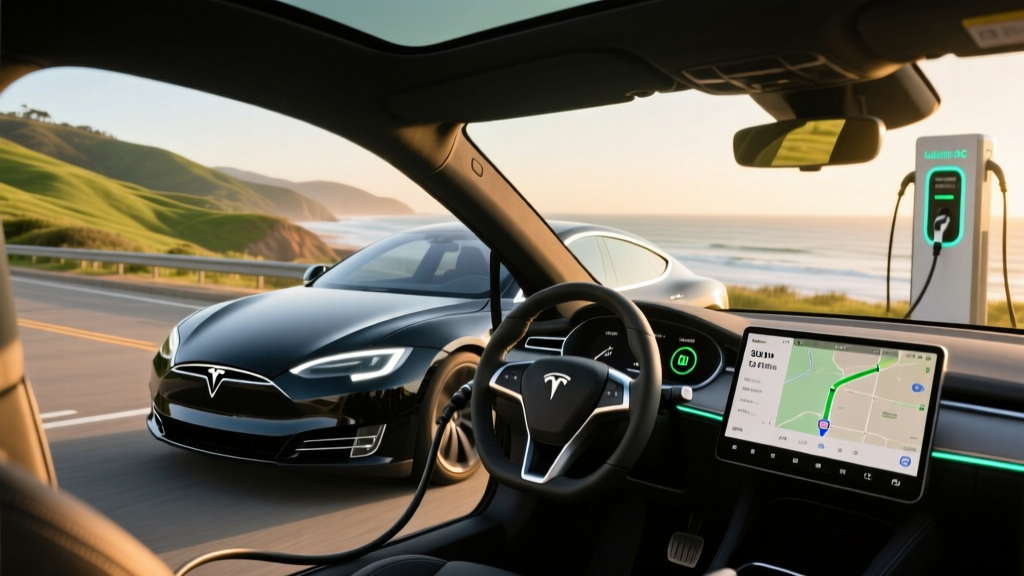
- Preconditioning matters. Navigate to a Supercharger in the Tesla app or nav system, and the car will warm the battery en route. Skip this step on a cold day and your 10–80% time can double.
- The 80% taper is real. Charging from 80–100% often takes as long as 10–80%. For road trips, plan 20-minute hops between 10% and 80% rather than one long 10–100% session.
- LFP packs (Model 3/Y RWD) can be charged to 100% daily without accelerated degradation — a key advantage over NMC, which Tesla recommends keeping at 80% for daily use.
- Home Level 2 is the sweet spot. A Tesla Wall Connector on a 60-amp circuit delivers 11.5 kW (~44 mi/hr). Overnight charging from 20–80% takes roughly 4 hours, which covers virtually any daily commute.
Performance, Cargo, and Tech: What You Get Beyond Range
Every 2026 Tesla shares a few signature traits: a minimalist interior dominated by a 15.4-inch center touchscreen, over-the-air updates, and standard Autopilot (a SAE Level 2 driver-assist system — not self-driving). FSD (Supervised) remains a $8,000 option or $99/month add-on and still requires active driver engagement despite its name.
Performance varies wildly by trim. The Model 3 Performance hits 60 mph in 2.9 seconds — supercar territory for under $55k — while the Model Y RWD takes a leisurely 6.6 seconds. The Cybertruck's stainless-steel exoskeleton and 6,800-lb curb weight blunt its dual-motor output to a 4.1-second 0–60, and its 76 MPGe combined makes it the least efficient Tesla by a wide margin.
Cargo capacity:
- Model 3: 23 cu ft trunk + 3.1 cu ft frunk (total ~26 cu ft)
- Model Y: 34 cu ft behind 2nd row, 76 cu ft folded + 4.1 cu ft frunk
- Model S: 28 cu ft rear + 5.3 cu ft frunk, plus hatchback versatility
- Model X: Up to 91 cu ft with seats folded (5-seat config); falcon-wing doors need 12+ inches of side clearance
- Cybertruck: 6.5-ft bed with 3,500-lb payload, ~100 cu ft under the tonneau
Tech highlights include Tesla's proprietary infotainment (no Apple CarPlay or Android Auto), a robust mobile app with remote climate and Sentry Mode cameras, and the best public charging network in North America. Drawbacks include panel-gap inconsistencies, no physical instrument cluster, and reliance on touchscreen controls for nearly every function — including windshield wipers and mirror adjustment.
Pricing, Tax Credits, and Total Cost
Tesla pricing has stabilized after years of volatility. Here's what the 2026 lineup costs before and after the federal §30D EV tax credit, which offers up to $7,500 — either as a tax-credit offset or a point-of-sale rebate at the dealer (Tesla now supports POS transfer).
| Model | Base MSRP | §30D Credit Eligible? | Effective Price (w/ max credit) |
|---|---|---|---|
| Model 3 RWD | $38,990 | Yes — $7,500 | ~$31,490 |
| Model 3 Long Range AWD | $45,490 | Yes — $7,500 | ~$37,990 |
| Model 3 Performance | $52,990 | Yes — $7,500 | ~$45,490 |
| Model Y RWD | $44,990 | Yes — $7,500 | ~$37,490 |
| Model Y Long Range AWD | $49,990 | Yes — $7,500 | ~$42,490 |
| Model S Long Range | $74,990 | No — exceeds $55k sedan MSRP cap | $74,990 |
| Model X Long Range | $79,990 | No — exceeds $80k SUV cap (varies by config) | $79,990 |
| Cybertruck AWD | $79,990 | No — exceeds $80k truck cap | $79,990 |
- Buyer AGI must not exceed $150k (single), $225k (head of household), or $300k (joint).
- Vehicle MSRP cap: $55,000 for sedans; $80,000 for SUVs, vans, and trucks.
- Battery must meet critical-mineral and battery-component sourcing thresholds (updated annually — verify on fueleconomy.gov).
- Credit can be transferred to the dealer as a point-of-sale discount (new in 2024, continuing in 2026).
- Consult a tax professional — this is not tax advice.
Warranty, Battery Longevity, and Degradation
Tesla's warranty structure is straightforward:
- Basic vehicle: 4 years / 50,000 miles
- Battery & drive unit (Model 3/Y RWD): 8 years / 100,000 miles, 70% capacity retention
- Battery & drive unit (Long Range / Performance / S / X): 8 years / 120,000 miles, 70% capacity retention
Real-world degradation data from large Tesla fleet samples shows NMC packs typically lose 5–8% capacity over the first 50,000 miles, then plateau. LFP packs (Model 3/Y RWD) show similar or slightly lower degradation but tolerate 100% daily charging without harm — an advantage for drivers who want maximum daily range without babying the battery.
Out-of-warranty battery replacement runs $12,000–$18,000 depending on the model, though most Tesla packs are lasting well beyond 150,000 miles with less than 15% degradation. The more common failure point is the 12V auxiliary battery (now lithium in 2026 models), which is far cheaper to replace.
Pros, Cons, and Who Should Buy a Tesla in 2026
- Supercharger network: 65,000+ stalls globally, best uptime in the industry
- Class-leading efficiency (Model 3 LR: 134 MPGe combined)
- OTA updates add features years after purchase
- LFP option allows 100% daily charging without degradation guilt
- Strong resale value relative to most EV competitors
- Point-of-sale §30D credit makes Model 3 RWD a ~$31,500 car
- No Apple CarPlay or Android Auto — Tesla's walled garden
- Touchscreen-only controls frustrate some drivers
- Panel gaps and paint quality remain inconsistent
- FSD (Supervised) is expensive and still Level 2 — not autonomous
- Cybertruck and Model S/X don't qualify for §30D credit
- Insurance premiums run 15–30% higher than comparable gas sedans
Best for commuters: Model 3 RWD at ~$31,500 after credit. LFP battery, 272 mi EPA, low running costs.
Best for road trips: Model 3 Long Range AWD. 363 mi EPA, 22-min 10–80% charge, Supercharger access.
Best for families: Model Y Long Range AWD. 330 mi EPA, 76 cu ft cargo, hatchback practicality, optional 7-seat (small 3rd row).
Best for towing / utility: Cybertruck AWD. 11,000-lb tow rating, 6.5-ft bed — but poor efficiency and no tax credit.
How Does Tesla Compare to Key Competitors?
The Hyundai Ioniq 6 SE Long Range offers 361 mi EPA at ~$42,000 — competitive with the Model 3 Long Range but without Supercharger access (CCS only, though Tesla's NACS adapter opens the network for non-Teslas in 2026). The Chevrolet Equinox EV 3RS delivers 319 mi EPA for ~$43,000 and qualifies for the full credit. The Ford Mustang Mach-E Extended Range AWD provides 320 mi EPA and a more conventional interior with physical controls.
Tesla's moat in 2026 is the integrated ecosystem: Supercharger reliability, OTA updates, and the mobile app remain best-in-class. But the gap has closed substantially, and competitors now match or beat Tesla on interior quality, ride comfort, and infotainment flexibility (CarPlay support). If you prioritize charging convenience and software above all else, Tesla still wins. If you want a quieter ride, physical buttons, or a dealer service network, the alternatives deserve a serious test drive.
FAQ: Tesla Range and Ownership Questions
How far does a Tesla go on one charge in real highway driving?
Expect 10–15% below EPA at steady 75-mph speeds on NMC trims, and up to 20% below on the Cybertruck. A Model 3 Long Range rated at 363 mi EPA typically delivers 290–310 mi on a warm highway drive.
Does cold weather significantly reduce Tesla range?
Yes. At 20–30°F, plan for 20–30% range loss even with Tesla's heat pump and preconditioning. A 363-mi Model 3 LR may deliver 250–270 mi in cold highway conditions. Garage parking and preconditioning while plugged in help substantially.
How long does it take to charge a Tesla at home?
On a Level 2 Tesla Wall Connector (11.5 kW, 48-amp circuit), a full charge from 20% to 80% takes about 4 hours for a Long Range model. Level 1 (standard 120V outlet) adds only 3–5 miles per hour — adequate for low-mileage commuters but not road-trip replenishment.
Does the Tesla Model 3 qualify for the $7,500 federal tax credit?
All 2026 Model 3 trims qualify for the full $7,500 §30D credit, provided the buyer meets income limits ($150k single / $300k joint) and the vehicle meets battery-sourcing requirements. The credit can be applied as a point-of-sale discount. Verify current eligibility at IRS.gov.
Is a Tesla worth buying vs. Hyundai, Ford, or Chevy EVs?
Tesla still leads in charging infrastructure and software. Competitors like the Ioniq 6, Mach-E, and Equinox EV match or exceed Tesla on interior quality and ride comfort. If Supercharger access and OTA updates are your top priorities, Tesla wins. If you prefer CarPlay, physical controls, or a dealer service experience, test-drive the alternatives — the gap has narrowed considerably in 2026.
How long will a Tesla battery last before needing replacement?
Tesla warranties the battery for 8 years / 100,000–120,000 miles (depending on trim) at 70% capacity retention. Fleet data shows most packs retain 85–92% capacity at 100,000 miles. Out-of-warranty replacement costs $12,000–$18,000 but is rarely needed before 150,000+ miles.