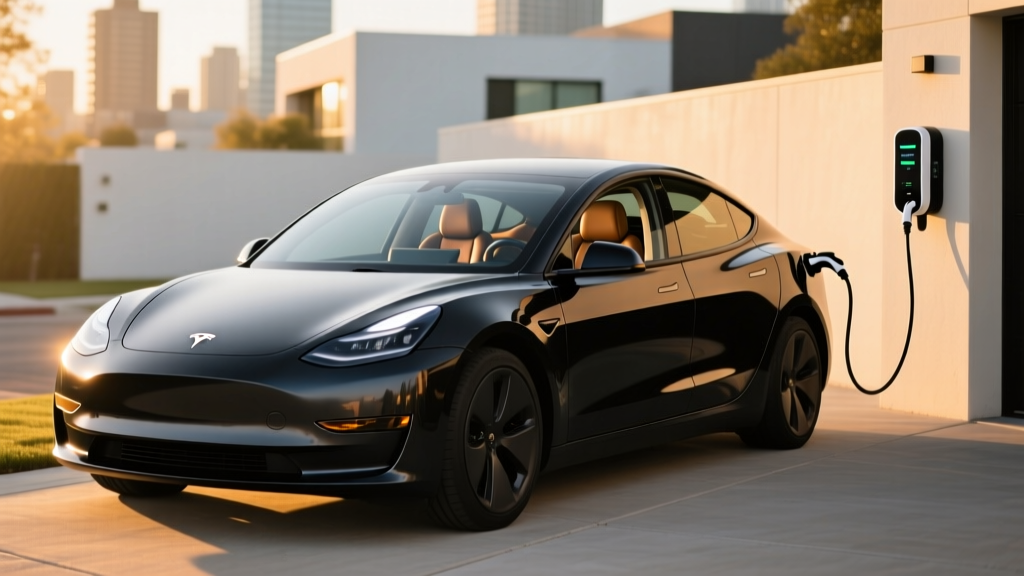
The refreshed Tesla Model 3 (internally dubbed "Highland") arrived for the 2024 model year with meaningful upgrades to ride quality, cabin noise, and interior materials — while keeping the core formula that made it the best-selling premium EV sedan in America. Now well into its lifecycle, the 2024 Model 3 remains a benchmark for efficiency and charging infrastructure access, though competitors have narrowed the gap in comfort and build consistency. Here is the data-driven breakdown every buyer needs.
Range, Battery, and Real-World Efficiency
The 2024 Model 3 is offered in three trims, each with a different battery pack and drivetrain configuration. Tesla does not officially publish usable battery capacity, but teardown data and third-party testing confirm the following:
| Trim | Battery (usable kWh) | Chemistry | Drivetrain | EPA Range | MPGe (combined) | kWh/100 mi |
|---|---|---|---|---|---|---|
| RWD (Standard Range) | ~57.5 kWh | LFP (CATL) | Rear-Wheel Drive | 272 mi | 132 MPGe | 25 |
| Long Range RWD | ~75 kWh | NMC | Rear-Wheel Drive | 363 mi | 137 MPGe | 24 |
| Long Range AWD | ~75 kWh | NMC | Dual-Motor AWD | 341 mi | 125 MPGe | 27 |
The LFP (lithium iron phosphate) battery in the RWD trim offers a key advantage: Tesla recommends charging it to 100% regularly, whereas the NMC packs in Long Range trims are best kept between 20-80% for daily use to maximize longevity. This means the RWD's usable daily range is closer to its EPA figure, while Long Range owners should plan around ~300 miles of practical daily range (80% of 363/341). For a deeper look at LFP vs NMC trade-offs, see our battery chemistry guide.
Charging Speed: DC Fast Charge and Home Level 2
Charging speed is where the 2024 Model 3's Tesla ecosystem advantage becomes concrete. Access to the Supercharger network — now expanding to NACS-equipped non-Tesla EVs — remains the most reliable public charging experience in North America.
| Charge Method | RWD (LFP) | Long Range (NMC) | Notes |
|---|---|---|---|
| Max DC Fast Charge (kW) | 170 kW | 250 kW | Peak rate; tapers above ~50-60% SoC |
| 10-80% DCFC Time | ~30 min | ~25 min | At V3 Supercharger (250 kW capable) |
| Level 2 Home (kW) | 11 kW (48A) | 11 kW (48A) | Requires 60A circuit; ~30-44 mi/hr |
| Level 1 (120V) | ~1.4 kW | ~1.4 kW | ~3-5 mi/hr; emergency/trickle only |
| Connector | NACS (native) | NACS (native) | CCS1 via adapter (included) |
A critical ownership note: the 250 kW peak charge rate on Long Range models is not sustained across the entire session. The charge curve peaks between roughly 10-45% State of Charge (SoC), then tapers progressively. From 80-100%, charging slows dramatically to protect battery health — adding the final 20% can take as long as the first 60%. For road trips, plan stops around the 10-80% window for maximum time efficiency.
Home charging at 11 kW (48 amps on a 240V circuit) adds approximately 30-44 miles of range per hour depending on trim, meaning a full overnight charge (8-10 hours) easily replenishes any daily driving. A Level 2 home installation typically costs $800-$2,000 including the Tesla Wall Connector ($475) and electrician labor, assuming your panel has capacity for a 60A breaker.
Performance, Ride, and Driving Dynamics
The Highland refresh brought meaningful mechanical improvements. Tesla retuned the suspension, added frequency-selective dampers, and improved acoustic insulation throughout the cabin. The result is a noticeably quieter, more compliant ride than the pre-2024 Model 3 — addressing one of the most common owner complaints.
| Spec | RWD | Long Range RWD | Long Range AWD |
|---|---|---|---|
| 0-60 mph | 5.8 sec | 4.9 sec | 4.2 sec |
| Horsepower | 271 hp | 346 hp | 346 hp (combined) |
| Top Speed | 125 mph | 125 mph | 125 mph |
| Drivetrain | RWD (single motor) | RWD (single motor) | AWD (dual motor) |
| Towing Capacity | Not rated | Not rated | Not rated |
Even the base RWD trim hits 60 mph in a respectable 5.8 seconds. The Long Range AWD's 4.2-second sprint is genuinely quick for a sedan in this price bracket. One-pedal driving via regenerative braking is well-calibrated, and the steering — while still on the numb side — is more communicative than prior years thanks to the revised front suspension geometry.
The 2024 Model 3 is not rated for towing, which limits its utility for buyers who need to pull a small trailer or bike rack. If towing is a priority, look at the Model Y or a competitor like the Hyundai Ioniq 5 (which is also not rated for towing in the US, but offers a hitch accessory for bike racks).
Interior, Tech, and Cargo Space
The Highland interior overhaul removed the traditional turn signal stalk (now integrated into the steering wheel buttons) and the gear selector stalk (now a touch-sensitive strip on the center console). These changes are polarizing — some owners adapt quickly, others find them frustrating, especially during three-point turns or roundabout navigation.
The 15.4-inch center touchscreen handles all vehicle functions, infotainment, and navigation. A rear 8-inch touchscreen was added for climate and media control for back-seat passengers. Build quality and material quality improved noticeably, with ventilated front seats, ambient lighting, and acoustic glass all around.
| Measurement | Specification |
|---|---|
| Front Legroom | 42.7 in |
| Rear Legroom | 35.2 in |
| Cargo (Trunk) | 23 cu ft |
| Frunk (Front Trunk) | 3.1 cu ft |
| Total Cargo | 26.1 cu ft |
| Seating Capacity | 5 passengers |
Cargo space is generous for a compact sedan, though the sloping roofline limits vertical space for taller items. The frunk is small — useful for charging cables and a bag or two, but not a substitute for the main trunk. Rear-seat headroom is tighter than in crossovers like the Model Y or Hyundai Ioniq 5, which matters for passengers over 6 feet.
Pricing, Trims, and Federal Tax Credit Eligibility
| Trim | Base MSRP | Est. §30D Credit | Effective Price | Credit Eligibility Notes |
|---|---|---|---|---|
| RWD | $38,990 | Up to $7,500 | ~$31,490 | Subject to income, sourcing rules |
| Long Range RWD | $42,490 | Up to $7,500 | ~$34,990 | Subject to income, sourcing rules |
| Long Range AWD | $45,490 | Up to $7,500 | ~$37,990 | Subject to income, sourcing rules |
The IRS §30D federal tax credit offers up to $7,500, but eligibility is not automatic. Key requirements for 2024-2025 purchases (rules remain current into 2026 unless amended by Congress):
- MSRP Cap: Sedans must be priced at or below $55,000. All 2024 Model 3 trims qualify at base MSRP, but adding options like FSD, premium wheels, or special paint can push the Long Range AWD near or above the cap — check your build carefully.
- Income Cap: Modified adjusted gross income (MAGI) must not exceed $150,000 (single), $225,000 (head of household), or $300,000 (joint filers).
- Battery Sourcing: The $7,500 credit is split into two halves — $3,750 for critical minerals and $3,750 for battery components. Sourcing requirements tighten annually. Tesla's US-built batteries and CATL LFP cells have faced scrutiny under FEOC (Foreign Entity of Concern) rules. Verify current eligibility on fueleconomy.gov before purchasing.
- Point-of-Sale Transfer: As of 2024, eligible buyers can transfer the credit to the dealer at purchase, reducing the out-of-pocket cost immediately rather than waiting for tax filing.
Disclaimer: Tax credit eligibility depends on individual circumstances and current IRS rules. Consult a tax professional and verify on irs.gov before relying on credit estimates.
Driver Assistance: Autopilot and FSD (Supervised)
Every 2024 Model 3 includes basic Autopilot (traffic-aware cruise control and lane centering). Full Self-Driving (Supervised) is an optional $8,000 add-on (or $99/month subscription as of 2025) that adds automatic lane changes, traffic light/stop sign recognition, and navigation-guided driving on highways and city streets.
The 2024 Model 3 earned a 5-star overall safety rating from NHTSA and a Top Safety Pick+ designation from IIHS, with strong crash-test performance across all categories.
Warranty and Long-Term Ownership
| Coverage | Terms |
|---|---|
| Basic Vehicle Limited Warranty | 4 years / 50,000 miles |
| Battery & Drive Unit (RWD) | 8 years / 100,000 miles (70% minimum capacity retention) |
| Battery & Drive Unit (Long Range) | 8 years / 120,000 miles (70% minimum capacity retention) |
| Roadside Assistance | 4 years / 50,000 miles |
Tesla's battery warranty guarantees at least 70% capacity retention over the warranty period. Real-world degradation data from Tesla's fleet suggests most Model 3 packs retain approximately 85-90% capacity after 100,000 miles, with LFP packs showing slightly slower degradation curves than NMC. Out-of-warranty battery replacement costs range from $12,000-$16,000 depending on pack size, though replacements are rare within the first 10 years of ownership based on current fleet data.
Who Should Buy the 2024 Tesla Model 3?
Buy the Model 3 Long Range AWD if: You take regular road trips (300+ miles), live in a region with cold winters where AWD traction matters, and want the fastest DC charging at 250 kW.
Buy the Model 3 Long Range RWD if: You want maximum range (363 mi EPA) without the AWD premium, and live in a mild climate.
Look elsewhere if: You need a hatchback/crossover for cargo versatility, require towing capability, prefer physical buttons and stalks, or want a more cushioned ride (consider the Hyundai Ioniq 6 or BMW i4).
Pros and Cons
- Best-in-class efficiency (up to 137 MPGe combined)
- Access to Tesla Supercharger network — most reliable DCFC in North America
- Strong 5-star NHTSA safety and IIHS Top Safety Pick+
- Excellent real-world DC charging speed (250 kW peak, ~25 min 10-80%)
- Highland refresh fixed ride quality and cabin noise complaints
- OTA software updates continue to add features post-purchase
- No turn signal or gear selector stalks — steep adjustment curve
- Rear-seat headroom tight for tall passengers
- No towing capacity
- FSD (Supervised) is expensive ($8,000) and still Level 2
- Limited physical controls; everything routes through touchscreen
- Insurance premiums tend to run 15-25% higher than comparable gas sedans
2024 Tesla Model 3 vs. Key Competitors
The Model 3's most direct competitors are the Hyundai Ioniq 6 (sleek sedan, 361 mi range, CCS charging), the BMW i4 (premium badge, 301 mi range, higher price), and the Tesla Model Y (crossover sibling, more cargo, slightly less range). The Ioniq 6 charges at up to 350 kW on compatible chargers, but the real-world Supercharger reliability advantage still favors Tesla for road-trippers. The BMW i4 offers a more traditional luxury interior with physical controls but costs $10,000-$15,000 more for comparable range.
For buyers who value charging infrastructure access, software integration, and efficiency above all else, the 2024 Model 3 remains difficult to beat at its price point. For those who prioritize interior ergonomics, rear-seat space, or a more plush ride, test-driving the Ioniq 6 and Model Y alongside is essential.
Frequently Asked Questions
What is the real-world range of the 2024 Tesla Model 3?
In mixed driving, expect 290-310 miles from the Long Range AWD (EPA 341 mi). Highway-only driving at 75 mph reduces this to roughly 270-290 miles. In sub-freezing weather, plan for 240-270 miles. The RWD (EPA 272 mi) delivers approximately 230-250 real-world miles in mixed conditions.
How fast does the 2024 Model 3 charge?
On a V3 Supercharger (250 kW), the Long Range charges from 10-80% in approximately 25 minutes. The RWD peaks at 170 kW, taking about 30 minutes for the same session. At home on a Level 2 charger (11 kW / 48A), expect a full charge in 6-8 hours, adding roughly 30-44 miles of range per hour.
How much does the 2024 Model 3 cost after tax credits?
The RWD starts at $38,990 MSRP. With the full $7,500 federal tax credit (if eligible), the effective price drops to approximately $31,490. The Long Range AWD starts at $45,490, or roughly $37,990 after credit. Eligibility depends on income limits, battery sourcing requirements, and MSRP caps under IRS §30D.
Does the 2024 Model 3 qualify for the $7,500 federal EV tax credit?
All trims fall under the $55,000 sedan MSRP cap, making them potentially eligible. However, the buyer must meet income limits ($150K single / $300K joint), and battery sourcing requirements under the Inflation Reduction Act must be satisfied. The credit amount can be $3,750 or $7,500 depending on critical mineral and battery component sourcing. Always verify current eligibility on fueleconomy.gov and consult a tax professional.
Is the 2024 Model 3 worth buying vs. the Ioniq 6 or BMW i4?
If Supercharger access, software, and efficiency are your top priorities, the Model 3 wins. If you prefer a quieter, more traditional luxury interior (BMW i4) or faster peak charging on Electrify America's 350 kW stations (Ioniq 6), those are compelling alternatives. The Model 3's total cost of ownership — especially after the tax credit — is generally the lowest in this segment.
Is Tesla Autopilot or FSD self-driving?
No. Both are SAE Level 2 driver-assistance systems that require the driver to remain fully engaged, with hands on the wheel and eyes on the road. They do not make the car autonomous. Only Level 4 robotaxi services (like Waymo in select metro areas) operate without a human driver.