Quick Verdict: The 2023 Model 3 at a Glance
The Tesla 2023 Model 3 occupies a unique spot in the used-EV market heading into 2026. It's the final model year before Tesla's major "Highland" refresh (which arrived for the 2024 model year), meaning it represents the most mature, bug-sorted version of the original Model 3 platform. With EPA-estimated ranges spanning 272 to 333 miles depending on trim, a proven Supercharger network advantage, and eligibility for both the federal new-EV credit (if purchased before the Highland switchover) and the up-to-$4,000 used-EV tax credit on the secondary market today, the 2023 Model 3 remains one of the most compelling entry points into Tesla ownership.
But it's not without compromises. The 2023 model year carries over the pre-refresh interior — no ventilated seats, no ambient lighting, and a rear touchscreen that was only added in late 2022 production. Ride quality on the standard 18-inch wheels is firm by midsize-sedan standards, and the LFP battery in the Base RWD variant trades some cold-weather range for long-term durability. This review breaks down every spec, real-world expectation, and ownership cost you need to evaluate before buying.
| Spec | Base RWD | Long Range AWD | Performance AWD |
|---|---|---|---|
| EPA Range | 272 mi | 333 mi | 315 mi |
| Battery (usable, est.) | ~57.5 kWh (LFP) | ~75 kWh (NMC) | ~75 kWh (NMC) |
| Drivetrain | Rear-Wheel Drive | Dual-Motor AWD | Dual-Motor AWD |
| Horsepower | 283 hp | 346 hp | 450 hp |
| 0–60 mph | 5.8 sec | 4.2 sec | 3.1 sec |
| MPGe (combined) | 132 MPGe | 131 MPGe | 115 MPGe |
| kWh/100 mi | 25 | 26 | 29 |
| Max DC Fast Charge | 170 kW | 250 kW | 250 kW |
| 10–80% DC Fast Charge | ~30 min | ~30 min | ~28 min |
| Original MSRP (base) | $40,240 | $47,740 | $53,240 |
Sources: EPA fueleconomy.gov, Tesla archived spec sheets.
Real-World Range: What the EPA Number Doesn't Tell You
- Base RWD (EPA 272 mi): Expect 230–250 mi on mixed highway driving; 190–220 mi in sub-30°F winter conditions.
- Long Range AWD (EPA 333 mi): Expect 280–310 mi highway; 240–270 mi in cold weather.
- Performance AWD (EPA 315 mi): Expect 265–290 mi highway; 220–250 mi in cold weather.
The EPA combined-cycle figures above are useful for comparison shopping, but real-world range depends heavily on speed, temperature, and terrain. The 2023 Model 3's efficiency is among the best in its class — Tesla's thermal management system, including the octovalve heat pump introduced in prior model years, keeps the battery in its optimal temperature window more effectively than most competitors.
On a 70-mph highway loop in 65°F conditions, independent testing by outlets like InsideEVs and Edmunds has consistently shown the Long Range AWD achieving 280–310 miles before reaching 5% State of Charge. That's roughly 85–93% of the EPA sticker — strong for a dual-motor AWD sedan.
Cold weather is the real variable. Lithium-ion batteries lose efficiency in cold temperatures, and cabin heating draws significant energy. The Base RWD trim's LFP (lithium iron phosphate) chemistry is slightly more susceptible to cold-weather range loss than the NMC packs in the Long Range and Performance trims. If you live in a climate where winters regularly dip below freezing, budget for 20–30% range reduction from the EPA number. Preconditioning the battery while plugged in (a feature accessible through the Tesla app) mitigates this by warming the pack before you drive, and it's essential for maximizing regenerative braking in cold weather.
Charging Speed: DC Fast, Level 2, and Supercharger Access
Charging speed is where the 2023 Model 3's trim differences become most consequential. The Base RWD's smaller LFP battery caps DC fast charging at 170 kW peak, while the Long Range and Performance trims support up to 250 kW on V3 Superchargers or CCS-equipped third-party stations (via adapter).
| Charging Level | Power / Rate | Miles Added per Hour | Notes |
|---|---|---|---|
| Level 1 (120V household) | ~1.4 kW | ~3–5 mi/hr | Emergency/top-up only |
| Level 2 (240V, 32A Mobile Connector) | 7.7 kW | ~30 mi/hr | Full charge in ~8–10 hrs |
| Level 2 (240V, 48A Wall Connector) | 11.5 kW | ~44 mi/hr | Full charge in ~5.5–7 hrs |
| DC Fast (Base RWD max) | 170 kW peak | ~170 mi in 15 min | Tapers above 60% SoC |
| DC Fast (LR / Perf max) | 250 kW peak | ~200 mi in 15 min | Tapers above 50% SoC |
Understanding the charge curve: The peak kW figure (170 or 250) is the maximum rate the car can accept at a low State of Charge — typically between 10–30%. As the battery fills, the rate tapers to protect cell health. A "10–80% in 30 minutes" claim means the average sustained rate over that session is closer to 130–160 kW, not the 250 kW peak. This is true of every EV on the market, but it matters for road-trip planning: expect 20–25 minute Supercharger stops on the Long Range if you keep sessions between 10–80%.
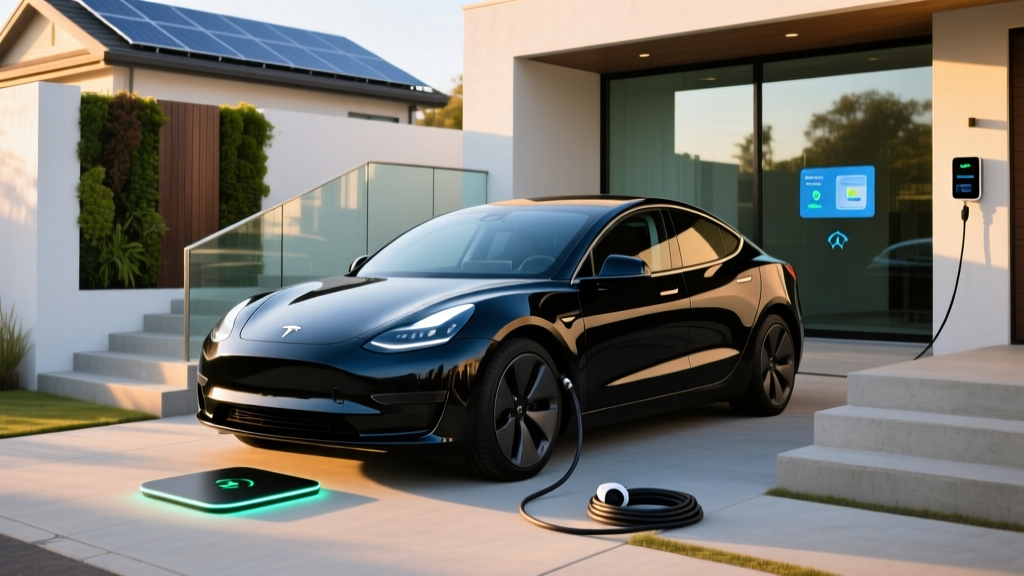
Home charging recommendation: For daily use, a Tesla Wall Connector on a 60-amp circuit (48A continuous) delivers 11.5 kW and adds roughly 44 miles of range per hour of charging. This is the sweet spot for overnight replenishment — most drivers will wake up to a full battery every morning. Installation costs typically range from $800 to $2,000 depending on your electrical panel capacity and run length; a licensed electrician should evaluate your panel before committing. The included Mobile Connector with a NEMA 14-50 adapter is a viable backup at 7.7 kW.
Connector note: The 2023 Model 3 uses the Tesla proprietary connector (now standardized as NACS). Tesla includes a CCS adapter with new vehicle purchases, and aftermarket CCS adapters are widely available. As of 2025, Tesla Superchargers with Magic Dock adapters also support CCS-equipped non-Tesla EVs, but for 2023 Model 3 owners, native NACS means seamless plug-and-charge at every Supercharger stall — still the most reliable public charging network in the U.S.
Performance and Driving Dynamics
The 2023 Model 3 lineup covers a wide performance spectrum. The Base RWD's single rear motor produces 283 hp and hits 0–60 mph in 5.8 seconds — quick for a daily commuter, and the instant electric torque makes it feel even faster in city driving. The Long Range AWD adds a front motor for 346 hp combined and a 4.2-second sprint, while the Performance trim's 450 hp and 3.1-second 0–60 puts it in sports-car territory.
All trims feature a low center of gravity thanks to the under-floor battery pack, and the steering is precise if somewhat numb. The 2023 model year carries the same suspension tuning as prior years — firm, especially on the Performance trim's 20-inch wheels and lowered sport suspension. Road imperfections transmit more than they do in comfort-oriented competitors like the Hyundai Ioniq 6 or BMW i4. If ride comfort is a priority, stick with the 18-inch Aero wheels on the Base or Long Range trims.
Regenerative braking is strong across all trims. Tesla removed the user-adjustable regen setting in 2020, so one-pedal driving is the default behavior. Most owners adapt within a week, but if you're transitioning from a gas car and prefer a coasting feel, this takes getting used to. In cold weather, regen is limited until the battery warms up — preconditioning via the app or scheduled departure resolves this.
Interior, Cargo, and Technology
The 2023 Model 3 interior is defined by Tesla's minimalist philosophy: a single 15-inch landscape touchscreen handles nearly every function — climate, navigation, media, vehicle settings. There are no physical buttons for HVAC or audio volume (though steering-wheel scroll wheels handle volume and media). This is polarizing: some owners love the clean aesthetic; others find it distracting to adjust fan speed through a touchscreen while driving.
Passenger space is adequate for a compact sedan. Front legroom measures 42.7 inches, rear legroom 35.2 inches. The rear seat fits two adults comfortably; a third middle passenger will feel squeezed on longer trips. Headroom is generous thanks to the glass roof, though that glass offers limited UV tinting — many owners add an aftermarket sunshade for summer.
Cargo capacity totals 23 cubic feet with the rear seats up (15.3 cu ft trunk + 3.1 cu ft frunk), expanding to 64.9 cu ft with the 60/40 rear seats folded. The frunk (front trunk) is useful for charging cables and small bags. Compared to the Hyundai Ioniq 6 (12.3 cu ft total) the Model 3 is significantly more practical; compared to the Model Y crossover (76 cu ft max), it's noticeably less.
Driver assistance: Every 2023 Model 3 ships with Basic Autopilot, which includes Traffic-Aware Cruise Control and Autosteer (lane centering). This is an SAE Level 2 system — the driver must keep hands on the wheel and eyes on the road at all times. Tesla's optional Full Self-Driving (FSD) capability package ($15,000 at the time, later reduced) adds features like Navigate on Autopilot, Auto Lane Change, and Smart Summon, but it remains a Level 2 supervised system. It does not make the car self-driving. For hands-free Level 2+ highway driving, GM's Super Cruise and Ford's BlueCruise are competitors worth cross-shopping.
Pricing, Trims, and Federal Tax Credit Eligibility
Original MSRPs for the 2023 Model 3 ranged from $40,240 (Base RWD) to $53,240 (Performance) before destination fees. Tesla adjusted pricing multiple times throughout 2023, so the exact sticker varied by order date. As of early 2026, used 2023 Model 3s typically trade between $22,000 and $35,000 depending on mileage, trim, and condition.
| Trim | Original MSRP | Used Market (est. 2026) | Used-EV Credit (IRC §25E) |
|---|---|---|---|
| Base RWD | $40,240 | $22,000–$26,000 | Up to $4,000 (30% of sale price) |
| Long Range AWD | $47,740 | $27,000–$32,000 | Up to $4,000 |
| Performance AWD | $53,240 | $30,000–$35,000 | Up to $4,000 |
Federal tax credit for used EVs (IRC §25E): If you're buying a 2023 Model 3 on the used market in 2026, you may qualify for a credit of 30% of the sale price, up to $4,000. Per IRS guidelines, the vehicle must be purchased from a licensed dealer for $25,000 or less, and buyer income must not exceed $75,000 (single), $112,500 (head of household), or $150,000 (joint). The credit can be transferred to the dealer at the point of sale as a price reduction. Always verify current-year eligibility with a tax professional, as rules are subject to legislative change.
New-vehicle credit (IRC §30D) — historical context: When purchased new in 2023, the Model 3 Base RWD and Long Range qualified for the full $7,500 federal credit (subject to buyer income caps of $150K single / $300K joint). The Performance trim was subject to the $55,000 MSRP cap for sedans — it qualified at certain price points but not when optioned above the cap. Battery sourcing and critical-mineral requirements under the Inflation Reduction Act affected eligibility throughout 2023 as Tesla's supply chain evolved.
Warranty and Long-Term Battery Outlook
Tesla's warranty coverage for the 2023 Model 3 is competitive with the EV segment:
- Basic Vehicle Limited Warranty: 4 years / 50,000 miles
- Battery & Drive Unit Warranty (Base RWD): 8 years / 100,000 miles, minimum 70% capacity retention
- Battery & Drive Unit Warranty (Long Range / Performance): 8 years / 120,000 miles, minimum 70% capacity retention
The 70% retention threshold is standard for the industry. In practice, Tesla's NMC batteries in the Long Range and Performance trims have shown degradation curves that plateau around 8–12% loss after the first 50,000 miles, based on aggregated owner data from TeslaFi and Recurrent Auto. The LFP battery in the Base RWD degrades more slowly overall but benefits from regular charging to 100% — unlike NMC packs, which Tesla recommends keeping between 20–80% for daily use, LFP chemistry tolerates and actually benefits from periodic full charges to maintain cell balancing accuracy.
Battery replacement cost: Out-of-warranty battery replacement for a 2023 Model 3 ranges from approximately $12,000 to $16,000 including labor, based on current service-center pricing. This is a worst-case scenario — the vast majority of Model 3 batteries outlast the vehicle's useful life. For context, Recurrent Auto's fleet data shows most Tesla batteries retaining 85–90% capacity at 100,000 miles.
Who the 2023 Model 3 Suits Best
- You want the most reliable public charging network (Superchargers) for road trips
- You value best-in-class efficiency (25–29 kWh/100 mi) to minimize electricity costs
- You prefer a sport-sedan driving feel with quick acceleration
- You're buying used and want to leverage the $4,000 §25E credit
- You want a proven platform with extensive real-world reliability data
- You need a spacious rear seat for car seats or tall passengers (consider Model Y or Ioniq 5)
- You prefer physical buttons and a traditional infotainment layout
- You want hands-free Level 2+ highway driving (GM Super Cruise or Ford BlueCruise)
- Ride comfort is your top priority (the 2023 Model 3 is firm, especially on 19/20-inch wheels)
- You need towing capability (Model 3 is not rated for towing; consider Model Y at 3,500 lbs)
Pros and Cons
- Class-leading efficiency (132 MPGe combined on Base RWD)
- Supercharger network — still the gold standard for reliability
- Strong performance across all trims (3.1s 0–60 on Performance)
- Excellent cargo space for a sedan (23 cu ft total)
- Used-EV tax credit eligibility (up to $4,000)
- Over-the-air updates continue to add features post-purchase
- Mature platform — most early-production issues resolved by 2023
- Firm ride quality, especially on larger wheels
- Touchscreen-only controls require learning curve and can distract
- No ventilated seats or ambient lighting (added in 2024 Highland refresh)
- Rear visibility is limited; relies heavily on backup camera
- Base RWD cold-weather range drops significantly (LFP chemistry)
- Autopilot/FSD is Level 2 only — not self-driving despite the name
- Insurance costs tend to be higher than segment average
Frequently Asked Questions
What is the real-world range of the Tesla 2023 Model 3?
In mixed driving at moderate temperatures, expect 230–310 real-world miles depending on trim. Highway driving at 70+ mph reduces range by roughly 10–15% versus the EPA sticker. Sub-freezing temperatures can reduce range by 20–30%. The Long Range AWD is the most versatile for road trips, reliably delivering 280+ miles in fair conditions.
How fast does the 2023 Model 3 charge at home and on the road?
At home on a 48A Level 2 Wall Connector, the 2023 Model 3 charges at up to 11.5 kW, adding about 44 miles of range per hour — a full overnight charge for any trim. On DC fast chargers, the Long Range and Performance trims peak at 250 kW (10–80% in ~30 minutes), while the Base RWD peaks at 170 kW (10–80% in ~30 minutes due to the smaller battery).
How much does a used 2023 Model 3 cost after tax credits?
Used 2023 Model 3s range from roughly $22,000 to $35,000 in early 2026. If you buy from a dealer for $25,000 or less and meet income requirements, the federal used-EV credit (§25E) can reduce your effective cost by up to $4,000 — bringing a Base RWD to as low as $18,000–$22,000 out the door.
Does the 2023 Model 3 qualify for the federal EV tax credit?
When purchased new, it qualified for up to $7,500 under §30D (subject to income and MSRP caps). Today on the used market, it qualifies for the used-EV credit under §25E — 30% of the sale price up to $4,000, with buyer income caps and a $25,000 maximum sale price. Check IRS.gov for current rules and consult a tax professional.
Is the 2023 Model 3 worth buying vs. competitors?
Against the Hyundai Ioniq 6 (EPA 361 mi SE range, $42k new MSRP), the Model 3 trades some range for Supercharger access and stronger performance. Against the BMW i4 (EPA 301 mi eDrive40, ~$52k new), the Model 3 is significantly more affordable on the used market. If charging-network reliability and efficiency are your top priorities, the 2023 Model 3 remains a top pick. If you prefer a more luxurious interior or hands-free driving assist, cross-shop the i4 or vehicles with GM Super Cruise.
What's the difference between LFP and NMC batteries in the 2023 Model 3?
The Base RWD uses an LFP (lithium iron phosphate) battery — it's slightly heavier, has lower energy density (hence 272 mi range), but offers longer cycle life, better thermal stability, and can be charged to 100% daily without accelerated degradation. The Long Range and Performance use NMC (nickel manganese cobalt) packs with higher energy density (333 and 315 mi) but are best kept between 20–80% for daily use to maximize longevity.
Is Tesla's Autopilot or FSD self-driving?
No. Both Basic Autopilot and the optional Full Self-Driving (FSD) Supervised package are SAE Level 2 driver-assistance systems. The driver must remain fully attentive, with hands on the wheel and eyes on the road, at all times. FSD adds convenience features like automatic lane changes and traffic-light recognition, but it does not replace the driver. Only Level 4 robotaxi services like Waymo operate without a human driver — and those are geofenced to specific cities.