Quick Verdict: The 2017 Model S in 2026
The 2017 Tesla Model S occupies a unique space in the used EV market. It was the year Tesla transitioned from the aging 90 kWh battery to the newer 100 kWh pack, introduced the refreshed "Palladium" interior (late 2016 carryover), and offered both the 75D and P100D trims. For buyers searching for tesla 2017 model s interior details, the cabin represents a pivot point between the original minimalist sedan and the more refined versions that followed. But beyond the dashboard, the real questions for 2026 used shoppers are about battery health, Supercharger access, and whether an eight-year-old luxury EV still makes financial sense.
This guide covers the 2017 Model S 75D and P100D — the two most common variants from that model year — with exact specs, real-world range expectations, charging performance, and ownership economics.
2017 Model S Specifications at a Glance
| Spec | 75D | P100D (100 kWh) |
|---|---|---|
| EPA Range | 259 mi | 315 mi |
| Battery (usable) | ~75 kWh (NMC) | ~100 kWh (NMC) |
| Drivetrain | Dual Motor AWD | Dual Motor AWD |
| Horsepower | ~328 hp | ~762 hp (Ludicrous) |
| 0–60 mph | 4.2 sec | 2.5 sec |
| Max DC Fast Charge | ~120 kW | ~120 kW |
| 10–80% DC Time | ~45 min | ~55 min |
| Level 2 Charge Rate | 11.5 kW (~29 mi/hr) | 11.5 kW (~29 mi/hr) |
| MPGe (combined) | 104 MPGe | 102 MPGe |
| Cargo Volume | 26.3 cu ft (rear) + 5.3 cu ft (frunk) | 26.3 cu ft (rear) + 5.3 cu ft (frunk) |
| Rear Legroom | 35.4 in | 35.4 in |
| Battery Warranty (original) | 8 yr / 150,000 mi | 8 yr / 150,000 mi |
| Original MSRP | ~$74,500 | ~$134,500 |
Sources: EPA / fueleconomy.gov, Tesla 2017 owner's manual.
Range, Efficiency, and Real-World Expectations
EPA 75D: 259 mi | Real-world highway (70 mph): ~210–225 mi | Cold weather (30°F): ~175–195 mi
EPA P100D: 315 mi | Real-world highway (70 mph): ~260–280 mi | Cold weather (30°F): ~220–245 mi
The 2017 Model S 75D's 259-mile EPA rating was competitive at launch, but by 2026 standards it sits in the middle of the pack. The larger 100 kWh pack in the P100D delivers a more usable 315 miles on paper. However, the Model S's aerodynamic profile (0.24 Cd) helps it hold efficiency better at highway speeds than most SUVs, though the lack of a heat pump in the 2017 model year means cold-weather range loss is significant — expect a 20–30% reduction when temperatures drop below freezing, primarily due to resistive cabin heating and battery thermal management overhead.
Efficiency-wise, the 75D achieves roughly 104 MPGe combined (about 32 kWh/100 mi), while the P100D lands at 102 MPGe (33 kWh/100 mi). Aggressive driving in the P100D will crater that figure well below the EPA estimate.
Charging Speeds: Supercharger and Home
| Charging Level | Power / Rate | Miles Added per Hour | Notes |
|---|---|---|---|
| Level 1 (120V) | ~1.4 kW | ~3–4 mi/hr | Emergency/trickle only |
| Level 2 (240V, 48A) | 11.5 kW | ~29 mi/hr | Full charge in ~9–11 hours |
| DC Fast (Tesla Supercharger V2) | Up to 120 kW peak | ~250 mi/hr (peak) | 10–80% in ~45–55 min |
| DC Fast (V3 Supercharger) | Capped at ~120 kW | ~250 mi/hr (peak) | 2017 Model S cannot use full 250 kW V3 rate |
The 2017 Model S charges via Tesla's proprietary connector (now called NACS). It can access the entire Tesla Supercharger network — a significant advantage over 2017-era competitors like the Chevrolet Bolt or Nissan Leaf that relied on CCS or CHAdeMO networks with spotty coverage.
However, the 2017 Model S architecture predates Tesla's V3 Supercharger capability. Even at a 250 kW V3 stall, the car will peak around 120 kW and taper significantly above 60% State of Charge (SoC). The charge curve is the critical detail: you'll see 100+ kW from 10–50%, then it drops to ~60 kW through 70%, and below 30 kW past 85%. Plan road-trip stops to charge from 10–80% and move on rather than waiting for a full charge.
For home charging, the onboard charger supports 11.5 kW (48 amps) on a Level 2 circuit. A NEMA 14-50 outlet or a Tesla Wall Connector on a 60-amp circuit will deliver roughly 29 miles of range per hour — enough to fully replenish either battery overnight. Installation of a 240V/60A circuit typically costs $500–$2,000 depending on panel proximity and local permitting.
The 2017 Model S Interior: What Buyers Search For
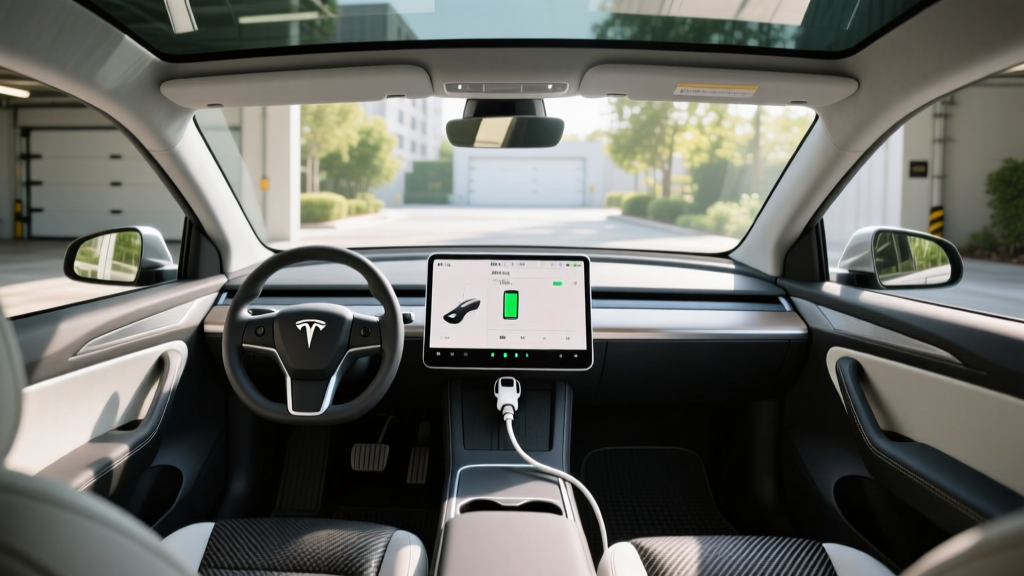
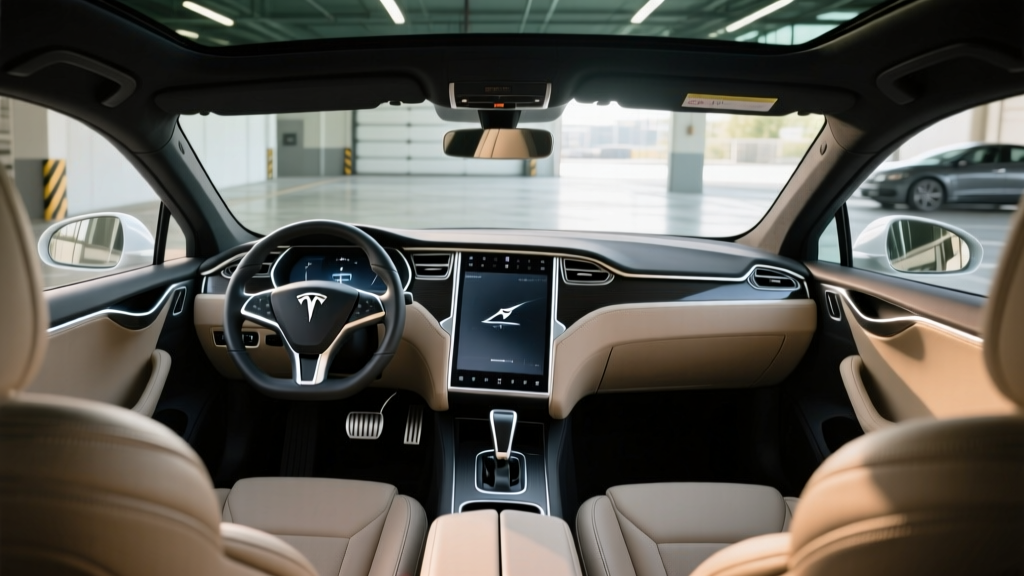
The tesla 2017 model s interior was carried over from the April 2016 refresh, which replaced the original 2012-era dashboard with a more cohesive design. Key interior features include:
- 17-inch center touchscreen — vertically oriented, controlling all vehicle functions, navigation, media, and climate. By 2026 standards, the resolution and processor speed (Nvidia Tegra 3 in 2017 models) feel sluggish compared to Tesla's current AMD Ryzen-based infotainment.
- Minimalist instrument cluster — a small digital display behind the steering wheel showing speed, range, and navigation directions. No head-up display.
- Premium interior option — included Alcantara headliner, LED ambient lighting, premium leather seats with ventilation (front), and a HEPA air filtration system with "Bioweapon Defense Mode."
- Seating — standard 5-seat layout; an optional rear-facing third row (for small children) was available but rare. Front seats are comfortable for long trips; rear seats offer 35.4 inches of legroom — adequate but less generous than a Mercedes E-Class.
- Materials — soft-touch surfaces on the dash and door panels, but some lower trim pieces use harder plastics that don't match the $75K–$135K original price point. Eight-year-old examples may show wear on the driver's seat bolster and steering wheel.
- Storage — 26.3 cu ft behind the rear seats (with a wide liftgate opening), plus a 5.3 cu ft front trunk (frunk). The frunk in 2017 models is fully lined and includes a drain plug.
Performance and Driving Dynamics
The 2017 Model S 75D delivers 328 horsepower and a 4.2-second 0–60 mph time — still quick by any sedan standard. Dual-motor all-wheel drive provides confident traction in rain and light snow. The air suspension (standard on most 2017 models) offers adjustable ride height and a comfortable highway ride, though sport mode firms things up noticeably.
The P100D is a different animal entirely: 762 horsepower in Ludicrous mode, 2.5 seconds to 60 mph. This was the quickest production sedan in the world at launch. However, the performance comes with higher tire wear (21-inch wheels with sticky Michelin Pilot Super Sports), more strain on the battery, and higher insurance premiums.
Both variants use electrically assisted rack-and-pinion steering that is precise but light on feedback. The low center of gravity (battery pack under the floor) gives the Model S composed handling for a 4,600–4,900 lb vehicle, though it's not a sports sedan in the traditional sense — body roll is noticeable in hard cornering.
Autopilot and Driver Assistance (SAE Level 2)
The 2017 Model S with Enhanced Autopilot is a Level 2 driver-assistance system. The driver must remain fully engaged, hands on the wheel, and eyes on the road at all times. This is not self-driving. Full Self-Driving (FSD) capability was not available on 2017 models at launch; some later received FSD software via purchase, but hardware 2.5 (introduced mid-2017) has limited FSD functionality compared to Tesla's current HW4.
Enhanced Autopilot on the 2017 model includes adaptive cruise control, lane-keeping assist, auto lane-change (with turn signal), autosteer on highways, and self-parking. It works well on well-marked divided highways but can struggle in construction zones, faded lane markings, and heavy rain. The 2017 hardware suite (8 cameras, 12 ultrasonic sensors, forward radar) remains capable but is generationally behind Tesla's current vision-only HW4 stack.
Pricing, Tax Credits, and Used-Buyer Economics
| Cost Factor | 75D | P100D |
|---|---|---|
| Original MSRP (2017) | ~$74,500 | ~$134,500 |
| Typical Used Price (2026, ~80K mi) | $22,000–$30,000 | $38,000–$52,000 |
| Federal Used EV Credit (§25E) | Up to $4,000 (if eligible) | Up to $4,000 (if eligible) |
| New EV Credit (§30D) | N/A (used vehicle) | N/A (used vehicle) |
| Estimated Annual Insurance | $2,200–$3,000 | $3,000–$4,200 |
The 2017 Model S is no longer eligible for the new federal EV tax credit (IRS §30D) since it's a used vehicle. However, the IRS §25E Used Clean Vehicle Credit may apply: up to $4,000 or 30% of the sale price (whichever is lower) for used EVs sold by a licensed dealer for $25,000 or less. This means the 75D at the lower end of its price range could qualify, while the P100D almost certainly will not due to the $25,000 sale-price cap. Income limits apply: $75,000 single / $150,000 joint filers. Always verify current-year rules with a tax professional.
Insurance is a real cost factor. The Model S carries higher premiums than comparable gas sedans due to repair costs, aluminum body panels, and Tesla's proprietary parts ecosystem. Get an insurance quote before committing to a purchase.
Battery Health, Warranty, and Longevity
The 2017 Model S uses NMC (nickel manganese cobalt) lithium-ion cells in both the 75 and 100 kWh packs. Tesla's original battery warranty was 8 years / 150,000 miles (whichever comes first) with a capacity retention threshold of 70%. For most 2017 examples in 2026, the 8-year warranty has expired unless the vehicle has very low mileage and an extended service plan was purchased.
Real-world degradation data from Tesla fleet reports and owner surveys show that 2017 Model S batteries typically retain 85–92% of original capacity at 80,000–100,000 miles. However, the 100 kWh pack has shown slightly higher degradation rates than the 75 kWh variant — likely because the higher energy density stresses cells more. A replacement battery out of warranty costs $12,000–$20,000 depending on pack size and whether Tesla offers a remanufactured unit.
Key battery-care tips for used buyers:
- Check the car's energy graph to estimate current range at 100% SoC versus the original EPA figure.
- Avoid examples with a history of frequent 100% charging or repeated DC fast-charging in extreme heat without preconditioning.
- NMC batteries are happiest when daily-charged to 80% and only brought to 100% before long trips.
Pros and Cons
- Supercharger network access (most reliable DC fast-charging in the US)
- Strong real-world range, especially P100D (260+ mi highway)
- Spacious liftback cargo area + frunk
- Air suspension and premium ride quality
- OTA software updates still arriving (though limited by MCU hardware)
- Depreciation already absorbed — strong value at $22K–$30K for 75D
- No heat pump — significant cold-weather range loss
- MCU1 infotainment is slow and may need costly upgrade
- Battery warranty likely expired on most examples
- 120 kW max DC charge rate is slow vs. modern 250+ kW EVs
- High insurance premiums and potential out-of-warranty repair costs
- Older Autopilot hardware limits FSD functionality
- Rear seat space is tighter than German luxury rivals
Who Should Buy the 2017 Model S?
- Commuters with home charging and round trips under 150 miles — the 75D handles this easily with range to spare.
- Road-trip enthusiasts who value Tesla's Supercharger network — still the most seamless long-distance EV charging experience in 2026.
- Performance seekers on a budget — a used P100D delivers supercar acceleration for the price of a new compact EV.
- You live in a very cold climate and need reliable 300+ mile range year-round.
- You want the latest infotainment speed and driver-assist hardware.
- You need a warranty safety net — budget for potential $5K–$15K repairs.
Frequently Asked Questions
What is the real-world range of the 2017 Model S?
The 75D delivers roughly 210–225 miles on the highway at 70 mph in mild weather, and 175–195 miles in freezing conditions. The P100D manages 260–280 highway miles in mild weather, dropping to 220–245 in the cold. Actual range depends heavily on driving style, temperature, and battery health.
How fast does the 2017 Model S charge?
On a Tesla Supercharger, the 2017 Model S peaks at approximately 120 kW, adding about 170 miles in 30 minutes under ideal conditions. A 10–80% charge takes roughly 45 minutes (75D) or 55 minutes (P100D). At home on a Level 2 (240V, 48A) connection, expect about 29 miles of range per hour.
Does the 2017 Model S qualify for any federal tax credit?
Not the new-vehicle §30D credit. However, if purchased from a licensed dealer for $25,000 or less, it may qualify for the IRS §25E Used Clean Vehicle Credit of up to $4,000, subject to buyer income caps ($75K single / $150K joint). Verify eligibility with a tax professional.
Is the 2017 Model S worth buying vs. newer used EVs?
It depends on priorities. The 2017 Model S offers Supercharger access, a spacious liftback, and proven long-distance comfort that newer budget EVs (like a used Bolt or Leaf) can't match. However, a 2021+ Model 3 Long Range will charge faster, have a heat pump, and feature modern HW3/FSD hardware at a similar used price. The Model S wins on space and prestige; the Model 3 wins on efficiency and tech freshness.
What should I check before buying a used 2017 Model S?
Confirm the MCU version (MCU1 vs. MCU2), check battery degradation via the energy graph, verify Supercharger transferability (most 2017 models have paid Supercharging that does not transfer to subsequent owners), inspect air suspension for leaks, and get a pre-purchase inspection from a Tesla-certified technician or knowledgeable independent EV shop.
Additional sources: Tesla Model S Owner's Manual, NHTSA 2017 Tesla Model S.