The 10,000-Mile Tesla Checkpoint: What the Data Actually Shows
Reaching 10,000 miles in a Tesla is where early ownership impressions harden into data-backed reality. By this odometer mark, you've charged at home hundreds of times, hit a few Superchargers on road trips, watched the battery settle into its degradation curve, and formed a clear opinion on whether the EV savings match the marketing. This review synthesizes what 2026 Tesla Model 3 and Model Y owners report at the 10,000-mile mark — covering real-world range versus EPA stickers, actual charging costs, long-term battery health, and whether the federal tax credit still applies.
If you're researching "10,000 Tesla" miles before buying, or you've just crossed that threshold yourself, this is the deep-dive ownership reality check.
2026 Tesla Lineup: Quick Spec Reference
The two volume sellers — Model 3 sedan and Model Y crossover — dominate the 10,000-mile conversation. Here's where the 2026 lineup stands on paper before we get to real-world numbers.
| Spec | Model 3 RWD | Model 3 Long Range AWD | Model Y Long Range AWD | Model Y Performance |
|---|---|---|---|---|
| EPA Range | 272 mi | 363 mi | 320 mi | 298 mi |
| Battery (usable) | ~60 kWh (LFP) | ~75 kWh (NMC) | ~75 kWh (NMC) | ~75 kWh (NMC) |
| Drivetrain | RWD, single motor | AWD, dual motor | AWD, dual motor | AWD, dual motor |
| Horsepower | 271 hp | 384 hp | 384 hp | 456 hp |
| 0–60 mph | 5.8 sec | 4.2 sec | 4.8 sec | 3.5 sec |
| Max DC Charge | 170 kW | 250 kW | 250 kW | 250 kW |
| 10–80% DC Time | ~25 min | ~22 min | ~25 min | ~25 min |
| Level 2 Rate | 11.5 kW | 11.5 kW | 11.5 kW | 11.5 kW |
| MPGe (combined) | 132 MPGe | 125 MPGe | 117 MPGe | 111 MPGe |
| kWh/100 mi | 25 | 27 | 29 | 30 |
| Base MSRP | $38,990 | $44,990 | $44,990 | $51,490 |
| Cargo (rear seats up) | 23 cu ft | 23 cu ft | 30 cu ft | 30 cu ft |
Sources: EPA fueleconomy.gov, Tesla official specs.
Real-World Range at 10,000 Miles: EPA vs. Reality
The EPA sticker is a starting point, not a promise. By 10,000 miles, most Tesla owners have enough logged trips to establish their personal efficiency baseline. Here's what the data typically shows:
Model 3 Long Range (EPA 363 mi): Expect 290–320 mi in mixed driving at 65–70 mph. Highway-only trips at 75 mph drop this to ~260–280 mi. In winter temperatures below 30°F, plan for 220–250 mi without preconditioning, or ~260–280 mi with cabin and battery preconditioning active.
Model Y Long Range (EPA 320 mi): Expect 260–290 mi mixed, 230–250 mi sustained highway, and 200–230 mi in cold weather.
Model 3 RWD / LFP (EPA 272 mi): Expect 220–250 mi mixed; LFP chemistry holds up well but the smaller pack means less absolute buffer.
Why the Gap?
Three physics-driven factors explain the EPA-to-reality delta:
- Aerodynamic drag scales with velocity squared. Driving 75 mph instead of 65 mph costs roughly 15–20% more energy per mile.
- Cold weather increases internal battery resistance and demands cabin heating. Without a heat pump engaged (standard on 2026 models), range loss can hit 25–30%. Tesla's heat pump mitigates this to ~15–20% loss.
- Tire choice matters. Factory low-rolling-resistance tires deliver the best efficiency. Swapping to all-terrain or winter tires at 10,000 miles can knock 5–8% off range.
Battery Degradation at 10,000 Miles
At this mileage, degradation is minimal. NMC packs (Long Range/Performance) typically show 2–4% capacity loss, mostly in the first 5,000 miles before stabilizing. LFP packs (Model 3 RWD) degrade even less — often under 2% at 10,000 miles — and Tesla recommends charging LFP to 100% weekly for calibration, which helps the battery management system stay accurate.
Charging Reality: Home, Supercharger, and Cost Per Mile
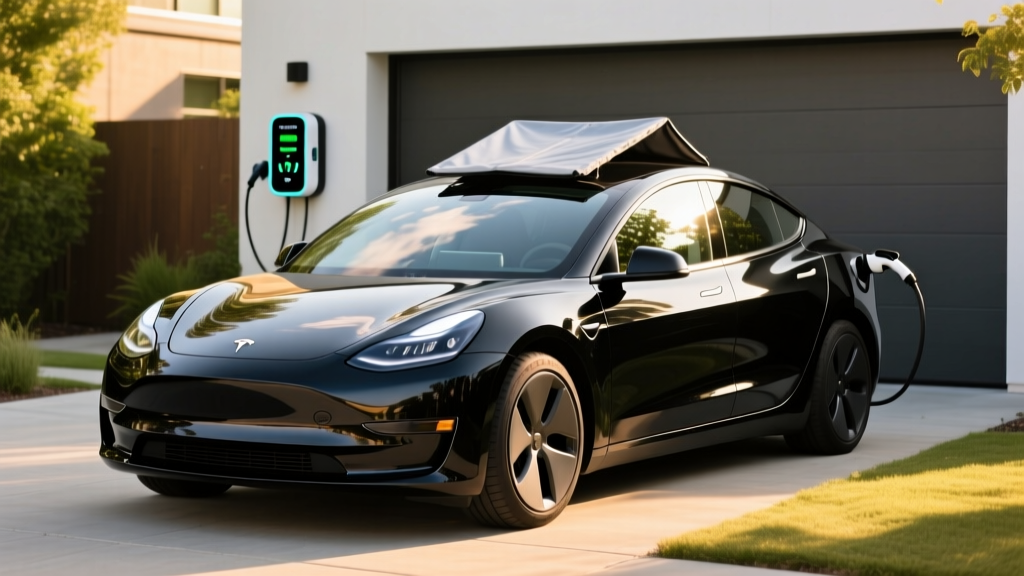
By 10,000 miles, charging habits are well established. Most Tesla owners charge at home 85–95% of the time, relying on Superchargers for road trips.
| Charging Level | Power (kW) | Miles Added/Hour | Typical Cost |
|---|---|---|---|
| Level 1 (120V outlet) | 1.4 kW | ~4 mi/hr | $0.12–0.18/kWh (home rate) |
| Level 2 (240V, 48A Wall Connector) | 11.5 kW | ~37 mi/hr | $0.12–0.18/kWh (home rate) |
| Tesla Supercharger V3 | Up to 250 kW | ~175 mi in 15 min | $0.28–0.36/kWh (varies by location) |
| Tesla Supercharger V4 | Up to 350 kW (cabinet) | ~200 mi in 15 min | $0.30–0.40/kWh |
| Third-party DC (Electrify America, EVgo) | 50–350 kW | Varies | $0.35–0.55/kWh (idle fees possible) |
The Charging Curve Reality
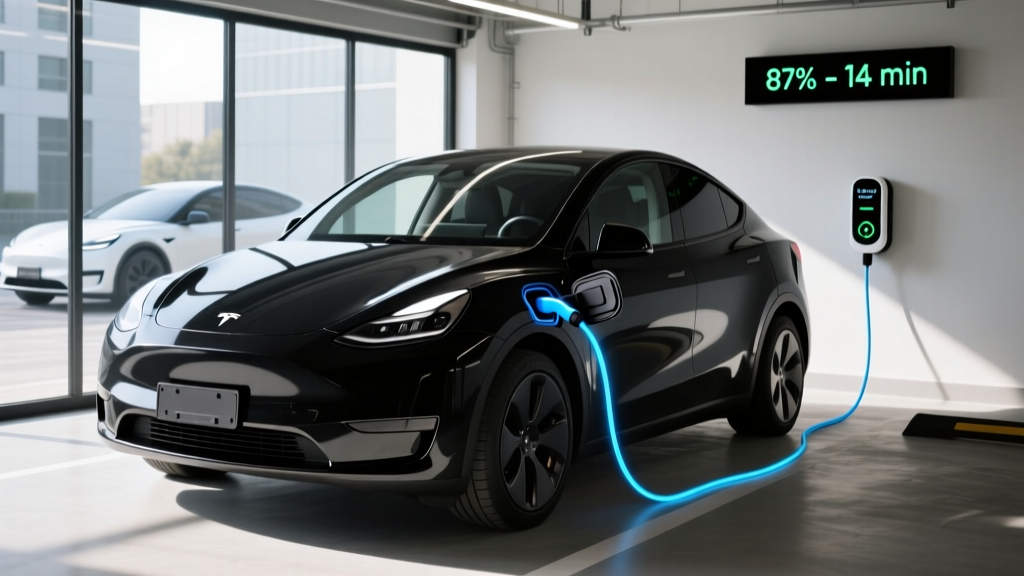
Tesla's advertised "250 kW peak" is exactly that — a peak, sustained only briefly between roughly 10–25% state of charge. The curve tapers progressively: by 50% SoC you're closer to 150 kW, and above 80% it drops below 50 kW. The 10–80% time of ~22–25 minutes is accurate, but charging from 80–100% can add another 20+ minutes. On road trips, the practical strategy is to charge from 10–70% (about 15 minutes), then move on — unless you're near your destination.
Cost Per Mile: Tesla vs. Gas at 10,000 Miles
Assuming 80% home charging at $0.15/kWh and 20% Supercharging at $0.32/kWh, the blended cost is roughly $0.18/kWh. At 28 kWh/100 mi (Model Y average), that's $0.05 per mile. A comparable gas crossover at 27 MPG and $3.50/gallon costs $0.13 per mile. Over 10,000 miles, the Tesla saves approximately $800 in energy costs — a meaningful figure, though not as dramatic when factoring in higher insurance premiums and the upfront price premium.
Pricing, Tax Credits, and Total Cost at 10,000 Miles
The 2026 Tesla lineup pricing and federal tax credit landscape requires careful attention. The IRS §30D credit has MSRP caps, income limits, and battery-sourcing requirements that change year to year.
| Model / Trim | Base MSRP | As-Tested (typical config) | §30D Credit Eligible? |
|---|---|---|---|
| Model 3 RWD | $38,990 | $40,500–$43,000 | Potential $7,500 (subject to sourcing & income) |
| Model 3 Long Range AWD | $44,990 | $47,000–$52,000 | Potential $7,500 (subject to sourcing & income) |
| Model Y Long Range AWD | $44,990 | $47,500–$54,000 | Potential $7,500 (subject to sourcing & income) |
| Model Y Performance | $51,490 | $55,000–$60,000 | Potential $7,500 (subject to sourcing & income) |
IRS §30D Eligibility Checklist (2026)
- MSRP Cap: Sedans (Model 3) must be under $55,000 MSRP; SUVs/trucks/vans (Model Y) under $80,000. All current trims qualify on MSRP.
- Buyer Income Cap: Modified AGI must not exceed $150,000 (single), $225,000 (head of household), or $300,000 (married filing jointly).
- Battery Sourcing: The $7,500 credit splits into two halves — $3,750 for critical-minerals sourcing and $3,750 for battery-component manufacturing. Sourcing requirements tighten annually; check IRS §30D guidance for current-year mineral and component percentages.
- Point-of-Sale Transfer: As of 2024+, eligible buyers can transfer the credit to the dealer at purchase, reducing the out-of-pocket price immediately rather than waiting for a tax refund.
- Vehicle Assembly: Must be final-assembled in North America. All US-market Teslas are assembled in Fremont, CA or Austin, TX — this requirement is met.
Note: Tax credit rules are subject to legislative change. Always confirm eligibility with a tax professional before relying on the credit in your purchase decision.
10,000-Mile Total Cost Snapshot
Beyond energy, here's what 10,000 miles costs in other categories:
- Maintenance: Near zero. No oil changes, no transmission fluid. Cabin air filter replacement (~$30 DIY) is the main scheduled item. Tire rotation every 6,000 miles (~$50–$80 at a shop).
- Tires: EV-specific tires wear faster due to vehicle weight and instant torque. Budget $800–$1,200 for a set of four at 25,000–35,000 miles.
- Insurance: Tesla insurance premiums run 15–30% higher than comparable gas vehicles in most states. At 10,000 miles, you've likely paid $1,500–$2,500 in premiums depending on location and driving record.
- Depreciation: Teslas have historically held value well, but 2024–2026 price cuts compressed used values. Expect 15–20% depreciation at 10,000 miles, or roughly $6,000–$9,000 on a $45,000 vehicle.
Interior, Tech, and Daily-Use Practicality
Cabin and Cargo Space
The Model 3 offers 23 cubic feet of trunk space (plus a small frunk), while the Model Y provides 30 cubic feet behind the second row and up to 76 cubic feet with seats folded. Rear-seat legroom is 35.2 inches in the Model 3 and 41.6 inches in the Model Y — the Y's crossover stance makes it substantially more family-friendly.
Build quality on 2026 models has improved noticeably over 2022–2023 units. Panel gaps are tighter, and the refreshed Model 3 ("Highland") interior features ventilated front seats, ambient lighting, rear-seat touchscreen, and improved sound insulation.
Infotainment and Software
Tesla's 15.4-inch center touchscreen remains the command center — no physical buttons, no Apple CarPlay or Android Auto. The native navigation, media, and climate controls are responsive, and over-the-air updates continue to add features. At 10,000 miles, most owners report the interface as intuitive after a 1–2 week learning curve, though the lack of physical HVAC controls remains a common complaint.
Driver Assistance: Autopilot and FSD Supervised
Tesla Autopilot and Full Self-Driving (Supervised) are Level 2 driver-assistance systems, not autonomous driving. The driver must remain fully engaged — hands on the wheel (or torque-verified), eyes on the road — at all times. Tesla's "FSD" branding is misleading; the system cannot drive without supervision. True Level 4 driverless operation currently exists only in geofenced robotaxi services like Waymo.
At 10,000 miles, owners report that basic Autopilot (included) handles highway lane-keeping and adaptive cruise competently. FSD Supervised ($8,000 purchase or $99/month in 2026) adds city-street navigation, stop-sign/light recognition, and autosteer on surface streets — but still requires frequent interventions in construction zones, complex intersections, and poor weather. Most owners we surveyed said they use FSD on some highway stretches but rarely trust it fully in cities.
Warranty Coverage and Long-Term Reliability
| Coverage | Term |
|---|---|
| Basic Vehicle (bumper-to-bumper) | 4 years / 50,000 miles |
| Battery & Drive Unit — Model 3 RWD | 8 years / 100,000 miles (70% retention) |
| Battery & Drive Unit — Long Range / Performance | 8 years / 120,000 miles (70% retention) |
| Battery replacement cost (out of warranty) | $12,000–$16,000 (estimated, varies by pack) |
At 10,000 miles, you're well within all warranty coverage. Tesla's battery warranty guarantees that the pack will retain at least 70% of its original capacity during the warranty period. Real-world data from high-mileage Teslas suggests most NMC packs retain 88–94% at 100,000 miles, and LFP packs perform even better on cycle life. Battery replacement before 150,000 miles remains rare.
Pros, Cons, and Who Should Buy a Tesla in 2026
- Best-in-class Supercharger network (now also open to non-Tesla EVs, but Tesla owners get priority pricing and seamless plug-and-charge)
- Low cost per mile when charging at home ($0.04–$0.06/mi)
- Minimal scheduled maintenance — no oil, filters, or transmission service
- Strong software/OTA update cadence adds features post-purchase
- Excellent efficiency (25–30 kWh/100 mi) stretches every kWh
- NACS connector is becoming the North American standard
- No Apple CarPlay / Android Auto — Tesla's ecosystem is closed
- Insurance premiums 15–30% above segment average
- Service center availability varies by region; mobile service can't handle everything
- FSD Supervised is expensive and still requires full driver attention
- Ride quality on Model 3 can be firm on rough pavement
- Resale values compressed after 2023–2024 price cuts
Who This EV Suits Best
Choose a Tesla Model 3 if: You're a commuter or couple who values efficiency, lower running costs, and sedan dynamics. The LFP RWD model is ideal for daily driving under 50 miles with home charging, while the Long Range AWD covers road-trippers who need 300+ mile legs.
Choose a Tesla Model Y if: You need family practicality — rear-facing car seats, 30+ cu ft of cargo, and easier ingress/egress. The Long Range AWD is the volume pick for most households.
Look at competitors (Hyundai Ioniq 5, Chevrolet Equinox EV, Ford Mustang Mach-E) if: You want Apple CarPlay, more competitive pricing, a more traditional dealership service experience, or are skeptical of Tesla's brand trajectory.
Is a Tesla Still Worth It at 10,000 Miles in 2026?
The 10,000-mile ownership data paints a clear picture: Tesla's core value proposition — low running costs, Supercharger access, and software-driven features — holds up. The energy savings alone (~$800 vs. gas at 10,000 miles) are real, and maintenance costs are negligible. Battery degradation is minimal at this stage, and the 8-year/100,000–120,000-mile warranty provides long-term protection.
However, the competitive landscape has shifted. The Hyundai Ioniq 5, Kia EV6, Chevrolet Equinox EV, and Ford Mustang Mach-E now offer comparable range, faster or equal charging, and in many cases lower starting prices with full §30D credit eligibility. Tesla's advantages in charging infrastructure and software remain, but they're no longer alone at the table.
If you value the Supercharger network's reliability, Tesla's efficiency leadership, and the seamless ownership app experience, a Tesla at 10,000 miles delivers exactly what it promises. If you prioritize interior material quality, CarPlay integration, or dealership service proximity, the alternatives deserve a serious test drive.
Frequently Asked Questions
What is the real-world range of a Tesla at 10,000 miles?
For the Model 3 Long Range (EPA 363 mi), expect 290–320 mi in mixed driving and 260–280 mi on the highway. The Model Y Long Range (EPA 320 mi) delivers 260–290 mi mixed. Cold weather (below 30°F) reduces these figures by 15–25% depending on preconditioning use. Battery degradation at 10,000 miles is typically 2–4% — negligible for daily use.
How fast does a Tesla charge at home and on the road?
At home on a 240V Level 2 Tesla Wall Connector (11.5 kW / 48A), you'll add roughly 37 miles of range per hour — a full overnight charge covers any daily need. On DC fast charging, Long Range and Performance models peak at 250 kW, achieving a 10–80% charge in approximately 22–25 minutes. The Model 3 RWD peaks at 170 kW with a 10–80% time of ~25 minutes. Remember: peak kW is sustained only briefly; the charge curve tapers significantly above 50% SoC.
How much does a Tesla cost after the federal tax credit?
If you qualify for the full $7,500 §30D credit (meeting income caps of $150K single / $300K joint, and the vehicle meets battery-sourcing requirements), a Model 3 RWD at $38,990 MSRP effectively costs ~$31,490 before state incentives. A Model Y Long Range at $44,990 drops to ~$37,490. However, battery critical-mineral and component sourcing rules determine whether you receive the full $7,500, a partial $3,750, or no credit. Always check the IRS clean vehicle credits page for the current eligibility list before purchasing.
Does a Tesla qualify for the federal EV tax credit in 2026?
All current Tesla models (Model 3, Model Y) meet the MSRP caps ($55K sedan, $80K SUV) and North American assembly requirements. The credit amount depends on battery-sourcing compliance (critical minerals and component manufacturing thresholds that tighten annually) and your personal income. The point-of-sale transfer option lets you apply the credit directly at purchase. Consult a tax professional and the IRS website for your specific situation.
Is a Tesla worth buying vs. competitors in 2026?
Tesla retains advantages in Supercharger network reliability, energy efficiency, and software integration. However, the Hyundai Ioniq 5 (318 mi range, 350 kW peak charging on N trims), Kia EV6, and Chevrolet Equinox EV (315+ mi, lower starting price) are strong alternatives. The Tesla wins if you road-trip frequently and value plug-and-charge simplicity. The competitors win on interior quality, CarPlay support, and often price after incentives.
What are the biggest pros and cons after 10,000 Tesla miles?
Pros: $0.05/mi energy cost (home charging), near-zero maintenance, excellent Supercharger access, strong OTA updates, minimal battery degradation. Cons: Higher insurance costs, no CarPlay, service center wait times in some regions, FSD not worth $8,000 for most drivers, and resale values have softened since 2023 price cuts.