Quick Verdict: Tesla's 0-60 Times Across the 2026 Lineup
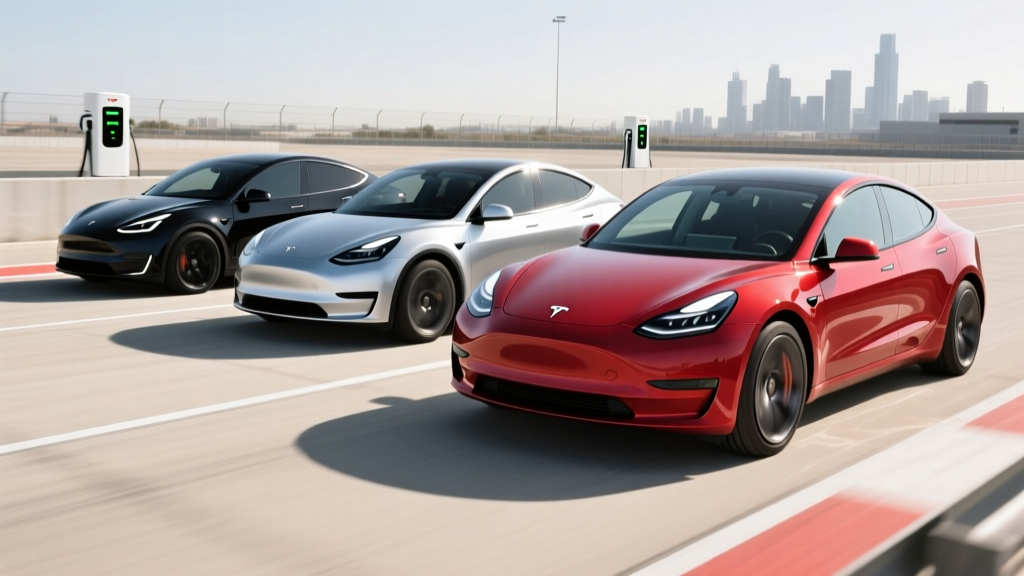
The question how fast can a Tesla go from 0 to 60 doesn't have one answer — it depends entirely on which model and trim you choose. Tesla's current U.S. lineup spans from the refreshed Model 3 Long Range at a brisk 4.2 seconds all the way to the Model S Plaid, which demolishes the sprint in an almost absurd 1.99 seconds. But acceleration is only one axis of the EV buying decision. This profile covers every current Tesla model with the data that matters: EPA range, real-world range expectations, charging speeds, battery chemistry, pricing, and federal tax credit eligibility under current IRS §30D rules.
| Model / Trim | 0-60 mph | Horsepower | Drivetrain | EPA Range | Base MSRP |
|---|---|---|---|---|---|
| Model 3 Long Range AWD | 4.2 sec | ~346 hp | Dual-Motor AWD | 341 mi | $47,740 |
| Model 3 Performance | 2.9 sec | ~510 hp | Dual-Motor AWD | 315 mi | $54,990 |
| Model Y Long Range AWD | 4.8 sec | ~384 hp | Dual-Motor AWD | 320 mi | $49,990 |
| Model Y Performance | 3.5 sec | ~456 hp | Dual-Motor AWD | 293 mi | $53,490 |
| Model S Long Range | 3.1 sec | ~670 hp | Dual-Motor AWD | 402 mi | $79,990 |
| Model S Plaid | 1.99 sec | ~1,020 hp | Tri-Motor AWD | 359 mi | $94,990 |
| Model X Long Range | 3.8 sec | ~670 hp | Dual-Motor AWD | 335 mi | $84,990 |
| Model X Plaid | 2.5 sec | ~1,020 hp | Tri-Motor AWD | 311 mi | $99,990 |
| Cybertruck AWD | 4.1 sec | ~600 hp | Dual-Motor AWD | 340 mi | $79,990 |
| Cybertruck Cyberbeast | 2.6 sec | ~845 hp | Tri-Motor AWD | 320 mi | $99,990 |
Sources: Tesla official specs, EPA fueleconomy.gov. Specs reflect current model-year data and may vary by production batch.
Real-World Range: What the EPA Sticker Doesn't Tell You
The EPA range figure assumes a mixed driving cycle. In real-world highway driving at 70-80 mph, expect to lose roughly 10-15% from the EPA number. In freezing temperatures (below 30°F), range can drop 20-30% due to battery conditioning demands and cabin heating, even with Tesla's standard heat pump. A Model 3 Long Range rated at 341 miles EPA may deliver ~290 miles on a warm highway day and as little as ~240 miles in sub-freezing winter conditions.
Tesla's efficiency remains among the best in the industry, thanks to strong aerodynamics, the heat pump (standard on all current models), and precise thermal management. According to fueleconomy.gov, the Model 3 Long Range achieves 132 MPGe combined (25 kWh/100 mi), while the Model Y Long Range returns 120 MPGe combined (28 kWh/100 mi). The heavier Model S Long Range lands at 116 MPGe combined (29 kWh/100 mi).
For context, the most efficient competitors — the Hyundai Ioniq 6 SE at 140 MPGe and the Lucid Air Pure at 137 MPGe — nudge slightly ahead of Tesla's sedan, but Tesla's Supercharger network advantage often offsets the small efficiency gap on road trips.
Battery Chemistry and Capacity: LFP vs. NMC Across the Lineup
Tesla uses two distinct battery chemistries depending on model and trim, and the choice affects longevity, charging habits, and energy density.
| Model / Trim | Chemistry | Usable Capacity (kWh) | Charging Recommendation |
|---|---|---|---|
| Model 3 RWD (Standard Range) | LFP (CATL) | ~57.5 kWh | Charge to 100% regularly |
| Model 3 Long Range / Performance | NMC (Panasonic) | ~75 kWh | Daily limit 80%; 100% for trips |
| Model Y Long Range / Performance | NMC (Panasonic) | ~75 kWh | Daily limit 80%; 100% for trips |
| Model S / Model X (all trims) | NMC (Panasonic) | ~95 kWh | Daily limit 80%; 100% for trips |
| Cybertruck (all trims) | NMC | ~123 kWh | Daily limit 80%; 100% for trips |
LFP (lithium iron phosphate) batteries, found in the base Model 3 RWD, trade lower energy density for longer cycle life, greater thermal stability, and the ability to charge to 100% daily without accelerated degradation. Tesla recommends 100% charges at least weekly for LFP packs to maintain accurate state-of-charge calibration.
NMC (nickel manganese cobalt) packs deliver higher energy density — essential for Long Range and Performance models — but degrade faster when held at 100% state of charge for extended periods. Tesla's onboard software limits daily charge to 80% by default for NMC vehicles, reserving 100% for road trips.
Charging Speed: DC Fast Charging and Home Level 2
Charging speed is where Tesla's vertical integration pays dividends. The Supercharger network, now open to other brands via NACS adapters, remains the most reliable DC fast-charging ecosystem in North America. But peak kW ratings don't tell the full story — the charge curve matters.
| Model | Max DC Fast Charge | 10-80% Time | Level 2 Home Rate | Miles Added/hr (L2) |
|---|---|---|---|---|
| Model 3 Long Range / Perf | 250 kW | ~25 min | 11.5 kW (48A) | ~44 mi/hr |
| Model Y Long Range / Perf | 250 kW | ~27 min | 11.5 kW (48A) | ~40 mi/hr |
| Model S / Model X | 250 kW | ~30 min | 11.5 kW (48A) | ~38 mi/hr |
| Cybertruck | 250 kW (350 kW capable*) | ~25 min | 11.5 kW (48A) | ~34 mi/hr |
*Cybertruck supports up to 350 kW at compatible V4 Supercharger stalls, though most current stalls deliver 250 kW max.
Charge curve reality: All Teslas peak at their max kW only between roughly 10-40% state of charge. Above 60%, the rate tapers significantly. Above 80%, expect speeds to drop below 50 kW as the battery management system protects cell health. This is why Tesla quotes 10-80% times rather than 0-100% — charging the final 20% can take as long as the first 70%.
At home, a Tesla Wall Connector on a 60-amp circuit delivers 11.5 kW (48 amps continuous), adding 34-44 miles of range per hour depending on the model. Most owners charging overnight from 30% to 80% will fully replenish in 4-5 hours. Installation typically costs $500-$1,500 if your electrical panel has capacity; a panel upgrade to 200A can add $1,500-$3,000.
Pricing, Trims, and Federal Tax Credit Eligibility
Tesla's pricing has shifted frequently, but as of the current model year, here's where the lineup stands — and crucially, which models may qualify for the federal EV tax credit under IRS §30D rules.
| Model / Trim | Base MSRP | Under $55k Sedan / $80k SUV Cap? | Potential §30D Credit |
|---|---|---|---|
| Model 3 RWD | $40,240 | Yes (sedan cap $55k) | Up to $7,500* |
| Model 3 Long Range AWD | $47,740 | Yes | Up to $7,500* |
| Model 3 Performance | $54,990 | Yes (just under $55k) | Up to $7,500* |
| Model Y Long Range AWD | $49,990 | Yes (SUV cap $80k) | Up to $7,500* |
| Model Y Performance | $53,490 | Yes | Up to $7,500* |
| Model S Long Range | $79,990 | No (exceeds $55k sedan cap) | Not eligible |
| Model S Plaid | $94,990 | No | Not eligible |
| Model X Long Range | $84,990 | No (exceeds $80k SUV cap) | Not eligible |
| Cybertruck AWD | $79,990 | Yes (classified as SUV/pickup, $80k cap) | Up to $7,500* |
| Cybertruck Cyberbeast | $99,990 | No | Not eligible |
*Critical eligibility requirements for §30D:
- Income caps: Modified AGI must not exceed $300,000 (joint), $225,000 (head of household), or $150,000 (single).
- MSRP caps: Sedans capped at $55,000; SUVs, vans, and pickups capped at $80,000.
- Battery sourcing: The full $7,500 requires meeting both critical-minerals and battery-component requirements. Partial credit ($3,750) applies if only one requirement is met. Tesla's North American battery production generally satisfies these rules, but verify current-year compliance at the point of sale.
- Point-of-sale transfer: Since 2024, buyers can transfer the credit to the dealer for an immediate price reduction rather than waiting for tax filing.
Always confirm eligibility with your tax professional before purchasing — rules are subject to change, and the IRS maintains the official eligibility page with the latest sourcing requirements.
Performance Deep Dive: What Makes Tesla's Acceleration Possible
The headline number — how fast can a Tesla go from 0 to 60 — comes down to three engineering advantages inherent to electric powertrains, which Tesla has refined further than most competitors.
Instant torque delivery. Electric motors produce maximum torque from 0 RPM. There's no turbo lag, no transmission shift delay, no rev-building. When you floor a Model 3 Performance, all 510 horsepower hits the pavement within milliseconds.
Dual- and tri-motor torque vectoring. Tesla's all-wheel-drive models use independent front and rear motors (and a third in Plaid/Cyberbeast trims) to distribute torque precisely. The system can shift power front-to-rear hundreds of times per second, maximizing traction during hard launches. This is why a 5,000-lb Model X Plaid can hit 60 mph in 2.5 seconds — the tri-motor system eliminates wheelspin almost entirely.
Low center of gravity. The structural battery pack sits beneath the floor, reducing weight transfer during acceleration. Less weight shifts rearward under hard throttle, meaning the front tires maintain grip for steering while the rears deliver power.
For comparison, a BMW M3 Competition (gas, 503 hp) hits 60 mph in about 3.4 seconds. The Model 3 Performance, at similar power and lower price, does it in 2.9 seconds. The Model S Plaid's 1.99-second run is faster than virtually any production car ever sold, including the Bugatti Chiron (2.3 sec).
Interior, Cargo, and Technology
Tesla's minimalist interior approach polarizes buyers. There's no instrument cluster — all information routes through the central 15.4-inch touchscreen (17-inch in Model S/X). Build quality has improved substantially since the Fremont early-production days, particularly in the refreshed Model 3 Highland and Model Y Juniper updates.
Cargo capacity:
- Model 3: 23 cu ft trunk + 3.1 cu ft frunk (26.1 total)
- Model Y: 30.2 cu ft behind second row + 4.1 cu ft frunk (76.2 cu ft with seats folded)
- Model S: 28 cu ft trunk + 2.8 cu ft frunk (with hatchback utility)
- Model X: Up to 88.1 cu ft with both rear rows folded + falcon-wing rear doors for easier loading
- Cybertruck: 34.2 cu ft bed (6-foot bed) + front trunk (frunk) accessible via power tonneau
Rear legroom: Model 3 offers 35.2 inches, Model Y provides 40.5 inches (best in class for compact SUVs), and Model S delivers 41.1 inches.
Standout tech:
- Over-the-air updates that add features post-purchase (recent additions include adaptive high beams, improved navigation routing, and UI refinements)
- Tesla Vision-based Autopilot (SAE Level 2 driver assist) — standard on all models
- Full Self-Driving (Supervised) available as a $8,000 add-on or $99/month subscription — still Level 2, requiring active driver supervision at all times
- Sentry Mode dashcam recording, Dog Mode climate control for pets, and built-in streaming (Netflix, YouTube, Spotify) while parked
- Vaporware-free towing: Model Y tows up to 3,500 lbs; Model X up to 5,000 lbs; Cybertruck up to 11,000 lbs
Tesla's Autopilot and Full Self-Driving (Supervised) are SAE Level 2 driver-assistance systems. You must keep your hands on the wheel, eyes on the road, and remain prepared to take over instantly. These systems do not make the vehicle autonomous. Only Level 4 services like Waymo operate without a driver.
Warranty Coverage
Tesla's warranty structure is straightforward but worth parsing carefully:
- Basic vehicle: 4 years / 50,000 miles (all models)
- Battery and drive unit: 8 years / 100,000 miles for Model 3 and Model Y; 8 years / 150,000 miles for Model S, Model X, and Cybertruck
- Capacity retention threshold: Tesla guarantees the battery will retain at least 70% of original capacity during the warranty period. Below that threshold, Tesla will repair or replace the pack.
Real-world degradation data from fleet analytics (including Tessie and Recurrent Auto reports) shows most Tesla NMC packs retain roughly 88-92% capacity after 100,000 miles. LFP packs in the Model 3 RWD show even flatter degradation curves, with many owners reporting 95%+ retention at 60,000 miles. The 70% warranty threshold is conservative — hitting it under normal use is extremely rare.
Who Should Buy a Tesla — And Who Shouldn't
- Choose Model 3 Long Range if: You want the best balance of price, range, and efficiency in a sedan. Ideal for commuters covering 30-60 miles daily with home charging. At ~$40,240 after a potential $7,500 credit, it undercuts most competitors on total cost of ownership.
- Choose Model 3 Performance if: Acceleration is a priority (2.9 sec 0-60) but you still want daily usability and a sub-$55,000 price that keeps the tax credit in play.
- Choose Model Y Long Range if: You need SUV cargo space and rear-seat room for a family. It's America's best-selling EV for a reason — 320 miles EPA, 40.5 inches of rear legroom, and a practical hatchback.
- Choose Model S Long Range if: You want 402 miles of range (the most of any current Tesla), premium luxury, and don't mind paying above the tax credit MSRP cap.
- Choose Model S Plaid if: You want the fastest sedan on Earth (1.99 sec 0-60) and budget is secondary. At $94,990, no tax credit applies.
- Choose Cybertruck if: You need truck utility (11,000-lb towing on AWD, 6-foot bed) with electric powertrain benefits. Understand that its polarizing design and large footprint aren't for everyone.
- Look elsewhere if: You want a traditional instrument cluster, physical buttons, Apple CarPlay/Android Auto integration (Tesla uses its own system exclusively), or a dealer service network with walk-in availability in every zip code.
- Class-leading acceleration across every model
- Supercharger network remains the most reliable DC fast-charging option
- Best-in-class efficiency (kWh/100 mi) for most segments
- Over-the-air updates add features over time
- Strong resale value relative to most EV competitors
- Tax credit eligibility on Model 3 and Model Y trims
- No Apple CarPlay or Android Auto
- Minimalist interior lacks physical controls (no turn signal stalk on refreshed models — signals are steering-wheel buttons)
- Service center availability uneven outside major metros
- FSD (Supervised) costs $8,000 extra and remains Level 2
- Model S, Model X, and Cyberbeast exceed tax credit MSRP caps
- Insurance premiums tend to run higher than segment averages
Frequently Asked Questions
What is the fastest Tesla from 0 to 60?
The Model S Plaid holds the title at 1.99 seconds with rollout subtracted (Tesla's published figure), making it one of the quickest production cars ever built. The Cybertruck Cyberbeast follows at 2.6 seconds, and the Model 3 Performance at 2.9 seconds — remarkable for a $54,990 sedan.
What is the real-world range of a Tesla?
Expect roughly 85-90% of the EPA figure in mixed real-world driving. A Model 3 Long Range rated at 341 miles EPA typically delivers 290-310 miles in moderate weather with mixed highway/city driving. In cold weather (below 30°F), plan for 240-270 miles. Highway-only driving at 75+ mph reduces range further due to aerodynamic drag.
How fast does a Tesla charge at home and on the road?
On a Tesla Wall Connector (Level 2, 11.5 kW), expect 34-44 miles of range added per hour — enough to fully replenish overnight. On a V3 Supercharger (250 kW DC), 10-80% takes roughly 25-30 minutes depending on the model. Charging above 80% slows dramatically to protect battery health.
Does Tesla qualify for the federal EV tax credit?
Model 3 (all trims under $55,000), Model Y (all trims under $80,000), and Cybertruck AWD (under $80,000) are potentially eligible for up to $7,500 under §30D, subject to buyer income caps ($150k single / $300k joint), battery sourcing requirements, and MSRP limits. Model S, Model X Long Range, and Cybertruck Cyberbeast exceed MSRP caps and do not qualify. Always verify at IRS.gov before purchasing.
Is a Tesla worth buying vs. competitors?
For acceleration-per-dollar, the Model 3 Performance is nearly unmatched — 2.9 seconds to 60 mph for ~$47,500 after the tax credit. Competitors like the Hyundai Ioniq 5 N (3.25 sec, ~$67,000) and BMW i4 M50 (3.7 sec, ~$68,000) cost significantly more. For families, the Model Y competes with the Kia EV6, Ford Mustang Mach-E, and Hyundai Ioniq 5 — all strong choices, but the Tesla's Supercharger network and efficiency still give it an edge on road trips. For luxury buyers cross-shopping the Model S, the Lucid Air, BMW i7, and Mercedes EQS offer more traditional luxury interiors but often at higher prices.
How long will a Tesla battery last?
Tesla warranties the battery for 8 years / 100,000-150,000 miles (depending on model) with a 70% capacity retention guarantee. Real-world fleet data suggests most packs retain 88-92% capacity at 100,000 miles. Many high-mileage Teslas have surpassed 200,000 miles on original packs. LFP chemistry (Model 3 RWD) shows even slower degradation. A full battery replacement out of warranty typically costs $12,000-$20,000 depending on the model — a meaningful expense, but one that rarely materializes within the vehicle's practical lifespan.