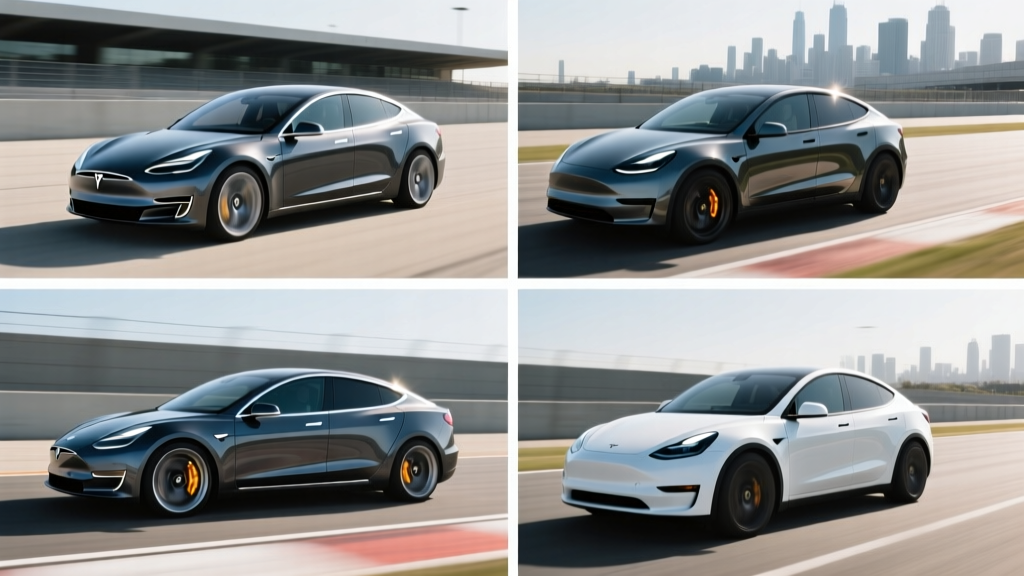
If you've ever typed "how fast does the Tesla go 0 to 60" into a search bar, you're not alone. Acceleration is one of the most visceral selling points of electric vehicles, and Tesla has leaned into it harder than almost any legacy automaker. Instant torque from electric motors eliminates the lag of turbo spool-up or transmission shifts, meaning even a base Tesla can embarrass sports cars off the line.
But speed isn't the whole story. In this guide, we break down every current 2026 Tesla model — the Model S, Model 3, Model X, and Model Y — with their exact 0-60 mph times, EPA range, charging speeds, pricing, and tax-credit eligibility. We'll also tell you what those numbers actually mean on the road, because a 1.99-second Plaid launch is a very different proposition from a 5.8-second base Model 3 commute.
Every 2026 Tesla's 0-60 Time at a Glance
| Model / Trim | 0-60 mph | Horsepower | Drivetrain | EPA Range | MPGe (combined) | Battery (usable kWh) | Base MSRP |
|---|---|---|---|---|---|---|---|
| Model 3 RWD | 5.8 sec | ~271 hp | Rear-Wheel Drive | 272 mi | 132 MPGe | ~60 kWh (LFP) | $42,380 |
| Model 3 Long Range AWD | 4.2 sec | ~346 hp | Dual-Motor AWD | 363 mi | 134 MPGe | ~79 kWh (NMC) | $48,880 |
| Model 3 Performance | 2.9 sec | ~510 hp | Dual-Motor AWD | 315 mi | 113 MPGe | ~79 kWh (NMC) | $54,880 |
| Model Y Long Range AWD | 4.8 sec | ~384 hp | Dual-Motor AWD | 320 mi | 122 MPGe | ~79 kWh (NMC) | $49,380 |
| Model Y Performance | 3.5 sec | ~456 hp | Dual-Motor AWD | 298 mi | 111 MPGe | ~79 kWh (NMC) | $54,880 |
| Model S Long Range | 3.1 sec | ~670 hp | Dual-Motor AWD | 402 mi | 124 MPGe | ~100 kWh (NMC) | $79,990 |
| Model S Plaid | 1.99 sec | ~1,020 hp | Tri-Motor AWD | 396 mi | 119 MPGe | ~100 kWh (NMC) | $94,990 |
| Model X Long Range | 3.8 sec | ~670 hp | Dual-Motor AWD | 335 mi | 104 MPGe | ~100 kWh (NMC) | $84,990 |
| Model X Plaid | 2.5 sec | ~1,020 hp | Tri-Motor AWD | 311 mi | 100 MPGe | ~100 kWh (NMC) | $99,990 |
Sources: Tesla official specs, fueleconomy.gov (EPA). All MSRP figures include destination fee. Performance times reflect rollout-adjusted manufacturer claims.
How Fast Does the Tesla Go 0 to 60 — The Real-World Reality
On paper, the Model S Plaid's 1.99-second 0-60 mph is supercar territory — faster than a Lamborghini Huracán and rivaling the Bugatti Chiron. But here's what the spec sheet doesn't tell you:
- The 1.99-second time requires specific conditions. Tesla's published Plaid time uses a 1-foot rollout (subtracting the first foot of travel, a drag-racing convention). With rollout, expect roughly 2.1-2.2 seconds in independent testing on a prepared surface.
- Battery state of charge matters. Peak acceleration requires SoC above 65%. Below 30%, even a Plaid will lose a noticeable tenth or two off the line.
- Tire temperature and road surface are critical. On cold, wet, or worn tires, traction-limited launches will add 0.3-0.5 seconds to any Tesla's time.
- The base Model 3 RWD at 5.8 seconds still out-accelerates most gas-powered sedans in its price class. A Toyota Camry V6 does 0-60 in about 6.6 seconds — so even Tesla's "slowest" model is genuinely quick.
Real-World Range: What to Actually Expect
The EPA range is measured on a controlled dynamometer cycle. In actual driving, expect the following adjustments:
- Highway driving at 75 mph: Subtract 10-15% from EPA (e.g., Model 3 LR's 363 mi → ~310-325 mi real highway)
- Cold weather (below 32°F): Subtract 20-30% due to battery chemistry slowdown and cabin heating (Model Y LR's 320 mi → ~225-255 mi)
- City/regenerative driving: Often matches or slightly exceeds EPA thanks to regen braking recovery
- Plaid/high-performance driving: Heavy throttle use can cut range by 40%+ vs. EPA
Tesla's efficiency remains class-leading. The Model 3 Long Range achieves roughly 25 kWh/100 miles (or 4 mi/kWh), among the best in the industry. The larger Model X and Model S use closer to 30-33 kWh/100 miles due to weight and frontal area.
The base Model 3 RWD uses an LFP (lithium iron phosphate) battery, which trades energy density for longevity and cost. LFP cells tolerate regular 100% charging without the degradation concerns of NMC chemistry — a major ownership advantage for commuters who can charge at home nightly. All Long Range and Performance variants use NMC (nickel manganese cobalt) chemistry, which Tesla recommends charging to 80% daily and 100% only for trips.
Charging Speed: DC Fast, Level 2, and the Supercharger Advantage
| Charging Level | Power / Rate | Miles Added per Hour | Notes |
|---|---|---|---|
| Level 1 (120V outlet) | ~1.4 kW | ~4-5 mi/hr | Emergency/trickle only |
| Level 2 (240V home, 48A) | ~11.5 kW | ~37-44 mi/hr | Tesla Wall Connector; ~8-10 hr for full charge |
| DC Fast — Model 3/Y | Peak 250 kW | ~170 mi in 15 min | 10-80% in ~25 min (V3 Supercharger) |
| DC Fast — Model S/X | Peak 250 kW | ~200 mi in 15 min | 10-80% in ~27 min (V3 Supercharger) |
| DC Fast — V4 Supercharger (select sites) | Up to 350 kW (capped by vehicle) | Similar to V3 | Current Teslas are vehicle-limited to ~250 kW |
Understanding kW vs kWh: kW (kilowatts) is the rate of charging — like water flowing through a hose. kWh (kilowatt-hours) is the total energy stored — like the size of the tank. A 250 kW charger delivers energy fast, but the car's battery size (60-100 kWh) determines how long a session lasts.
The charge curve reality: No Tesla sustains its peak 250 kW for an entire session. The peak rate applies roughly between 10-30% SoC, then tapers progressively. By 80%, you're typically at 40-60 kW. This is why Tesla (and the industry) quote 10-80% times rather than 0-100%. Charging past 80% at a DC fast charger adds significant time and isn't recommended for battery longevity.
One of Tesla's enduring advantages is the Supercharger network — over 6,000 U.S. stations with plug-and-charge simplicity, real-time stall availability in the app, and reliable uptime. While non-Tesla EVs now have NACS access to Superchargers (with an adapter), native Tesla vehicles still enjoy the most seamless public charging experience available.
Pricing, Tax Credits, and Total Cost
| Model / Trim | Base MSRP | §30D Federal Credit | Effective Price | Credit Notes |
|---|---|---|---|---|
| Model 3 RWD | $42,380 | $3,750 | ~$38,630 | Partial credit; LFP battery sourcing limits eligibility |
| Model 3 Long Range AWD | $48,880 | $7,500 | ~$41,380 | Full credit if buyer income and sourcing requirements met |
| Model 3 Performance | $54,880 | $7,500 | ~$47,380 | Under $55,000 sedan MSRP cap |
| Model Y Long Range AWD | $49,380 | $7,500 | ~$41,880 | SUV MSRP cap ($80,000) — comfortably eligible |
| Model Y Performance | $54,880 | $7,500 | ~$47,380 | Full credit eligible |
| Model S Long Range | $79,990 | $0 | $79,990 | Exceeds $55,000 sedan MSRP cap — ineligible |
| Model S Plaid | $94,990 | $0 | $94,990 | Ineligible — MSRP cap |
| Model X Long Range | $84,990 | $0 | $84,990 | Exceeds $80,000 SUV cap — ineligible |
| Model X Plaid | $99,990 | $0 | $99,990 | Ineligible — MSRP cap |
IRS §30D tax credit rules for 2026 include several caveats that can eliminate or reduce eligibility. Always verify with a tax professional and the IRS clean vehicle credit page.
- Buyer income caps: AGI must not exceed $300,000 (joint), $225,000 (head of household), or $150,000 (single).
- MSRP caps: Sedans (Model 3, Model S) capped at $55,000; SUVs/trucks/vans (Model Y, Model X) capped at $80,000.
- Battery sourcing requirements: Increasingly strict critical-mineral and battery-component rules phase in yearly. The Model 3 RWD's LFP battery (often CATL-sourced) has historically limited its credit to $3,750 rather than the full $7,500.
- Point-of-sale transfer: Since 2024, you can transfer the credit to the dealer at purchase, reducing your out-of-pocket cost immediately rather than waiting for a tax refund.
Which Tesla Is Right for You? A Decision Framework
- You commute solo or with one passenger
- You want the lowest price and best efficiency
- You don't need cargo space for a family
- Tax credit maximization matters ($41,380 effective for LR)
- You need a family vehicle (5 passengers + 76 cu ft cargo)
- You want hatchback utility and easy car-seat access
- You take regular road trips (320 mi EPA, Supercharger access)
- You value ride height and visibility
- You want 400+ mile range and executive comfort
- Performance (Plaid) is a priority and budget is flexible
- You don't need the federal credit (MSRP exceeds cap)
- Highway grand-touring is your primary use case
- You need 3-row seating (up to 7 passengers)
- You want falcon-wing doors and a premium SUV experience
- Towing capacity (up to 5,000 lbs) matters
- Budget is not the primary constraint
Interior, Cargo, and Tech: What It's Like to Live With
Cargo capacity (behind second row / max with seats folded):
- Model 3: 23 cu ft / 65 cu ft (trunk + frunk)
- Model Y: 30 cu ft / 76 cu ft (hatchback + frunk)
- Model S: 28 cu ft / 71 cu ft (liftback + frunk)
- Model X: 16 cu ft (5-seat, behind 3rd row) / 88 cu ft max
Standout tech features across the lineup:
- 15.4-inch center touchscreen (17-inch in S/X) controls everything — no physical buttons for climate, mirrors, or glovebox
- Over-the-air updates regularly add features; Tesla's software is the industry benchmark
- Sentry Mode and Dog Mode use external cameras and climate control for security and pet safety
- Autopilot (included) provides SAE Level 2 adaptive cruise and lane-centering — not self-driving; the driver must remain engaged at all times
- Full Self-Driving (Supervised) is an optional $8,000 add-on or $99/month subscription, still SAE Level 2 despite the name
- Heat pump standard on all models — significantly improves cold-weather range vs. resistive heating
Notable drawbacks:
- Minimalist interior frustrates some — no instrument cluster, no physical climate controls, limited storage cubbies
- Ride quality in Model 3/Y can be firm on rough pavement (improved in recent refreshes but still sporty)
- Phantom braking incidents reported with Autopilot; NHTSA has investigated
- Repair costs and insurance premiums run 15-25% higher than equivalent gas sedans/SUVs
- No Apple CarPlay or Android Auto — Tesla's native interface is the only option
Warranty and Long-Term Battery Outlook
| Coverage | Model 3 / Model Y | Model S / Model X |
|---|---|---|
| Basic Vehicle | 4 years / 50,000 miles | 4 years / 50,000 miles |
| Battery & Drive Unit | 8 years / 120,000 mi (LR/Perf) 8 years / 100,000 mi (RWD) | 8 years / 150,000 miles |
| Battery Retention Threshold | 70% capacity | 70% capacity |
Tesla's battery warranty guarantees the pack will retain at least 70% of original capacity during the warranty period. If it drops below that threshold, Tesla replaces or refurbishes the battery at no cost. In practice, Tesla's degradation data shows most packs retaining 88-92% capacity at 100,000 miles, well above the warranty floor. LFP packs in the Model 3 RWD may degrade even more slowly, though long-term fleet data is still maturing.
Out-of-warranty battery replacement costs range from approximately $12,000-$16,000 for Model 3/Y and $18,000-$22,000 for Model S/X, though full replacements are rare — individual module repairs are often possible at lower cost.
Pros and Cons at a Glance
- Class-leading acceleration across every trim
- Best-in-class Supercharger network
- Industry-best software and OTA updates
- Top efficiency (kWh/100mi) in segments
- Strong resale value relative to most EVs
- Heat pump standard (cold-weather advantage)
- No Apple CarPlay / Android Auto
- Minimalist interior polarizes buyers
- Higher insurance costs than gas equivalents
- Model S/X priced out of federal tax credit
- Repair network limited vs. legacy dealers
- FSD (Supervised) still Level 2 despite name and cost
Frequently Asked Questions
How fast does the Tesla go 0 to 60 in the cheapest model?
The base 2026 Model 3 RWD does 0-60 mph in 5.8 seconds. That's quicker than most gas-powered competitors in the $40,000 range, including the BMW 330i (5.6 sec, but at a higher price) and significantly quicker than a Toyota Camry (6.6 sec).
Is the Model S Plaid really faster than a supercar?
Yes, in a straight line. The Plaid's 1.99-second 0-60 (with rollout) beats virtually every production car ever made. However, supercars still outperform it in sustained track driving, braking, and lateral grip. The Plaid is a drag-strip monster, not a track-day tool.
Does the Model Y qualify for the full $7,500 tax credit in 2026?
The Model Y Long Range and Performance (both under the $80,000 SUV MSRP cap) are eligible for the full $7,500 federal credit, provided the buyer meets income requirements (≤$300,000 joint AGI) and the vehicle's battery components and critical minerals meet IRS §30D sourcing rules. Always confirm with a tax professional before purchasing.
What is the real-world range of a Tesla in winter?
Expect a 20-30% reduction in EPA range when temperatures drop below freezing, primarily due to battery chemistry resistance and cabin heating demands. A Model Y Long Range (320 mi EPA) may deliver 225-255 miles in cold highway driving. Preconditioning the battery while plugged in and using seat heaters instead of cabin heat can recover some of that loss.
How long does it take to charge a Tesla at home?
With a Tesla Wall Connector on a 240V/60A circuit (48A to the car), you'll add roughly 37-44 miles of range per hour, or a full charge overnight in 8-10 hours. Installation costs typically range from $800-$2,500 depending on your electrical panel's capacity and distance from the panel to the garage.
Is Tesla's Autopilot actually self-driving?
No. Autopilot and Full Self-Driving (Supervised) are both SAE Level 2 driver-assistance systems. You must keep your hands on the wheel, eyes on the road, and remain prepared to take over at any moment. True self-driving (Level 4) is currently only available through commercial robotaxi services like Waymo in select cities.
Should I buy a Tesla or a competitor like the Hyundai Ioniq 5 or BMW i4?
Choose Tesla if Supercharger access, software quality, and acceleration are your top priorities. Consider the Ioniq 5 if you want 800V ultra-fast charging (10-80% in ~18 min) and a more traditional interior. The BMW i4 is compelling if you prefer a premium cabin with Apple CarPlay and a more conventional driving experience. All are strong choices — test-drive each before deciding.