Tesla periodically rolls out promotional financing rates — including 0% APR for qualified buyers — as a lever to move inventory and counter rising competition from Hyundai, Ford, and Chinese EV makers. If you are browsing Tesla's configurator in 2026 and see a 0 percent financing banner, the headline is tempting. But is it actually the cheapest way to buy a Model Y? This review dissects the math behind Tesla 0 percent financing, pairs it with the 2026 Model Y's real-world range, charging performance, and federal tax credit eligibility, and benchmarks the total cost against key rivals.
2026 Tesla Model Y: Quick Verdict
The 2026 Model Y Long Range AWD remains Tesla's volume leader and the best all-around electric crossover for buyers who prioritize Supercharger access, cabin tech, and efficiency. It is not the most luxurious EV in its class, nor the most spacious, but its energy efficiency (measured in kWh per 100 miles) is class-leading, and the NACS charging ecosystem is the most reliable public network in the U.S. If you qualify for the promotional 0% APR and the §30D federal credit, the effective cost of ownership over five years undercuts nearly every competitor — including many gas-powered SUVs.
Range, Battery, and Efficiency
| Spec | Value |
|---|---|
| EPA Range | 320 miles |
| Battery (Usable) | ~75 kWh, NMC (nickel-manganese-cobalt) |
| MPGe (Combined) | 111 MPGe |
| Efficiency | 30 kWh/100 mi |
| Drivetrain | Dual-motor AWD |
| Horsepower | ~384 hp (combined) |
| 0-60 mph | 4.8 seconds |
The EPA rates the 2026 Model Y Long Range AWD at 320 miles. In real-world highway testing at 70-75 mph in moderate temperatures, expect 275–295 miles before needing to charge. In cold weather (below 30°F), range can drop an additional 15–25%, yielding roughly 230–260 miles on the highway. The Model Y's heat pump mitigates some cabin-heating loss, but battery chemistry still slows in the cold. City driving with regenerative braking returns closer to the EPA figure, often 300+ miles.
The Model Y uses an NMC (nickel-manganese-cobalt) lithium-ion pack, which offers higher energy density than LFP (lithium iron phosphate) chemistry found in the base RWD trim. NMC delivers more range per kilogram but is more sensitive to sustained 100% state of charge. Tesla recommends daily charging to 80–90% for Long Range models and 100% only for road trips. The base RWD Model Y, by contrast, uses an LFP battery that Tesla explicitly allows charging to 100% regularly — a trade-off worth understanding if you lack home charging and rely on topping up at public stations.
Charging Speed: DC Fast, Level 2, and Level 1
Charging speed is where Tesla's vertical integration pays off. The Model Y Long Range supports up to 250 kW peak on V3 Superchargers, though it does not sustain that rate for the full session. Here is what the charge curve looks like in practice:
| Charging Level | Power / Rate | Speed |
|---|---|---|
| DC Fast (V3 Supercharger) | Up to 250 kW peak | 10–80% in ~25 minutes; ~175 miles added in 15 min |
| DC Fast (CCS adapter / 350 kW station) | Up to 250 kW (car-limited) | Similar curve; adapter adds minor overhead |
| Level 2 (240V, 48A Wall Connector) | 11.5 kW | ~44 miles per hour of charging; full charge in ~8 hours |
| Level 2 (240V, 32A mobile connector) | 7.7 kW | ~30 miles per hour; full charge in ~11 hours |
| Level 1 (120V, 12A) | ~1.4 kW | ~3–5 miles per hour; emergency/trickle only |
A critical detail many spec sheets bury: peak kW is not sustained kW. The Model Y ramps quickly to around 250 kW at a low state of charge (10–20%), then tapers progressively — dropping to ~100 kW by 60% SoC and ~40 kW by 85%. This is why the 10–80% time (~25 min) is the meaningful metric, not the peak number. On road trips, plan stops around 20–25 minutes at V3 Superchargers and you will keep moving efficiently.
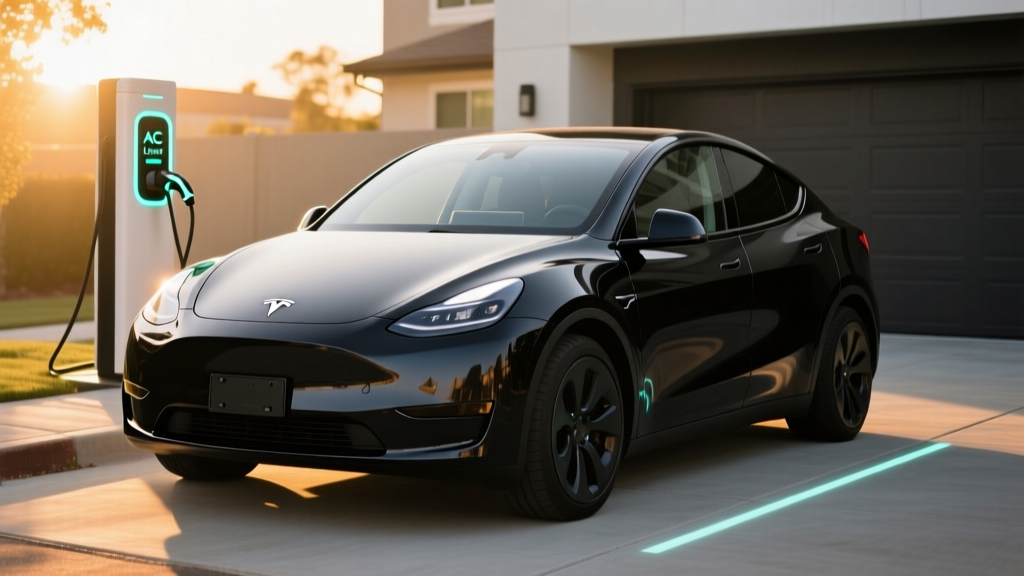
At home, the Tesla Wall Connector at 48 amps on a NEMA 14-50 or hardwired 60A circuit delivers 11.5 kW, which translates to roughly 44 miles of range per hour plugged in. Most owners who plug in overnight at home never visit a gas station or think about "range" during the work week. Installation typically costs $500–$1,500 for the electrician work if your panel has capacity; a 200-amp panel upgrade can add $1,500–$3,000.
Pricing, Tesla 0 Percent Financing, and Tax Credits
The 2026 Model Y Long Range AWD carries a base MSRP of approximately $48,990 (including destination). A Performance trim starts around $53,490. The base RWD (LFP battery, shorter range) undercuts at roughly $44,990. These prices fluctuate — Tesla adjusts pricing frequently, sometimes weekly.
How Tesla 0 Percent Financing Actually Works
When Tesla advertises 0% APR, it typically applies to specific terms (often 36 or 48 months) through Tesla's captive financing arm or a partner lender, and requires excellent credit (generally 720+ FICO). Here is the math on a Long Range AWD at $48,990 with 0% APR over 48 months:
- Monthly payment: $1,020.63 (principal only — no interest)
- Total paid over 48 months: $48,990
- Interest saved vs. a 6.5% APR loan: ~$6,800 over 48 months
Compare this to a typical 6.5% APR loan from a bank or credit union on the same amount and term, and you are paying roughly $1,163/month — a difference of $142/month or $6,816 over the life of the loan. The 0% offer is genuinely valuable if you qualify and do not sacrifice a larger cash discount or incentive by choosing it.
| Trim | Base MSRP | §30D Credit (max) | Effective Price |
|---|---|---|---|
| RWD (LFP) | $44,990 | Up to $7,500* | ~$37,490* |
| Long Range AWD | $48,990 | Up to $7,500* | ~$41,490* |
| Performance AWD | $53,490 | Up to $7,500* | ~$45,990* |
*Federal §30D credit eligibility depends on buyer income (AGI caps: $150K single / $300K joint), vehicle MSRP caps ($80K for SUVs), and battery critical-mineral and component sourcing requirements. The credit can now be transferred at point of sale as an instant discount per IRS guidelines. Always verify current eligibility on IRS.gov or with a tax professional before purchasing.
Does the Model Y Qualify for the Federal EV Tax Credit?
As of 2026, the Model Y qualifies for up to the full $7,500 §30D credit, provided the buyer meets income thresholds and the specific vehicle's battery satisfies the critical-minerals and foreign-entity-of-concern (FEOC) sourcing rules. Tesla has worked to localize battery component and mineral sourcing to North America and free-trade-agreement partners, but the exact credit amount ($3,750 or $7,500) can vary by production batch. The point-of-sale transfer option means you can apply the credit as an instant rebate at delivery rather than waiting to claim it on your tax return. Confirm with your Tesla advisor which credit tier the specific VIN you are ordering qualifies for.
Interior, Cargo, and Daily Livability
The Model Y cabin is minimalist — a single 15.4-inch touchscreen handles navigation, climate, media, and vehicle settings. There is no instrument cluster; speed and range appear in the top corner of the screen. Whether this is elegant or frustrating depends on your tolerance for screen-based controls. The 2026 refresh adds ventilated front seats, ambient lighting, and a rear-seat touchscreen for passengers, narrowing the gap with Hyundai's Ioniq 5 and the Ford Mustang Mach-E in perceived quality.
- Cargo (behind 2nd row): 30.2 cu ft
- Cargo (2nd row folded): 72.1 cu ft
- Front trunk (frunk): 4.1 cu ft
- Rear legroom: 41.6 inches
- Front headroom: 41.0 inches
- Seating: 5 standard; optional 7-seat (third row is very small, best for children)
The cargo area is generous for the segment, and the flat floor with folded seats makes the Model Y practical for hauling furniture, camping gear, or bikes. The optional tow hitch provides a 3,500-lb towing capacity — adequate for a small utility trailer or lightweight boat, but less than the Ford F-150 Lightning or Rivian R1S.
Driver Assistance and Technology
Tesla's Autopilot and Full Self-Driving (Supervised) are SAE Level 2 driver-assistance systems. The driver must remain fully engaged, eyes on the road, hands on the wheel (or demonstrating attention via the cabin camera). These are not autonomous or self-driving systems. Only Level 4 services like Waymo operate without a human driver — and those are geofenced robotaxis, not consumer vehicles.
Standard Autopilot includes Traffic-Aware Cruise Control and Autosteer (lane centering). The $8,000 FSD (Supervised) upgrade adds automatic lane changes, navigate-on-autopilot for highway interchanges, traffic-light and stop-sign recognition, and a city-streets driving mode. FSD has improved significantly, but it still requires constant supervision and can make unpredictable decisions in construction zones or unusual intersections. Most buyers are better served by the included Autopilot, which handles highway cruising competently.
Other tech highlights: over-the-air updates that add features post-purchase, Sentry Mode (360° parked-camera recording), Dog Mode (climate control for pets), and a built-in dashcam. The Tesla app provides remote climate control, location tracking, and charging management — arguably the best EV companion app in the industry.
Warranty and Long-Term Ownership
| Component | Coverage |
|---|---|
| Basic Vehicle | 4 years / 50,000 miles |
| Battery & Drive Unit | 8 years / 120,000 miles (Long Range/Performance) |
| Battery & Drive Unit (RWD LFP) | 8 years / 100,000 miles |
| Battery Capacity Retention | Minimum 70% over warranty period |
Tesla's battery warranty guarantees at least 70% capacity retention over 8 years or 120,000 miles (whichever comes first) for Long Range and Performance trims. Real-world degradation data from Tesla's fleet shows most Model Y packs retain approximately 85–90% capacity after 100,000 miles, with the steepest drop occurring in the first 10,000–20,000 miles before leveling off. A full battery replacement outside warranty currently costs roughly $12,000–$16,000 depending on pack size — rare, but worth budgeting for if you plan to keep the vehicle 12+ years.
Insurance costs are a real ownership factor. The Model Y is more expensive to insure than a comparable gas crossover, with national averages around $2,200–$2,800/year depending on your profile. Tesla offers its own insurance product in many states, which uses real-time driving data to set premiums — some drivers save, others pay more. Get quotes before ordering.
Pros, Cons, and Who Should Buy
- Class-leading efficiency (30 kWh/100 mi)
- Supercharger network — most reliable DC fast-charging in the U.S.
- Strong 0-60 performance (4.8 sec) with practicality
- Over-the-air updates keep the car current
- 0% financing saves ~$6,800 vs. a 6.5% loan (if qualified)
- Point-of-sale §30D credit reduces delivery cost
- Minimalist interior not for everyone; no physical buttons
- Ride quality firm on 20" wheels; road noise at highway speed
- FSD (Supervised) is expensive ($8,000) and still requires full attention
- Insurance premiums above segment average
- Third-row seat is cramped (children only)
- Panel gaps and paint quality still inconsistent on some units
Who the Model Y Suits Best
Daily commuters and road-trippers benefit most from the Model Y's efficiency and Supercharger access. If you drive 30–80 miles round-trip daily and can charge at home, you will rarely think about range. Families will appreciate the cargo space and optional third row, though the Hyundai Ioniq 5 and Kia EV6 offer more rear-seat room. Buyers who qualify for 0% financing and the full §30D credit will find the effective price difficult to beat anywhere in the EV market.
Is the Model Y Worth It vs. Key Competitors?
The Hyundai Ioniq 5 charges faster (10–80% in 18 min on 350 kW chargers) and has a more spacious rear seat, but lacks Supercharger-native access (adapters required). The Ford Mustang Mach-E offers a sportier driving feel and a more conventional interior, but its public charging experience is less seamless. The Kia EV6 matches Ioniq 5 charging and has striking design, but its dealer network and software experience lag Tesla's. If Supercharger reliability and software integration are priorities, the Model Y still leads. If interior quality and physical controls matter more, cross-shop Hyundai and Ford.
Frequently Asked Questions
What is the real-world range of the 2026 Tesla Model Y?
The EPA rates it at 320 miles, but expect 275–295 miles on the highway in moderate weather, and 230–260 miles in cold conditions below 30°F. City driving with regenerative braking returns closer to the EPA number.
How fast does the Model Y charge at home and on the road?
On a V3 Supercharger (250 kW), it charges 10–80% in approximately 25 minutes. At home on a 48A Level 2 Wall Connector (11.5 kW), it adds ~44 miles per hour, fully charging overnight in about 8 hours.
Does the Model Y qualify for the $7,500 federal tax credit?
It can qualify for up to $7,500 under IRS §30D rules, subject to buyer income caps ($300K joint / $150K single), MSRP caps ($80K for SUVs), and battery sourcing requirements. The credit can be applied at point of sale as an instant discount.
Is Tesla 0 percent financing a good deal?
If you qualify (typically 720+ credit score), 0% APR over 36–48 months saves roughly $6,800 in interest compared to a 6.5% loan. It is one of the cheapest ways to finance an EV — but confirm the promotional term and ensure you are not forgoing a larger cash incentive.
What are the biggest drawbacks of the Model Y?
The minimalist touchscreen-only interior, firm ride on larger wheels, above-average insurance costs, and the $8,000 FSD upgrade that still requires full driver attention are the most common complaints. Panel-gap consistency has improved but is not yet on par with German or Korean competitors.
How does the Model Y compare to the Hyundai Ioniq 5?
The Ioniq 5 charges faster (18 min 10–80%) and has a roomier rear seat. The Model Y wins on efficiency, Supercharger network access, and software. Choose Tesla for road-trip charging ease; choose Hyundai for interior space and faster DC charging.
Sources: EPA Fuel Economy — Tesla Model Y, IRS §30D Clean Vehicle Credit, NHTSA Vehicle Safety.