Tesla's 0% APR Promotions: What Buyers Need to Know in 2026
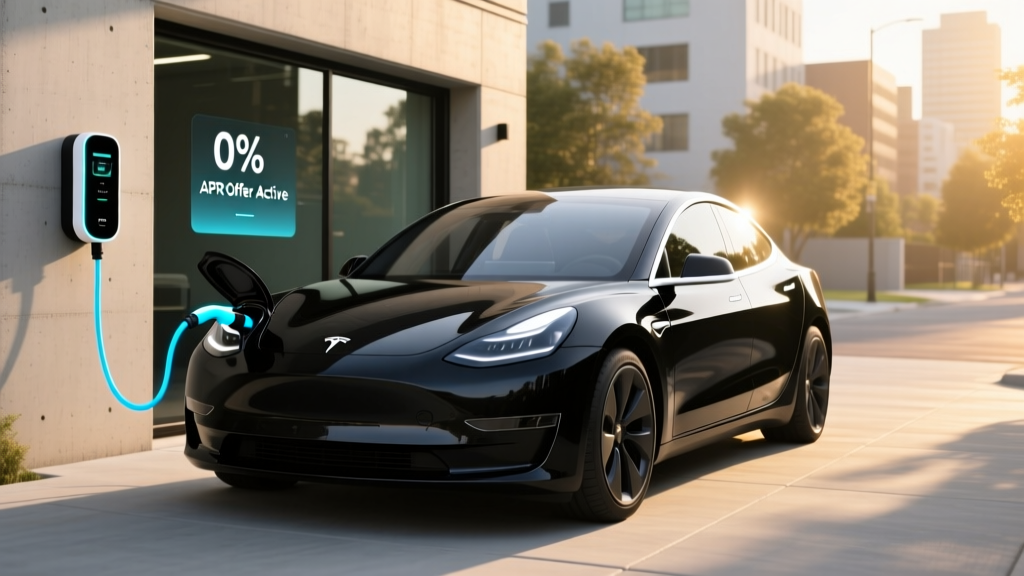
Tesla has periodically offered 0% APR financing on select models and trims as a way to move inventory without officially cutting MSRPs. In early 2026, these promotions have resurfaced — but they apply only to specific configurations and come with trade-offs worth understanding before you sign. This guide breaks down which Tesla models currently qualify for 0% APR, what the real monthly cost looks like, and how the vehicles themselves stack up on range, charging, and ownership value.
Zero-percent financing means you pay no interest on your auto loan. On a $45,000 vehicle financed over 60 months, that saves roughly $3,500–$5,000 compared to a 6–7% market-rate loan. But 0% APR deals typically require excellent credit (720+ FICO), shorter loan terms (36–60 months), and may exclude you from stacking certain cash incentives. Let's examine what's actually on the table.
Which Tesla Models Qualify for 0% APR?
As of early 2026, Tesla's 0% APR offers have primarily targeted the Model 3 Rear-Wheel Drive and Model Y Long Range AWD — the brand's highest-volume sellers. These promotions are typically structured as 36- or 48-month terms and require financing through Tesla's preferred lending partners. The high-performance variants (Model 3 Performance, Model Y Performance) and the Cybertruck have generally been excluded from 0% APR promotions.
| Model / Trim | Base MSRP | 0% APR Eligible? | Federal §30D Credit | Effective Price (w/ Credit) |
|---|---|---|---|---|
| Model 3 RWD | $38,990 | Yes (36–60 mo) | Up to $7,500* | ~$31,490 |
| Model 3 Long Range AWD | $45,490 | Limited | Up to $7,500* | ~$37,990 |
| Model 3 Performance | $52,990 | No | Up to $7,500* | ~$45,490 |
| Model Y Long Range AWD | $44,990 | Yes (36–48 mo) | Up to $7,500* | ~$37,490 |
| Model Y Performance | $49,990 | No | Up to $7,500* | ~$42,490 |
*Federal §30D credit eligibility depends on buyer income caps ($150K single / $300K joint MAGI), MSRP caps ($55K sedans / $80K SUVs), and battery critical-mineral sourcing requirements. Point-of-sale transfer available at participating dealers. Verify current rules at IRS.gov.
A critical nuance: accepting 0% APR may require you to forgo other Tesla promotional incentives (such as referral credits or price reductions). Always run the math on total cost — a slightly higher APR with a cash rebate may sometimes yield a lower total payment.
Tesla Model 3 RWD: Range, Battery, and Real-World Efficiency
The Model 3 Rear-Wheel Drive is Tesla's entry point and the trim most commonly bundled with 0% APR offers. Here's what the numbers look like for the 2026 model year.
| Spec | Value |
|---|---|
| EPA Range | 272 miles |
| Battery Capacity | 60 kWh usable (LFP chemistry) |
| Drivetrain | Rear-Wheel Drive (single motor) |
| Horsepower | 271 hp |
| 0–60 mph | 5.8 seconds |
| Efficiency | 132 MPGe combined / 25 kWh/100mi |
| Max DC Fast Charge | 170 kW peak |
| 10–80% DC Charge Time | ~25 minutes |
| Level 2 Home Charge Rate | 11.5 kW (~44 mi/hr) |
| Cargo Volume | 23 cu ft (rear trunk + frunk) |
| Rear Legroom | 35.3 inches |
| Battery Warranty | 8 years / 100,000 miles (70% min retention) |
| Basic Vehicle Warranty | 4 years / 50,000 miles |
Real-World Range: What to Actually Expect
EPA Sticker: 272 miles
Highway (70 mph, moderate weather): ~235–250 miles
Cold weather (below 32°F, mixed driving): ~190–215 miles
City / stop-and-go with regen: ~265–280 miles
The Model 3 RWD uses an LFP (lithium iron phosphate) battery. LFP cells tolerate frequent 100% charging better than NMC chemistries — Tesla actually recommends periodic full charges for LFP packs to maintain cell-balancing accuracy. However, LFP batteries lose a slightly higher percentage of range in extreme cold compared to NMC. Expect a 20–30% range reduction in sub-freezing conditions, consistent with EPA cold-weather EV testing data.
Charging Speed Breakdown: Home and DC Fast Charging
Charging speed is where Tesla's Supercharger network advantage remains tangible. The Model 3 RWD peaks at 170 kW on DC fast chargers — adequate but not class-leading. Competitors like the Hyundai Ioniq 6 (up to 240 kW) charge noticeably faster on compatible infrastructure.
| Charging Level | Power (kW) | Miles Added per Hour | Typical Use Case |
|---|---|---|---|
| Level 1 (120V household) | ~1.4 kW | ~5 mi/hr | Overnight trickle, emergencies |
| Level 2 (240V home wall connector) | 11.5 kW | ~44 mi/hr | Daily home charging |
| DC Fast (Supercharger V3/V4) | Up to 170 kW | ~180 mi in 15 min (peak) | Road trips |
On a Tesla Supercharger V3 or V4 station, the Model 3 RWD will charge from 10% to 80% in approximately 25 minutes. Note that charge rate tapers significantly above 80% — going from 80% to 100% can take an additional 15–20 minutes. For road-trip efficiency, plan your stops around 10–80% charging windows.
For home charging, Tesla's Wall Connector ($475) on a 60-amp circuit delivers the full 11.5 kW, replenishing a depleted battery in about 5.5 hours. A NEMA 14-50 outlet on a 50-amp circuit provides roughly 7.7 kW (~30 mi/hr). Budget $500–$1,500 for professional electrical installation depending on panel proximity and local permit requirements.
Model Y Long Range AWD: The 0% APR SUV Option
For buyers needing more space, the Model Y Long Range AWD is the other primary 0% APR candidate. It trades some efficiency for cargo room and dual-motor capability.
| Spec | Value |
|---|---|
| EPA Range | 308 miles |
| Battery Capacity | 75 kWh usable (NMC chemistry) |
| Drivetrain | Dual-Motor AWD |
| Horsepower | 384 hp |
| 0–60 mph | 4.8 seconds |
| Efficiency | 117 MPGe combined / 29 kWh/100mi |
| Max DC Fast Charge | 250 kW peak |
| 10–80% DC Charge Time | ~20 minutes |
| Level 2 Home Charge Rate | 11.5 kW (~37 mi/hr) |
| Cargo Volume (behind 2nd row) | 30 cu ft (76 cu ft folded) |
| Rear Legroom | 36.5 inches |
| Battery Warranty | 8 years / 120,000 miles (70% min retention) |
Real-World Range: Model Y Long Range AWD
EPA Sticker: 308 miles
Highway (70 mph): ~265–280 miles
Cold weather (below 32°F): ~220–245 miles
City / commuter driving: ~295–310 miles
The Model Y's NMC battery offers higher energy density and slightly better cold-weather retention than LFP, but Tesla recommends daily charging to 80–90% rather than 100% for longevity. The 250 kW peak charge rate means faster Supercharger stops than the Model 3 RWD — a meaningful advantage on road trips.
Federal Tax Credit Eligibility: §30D Rules for 2026
Both the Model 3 and Model Y remain eligible for the federal clean vehicle credit under IRS §30D, but qualification is not automatic. Here's the checklist:
- MSRP Cap: Sedans (Model 3) must be under $55,000; SUVs/trucks (Model Y) under $80,000. All current trims qualify.
- Buyer Income Cap: Modified AGI must not exceed $150,000 (single), $225,000 (head of household), or $300,000 (joint filing).
- Battery Sourcing: Critical minerals and battery components must meet escalating domestic/free-trade-partner thresholds. Tesla's shifting supply chains mean eligibility can change mid-year — verify the specific VIN's compliance at purchase.
- Point-of-Sale Transfer: You can transfer the credit to the dealer at purchase, reducing your out-of-pocket cost immediately rather than waiting for a tax refund.
- Assembly: Vehicle must be assembled in North America. Both Model 3 (Fremont, CA) and Model Y (Austin, TX / Fremont, CA) qualify.
The interaction between 0% APR and the tax credit is straightforward: they stack. You can finance at 0% APR and still claim (or transfer) the $7,500 credit, provided you meet all §30D requirements. This combination makes the effective entry price for a Model 3 RWD approximately $31,490 — competitive with many gas-powered compact sedans.
For the latest sourcing requirements and income thresholds, consult the IRS Clean Vehicle Credit page or speak with a tax professional before purchasing.
Tech, Driver Assistance, and Interior
Tesla's minimalist interior approach remains polarizing. The Model 3 "Highland" refresh (carried into 2026) added ventilated front seats, ambient lighting, rear-seat touchscreen, and improved sound insulation — addressing many of the prior generation's comfort complaints.
Infotainment: All controls route through a 15.4-inch center touchscreen. No physical instrument cluster. The system is responsive and feature-rich (streaming, gaming, navigation with live Supercharger routing), but the lack of Apple CarPlay/Android Auto frustrates some buyers.
Driver Assistance (Autopilot / FSD):
SAE Automation Level: Level 2
Tesla Autopilot and Full Self-Driving (Supervised) are SAE Level 2 driver-assistance systems. The driver must remain fully engaged, hands on or near the wheel, and eyes on the road at all times. These systems do not make the vehicle self-driving. Only Level 4 services like Waymo operate without a human driver in geofenced areas.
Standard Autopilot includes Traffic-Aware Cruise Control and Autosteer (lane centering). FSD (Supervised) — a $8,000 add-on or $99/month subscription — adds automatic lane changes, Navigate on Autopilot, and traffic-light/stop-sign recognition. Real-world FSD performance has improved significantly but still requires vigilant supervision, particularly in construction zones and unmapped areas. NHTSA continues to monitor Tesla's driver-monitoring systems.
Notable Drawbacks:
- No physical stalks on the refreshed Model 3 — turn signals are steering-wheel buttons, which many drivers find unintuitive
- No Apple CarPlay or Android Auto
- Panel gaps and paint quality, while improved, still trail legacy luxury brands
- No heads-up display
- Ride quality is firm, especially with the 19-inch sport wheels
How Does Tesla's 0% APR Compare to Competitors?
Tesla isn't the only automaker offering promotional financing. Here's how the value proposition stacks up against key competitors in the same price range:
Tesla Model 3 RWD
Effective Price: ~$31,490 (after credit)
Range: 272 mi EPA
Charging: 170 kW peak, Supercharger network
Edge: Supercharger access, software ecosystem, 0% APR + $7,500 credit stacking
Hyundai Ioniq 6 SE Long Range
Effective Price: ~$33,500 (after credit)
Range: 361 mi EPA
Charging: 240 kW peak (800V architecture)
Edge: Class-leading range, faster charging, CarPlay, more conventional interior
Tesla Model Y LR AWD
Effective Price: ~$37,490 (after credit)
Range: 308 mi EPA
Cargo: 76 cu ft folded
Edge: Supercharger network, spacious interior, strong resale value
Ford Mustang Mach-E Premium AWD
Effective Price: ~$38,000 (after credit, varies)
Range: 290 mi EPA (extended range)
Cargo: 57 cu ft folded
Edge: More engaging driving dynamics, BlueCruise hands-free, dealer service network
Tesla's 0% APR offer is most compelling when combined with the full $7,500 federal credit. The Hyundai Ioniq 6 offers more range and faster charging, but its promotional financing rates have typically been 1.9–3.9% APR rather than 0%. Run the numbers on total interest paid over your loan term before deciding.
Monthly Payment Math: 0% APR vs. Market Rate
Here's what a Model 3 RWD actually costs per month under different financing scenarios, assuming the full $7,500 credit is applied to reduce the financed amount:
| Scenario | Financed Amount | Term | APR | Monthly Payment | Total Interest Paid |
|---|---|---|---|---|---|
| Tesla 0% APR | $31,490 | 60 months | 0.0% | $525 | $0 |
| Market-rate loan | $31,490 | 60 months | 6.5% | $616 | $5,470 |
| Tesla 0% APR (36 mo) | $31,490 | 36 months | 0.0% | $875 | $0 |
The savings are substantial — over $5,000 in avoided interest on a 60-month loan. However, the 36-month 0% APR term means significantly higher monthly payments. Choose the term that fits your cash flow, not just the headline rate.
Pros and Cons: Tesla 0% APR Offers
Pros
- 0% APR saves $3,500–$5,500 in interest vs. market-rate loans
- Stacks with the $7,500 federal §30D tax credit (if eligible)
- Access to Tesla's Supercharger network — the most reliable DC fast-charging network in North America
- Over-the-air software updates continuously add features
- Strong resale value relative to most EV competitors
- LFP battery (Model 3 RWD) tolerates daily 100% charging
- Low operating cost: ~$0.04–$0.06/mile on home electricity
Cons
- 0% APR requires excellent credit (typically 720+ FICO)
- Shorter loan terms (36–48 months) mean higher monthly payments
- Model 3 RWD range (272 mi EPA) trails competitors like Ioniq 6 (361 mi)
- DC fast charging at 170 kW (Model 3) is slower than 800V competitors
- No Apple CarPlay or Android Auto
- No physical turn-signal stalks on refreshed Model 3
- FSD ($8,000) remains a Level 2 system despite its name
- Tax credit eligibility can change due to battery sourcing rules — verify at purchase
Who Should Take Advantage of Tesla's 0% APR?
Choose Tesla with 0% APR if:
- Daily commuters driving 30–80 miles round-trip with home charging access — the Model 3 RWD handles this effortlessly and costs pennies per mile
- Tech-forward buyers who value OTA updates, the Supercharger network, and Tesla's software ecosystem
- Buyers with strong credit (720+) who can qualify for 0% and want to minimize total cost of ownership
- Small families who need the Model Y's cargo space and can benefit from 0% APR on the Long Range AWD trim
Look elsewhere if:
- Road-trip-heavy drivers who need maximum range per charge — the Ioniq 6 or Chevy Equinox EV offer more miles
- Buyers who prefer physical controls and CarPlay/Android Auto integration
- Those who can't charge at home — public charging costs 2–3x more than home charging and erodes the EV cost advantage
- Longer loan terms needed — if you need 72–84 months to afford the payment, 0% APR isn't available and you should reconsider the purchase
Frequently Asked Questions
What is the real-world range of the Tesla Model 3 RWD?
The EPA rates the 2026 Model 3 RWD at 272 miles. In real-world highway driving at 70 mph, expect approximately 235–250 miles. In cold weather (below freezing), range drops to roughly 190–215 miles due to battery resistance and cabin heating demands. City driving with regenerative braking can approach or slightly exceed the EPA figure.
How fast does the Model 3 charge at home and on road trips?
At home on a Level 2 (240V) Tesla Wall Connector, the Model 3 charges at 11.5 kW, adding roughly 44 miles of range per hour — a full charge takes about 5.5 hours. On Tesla Superchargers, it peaks at 170 kW DC, reaching 10–80% in approximately 25 minutes. Charge rate tapers above 80%, so plan stops around the 10–80% window for maximum efficiency.
Does the Tesla Model 3 qualify for the $7,500 federal EV tax credit?
Yes, the Model 3 qualifies for up to $7,500 under IRS §30D, subject to buyer income limits ($150K single / $300K joint), the $55,000 MSRP cap for sedans, and battery critical-mineral sourcing requirements. The credit can be transferred at point of sale to reduce your purchase price immediately. However, sourcing requirements can change — confirm your specific vehicle's VIN eligibility before finalizing the purchase.
How much does a Tesla Model 3 RWD cost after tax credits and 0% APR?
With the $7,500 federal credit applied and 0% APR financing over 60 months, the effective price is approximately $31,490, resulting in a monthly payment of about $525 with zero interest charges. This makes the Model 3 RWD one of the most affordable premium EVs on the market when all incentives are combined.
Is the Tesla Model 3 worth buying over the Hyundai Ioniq 6 or Chevy Equinox EV?
It depends on priorities. The Model 3 wins on Supercharger network access, software, and the 0% APR + tax credit combination. The Ioniq 6 wins on EPA range (361 vs. 272 miles) and charging speed (240 kW vs. 170 kW). The Equinox EV offers a more traditional interior and longer range at a similar price. If you have reliable home charging and value the Tesla ecosystem, the 0% APR deal makes the Model 3 financially compelling. If maximum range and faster public charging matter more, test-drive the Ioniq 6.
Can I combine Tesla's 0% APR with the federal tax credit?
Yes. The 0% APR is a financing promotion from Tesla and its lending partners. The federal §30D tax credit is a separate government incentive. They stack — you finance the vehicle at 0% interest and still claim or transfer the tax credit, reducing your effective purchase price. Some state incentives (like California's CVRP or Colorado's innovative motor vehicle credit) may also stack, but check your state's specific rules.
What credit score do I need for Tesla's 0% APR financing?
Tesla does not publish an exact minimum, but 0% APR promotional rates through auto lenders typically require a FICO score of 720 or above, along with a strong debt-to-income ratio. Buyers with scores in the 680–720 range may be offered reduced-rate financing (1.9–3.9%) rather than 0%. Check your credit before applying and consider whether the higher monthly payment of a shorter 0% term fits your budget.
Sources: EPA Fuel Economy, IRS Clean Vehicle Credits, NHTSA Automated Vehicle Safety. All pricing and specifications reflect 2026 model year data available at time of publication. Verify current promotions and credit eligibility directly with Tesla and the IRS before purchasing.