Why Tesla's 0% APR Financing Deserves a Hard Look in 2026
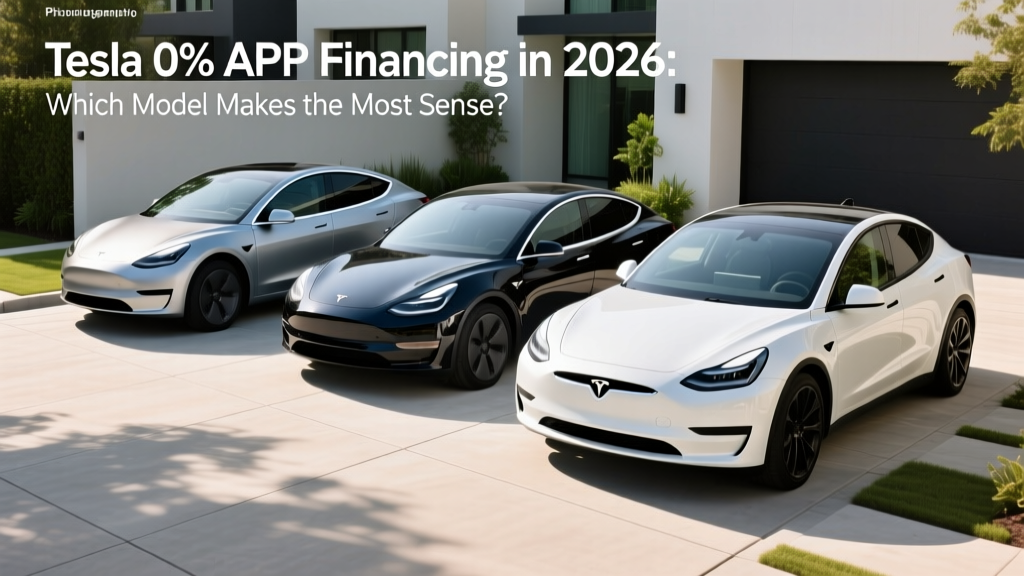
When Tesla periodically rolls out 0% APR financing — typically on 36- to 60-month terms for qualified buyers — it's one of the few moments in the EV market where the cost of borrowing drops to zero. In a rate environment where conventional auto loans hover between 5% and 8% APR for well-qualified buyers, a 0% promotional rate on a $40,000–$80,000 vehicle can save $3,000–$7,000 in interest over the life of the loan. But financing terms only matter if the underlying vehicle is right for your needs. This review examines the full 2026 Tesla lineup — Model 3, Model Y, Model S, and Model X — through the lens of real-world ownership: EPA range versus what you'll actually get, charging speeds that matter on road trips, true cost after the federal §30D tax credit, and which model justifies locking in 0% APR.
2026 Tesla Lineup: Spec Comparison at a Glance
| Spec | Model 3 Long Range AWD | Model Y Long Range AWD | Model S Long Range | Model X Long Range |
|---|---|---|---|---|
| EPA Range | 363 mi | 337 mi | 402 mi | 348 mi |
| Battery (usable) | ~75 kWh (NMC) | ~75 kWh (NMC) | ~95 kWh (NMC) | ~95 kWh (NMC) |
| Drivetrain | Dual-motor AWD | Dual-motor AWD | Dual-motor AWD | Dual-motor AWD |
| Horsepower | ~346 hp | ~384 hp | ~670 hp | ~670 hp |
| 0-60 mph | 4.2 sec | 4.8 sec | 3.1 sec | 3.8 sec |
| MPGe (combined) | 132 MPGe | 122 MPGe | 120 MPGe | 102 MPGe |
| Efficiency | 25 kWh/100mi | 28 kWh/100mi | 28 kWh/100mi | 33 kWh/100mi |
| Peak DC Charge | 250 kW | 250 kW | 250 kW | 250 kW |
| 10-80% DC Time | ~25 min | ~27 min | ~30 min | ~32 min |
| Level 2 Rate | 11.5 kW (~44 mi/hr) | 11.5 kW (~44 mi/hr) | 11.5 kW (~35 mi/hr) | 11.5 kW (~30 mi/hr) |
| Cargo (rear seats up) | 23 cu ft | 30 cu ft (+12 frunk) | 28 cu ft (+5 frunk) | 42 cu ft (+7 frunk) |
| Rear Legroom | 35.2 in | 40.5 in | 35.4 in | 40.9 in |
| Base MSRP (2026) | $47,740 | $50,630 | $79,990 | $84,990 |
| Battery Warranty | 8 yr / 120,000 mi | 8 yr / 120,000 mi | 8 yr / 150,000 mi | 8 yr / 150,000 mi |
Source: fueleconomy.gov and Tesla's official 2026 spec sheets. Pricing excludes destination fee.
Real-World Range: What the EPA Sticker Doesn't Tell You
EPA vs. Reality: Tesla's EPA estimates are generally achievable in mixed city/suburban driving at moderate speeds. On sustained highway trips at 70-75 mph, expect a 10-15% reduction. In freezing temperatures (below 32°F), range can drop 20-30% depending on cabin heating demands and whether you precondition.
For the Model 3 Long Range, the 363-mile EPA figure translates to roughly 310-320 miles on a flat, temperate highway run. In winter conditions at highway speeds, plan for 260-280 miles of usable range before needing to stop. The Model 3's heat pump — standard across all 2026 trims — mitigates cold-weather losses better than resistive heating, but physics still wins in sub-zero weather.
The Model Y Long Range suffers a slightly larger real-world gap because of its taller, less aerodynamic profile. At 70 mph, expect ~285-300 miles in fair weather, dropping to ~240-260 miles in cold highway driving. Its efficiency of 28 kWh/100mi is still excellent for a crossover, but the Model 3's lower drag coefficient gives it a measurable edge on long trips.
The Model S leverages its larger ~95 kWh battery to deliver a genuine 340-360 miles on the highway in good conditions — the most road-trip-capable sedan in the lineup. The Model X, despite sharing that battery, is penalized by its weight and boxy shape: 290-310 highway miles is realistic, making it the weakest road-trip performer per dollar in the family.
Charging Speed: Supercharger Network Advantage
All 2026 Teslas peak at 250 kW on DC fast chargers — specifically on Tesla's V3 and V4 Superchargers. That peak rate is not sustained across the full session. The charge curve is aggressive in the 10-50% state-of-charge window, then tapers progressively. Here's what that looks like in practice:
| Charging Scenario | Model 3 LR | Model Y LR | Model S LR | Model X LR |
|---|---|---|---|---|
| 10-80% at 250 kW Supercharger | ~25 min | ~27 min | ~30 min | ~32 min |
| Miles added in 15 min | ~175 mi | ~160 mi | ~200 mi | ~170 mi |
| Level 2 at home (11.5 kW / 48A) | ~44 mi/hr | ~44 mi/hr | ~35 mi/hr | ~30 mi/hr |
| Level 1 (120V, 1.4 kW) | ~5 mi/hr | ~5 mi/hr | ~4 mi/hr | ~4 mi/hr |
One advantage Tesla retains over nearly every competitor: the Supercharger network's reliability. With over 25,000 V3/V4 stalls across North America and native NACS connectors on all 2026 Teslas, you avoid the adapter hassles that CCS-equipped vehicles face at Tesla stalls. Non-Tesla DC networks (Electrify America, EVgo) now also support NACS natively, but Tesla's own network still posts the highest uptime percentages in industry surveys.
For home charging, a 48-amp Level 2 wall connector on a 60-amp circuit delivers the full 11.5 kW. That's enough to fully replenish any Tesla overnight — typically 7-9 hours from 10% to 100%. Budget $500-$1,500 for a licensed electrician to install a NEMA 14-50 outlet or hardwired Wall Connector, depending on your panel's proximity to the garage and whether a panel upgrade is needed.
Pricing, Tax Credits, and the 0% APR Equation
The headline appeal of Tesla's 0% APR financing is straightforward: zero interest on a 36- or 48-month loan. But the true cost picture requires factoring in the federal §30D clean vehicle credit, which can reduce your effective purchase price by up to $7,500 — or eliminate it entirely depending on the model, your income, and battery-sourcing compliance.
| Model | Base MSRP | §30D Credit (est.) | Effective Price | Monthly at 0% APR / 60 mo |
|---|---|---|---|---|
| Model 3 Long Range AWD | $47,740 | $7,500* | ~$40,240 | ~$671 |
| Model Y Long Range AWD | $50,630 | $7,500* | ~$43,130 | ~$719 |
| Model S Long Range | $79,990 | $0** | $79,990 | ~$1,333 |
| Model X Long Range | $84,990 | $0** | $84,990 | ~$1,417 |
*Assumes buyer meets all §30D requirements. **Model S and X exceed the MSRP cap ($55,000 for sedans, $80,000 for SUVs/vans/pickups) and do not qualify.
§30D Federal Tax Credit Requirements (2026):
- MSRP cap: $55,000 for sedans (Model 3); $80,000 for SUVs/trucks (Model Y qualifies; Model S/X do not)
- Income cap: Modified AGI ≤ $150,000 (single) / $300,000 (joint) / $225,000 (head of household)
- Battery sourcing: Increasing percentages of critical minerals and battery components must be sourced from the US or FTA partners — this threshold tightens annually
- Point-of-sale transfer: You can transfer the credit to the dealer at purchase, reducing your financed amount immediately
- New rule (2025+): Vehicles with battery components from a "foreign entity of concern" may be disqualified — verify current-year eligibility on fueleconomy.gov
Here's where 0% APR amplifies the value: if you finance a Model 3 Long Range at $40,240 (after the $7,500 point-of-sale credit) over 60 months at 0%, your monthly payment is $671 — compared to roughly $758/month at 5.9% APR. Over five years, you save approximately $5,200 in interest. That's effectively a second incentive layered on top of the tax credit.
Tech, Driver Assistance, and Interior Reality
All 2026 Teslas ship with Tesla's current infotainment platform: a 15.4-inch center touchscreen (Model 3/Y) or 17-inch (Model S/X), over-the-air updates, and the full Tesla app ecosystem. The Model 3 Highlandand Model Y Juniper refreshes brought meaningful interior improvements — ventilated front seats, ambient lighting, rear-seat touchscreen, and improved acoustic glass.
Driver Assistance — SAE Level 2: Tesla's Autopilot (standard) and Full Self-Driving Supervised ($8,000 option or $99/month subscription) are SAE Level 2 systems. They provide lane-keeping, adaptive cruise, and automatic lane changes, but the driver must remain fully engaged at all times. These are not autonomous driving systems. Hands-on-wheel monitoring and camera-based attention tracking are enforced.
Notable tech strengths:
- Supercharger-based navigation with automatic battery preconditioning (warms the pack before DC charging for faster speeds)
- Sentry Mode dashcam recording and remote monitoring
- Over-the-air feature additions — Tesla regularly ships new capabilities post-purchase
- Vehicle-to-load (V2L) capability via the 12V system on Model 3/Y; Powerwall integration for home backup
Notable drawbacks:
- No Apple CarPlay or Android Auto — Tesla's ecosystem is closed
- Minimalist interior means no physical buttons for climate, wipers, or glovebox (screen-dependent)
- Panel gaps and paint quality, while improved, still trail legacy luxury brands at the Model S/X price point
- FSD Supervised remains a Level 2 system despite its name — buyers expecting autonomy will be disappointed
Pros and Cons: The Honest Summary
Pros
- Class-leading efficiency (Model 3 at 25 kWh/100mi is among the best in the industry)
- Supercharger network: 25,000+ stalls, native NACS, highest reliability in public charging
- 0% APR financing eliminates interest costs — rare in the current rate environment
- $7,500 federal credit available on Model 3 and Y (with point-of-sale transfer)
- Strong over-the-air update cadence keeps vehicles current
- Excellent regenerative braking enables true one-pedal driving
- Model Y offers best-in-class cargo volume for an electric crossover
Cons
- No Apple CarPlay/Android Auto — dealbreaker for some buyers
- FSD Supervised is expensive ($8,000) and still requires full driver attention
- Model S and X do not qualify for the federal tax credit (MSRP cap)
- 250 kW peak DC charging is good but trails Hyundai/Kia's 350 kW capability
- Insurance premiums run 15-25% higher than comparable gas vehicles
- Screen-dependent controls (climate, mirrors, glovebox) require adaptation
- Ride quality on Model 3/Y is firm — not ideal for poorly maintained roads
Who Should Buy — And Who Should Look Elsewhere
Choose the Model 3 Long Range if: You're a commuter or couple who prioritizes efficiency and real-world range. At ~$40,240 after the tax credit and $671/month on 0% APR, it's one of the most cost-effective long-range EVs available. Best for: daily drivers covering 30-60 miles with occasional road trips.
Choose the Model Y Long Range if: You need crossover cargo space and rear-seat room for a family. The 30 cu ft cargo area and 40.5 inches of rear legroom make it genuinely practical. At ~$719/month on 0% APR, it's the sweet spot of the lineup. Best for: families, pet owners, and anyone who regularly hauls gear.
Choose the Model S if: You want a luxury performance sedan with 400+ mile range and don't need the tax credit. The 3.1-second 0-60 and 402-mile EPA range are genuinely impressive. But at $79,990 with no credit and no 0% APR guarantee, it competes against the Lucid Air and BMW i5 — do a cross-shop. Best for: performance-sedan buyers who want Tesla's ecosystem.
Choose the Model X if: You need three-row seating and falcon-wing doors genuinely help with car-seat access. But at $84,990 with no tax credit, it's the hardest Tesla to justify financially. The Rivian R1S and Kia EV9 offer three rows at significantly lower prices. Best for: buyers specifically committed to the Tesla ecosystem who need three rows.
Frequently Asked Questions
Does Tesla's 0% APR financing apply to all models?
Tesla's promotional financing offers rotate and are not always available on every trim. Historically, 0% APR has been offered on Model 3 and Model Y most consistently, with Model S and X occasionally included on shorter terms (36 months). Check Tesla's current offers page before configuring — promotional rates can change monthly and are subject to credit approval (typically requiring a FICO score above 720).
Can I combine 0% APR financing with the $7,500 federal tax credit?
Yes. The §30D tax credit is independent of your financing method. You can take the credit as a point-of-sale transfer (reducing the amount you finance) and still benefit from 0% APR on the remaining balance. This is the optimal strategy: lower principal plus zero interest. Confirm eligibility requirements with a tax professional, as income caps and battery-sourcing rules apply.
What is the real-world range of the Tesla Model Y?
The Model Y Long Range AWD carries a 337-mile EPA estimate. In real-world highway driving at 70 mph in moderate temperatures, expect 285-300 miles. In cold weather (below freezing) at highway speeds, plan for 240-260 miles. The heat pump helps, but battery chemistry is inherently less efficient in the cold.
How fast does a Tesla charge at home?
On a properly installed Level 2 home charger (48 amps / 11.5 kW), the Model 3 and Model Y add approximately 44 miles of range per hour — enough to fully charge overnight in 7-9 hours. The Model S and X add 30-35 miles per hour due to their larger batteries. A standard 120V outlet adds only 4-5 miles per hour — adequate for low-mileage drivers but impractical as a primary charging method.
Is Tesla's FSD worth the $8,000 cost?
For most buyers, no. FSD Supervised is a Level 2 driver-assist system — it does not drive autonomously, and you must remain fully engaged. The standard Autopilot (included) handles adaptive cruise and lane-keeping well. FSD adds automatic lane changes, traffic-light recognition, and city-street navigation, but the $8,000 price or $99/month subscription is hard to justify when you're still doing all the driving. The $99/month subscription is a better way to trial it before committing.
How does Tesla's warranty compare to competitors?
Tesla covers the battery and drive unit for 8 years / 120,000 miles on Model 3 and Y, and 8 years / 150,000 miles on Model S and X — with a minimum 70% capacity retention guarantee. The basic vehicle warranty is 4 years / 50,000 miles. Hyundai/Kia offer 10-year / 100,000-mile battery warranties, which is a notable advantage. However, Tesla's battery degradation data from real-world fleets shows most packs retain 85-90% capacity at 100,000 miles, well above the warranty threshold.
Always verify current Tesla financing promotions, pricing, and IRS §30D tax credit eligibility before purchasing. Rules and offers change frequently. Consult a tax professional for personal credit eligibility.