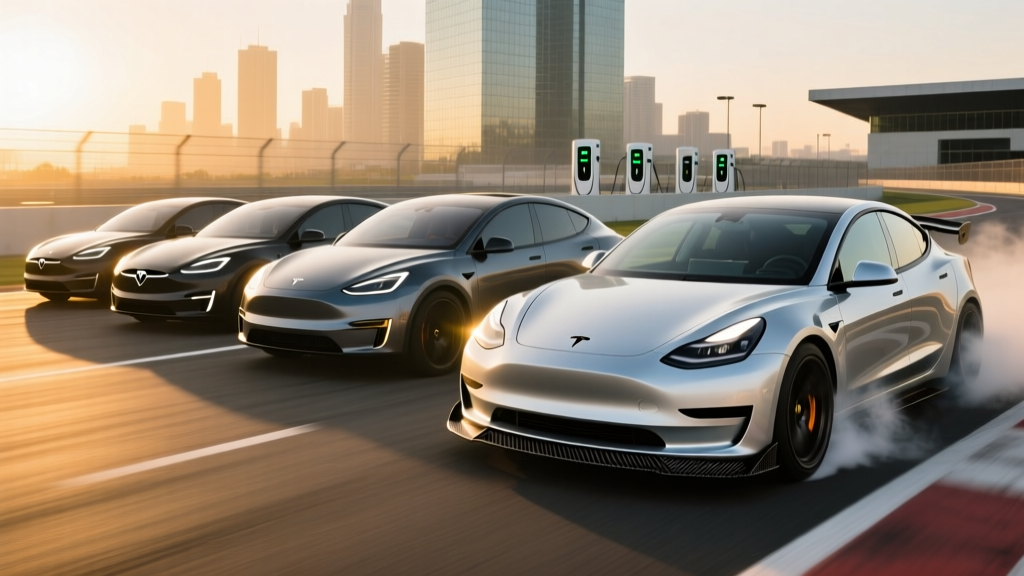
Acceleration has become Tesla's signature party trick, but the headline Tesla 0-60 time figures don't tell the whole story. A Model S Plaid will warp to 60 mph in 1.99 seconds — faster than most hypercars — while the base Model 3 Rear-Wheel-Drive still posts a respectable 5.8-second run. What matters for real buyers is how those sprints pair with range, charging speed, daily usability, and the evolving price tag after federal tax credits.
This 2025–2026 profile ranks every current-production Tesla by 0-60 time, then walks through the specs that actually shape ownership: real-world range, DC fast-charge curves, LFP vs. NMC battery chemistry, Level 2 home charging, §30D tax-credit eligibility, and which model fits which driver.
Every Current Tesla Ranked by 0-60 mph Time
Tesla publishes manufacturer-claimed acceleration numbers that include a one-foot rollout (standard in the industry but worth noting). Here's the current U.S. lineup sorted quickest to slowest, with drivetrain layout and peak output for context.
| Model / Trim | 0-60 mph (sec) | Drivetrain | Peak HP (est.) | Top Speed |
|---|---|---|---|---|
| Model S Plaid | 1.99 | Tri-Motor AWD | 1,020 | 200 mph |
| Roadster (announced) | 1.9* | Tri-Motor AWD | ~1,000+ | 250+ mph |
| Model 3 Performance (AWD) | 2.9 | Dual-Motor AWD | 510 | 163 mph |
| Model X Plaid | 2.5 | Tri-Motor AWD | 1,020 | 163 mph |
| Model Y Performance (AWD) | 3.5 | Dual-Motor AWD | 456 | 155 mph |
| Model S Long Range | 3.1 | Dual-Motor AWD | 670 | 155 mph |
| Model X Long Range | 3.8 | Dual-Motor AWD | 670 | 155 mph |
| Cybertruck Cyberbeast | 2.6 | Tri-Motor AWD | 845 | 130 mph |
| Cybertruck AWD | 3.9 | Dual-Motor AWD | 600 | 112 mph |
| Cybertruck RWD | 6.5 (est.) | Rear-Wheel-Drive | ~315 | 112 mph |
| Model 3 Long Range AWD | 4.2 | Dual-Motor AWD | 346 | 125 mph |
| Model Y Long Range AWD | 4.8 | Dual-Motor AWD | 384 | 125 mph |
| Model 3 RWD | 5.8 | Rear-Wheel-Drive | 271 | 125 mph |
| Model Y RWD (Long Range RWD) | 6.5 (est.) | Rear-Wheel-Drive | ~295 | 125 mph |
*The next-generation Roadster remains announced but is not yet in customer hands; specs are preliminary.
Range, Battery Chemistry, and Real-World Expectations
Acceleration is only one axis. The more useful question is how far you can drive between charges — and how much of the EPA sticker you'll actually see on a 70-mph road trip or a freezing January commute.
EPA figures assume a mixed city/highway cycle at moderate temperatures. Expect highway-only driving at 70–75 mph to return roughly 85–90% of the EPA sticker, and cold-weather (below 32°F) driving to drop 20–30% due to cabin heating and battery resistance. Preconditioning the battery while plugged in recovers some of that loss.
| Model / Trim | EPA Range (mi) | Battery (usable kWh) | Chemistry | MPGe (combined) | kWh/100 mi |
|---|---|---|---|---|---|
| Model S Long Range | 402 | ~95 | NMC | 122 | 28 |
| Model S Plaid | 359 | ~95 | NMC | 116 | 29 |
| Model X Long Range | 335 | ~95 | NMC | 103 | 33 |
| Model X Plaid | 326 | ~95 | NMC | 101 | 33 |
| Model 3 Long Range AWD | 341 | ~75 | NMC | 131 | 26 |
| Model 3 Performance | 315 | ~75 | NMC | 122 | 28 |
| Model 3 RWD | 272 | ~57 | LFP | 132 | 25 |
| Model Y Long Range AWD | 320 | ~75 | NMC | 122 | 28 |
| Model Y Performance | 285 | ~75 | NMC | 117 | 29 |
| Cybertruck AWD | 340 | ~123 | NMC | 78 | 43 |
| Cybertruck Cyberbeast | 320 | ~123 | NMC | 76 | 44 |
LFP vs. NMC, in plain terms: The Model 3 RWD uses lithium iron phosphate (LFP), which is heavier and less energy-dense but more durable across charge cycles and can (and should) be charged to 100% daily. NMC packs in the Long Range and Performance trims offer more range per pound but Tesla recommends daily charging to 80% to preserve long-term health. Per fueleconomy.gov, the Model 3 RWD's 132 MPGe combined makes it one of the most efficient EVs sold in the U.S.
Charging Speed: DC Fast, Level 2, and the Curve Nobody Talks About
Tesla's Supercharger network remains its strongest ownership advantage — but "up to 250 kW" is a peak, not an average. Every lithium-ion pack tapers charge rate as state of charge climbs, and thermal management plays a huge role.
| Platform | Peak DC kW | 10–80% Time | Level 2 (240V/48A) | Connector |
|---|---|---|---|---|
| Model 3 / Model Y (current) | 250 | ~25–28 min | ~44 mi/hr (11.5 kW) | NACS (native) |
| Model S / Model X | 250 | ~28–32 min | ~34 mi/hr (11.5 kW) | NACS (native) |
| Cybertruck | 250+ | ~25–30 min | ~37 mi/hr (11.5 kW) | NACS (native) |
On a V3 or V4 Supercharger, a preconditioned Model 3 Long Range will sustain roughly 150–170 kW on average between 10% and 80% — not the 250 kW peak it flashes for a minute or two around 20% SoC. For road trips, plan stops around 20–25 minutes to go from 10% to 80%, then move on. Charging past 80% slows dramatically — often below 50 kW — so only top off when you genuinely need it.
At home, a Tesla Wall Connector on a 60-amp circuit delivers up to 11.5 kW (48A). That's roughly 44 miles of range per hour in a Model 3, easily refilling a day's driving overnight. Budget $500–$1,500 for installation depending on panel proximity; a 200-amp panel upgrade can add $1,500–$3,000 if your home is older.
Pricing, Trims, and Federal Tax-Credit Eligibility
Tesla's MSRPs have settled after years of volatility, but the §30D federal tax credit adds a layer of math that depends on your income, the vehicle's MSRP cap, and battery-sourcing rules.
| Model / Trim | Base MSRP | As-Tested (typical) | §30D Credit Eligible? |
|---|---|---|---|
| Model 3 RWD | $38,990 | $40,500 | Yes — up to $7,500 (point-of-sale) |
| Model 3 Long Range AWD | $45,240 | $47,800 | Yes — up to $7,500 |
| Model 3 Performance | $52,990 | $55,500 | Yes — up to $7,500 |
| Model Y Long Range AWD | $46,630 | $49,200 | Yes — up to $7,500 |
| Model Y Performance | $51,490 | $54,000 | Yes — up to $7,500 |
| Model S Long Range | $79,990 | $85,000 | No — exceeds $55k sedan cap |
| Model S Plaid | $94,990 | $100,000+ | No — exceeds $55k sedan cap |
| Model X Long Range | $79,990 | $86,000 | Yes — qualifies under $80k SUV cap |
| Model X Plaid | $94,990 | $101,000+ | No — exceeds $80k SUV cap |
| Cybertruck AWD | $79,990 | $84,000 | Borderline — under $80k cap, sourcing rules apply |
| Cybertruck Cyberbeast | $99,990 | $105,000+ | No — exceeds $80k SUV/truck cap |
§30D eligibility rules to verify before you buy (per the IRS clean vehicle credit page):
- Buyer income caps: AGI ≤ $150,000 single / $300,000 married filing jointly / $225,000 head of household.
- MSRP caps: ≤ $55,000 for sedans (Model 3); ≤ $80,000 for SUVs, vans, and trucks (Model Y, Model X base, Cybertruck AWD).
- Battery sourcing: Critical-mineral and battery-component requirements phase up annually; Tesla's U.S.-assembled vehicles with North-American-sourced cells currently meet the full $7,500 threshold for qualifying trims, but rules tighten each year.
- Point-of-sale transfer: As of 2024+, you can transfer the credit to the dealer at purchase and take it as a price reduction rather than waiting for tax filing.
Always confirm eligibility the week you buy — the DOE's fueleconomy.gov tax credit tool tracks qualifying VINs in near real-time.
Interior, Cargo, and Tech That Defines the Ownership Experience
Tesla cabins are minimalist by design — a single 15.4-inch center touchscreen (17-inch tilt-screen in Model S/X) handles climate, media, navigation, and vehicle settings. A rear 8-inch screen appears in Model S/X and the refreshed Model 3 Highland. Build quality on the 2025+ Model 3 and Model Y Juniper refresh has closed the gap with legacy luxury brands: tighter panel gaps, acoustic glass, ventilated front seats, and ambient lighting.
| Model | Cargo (rear seats up) | Cargo (seats folded) | Frunk | Rear Legroom |
|---|---|---|---|---|
| Model 3 | 21 cu ft | ~56 cu ft | 3.1 cu ft | 34.9 in |
| Model Y | 30 cu ft | 72 cu ft | 4.1 cu ft | 41.6 in |
| Model S | 28 cu ft | ~65 cu ft | ~3 cu ft | 35.4 in |
| Model X (5-seat) | ~40 cu ft | ~88 cu ft | ~6 cu ft | 38.4 in |
| Cybertruck | 6-ft bed (68 cu ft vault) | — | Front trunk (frunk) ~7 cu ft | ~38 in |
Standout tech: Tesla's Supercharger network (25,000+ stalls globally, with V4 cabinets rolling out), over-the-air updates that add features years after purchase, and the optional FSD (Supervised) system — which is an SAE Level 2 driver-assist, not self-driving. You must keep eyes on the road and hands responsive. Competing Level 2 systems like GM Super Cruise and Ford BlueCruise now match it on highway lane-centering; Tesla's edge remains in city-street coverage, albeit with ongoing NHTSA scrutiny.
Notable drawbacks: No Apple CarPlay or Android Auto (Tesla's UI is the UI), no physical stalks on the refreshed Model 3 (turn signals on the steering wheel), and a stiff ride on 20-inch wheels in the Performance trims. Insurance premiums on Teslas run 15–30% higher than segment averages in most states, per industry data.
Warranty and Long-Term Battery Health
Tesla's warranty structure is straightforward:
- Basic vehicle: 4 years / 50,000 miles.
- Battery & drive unit:
- Model 3 RWD (LFP): 8 years / 100,000 miles
- Model 3 Long Range/Performance & Model Y: 8 years / 120,000 miles
- Model S & Model X: 8 years / 150,000 miles
- Retention threshold: Tesla warrants at least 70% capacity retention during the warranty period — consistent with industry norms.
Real-world degradation data from aggregated fleet studies shows NMC packs losing roughly 10–12% capacity in the first 100,000 miles before flattening; LFP packs degrade more slowly and tolerate 100% daily charges, making the base Model 3 RWD one of the best long-term value plays in the lineup.
Which Tesla Fits Which Driver?
- Class-leading 0-60 times across the lineup
- Supercharger network is the most reliable DC fast-charge ecosystem in North America
- OTA updates keep vehicles current for years
- Strong resale values relative to most EVs
- LFP option on Model 3 RWD for durability and daily 100% charging
- High insurance premiums across all models
- No CarPlay/Android Auto
- Model S/X pricing exceeds §30D caps
- Stalkless steering wheel on refreshed Model 3 takes adaptation
- Cybertruck efficiency is poor (43–44 kWh/100 mi)
Choose based on use case:
- Daily commuter / budget-focused: Model 3 RWD — $38,990 MSRP, $31,490 after §30D, 272-mile range, lowest running costs.
- Family road-tripper: Model Y Long Range AWD — best cargo-to-efficiency balance, 320-mile range, Supercharger access.
- Performance enthusiast: Model 3 Performance — 2.9-second 0-60 at $52,990 is supercar territory at a fraction of the cost.
- Luxury + space: Model X Long Range (qualifies for §30D) or Model S Long Range (does not).
- Truck/utility buyer: Cybertruck AWD if you need the bed; expect frequent charge stops on road trips due to efficiency.
- Track-day bragging rights: Model S Plaid — 1.99-second 0-60, but plan around $100k out-the-door and no tax credit.
Tesla 0-60 FAQ
What is the fastest Tesla 0-60 time available today?
The Model S Plaid posts a manufacturer-claimed 1.99-second 0-60 mph with rollout subtracted, making it one of the quickest production cars ever sold. Independent tests from outlets like Car and Driver and MotorTrend have verified sub-2.0-second runs on prepped surfaces.
Does the base Model 3 feel slow?
No. The Model 3 RWD's 5.8-second 0-60 matches a Honda Accord 2.0T or a warm hatch. Instant electric torque makes it feel quicker in city driving than the number suggests.
Which Tesla qualifies for the $7,500 federal tax credit?
As of the 2025–2026 tax year, the Model 3 (all trims) and Model Y (all trims) qualify for up to $7,500 under §30D, subject to buyer AGI limits and battery-sourcing rules. Model X Long Range just clears the $80,000 SUV cap. Model S, Plaid trims of Model X, and Cyberbeast exceed their respective MSRP caps.
How does Tesla's 0-60 compare to competitors?
The Model 3 Performance (2.9s) beats the BMW i4 M50 (3.7s), Porsche Taycan 4S (3.8s), and Hyundai Ioniq 5 N (3.25s) to 60 mph. The Model S Plaid's 1.99s outruns the Lucid Air Sapphire (1.89s claimed) only on paper — both are in a class of their own. For SUVs, the Model Y Performance (3.5s) is quicker than the Ford Mustang Mach-E GT (3.5s tie) and BMW iX M60 (3.6s).
What's the real-world range on a Tesla at highway speeds?
Expect roughly 85–90% of the EPA sticker at 70–75 mph in mild weather. A Model 3 Long Range AWD rated at 341 miles EPA will typically deliver 285–305 miles on a flat highway run at 70°F. In sub-freezing temps, drop that by another 20–30%.
Is Tesla's Autopilot or FSD self-driving?
No. Both are SAE Level 2 driver-assist systems, meaning the driver must remain attentive and ready to intervene at all times. True driverless (Level 4) service in the U.S. currently exists only in limited robotaxi geofences operated by Waymo and Cruise. FSD (Supervised) handles more scenarios than basic Autopilot, but liability remains with the driver.
Should I buy LFP or NMC?
If you want lower cost, longer cycle life, and don't mind ~272 miles of range, the LFP Model 3 RWD is an excellent pick — and you can charge it to 100% daily without guilt. If you need 320+ miles or AWD, the NMC Long Range models are the right call, but stick to 80% daily charging for longevity.
Sources: EPA fuel-economy data via fueleconomy.gov, Tesla U.S. spec pages, IRS §30D guidance, NHTSA safety ratings.