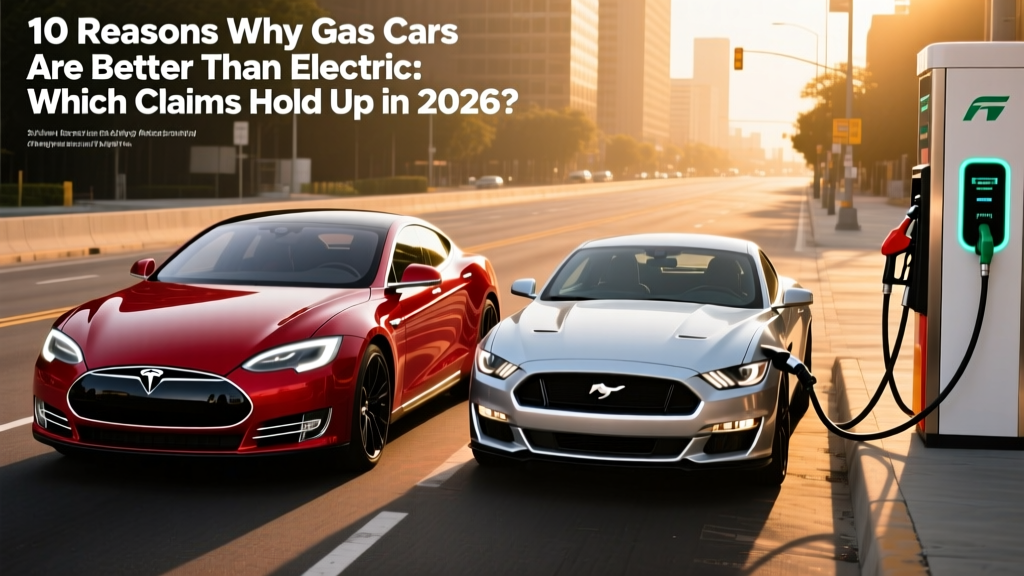
If you have searched for "10 reasons why gas cars are better than electric," you have likely found a mix of legitimate concerns and outdated myths. The short answer: gas cars still win on upfront purchase price (typically $5,000–$12,000 cheaper for comparable segments), fast refueling (5 minutes vs. 18–40 minutes for EV DC fast charging), and access in rural charging deserts. However, several commonly cited advantages — like long-term cost savings, battery replacement fears, and cold-weather usability — do not hold up against 2026 data. Below, we examine each claim with exact numbers so you can decide which vehicle type actually fits your driving pattern, budget, and home-charging situation.
The Quick Answer: Where Gas Cars Genuinely Win
Gas cars have real, measurable advantages in three areas:
- Lower upfront cost: The average new gas vehicle transaction price sits around $38,500 vs. $48,200 for a new EV (before incentives), per 2026 industry data.
- Refueling speed and infrastructure density: 5 minutes at any of the ~145,000 US gas stations vs. 18–40 minutes at one of ~75,000 public EV charging ports.
- No home-charging requirement: Gas cars work for apartment dwellers and street parkers without a $500–$2,500 Level 2 home install.
Where the "gas is better" narrative breaks down: fuel cost per mile (EV wins at ~$0.04/mi vs. $0.12/mi for gas at $3.40/gal and 28 MPG combined), maintenance cost (EVs average ~40% less over 5 years), and total cost of ownership over 5+ years for home-charging-capable drivers.
Reason 1: Lower Sticker Price — True, but Shrinking
The most defensible argument for gas cars is purchase price. A 2026 Toyota Camry LE (gas) starts at $29,995 MSRP. A comparable EV like the 2026 Hyundai Ioniq 6 SE starts at $38,650. That is an $8,655 gap before incentives.
However, the IRS §30D federal tax credit can close this gap substantially — up to $7,500 if the vehicle meets battery sourcing, critical mineral, MSRP cap ($55,000 for sedans, $80,000 for SUVs/trucks), and buyer income limits ($150K single / $300K joint). The Ioniq 6 qualifies for the full $7,500 in 2026 when purchased via point-of-sale transfer, bringing its effective price to ~$31,150 — within $1,200 of the Camry.
Verdict: TRUE — but the gap narrows to $1,000–$3,000 for credit-eligible buyers choosing credit-eligible models.
Reason 2: Faster Refueling — Absolutely True
This is not a myth. Pumping 12 gallons of gas takes 3–5 minutes and adds ~350 miles of range. Even the fastest-charging EVs in 2026 require meaningful time:
| Metric | Gas Car (28 MPG avg) | Fast-Charging EV (e.g., Ioniq 5) | Slower EV (e.g., Chevy Equinox EV) |
|---|---|---|---|
| "Refuel" to add 200 miles | ~3 min | ~12 min (peak 240 kW) | ~25 min (peak 150 kW) |
| Full tank / 10-80% charge | ~5 min (12 gal) | ~18 min (10-80%) | ~32 min (10-80%) |
| Stops per 600-mile trip | 1 stop | 2 stops | 2-3 stops |
| Time lost on 600-mile trip | ~5 min | ~30-40 min | ~55-75 min |
On long road trips, the gas car wins by 30–70 minutes. For daily commuting, however, this advantage disappears — home-charged EVs start every morning with a "full tank," eliminating fuel stops entirely.
Verdict: TRUE — especially for frequent road-trippers covering 300+ miles in a single day.
Reason 3: More Infrastructure — Still True in Rural Areas
The US has approximately 145,000 gas stations but only ~75,000 public EV charging ports (including Level 2 and DC fast chargers), per AFDC data. More critically, DC fast chargers capable of 150+ kW remain sparse in rural corridors across Montana, the Dakotas, West Virginia, and parts of the rural South.
If you live in a metro area with reliable public charging or can install a Level 2 charger at home, this gap is irrelevant. If you live in a rural area without home-charging access and regularly drive 200+ miles between destinations, gas infrastructure is a genuine advantage.
Verdict: CONDITIONALLY TRUE — depends entirely on your zip code and home-charging access.
Reason 4: No Range Anxiety — Partially True
Gas cars do not trigger range anxiety because refueling is fast and ubiquitous. But modern EVs have largely closed the range gap:
- 2026 Tesla Model 3 Long Range: EPA 363 miles
- 2026 Hyundai Ioniq 6 SE Long Range: EPA 361 miles
- 2026 Chevrolet Silverado EV 4WT: EPA 380 miles
- 2026 Lucid Air Grand Touring: EPA 512 miles
The real-world caveat matters. Highway driving at 75+ mph typically reduces EPA range by 10–15%. Cold weather (below 32°F) can reduce it 20–30% in EVs without heat pumps, and 10–15% in those with heat pumps (like the Ioniq 5 and Model 3). A 361-mile EPA-rated Ioniq 6 might deliver ~260 miles on a 20°F winter highway drive.
A gas car with a 14-gallon tank and 30 MPG highway delivers ~420 miles consistently regardless of temperature.
Verdict: PARTIALLY TRUE — cold-weather range loss is real for EVs, but 300+ mile EPA ratings make daily range anxiety rare for most drivers.
Reason 5: Cheaper to Maintain — Gas Cars Lose This One
This is where the "gas is better" argument collapses. EVs have far fewer moving parts — no oil changes, no transmission fluid, no spark plugs, no exhaust system, no timing belt. Regenerative braking extends brake pad life significantly (many EV owners report 80,000+ miles on original pads).
| Maintenance Item (5-Year / 75,000 mi) | Gas Car Cost | EV Cost |
|---|---|---|
| Oil changes (5-7) | $350–$560 | $0 |
| Transmission fluid | $150–$300 | $0 (most EVs) |
| Brake pads | $300–$500 | $0–$200 (regen extends life) |
| Engine air filter | $75–$150 | $0 (cabin filter only) |
| Spark plugs | $200–$400 | $0 |
| Coolant flush | $100–$150 | $100–$150 |
| Tire rotation (same for both) | $150–$250 | $150–$250 |
| Total 5-Year Maintenance | $1,325–$2,310 | $250–$600 |
EVs save $1,000–$1,700 in routine maintenance over five years. The one area where EVs can cost more: tires. Heavier EVs with instant torque can wear tires 20–30% faster, adding $200–$400 over 5 years.
Verdict: FALSE — gas cars cost significantly more to maintain.
Reason 6: Battery Replacement Will Bankrupt You — Mostly Myth
The fear of a $15,000–$20,000 battery replacement is the single biggest deterrent for prospective EV buyers. Here is what the data actually shows:
- Federal warranty mandate: All EV batteries carry a minimum 8-year/100,000-mile warranty (10 years/150,000 miles in CARB states like California). If capacity drops below ~70%, the manufacturer replaces it at no cost.
- Real-world degradation: Data from Recurrent Auto and fleet studies show most modern NMC and LFP batteries retain 90–95% capacity after 5 years / 75,000 miles. A 2026 Tesla Model 3 with a 75 kWh NMC pack typically shows ~5–8% degradation at 100,000 miles.
- Failure rate: Complete battery failure outside of warranty is rare — estimated at 1.5–2.5% of vehicles over 10 years, per industry analyses.
- Replacement cost (out of warranty): $8,000–$16,000 depending on pack size, but prices continue to fall as cell costs decline (~$100/kWh at the pack level in 2026).
Compare this to a gas car's powertrain risk: a transmission replacement runs $3,000–$7,000, and an engine rebuild can exceed $5,000. These failures are also not rare on high-mileage gas vehicles.
Verdict: MOSTLY FALSE — battery failures are uncommon, covered by long warranties, and comparable in financial risk to gas powertrain failures.
Reason 7: Better for Long Road Trips — True for Certain Routes
If your typical road trip involves I-5 in California, I-95 on the East Coast, or I-70 through Colorado, modern DC fast-charging networks (Tesla Supercharger, Electrify America, EVgo) make EV road-tripping practical with 20–30 minute stops every 200–250 miles.
If your trips take you through rural Montana, the Upper Peninsula of Michigan, or the back roads of Appalachia, charging gaps of 100–150 miles between DC fast chargers are real. A gas car is the rational choice for these routes.
Verdict: ROUTE-DEPENDENT — gas wins in charging deserts; EVs are viable on well-served corridors.
Reason 8: EVs Lose More Value — Changing Fast
Early EVs (2018–2022) suffered steep depreciation due to rapidly improving newer models, Tesla price cuts, and lease-end market flooding. In 2024–2025, some EVs lost 50–60% of value in three years vs. 30–40% for comparable gas cars.
By 2026, EV depreciation has stabilized as price wars cooled, ranges standardized around 280–350 miles, and buyer confidence grew. However, gas cars still hold a slight edge in resale value for mainstream segments, primarily because the used-EV market is still maturing and battery health uncertainty gives some used buyers pause.
Verdict: PARTIALLY TRUE — gas cars still depreciate slightly less on average, but the gap has narrowed significantly.
Reason 9: Gas Cars Are Simpler to Repair — Partially True
Any independent mechanic can diagnose and fix a gas car. EV-specific repairs (battery module replacement, inverter service, high-voltage system diagnostics) require specialized training and equipment, limiting you to dealer service centers or a small number of certified independent EV shops.
However, EVs simply need fewer repairs. The items that do require service — cabin air filters, wiper blades, brake fluid, 12V battery replacement — are straightforward and often owner-serviceable.
Verdict: PARTIALLY TRUE — when EVs need specialized repair, options are limited, but they need specialized repair far less often.
Reason 10: Fueling Cost — Gas Cars Lose Decisively
This is the category where EVs dominate and the "gas is cheaper" argument falls apart completely.
| Cost Metric | Gas Car (28 MPG combined) | EV (Home Level 2, $0.14/kWh avg) | EV (Public DC Fast, $0.40/kWh avg) |
|---|---|---|---|
| Cost per mile | $0.12 (at $3.40/gal) | $0.04 (at 3.5 mi/kWh) | $0.11 (at 3.5 mi/kWh) |
| Annual cost (12,000 mi) | $1,440 | $480 | $1,320 |
| 5-year fuel/energy cost | $7,200 | $2,400 | $6,600 |
Home-charging EV owners save $4,800 over five years on energy alone. Even exclusive public DC fast-charging nearly matches gas costs — and most EV owners do 80%+ of their charging at home. Check your local electricity rates on your utility bill; some areas offer off-peak EV rates as low as $0.08/kWh, dropping cost per mile to ~$0.02.
See fueleconomy.gov's EV comparison tool for personalized cost estimates based on your zip code and electricity rate.
Verdict: FALSE — gas cars cost 2–3x more per mile to fuel for home-charging EV owners.
The Real Costs: 5-Year Total Ownership Breakdown
Individual advantages and disadvantages matter less than the total picture. Here is a realistic 5-year/75,000-mile comparison between a 2026 Toyota Camry LE ($29,995) and a 2026 Hyundai Ioniq 6 SE ($38,650, $7,500 credit eligible):
| Cost Category | Gas Car (Camry LE) | EV (Ioniq 6 SE, after credit) |
|---|---|---|
| Effective purchase price | $29,995 | $31,150 (after §30D credit) |
| Fuel / energy (5 years) | $7,200 | $2,400 (home charging) |
| Maintenance (5 years) | $1,800 | $450 |
| Insurance (5 years, EV ~15% higher) | $6,500 | $7,475 |
| Home charger install (one-time) | $0 | $800–$1,500 |
| Estimated depreciation (5 yr) | $12,000 | $13,500 |
| Total 5-Year Cost | $57,495 | $56,475–$57,175 |
At the 5-year mark with home charging, the EV breaks even or slightly beats the gas car on total cost — even with higher insurance and a home charger install. By year 7–8, the EV pulls ahead by $2,000–$4,000 as fuel and maintenance savings compound. Note: if you cannot charge at home and rely on expensive public DC fast charging, the gas car wins on total cost.
Decision Framework: Gas, EV, or Hybrid?
Choose a GAS CAR if:
- You cannot install a home charger (apartment, street parking, HOA restriction)
- You regularly drive 300+ miles through rural areas with sparse charging
- Your budget is strictly under $30,000 and you do not qualify for the §30D credit
- You live in extreme cold (below 0°F regularly) and cannot garage your vehicle
Choose an EV if:
- You can install a Level 2 home charger (240V, 32–48 amp circuit)
- Your daily driving is under 80 miles round-trip (covers 95%+ of US commutes)
- You qualify for the §30D credit (income under $150K single / $300K joint, vehicle under MSRP cap)
- You want to minimize long-term operating costs and routine maintenance
Choose a HYBRID (HEV) or PHEV if:
- You want EV-like city efficiency without range anxiety or charging dependence
- A PHEV with 30–45 miles of electric range covers your commute, and the gas engine handles road trips (e.g., 2026 Toyota RAV4 Prime: 42 mi electric, 38 MPG combined after)
- You are not ready to commit to full electric but want meaningful fuel savings
Frequently Asked Questions
Are gas cars really cheaper to own than electric?
On purchase price alone, yes — gas cars cost $5,000–$12,000 less upfront on average. On total 5-year cost including fuel, maintenance, and incentives, EVs with home charging often match or beat gas cars. Without home charging, gas cars usually win on total cost.
Will I save money switching from gas to electric?
Most home-charging EV owners save $800–$1,200 per year on fuel and maintenance combined. Over 5 years, that is $4,000–$6,000 in savings — enough to offset the typical EV price premium after the §30D credit. Your exact savings depend on local electricity rates, driving mileage, and the specific models compared.
What about cold weather? Are gas cars better in winter?
Gas cars do not lose range in cold weather the way EVs do. An EV can lose 20–30% of EPA-rated range below 32°F due to battery chemistry and cabin heating demands. A gas car with a 400-mile range still delivers ~400 miles in winter. If you live in Minnesota, North Dakota, or similar climates and cannot charge at home, a gas car or hybrid is the pragmatic choice. If you can garage and home-charge, preconditioning your EV while plugged in largely mitigates the cold-weather penalty for daily driving.
Do EV batteries really need replacing after a few years?
No. Modern EV batteries are designed to last the life of the vehicle. Federal law mandates 8-year/100,000-mile battery warranties (longer in CARB states). Real-world data shows most packs retain 90%+ capacity at 100,000 miles. Complete failures are rare (1.5–2.5% over 10 years). The idea that you will face a $15,000 battery bill at year 6 is a persistent myth not supported by fleet data.
Should I buy a hybrid instead of a full EV or gas car?
A hybrid (HEV) like the 2026 Toyota Camry Hybrid (51 MPG combined) offers a compelling middle ground: no plug needed, 40–50% better fuel economy than a gas-only car, and a purchase price only $1,500–$2,500 above the gas version. A PHEV like the RAV4 Prime gives you 42 miles of electric-only commuting plus a gas engine for road trips. If you are undecided, a PHEV is often the lowest-risk entry into electrified driving.