The Quick Answer on Temu Electric Boats
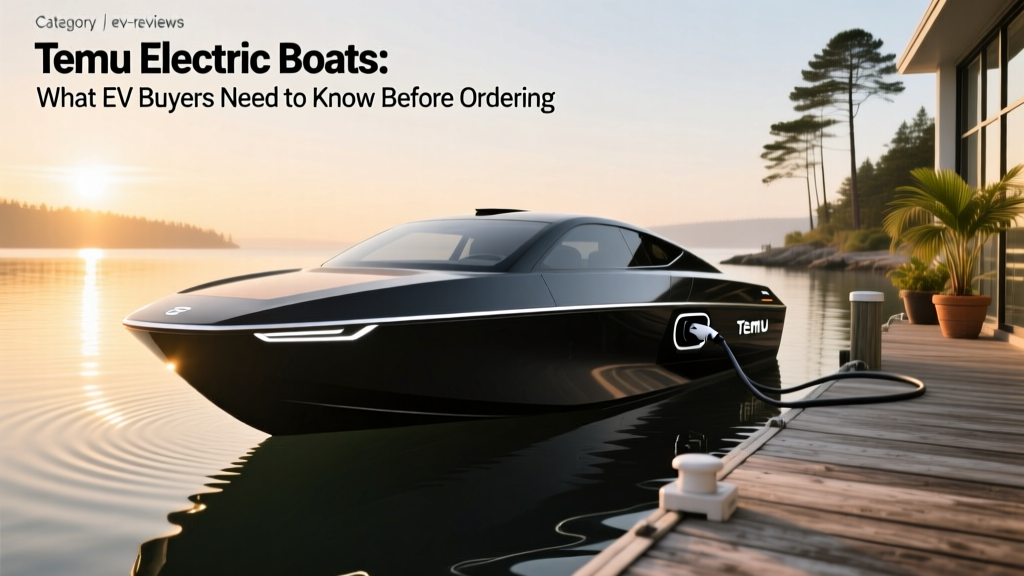
Temu does list small electric watercraft and inflatable electric boat accessories — primarily low-speed electric trolling motors, inflatable dinghies with battery packs, and toy-grade electric boats priced between $30 and $600. However, Temu is not a marine vehicle manufacturer, and the platform does not sell highway-legal, Coast Guard-certified, or ABYC-compliant electric boats suitable for serious recreational use. If you're an EV owner exploring electrified recreation, Temu listings carry significant battery safety, warranty, and performance risks compared to established brands like Torqeedo, ePropulsion, or Candela. Treat any Temu electric boat purchase as you would an uncertified electronics import: verify cell chemistry, UL/CE markings, and return policies before clicking buy.
What Temu Electric Boats Actually Are (and Aren't)
When you search "temu electric boats" on the platform, you'll find three main product categories:
- Electric trolling motors ($30–$180): Brushless DC motors rated 30–86 lbs of thrust, typically running on separate 12V or 24V lead-acid or lithium battery packs you supply yourself.
- Inflatable electric dinghies and kayaks ($150–$600): Small PVC or Hypalon hulls bundled with integrated low-power electric motors (200W–800W), claiming top speeds of 3–8 mph and "ranges" of 10–30 miles.
- Toy-grade and hobby RC electric boats ($15–$80): Remote-controlled or small personal watercraft not rated for passenger use.
None of these are the electric equivalent of a Tesla Model Y or even a Candela C-8 hydrofoiling electric boat. They are low-speed, low-power marine accessories that happen to run on battery electricity. If you arrived here expecting a Temu equivalent of a $30,000–$100,000+ certified electric pontoon or runabout, that product does not exist on the platform as of 2026.
Battery Chemistry, Safety, and the Missing Certifications
For EV owners accustomed to NMC or LFP traction batteries with sophisticated battery management systems (BMS), thermal management, and 8-year/100,000-mile warranties, the battery packs in most Temu electric boats represent a dramatically different risk profile.
| Claim on Listing | Reality for Buyers |
|---|---|
| "Lithium battery, 48V 20Ah" | Often generic 18650 or pouch cells with unknown provenance; no published cycle-life data or cell manufacturer (Samsung, CATL, EVE, etc.) |
| "2-hour fast charge" | Typically means charging at 1C or above with minimal thermal management — accelerates degradation and increases thermal-runaway risk in marine (humid, hot) environments |
| "30-mile range" | Measured at minimum speed, calm water, single rider; expect 40–60% less under real conditions (headwind, current, two passengers) |
| "Waterproof battery" | Rarely specifies IP rating; ABYC E-11 and E-30 marine electrical standards require sealed, ventilated, and overcurrent-protected battery compartments — almost never present |
| "1-year warranty" | Enforcement through Temu's dispute system is inconsistent; no US-based service centers for marine battery replacement |
The American Boat & Yacht Council (ABYC) publishes voluntary but widely-adopted standards for marine electrical systems. Established electric outboard makers like Torqeedo (BMW Group) and ePropulsion design their battery packs to ABYC E-11, include marine-grade BMS with cell balancing, low-voltage cutoff, and salt-spray-rated enclosures. A $4,000 Torqeedo Cruise 10.0 with Power 48-5000 battery delivers 48V/5 kWh of usable energy with documented IP67 submersion rating. A $350 Temu listing claiming comparable specs almost certainly does not meet those engineering thresholds.
Cost Comparison: Temu vs. Established Electric Marine Brands
Here's how the economics actually break down when you compare a Temu-sourced electric boat setup against certified alternatives. The upfront savings are real, but total cost of ownership tells a different story.
| Category | Temu Inflatable + Motor | ePropulsion Spirit 1.0 Plus | Torqeedo Cruise 10.0 TL |
|---|---|---|---|
| Upfront cost (motor + battery + hull) | $400–$700 | $2,499 (motor+battery) + $800 hull | $5,200 (motor+2x battery) + $2,000 hull |
| Battery capacity (usable kWh) | 0.5–1.2 kWh (claimed) | 1.27 kWh (Samsung cells) | 5.0 kWh per pack (LFP) |
| Realistic range at 5 mph | 4–8 miles | 12–18 miles | 30–45 miles |
| Warranty | 30-day Temu return; no battery warranty | 2 years motor, 1 year battery | 2 years motor, 2 years battery |
| Replacement battery cost | $80–$200 (unbranded, unknown cells) | $899 | $2,800 per pack |
| Estimated lifespan (cycles to 80% SoH) | 150–300 cycles (estimated) | 800+ cycles (documented) | 2,000+ cycles (LFP chemistry) |
| 5-year total cost (assuming 2 battery replacements for Temu) | $800–$1,100 | $3,299 (no replacement needed) | $7,200 (no replacement needed) |
The Temu option costs less upfront but requires battery replacement 2–3x more frequently, carries no documented safety certifications, and offers no dealer network. For occasional pond fishing, the risk may be acceptable. For family use on lakes or coastal waters, the certified options are the rational choice — just as buying a certified EV from an established automaker is safer than importing an uncertified battery-electric vehicle.
How This Compares to Electrifying Your Car: An EV Owner's Framework
If you're reading AutoEdgeView, you likely already own or are shopping for an electric vehicle. The decision logic for electric marine equipment mirrors EV buying in several key ways:
| Factor | EV Car Buying | Electric Boat Buying |
|---|---|---|
| Battery chemistry matters | LFP for longevity, NMC for energy density | LFP preferred for marine (safer thermal profile); NMC acceptable if BMS is marine-grade |
| EPA range vs. real-world | Highway driving loses 15–30%; cold weather loses 20–40% | Headwind, current, and passenger load reduce range 40–60% vs. calm-water claims |
| Charging infrastructure | Level 2 at home; DC fast charging on road trips | Shore power at marina (120V/20A typical); no DC fast-charging standard for small craft yet |
| Federal tax credits | Up to $7,500 under IRS §30D (income + MSRP + sourcing rules apply) | No federal tax credit for electric boats; some states offer clean marine rebates (check local programs) |
| Certification | NHTSA, IIHS crash ratings; FMVSS compliance | ABYC standards, USCG compliance for vessels over 20 feet; UL marine certification for battery systems |
The critical insight: the same skepticism you apply to EV range claims should apply even more aggressively to electric boat claims. Marine environments are harsher than roads — salt spray, UV exposure, vibration, and the catastrophic consequence of battery failure over water all demand higher engineering standards, not lower ones.
Real-World Ownership Considerations Before You Buy
Before ordering any electric watercraft from a marketplace platform, honestly assess these factors:
Where Will You Use It?
Calm, shallow, freshwater ponds or slow rivers within swimming distance of shore represent the lowest-risk environment for an uncertified electric boat. If you plan to use it on a large lake (Lake Tahoe, Lake Michigan), coastal waters, or anywhere more than a 5-minute swim from shore, the safety margin of a certified marine battery system is non-negotiable. Lithium thermal runaway in a marine environment is not equivalent to a laptop battery fire — there is no safe place to pull over.
Charging and Storage Logistics
Most Temu electric boat batteries charge via a proprietary barrel connector or XT60 at 120V AC, drawing 2–5 amps. Expect 4–8 hours for a full charge on a standard household outlet. Unlike your EV, these batteries have no thermal preconditioning, no charge-curve optimization, and typically no app-based monitoring. Store them in a fire-resistant location — not inside your home's living space or near flammable materials. Treat them with the same caution you would an e-bike battery from an unknown source.
Insurance and Liability
Most marine insurers will not cover a vessel with an uncertified battery system, or will exclude battery-related claims. If a Temu-sourced battery pack causes a fire that damages a marina, dock, or neighboring vessel, your homeowner's or renter's insurance may deny the claim based on the use of non-compliant equipment. Verify coverage in writing before operating.
Actionable Decision Framework: Should You Buy?
Buy a Temu electric boat or trolling motor IF:
- You're using it on a small, calm, freshwater pond within easy swimming distance of shore
- You're a single adult rider (not carrying children or passengers)
- You understand the battery may degrade significantly within 1–2 seasons and budget for replacement
- You can store and charge the battery in a fire-safe location (detached garage, metal cabinet)
- You accept that no warranty service or dealer support exists in the US
- Total budget is under $500 and you view this as a disposable recreational purchase
Invest in a certified electric marine brand (Torqeedo, ePropulsion, Elco, Flux Marine) IF:
- You'll operate on lakes, rivers with current, or coastal waters
- You'll carry passengers, children, or pets
- You need reliable range (15+ miles) and documented battery longevity (800+ cycles)
- You want insurance coverage and potential resale value
- Your budget is $2,000+ and you view this as a multi-year investment
- You value ABYC compliance and marine-grade IP ratings
Consider a used certified electric outboard IF:
- Your budget is $800–$1,500
- You can verify battery State of Health (SoH) through the manufacturer's diagnostic tool
- You buy from a dealer or verified owner with documented charge-cycle history
Common Misconceptions About Temu Electric Boats
| Myth | Fact |
|---|---|
| "It's electric, so it's automatically eco-friendly" | A battery pack made with untraceable cells, shipped internationally, and discarded after 200 cycles has a worse lifecycle environmental impact than a quality pack lasting 2,000+ cycles. The same logic applies to cheap EVs vs. well-engineered ones. |
| "If it's on Temu, it must meet US safety standards" | Temu is a marketplace, not a certifying body. Listings are not independently tested for ABYC, UL, or USCG compliance. Buyer assumes all risk. |
| "I can upgrade the battery later with a better pack" | Most Temu motors use proprietary connectors, non-standard voltages, and lack a BMS communication protocol. Swapping in a quality battery often requires custom fabrication and voids any remaining return option. |
| "It's just a small boat — what's the worst that happens?" | Lithium battery fires burn at 1,000°C+, cannot be extinguished with water, and release toxic hydrogen fluoride gas. On water, you cannot simply exit the vehicle and walk away. |
FAQ: Temu Electric Boats for EV Owners
Can I charge a Temu electric boat battery using my EV's Level 2 home charger?
No. EV Level 2 chargers output 240V AC through a J1772 or NACS connector with a communication handshake protocol. Temu electric boat batteries charge via simple 120V AC adapters with no communication protocol. They are not compatible, and attempting to wire an adapter is dangerous.
Does the federal EV tax credit apply to electric boats?
No. The IRS §30D clean vehicle credit applies only to highway-capable vehicles with four wheels and a gross vehicle weight rating under 14,000 lbs. Electric boats, personal watercraft, and marine vessels do not qualify. Some states (California, New York, Washington) have explored clean marine incentive programs, but no federal equivalent exists as of 2026.
Are Temu electric trolling motors at least decent for the price?
For occasional use on a small pond, a $60–$120 Temu trolling motor can be functional — the brushless DC motor itself is often adequate. The risk lies in the battery pack, not the motor. If you buy a Temu trolling motor but pair it with a quality, name-brand LiFePO4 (LFP) battery from Battle Born, RELiON, or Dakota Lithium, you get a safer, longer-lasting system for roughly $400–$700 total.
What about electric boats from Alibaba or AliExpress — are those any better?
Alibaba connects you directly with manufacturers and sometimes offers more detailed spec sheets (cell brand, BMS specs, IP ratings). However, minimum order quantities, shipping costs, and the same certification gaps apply. For single-unit purchases, certified brands with US dealer networks remain the safer path.
If I'm an EV owner, should I wait for electric boat technology to mature?
Electric marine technology is advancing rapidly — companies like Candela (hydrofoiling), X Shore, and Arc Boats are pushing the category forward. But unlike EVs, which benefit from shared automotive battery R&D at massive scale, electric boats remain a niche market with slower cost reduction. If you need an electric boat in 2026, buy certified. If you can wait 3–5 years, expect LFP marine packs to drop 20–30% in cost as production scales.
Sources consulted: IRS §30D Clean Vehicle Credit rules, ABYC Standards Overview, manufacturer specification pages from Torqeedo and ePropulsion (2025–2026 model year data).