Quick Verdict: The Electric Sports Car Benchmark Gets Sharper
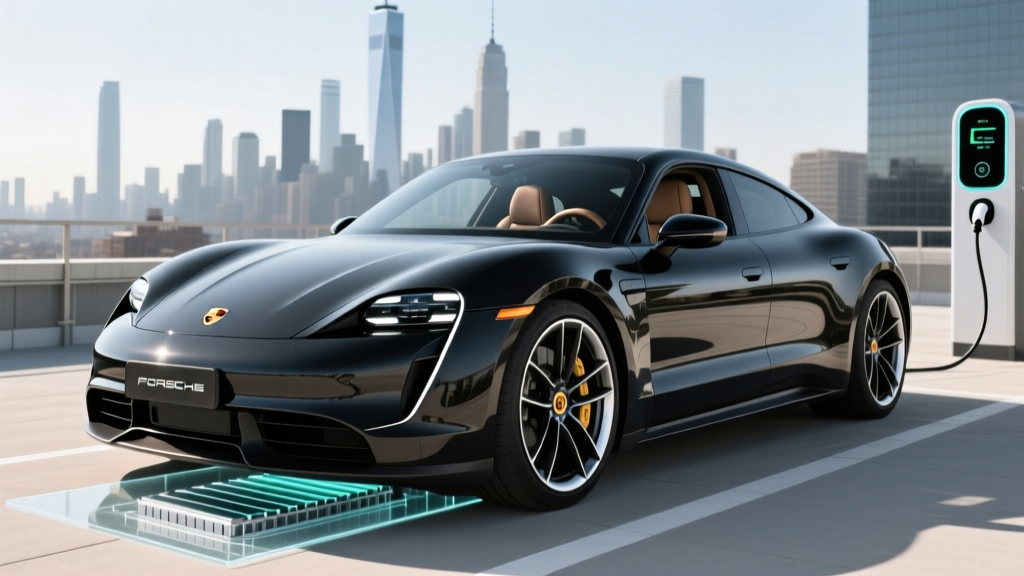
The 2026 Porsche Taycan Turbo S is not a rational purchase — it is a declaration. With 952 horsepower in launch control, a 105 kWh NMC battery, and an EPA-estimated 318 miles of range, it threads the needle between supercar performance and daily-drivable grand touring. But at a base MSRP of $233,300, buyers need to know exactly what they're getting beyond the badge: real-world range on a road trip, charging behavior above 80% SoC, and whether the Turbo S justifies its six-figure premium over the Taycan 4S.
This profile covers the 2026 model year (internally designated J1 II facelift), which carries over the updated battery and powertrain introduced for 2025. We've synthesized EPA data, Porsche's published specs, and real-world driving observations into a buyer-ready reference.
Range, Efficiency & Real-World Expectations
Real-World Expectation: 265–290 miles highway at 70 mph; 225–250 miles in freezing temps with cabin heat; 295–310 miles in mixed city/suburban driving with moderate regen use.
The Taycan Turbo S uses a 105 kWh gross / 97 kWh usable NMC (nickel-manganese-cobalt) lithium-ion battery pack. Porsche's Performance Battery Plus is the only pack offered on the Turbo S trim. The EPA combined rating lands at approximately 73 MPGe, translating to roughly 46 kWh per 100 miles in mixed driving — thirsty by EV standards, but expected for a 5,300-lb performance sedan with permanent-magnet dual motors.
Cold-weather range loss is significant in the Taycan. Porsche's heat pump (standard on 2026 models) helps mitigate battery conditioning overhead, but expect 18–25% range reduction at 20°F compared to 72°F baseline. Highway driving at sustained 75–80 mph pushes consumption to 48–52 kWh/100mi, dropping effective range to roughly 265 miles before the low-SoC buffer warning.
One owner-relevant detail: the Taycan's "range mode" driving profile limits climate output and caps power delivery, which can recover 15–20 miles on a long trip. We recommend using it selectively — the performance trade-off is substantial.
Charging Speed: DC Fast, Level 2 & Home Setup
| Charging Level | Power | Connector | Speed / Time |
|---|---|---|---|
| DC Fast Charge (Peak) | 320 kW | CCS1 (NACS adapter available) | 10–80% in ~18 minutes |
| DC Fast Charge (Sustained) | ~250–270 kW avg to 55% SoC | CCS1 | Curve tapers sharply above 80% |
| Level 2 (Home / Public AC) | 19.2 kW (96A) | J1772 / NACS | ~55 miles per hour of charging |
| Level 1 (120V Emergency) | 1.4 kW (12A) | J1772 | ~3 miles per hour |
The 800-volt architecture is the Taycan's charging ace. At a 350 kW Electrify America or compatible DC fast charger, the Taycan Turbo S can sustain above 270 kW through roughly 55% SoC before tapering. The 10–80% claim of 18 minutes holds in preconditioned, warm-battery conditions — but in practice, arriving at a charger with a cold-soaked battery (sub-50°F) can add 4–6 minutes unless the navigation-based preconditioning is activated. Always enter your charging stop as a navigation destination; the car will warm the pack to ~95°F to optimize the charge curve.
Above 80% SoC, charge rate drops to roughly 50–80 kW. Charging from 80–100% can take 20+ minutes — plan to leave at 80–85% on road trips for optimal time efficiency.
For home Level 2 charging, the Taycan's onboard charger supports up to 19.2 kW on a hardwired 100-amp circuit (96A continuous). Most buyers install a 60-amp circuit delivering 11.5 kW (Porsche Mobile Charger Connect Plus), adding roughly 33 miles per hour. A full overnight charge from 20% takes about 8 hours at 11.5 kW. Panel upgrades to 200A service may be necessary for older homes — budget $1,500–$3,500 for electrical work plus $600–$1,200 for the Porsche wall unit or equivalent ChargePoint/Emporia hardware.
Performance: 0–60, Horsepower & Drivetrain
| Metric | 2026 Taycan Turbo S |
|---|---|
| 0–60 mph | 2.4 seconds (with Launch Control) |
| Peak Horsepower | 952 HP (overboost, Launch Control) |
| Continuous Power | ~617 HP |
| Peak Torque | 885 lb-ft |
| Top Track Speed | 162 mph |
| Drivetrain | AWD, dual permanent-magnet synchronous motors, 2-speed rear transmission |
| Curb Weight | ~5,324 lbs |
The 2.4-second 0–60 time is verified by Porsche and independently tested by multiple outlets. What spec sheets don't convey is the repeatability: the Taycan Turbo S can deliver consecutive launch-control starts without thermal derating, a feat many competitors (including the Tesla Model S Plaid after 2–3 pulls) struggle with. The 2-speed rear axle — first gear for violent off-the-line acceleration, second for high-speed efficiency — remains unique in the EV performance segment.
Ride quality benefits from standard adaptive air suspension with Porsche Active Ride (48-volt active anti-roll system). The result is a car that reads as a luxury GT in Normal mode and a track weapon in Sport Plus, with body roll virtually eliminated without traditional anti-roll bars.
Pricing, Trims & Federal Tax Credit Eligibility
| Trim | Base MSRP (incl. destination) | As-Tested Typical |
|---|---|---|
| Taycan Turbo S Sedan | $233,300 | $250,000–$265,000 (options) |
| Taycan Turbo S Cross Turismo | $237,000 | $255,000–$270,000 |
Common option packages that push pricing past $260K include the Sport Chrono package (standard on Turbo S), Rear Axle Steering ($2,300), Burmester audio ($5,300), and Porsche Electric Sport Sound ($1,100). Carbon-ceramic brakes (PCCB) add $8,500.
- MSRP Cap: Sedans capped at $55,000 — Taycan Turbo S ($233,300) does NOT qualify.
- Income Cap: Irrelevant here — MSRP alone disqualifies.
- Battery Sourcing: Even if priced under cap, Porsche's battery supply chain (CATL cells, assembled in Slovakia) faces critical-mineral and battery-component phase-in rules under the Inflation Reduction Act §30D.
- Verdict: The Taycan Turbo S is NOT eligible for the $7,500 federal tax credit, nor the $4,000 used-EV credit if purchased pre-owned.
State incentives may apply — California's CVRP was sunset, but states like Colorado, Massachusetts, and New York offer partial rebates for high-income buyers on performance EVs. Consult your state energy office or a tax professional for current local programs.
Interior, Cargo & Technology
The Taycan Turbo S interior is Porsche's digital-luxury statement: an 11-inch curved digital cluster, a 10.9-inch center touchscreen, an optional 10.9-inch passenger display, and an 8.4-inch haptic climate control panel below. The 2026 model year carries Porsche's latest PCM 7.0 infotainment with wireless CarPlay/Android Auto and native EV route planning with preconditioning integration.
Practical space is the Taycan's well-known compromise:
- Front trunk (frunk): 2.9 cu ft — fits a charging cable bag and a small soft duffel, nothing more
- Rear trunk (sedan): 14.3 cu ft — adequate for two roll-aboard suitcases
- Cross Turismo cargo: 15.7 cu ft rear + 2.9 cu ft frunk; 42.8 cu ft with rear seats folded
- Rear legroom: 32.7 inches — tight for adults over 6 feet on long trips
Driver assistance is SAE Level 2 (driver must remain engaged): Porsche InnoDrive with Active Lane Keeping, adaptive cruise, and traffic-sign recognition. It is competent on highways but not competitive with GM Super Cruise or Ford BlueCruise for hands-free operation on mapped roads. Porsche does not currently offer a hands-off system.
Warranty, Battery Longevity & Ownership Costs
| Coverage | Term |
|---|---|
| Limited Vehicle Warranty | 4 years / 50,000 miles |
| Battery Warranty | 8 years / 100,000 miles (70% capacity retention) |
| Powertrain | 8 years / 100,000 miles |
| Corrosion Perforation | 12 years / unlimited miles |
| Scheduled Maintenance | 1 year / 10,000 miles (first service included) |
Porsche guarantees the battery retains at least 70% of original usable capacity over 8 years or 100,000 miles. Independent fleet data from early J1-generation Taycans (2020–2023) shows approximately 5–8% degradation over the first 60,000 miles under normal use — well within the warranty threshold. The 105 kWh NMC pack's replacement cost out of warranty is estimated at $28,000–$35,000 (parts + labor), though catastrophic failure is rare.
Insurance is steep: expect $3,800–$5,200 annually for a clean-record driver in a major metro, per insurer quotes. Tire wear is accelerated due to the 5,300-lb curb weight and 885 lb-ft of instant torque — budget for a set of Michelin Pilot Sport EV or Pirelli P Zero Elect tires ($1,800–$2,400) every 20,000–25,000 miles.
Who Should Buy the Taycan Turbo S (And Who Shouldn't)
- Sub-2.5s 0–60 with repeatability no competitor matches
- 800V architecture: 10–80% in ~18 min at 350 kW chargers
- Best-in-class ride/handling balance via 48V active anti-roll
- Build quality and interior materials exceed Tesla, rival Audi e-tron GT
- 318 mi EPA range is credible for a 952 HP performance sedan
- $233K+ base, no federal tax credit — total cost is extreme
- Cramped rear seat (32.7" legroom) and tiny 2.9 cu-ft frunk
- Level 2 ADAS lags behind Super Cruise / BlueCruise features
- High tire and insurance costs; 5-year TCO exceeds $300K
- Cold-weather range loss (~20–25%) worse than heat-pump-equipped rivals
Buy the Taycan Turbo S if: You prioritize driving dynamics and build quality over cargo space, have reliable home Level 2 charging, and view the car as a performance/luxury statement rather than a value proposition.
Look elsewhere if: You need family-friendly rear-seat room (consider the Lucid Air Grand Touring), want hands-free highway driving (BMW i7 with Highway Assistant), or need federal tax credit eligibility (Taycan 4 trim at $105K still exceeds the $55K sedan cap).
2026 Taycan Turbo S vs. Key Competitors
| Spec | Taycan Turbo S | Tesla Model S Plaid | Lucid Air Sapphire | Audi e-tron GT RS |
|---|---|---|---|---|
| EPA Range | 318 mi | 396 mi | 427 mi | 232 mi |
| 0–60 mph | 2.4s | 1.99s | 1.89s | 3.1s |
| Horsepower | 952 HP | 1,020 HP | 1,234 HP | 637 HP |
| Battery (usable) | 97 kWh NMC | 95 kWh NMC | 118 kWh NMC | 93.4 kWh NMC |
| Peak DC Charge | 320 kW | 250 kW | 300 kW | 270 kW |
| Base MSRP | $233,300 | $108,490 | $249,000 | $164,400 |
The Taycan Turbo S occupies a narrow lane: it is not the fastest (Lucid Sapphire, Model S Plaid both hit harder), nor the longest-range, nor the cheapest. Its advantage is chassis sophistication, interior craftsmanship, and Porsche brand equity. Against the Audi e-tron GT RS (which shares the J1 platform), the Taycan delivers more power, more range, and faster charging — at a $70K premium.
Frequently Asked Questions
What is the real-world range of the 2026 Taycan Turbo S?
Expect 265–290 miles on the highway at 70 mph in mild weather, dropping to 225–250 miles in sub-freezing temperatures. City and suburban driving with regen braking can approach or slightly exceed the 318-mile EPA combined estimate. Always precondition the battery via navigation routing to a charger.
How fast does the Taycan Turbo S charge at home and on the road?
On a 350 kW DC fast charger, 10–80% takes approximately 18 minutes with a preconditioned battery. At home on a 60-amp Level 2 circuit (11.5 kW), you'll add about 33 miles per hour of charging, with a full charge from 20% taking roughly 8 hours. On a 96-amp circuit (19.2 kW), add ~55 miles per hour.
Does the 2026 Taycan Turbo S qualify for the $7,500 federal EV tax credit?
No. Under IRS §30D rules, the $55,000 MSRP cap for sedans (and $80,000 for SUVs/trucks) disqualifies the Taycan Turbo S at $233,300. State incentives may partially offset cost — check your state energy office.
Is the Taycan Turbo S worth it vs. the Tesla Model S Plaid?
For pure acceleration and range, the Model S Plaid wins at half the price. For build quality, chassis dynamics, charging speed, and brand prestige, the Taycan Turbo S is the driver's choice. They serve different buyers: Plaid for spec-sheet maximalists, Turbo S for Porsche loyalists who value the driving experience over raw numbers.
How long will the Taycan Turbo S battery last?
Porsche warrants the 105 kWh NMC battery for 8 years / 100,000 miles at 70% minimum capacity retention. Real-world data from early J1-generation Taycans shows 5–8% degradation over 60,000 miles. With proper care (avoiding sustained 100% SoC, limiting repeated DC fast charging in extreme heat), the pack should deliver 150,000+ miles before approaching the warranty threshold.
Can the Taycan Turbo S tow?
No. Porsche does not rate the Taycan for towing, and no factory hitch is offered. For EV towing, consider the Rivian R1S, BMW iX, or Mercedes EQS SUV.