The Weissach Package Turns the Taycan Into a Track Weapon
The 2026 Porsche Taycan Turbo GT with the Weissach Package is the most powerful production car Porsche has ever built. With 1,019 horsepower on overboost, a 0-60 mph time of 2.1 seconds, and a Nürburgring lap record for production sedans, it exists at the extreme end of the electric-vehicle spectrum. But beyond the headline numbers, buyers spending north of $230,000 need practical answers about daily usability: real-world range, charging infrastructure compatibility, and whether this track-focused EV can function as a grand tourer.
This review breaks down the Taycan Turbo GT Weissach with the exact data points that matter — EPA efficiency, sustained DC fast-charging curves, battery chemistry, and the ownership economics that no brochure will tell you.
Full Specifications at a Glance
| Attribute | Specification |
|---|---|
| EPA Range | 269 miles (est., based on 2025 carryover) |
| Battery (usable / gross) | 97.0 kWh usable / 105.0 kWh gross (Performance Battery Plus) |
| Battery Chemistry | NMC (Nickel Manganese Cobalt) — high-silicon anode cells |
| Drivetrain | Dual-motor AWD with 2-speed rear transmission |
| Peak Horsepower | 1,019 hp (Launch Control / overboost) |
| Peak Torque | 988 lb-ft |
| 0-60 mph | 2.1 seconds |
| Top Speed | 190 mph (Weissach, with carbon aero) |
| Max DC Fast Charge | 320 kW peak |
| 10-80% DC Fast Charge | ~18 minutes (optimal conditions) |
| Level 2 Home Charge | 11 kW onboard charger (~33 miles/hr) |
| EPA Efficiency | 65 MPGe combined / 51 kWh/100 mi (est.) |
| Cargo Volume | 14.3 cu ft (rear trunk) + 2.9 cu ft (frunk) |
| Seating | 2 seats (Weissach deletes rear seats) |
| Curb Weight | ~4,850 lbs (Weissach saves ~157 lbs vs. standard Turbo GT) |
| Base MSRP | $233,200 (Turbo GT) + Weissach Package ~$8,000 = ~$241,200 |
| Battery Warranty | 8 years / 100,000 miles (min 70% capacity retention) |
| Vehicle Warranty | 4 years / 50,000 miles limited + 12 years corrosion |
Real-World Range: What the EPA Number Doesn't Tell You
Real-World Highway (70-80 mph): ~215–235 miles
Real-World Cold Weather (below 32°F): ~185–210 miles
Track / Aggressive Driving: 80–120 miles (highly variable)
The 269-mile EPA estimate applies to the standard Taycan Turbo GT. The Weissach Package, which deletes rear seats, adds carbon-fiber aero elements, and fits lighter forged wheels, may shift that figure slightly depending on final EPA certification for the 2026 model year. Porsche's 2025 certification data from fueleconomy.gov provides the baseline here.
On a 300-mile highway run at sustained 75-80 mph speeds, expect to use roughly 48-52 kWh/100 miles. That translates to 215-235 real highway miles before you need a charger. Cold weather compounds the loss: NMC chemistry sees reduced ion mobility below freezing, and cabin heating (even with the Taycan's heat pump) draws 2-4 kW continuously. Plan for 30-35% range reduction in sub-freezing conditions.
The critical context: this is a 1,019-horsepower track car. If you're using Launch Control or driving aggressively on canyon roads, energy consumption spikes to 70+ kWh/100 mi. The Taycan Turbo GT Weissach was engineered for lap times, not hypermiling. Range is a compromise you accept for the performance envelope.
Charging Performance: 320 kW Peak, but Read the Curve
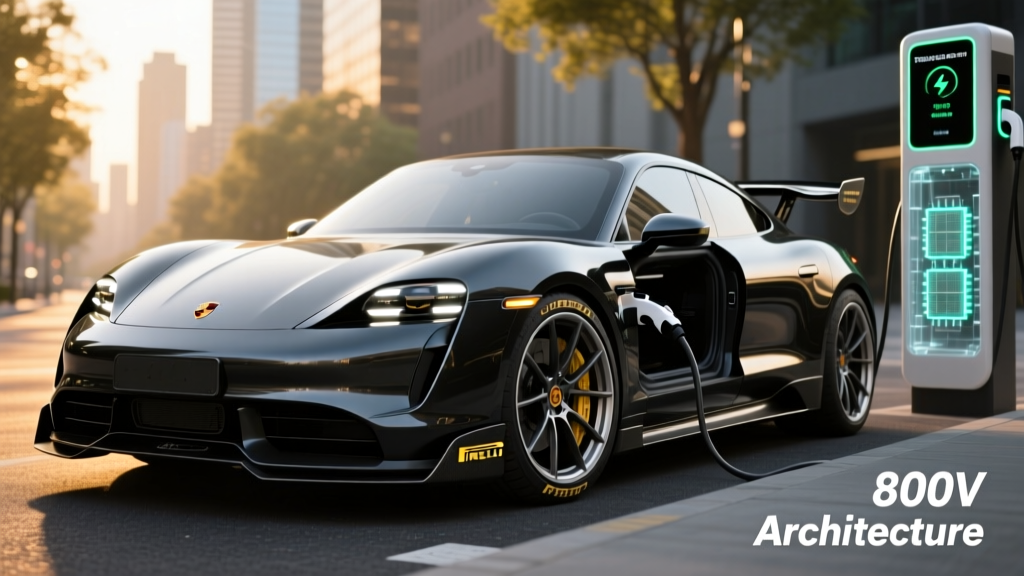
The Taycan Turbo GT uses Porsche's 800-volt architecture — the same platform that made the original Taycan a charging benchmark. For the current generation, Porsche upgraded the Performance Battery Plus to accept up to 320 kW peak DC fast charging, up from 270 kW on earlier models.
| Charging Level | Power / Voltage | Speed | Notes |
|---|---|---|---|
| Level 1 (120V household) | 1.4 kW | ~4 miles/hour | Emergency use only; full charge in ~70 hours |
| Level 2 (240V home) | 11 kW (48A) | ~33 miles/hour | 0-100% in ~10 hours; overnight ready |
| DC Fast (350 kW station) | 320 kW peak | 10-80% in ~18 min | Requires preconditioning + compatible charger |
| DC Fast (150 kW station) | 150 kW sustained | 10-80% in ~33 min | More common CCS station speed |
The 18-minute 10-80% claim requires specific conditions: a 350 kW-capable charger (Electrify America, Ionity, or equivalent), battery preconditioning activated via the navigation system, and a battery starting temperature around 70-95°F. The 800V architecture sustains high charging power longer than 400V competitors — you'll see 250+ kW held through roughly 50% SoC before tapering begins.
Above 80% SoC, charging slows dramatically to protect the NMC cells. Expect 80-100% to take an additional 15-20 minutes. For road trips, the practical strategy is charging to 80% and moving on — the time penalty for a full charge is rarely worth the extra 40-50 miles.
For home charging, the 11 kW onboard charger is a strong point. On a 48-amp Level 2 circuit (requiring a 60-amp breaker), you'll add roughly 33 miles per hour. A typical overnight session from 20% to full takes about 8-9 hours. Installation costs for a home Level 2 setup typically range from $800-$2,500 depending on your electrical panel capacity and run distance — a factor worth budgeting before delivery.
Performance and Drivetrain: Engineering That Justifies the Price
The Taycan Turbo GT Weissach's dual-motor AWD system produces 1,019 hp and 988 lb-ft of torque in Launch Control mode. The rear axle uses a unique 2-speed transmission — first gear multiplies torque for brutal acceleration, while second gear optimizes high-speed efficiency and top-speed runs.
Porsche's published 0-60 time of 2.1 seconds places this car in hypercar territory. Independent testing by publications like Car and Driver has verified sub-2.2-second runs. The Weissach Package's weight savings of approximately 157 lbs (removing rear seats, adding carbon-fiber components, lighter sound insulation) contributes to the sharper dynamics.
What the spec sheet doesn't convey is repeatability. The Taycan's thermal management system allows multiple consecutive launch-control starts without power derating — a problem that has plagued competitors like the Tesla Model S Plaid and Lucid Air Sapphire in back-to-back testing. Porsche engineered the battery cooling circuit to handle sustained 500+ kW discharge loads, which is exactly what track use demands.
The standard Turbo GT already includes Porsche Active Ride (hydraulic active suspension), rear-axle steering, and Porsche Torque Vectoring Plus. The Weissach Package adds a fixed carbon-fiber rear wing (replacing the adaptive spoiler), carbon roof, lightweight forged wheels, and a deleted rear-seat area replaced with a storage shelf and harness bar attachment points.
Pricing, Tax Credits, and Ownership Economics
The 2026 Taycan Turbo GT Weissach is not an impulse purchase. Here's the pricing reality:
| Item | Cost |
|---|---|
| Taycan Turbo GT Base MSRP | $233,200 |
| Weissach Package | ~$8,000 |
| Destination & Delivery | $1,650 |
| Typical Options (paint, interior, PCCB brakes) | $15,000–$35,000 |
| As-Tested Range | $250,000–$280,000 |
| Federal §30D Tax Credit | $0 — Does NOT qualify (see below) |
Does the Taycan Turbo GT Weissach Qualify for the Federal EV Tax Credit?
No. Under current IRS §30D rules, the federal EV tax credit has a strict MSRP cap: $55,000 for sedans and $80,000 for SUVs, vans, and pickup trucks (source: irs.gov). The Taycan Turbo GT Weissach, at $241,200+ base, exceeds the sedan cap by a factor of four. Additionally, the buyer income cap ($150,000 single / $300,000 joint AGI) would disqualify many buyers regardless of the MSRP issue.
There is no state-level workaround that applies universally — some states offer registration incentives or HOV lane access, but none offset the purchase price meaningfully at this tier. Buyers should also budget for insurance (typically $4,000-$7,000/year for a vehicle in this performance class), tire replacement ($800-$1,200 per corner for the Michelin Pilot Sport Cup 2 R or equivalent, with 10,000-15,000 mile tread life under aggressive use), and annual maintenance.
Interior, Cargo, and Daily Livability
The Weissach Package transforms the Taycan from a 4-door sports sedan into a 2-seat track car. The rear seat delete saves weight and creates a flat shelf behind the front occupants — useful for helmets, a track bag, or groceries, but not for passengers. If you need rear seating, the standard Turbo GT (without Weissach) retains a 4-passenger layout.
Cargo capacity remains:
- Rear trunk: 14.3 cubic feet (accessible via traditional sedan trunklid, not a hatch)
- Front trunk (frunk): 2.9 cubic feet (fits a charging cable bag and a small duffel)
The cabin features Porsche's curved digital instrument cluster (16.8 inches), a 12.6-inch center touchscreen running Porsche Communication Management (PCM), and an optional passenger display. The Weissach-specific interior includes lightweight carbon-fiber bucket seats with integrated headrests, Race-Tex (Alcantara-like) upholstery, and Weissach badging. The GT steering wheel with mode switch and drive mode selector is standard.
Driver-assistance features include adaptive cruise control, lane-keep assist, and night vision assist. These are SAE Level 2 systems — the driver must remain fully engaged at all times. Porsche's InnoDrive predictive cruise is excellent on highways, using map data and camera input to adjust speed for curves and speed limits proactively.
Pros and Cons: The Honest Verdict
✓ Pros
- Sub-2.2-second 0-60 with repeatable launches — no thermal derating
- 320 kW peak charging on 800V architecture — among the fastest in production
- Nürburgring-proven chassis with active hydraulic suspension
- Weissach weight savings make it genuinely track-capable
- Build quality, fit-and-finish, and dealer service network
- Strong 8-year/100,000-mile battery warranty at 70% retention threshold
✗ Cons
- 269-mile EPA range is modest for a $240K+ vehicle
- Weissach deletes rear seats — strictly a 2-person car
- Zero federal tax credit eligibility (MSRP far exceeds §30D caps)
- Tire wear is rapid under track use ($3,200-$4,800 per set)
- CCS1 connector — no native NACS (requires adapter for Tesla Superchargers)
- Efficiency of ~51 kWh/100 mi means expensive fast-charging on road trips
Who Should Buy the Taycan Turbo GT Weissach?
Look elsewhere if: You need rear seats, want 350+ miles of range, prioritize charging convenience over performance, or expect federal tax incentives to offset cost. For a more practical high-performance EV, the Taycan 4S (EPA ~316 mi, $107,400) or Tesla Model S Plaid (EPA 396 mi, ~$89,990) deliver enormous performance with better daily usability.
Competitive Comparison
| Spec | Porsche Taycan Turbo GT Weissach | Tesla Model S Plaid | Lucid Air Sapphire |
|---|---|---|---|
| Price | ~$241,200 | ~$89,990 | ~$249,000 |
| Horsepower | 1,019 hp | 1,020 hp | 1,234 hp |
| 0-60 mph | 2.1 sec | 1.99 sec | 1.89 sec |
| EPA Range | 269 mi | 396 mi | 427 mi |
| Max DC Charge | 320 kW | 250 kW | 300+ kW |
| Seats | 2 (Weissach) | 5 | 5 |
| Track Focus | Highest | Moderate | High |
The Model S Plaid offers similar peak power at a third of the price, with vastly superior range and 5-seat practicality. The Lucid Air Sapphire outsprints both on paper. But neither matches the Taycan Turbo GT Weissach's chassis sophistication, thermal resilience under repeated track use, or Porsche's motorsport-derived build quality. This is a purchase driven by driving dynamics and brand, not spec-sheet dominance.
Frequently Asked Questions
What is the real-world range of the Taycan Turbo GT Weissach?
Expect 215-235 miles on the highway at legal speeds, and 240-260 miles in mixed city/suburban driving where regenerative braking recaptures energy. In cold weather (below 32°F), plan for 185-210 miles. On a track, range drops to 80-120 miles depending on intensity.
How fast does the Taycan Turbo GT Weissach charge?
At a 350 kW-capable DC fast charger with battery preconditioning, 10-80% takes approximately 18 minutes. At a more common 150 kW CCS station, expect 33 minutes. At home on a Level 2 (240V/48A) charger, you'll add about 33 miles per hour, with a full charge taking roughly 10 hours.
Does the Taycan Turbo GT Weissach qualify for any EV tax credits?
No. The IRS §30D federal tax credit caps eligible sedans at $55,000 MSRP. At $241,200+, the Taycan Turbo GT Weissach is ineligible. Buyer income limits ($150K single / $300K joint) would also disqualify most buyers independently. Check with a tax professional for any applicable state or local incentives.
Is the Weissach Package worth the cost over the standard Turbo GT?
If you plan to attend track days or prioritize weight reduction and carbon-fiber aesthetics, yes. The 157-lb weight savings, fixed carbon wing, and deleted rear seats make it a meaningfully different car dynamically. If you need rear seats or drive exclusively on streets, the standard Turbo GT delivers identical powertrain performance with more practicality.
What connector does the Taycan Turbo GT use?
The Taycan uses the CCS1 (Combined Charging System) connector for DC fast charging and J1772 for Level 2 AC. Porsche offers a NACS adapter for access to Tesla Supercharger stations, but native NACS is not yet standard on the Taycan platform.
How long will the battery last?
Porsche warranties the Performance Battery Plus for 8 years or 100,000 miles, guaranteeing a minimum of 70% capacity retention. Real-world data from earlier Taycan models (2020-2024) shows NMC degradation of roughly 5-8% over the first 50,000 miles under normal use, with the curve flattening thereafter. Replacement cost, if needed out of warranty, is estimated at $25,000-$35,000 based on current Porsche parts pricing.