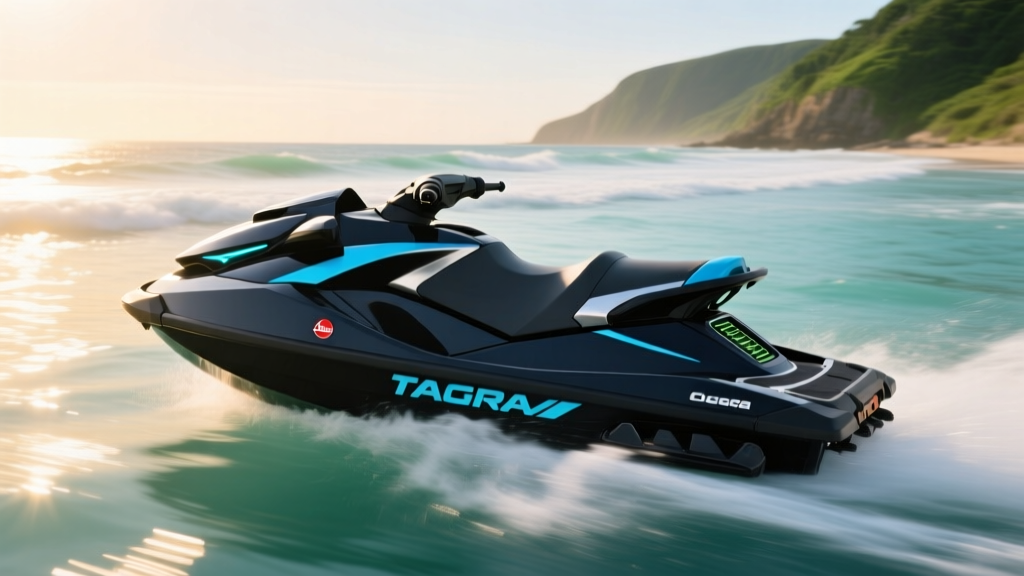
The bottom line on the Taiga Orca: The Taiga Orca is a fully electric personal watercraft (PWC) with up to 210 HP, a usable battery capacity of 23.6 kWh, and a manufacturer-claimed range of approximately 2 hours of mixed riding (roughly 45–60 miles depending on throttle usage). Starting at $12,990 for the Orca Sport and climbing to $17,490 for the Orca Carbon, it costs 20–50% more upfront than a comparable gas Sea-Doo or Yamaha. However, annual fuel and maintenance savings of $600–$1,200 can close that gap within 5–8 years for moderate riders. It is not eligible for the federal §30D EV tax credit because that credit applies only to highway-capable vehicles with four wheels.
What Is the Taiga Orca Electric Jet Ski?
The Taiga Orca is built by Taiga Motors, a Montreal-based company that began delivering its first production electric PWCs in 2022 and has iterated through several model years since. Unlike the dominant gas-powered personal watercraft from BRP (Sea-Doo), Yamaha (WaveRunner), and Kawasaki (Jet Ski), the Orca runs on a fully electric powertrain with zero tailpipe emissions and no internal combustion engine to winterize, fog, or rebuild.
For the 2026 model year, Taiga offers three primary trims:
- Orca Sport — 210 HP equivalent, 23.6 kWh battery, base price $12,990
- Orca Performance — 210 HP, upgraded suspension and hull tuning, $15,490
- Orca Carbon — 210 HP, carbon-fiber hull reducing weight by ~60 lbs, $17,490
These are manufacturer-announced figures. The Orca uses an NMC (nickel manganese cobalt) lithium-ion battery pack, chosen for its high energy density — critical in a watercraft where weight directly affects handling and planing efficiency.
Battery, Range, and Real-World Riding Time
The most common question from prospective buyers: how long does the Taiga Orca actually last on the water?
Taiga rates the Orca's range in time rather than miles because PWC usage is highly throttle-dependent. Here's what the numbers look like in practice:
| Riding Style | Est. Time on Water | Est. Distance | Avg Power Draw |
|---|---|---|---|
| Light cruising (10–15 mph) | ~2.0 hours | ~30–40 miles | ~12 kW |
| Mixed riding (cruise + play) | ~1.5 hours | ~40–50 miles | ~16 kW |
| Aggressive / full throttle | ~0.75–1.0 hour | ~35–45 miles | ~24–30 kW |
Real-world caveat: These estimates assume calm water and moderate ambient temperatures (70–85°F). Cold water (below 55°F) increases battery internal resistance and can reduce effective capacity by 8–12%. Choppy conditions and carrying a passenger also increase power draw substantially. If your typical lake session is 1–1.5 hours of mixed riding, the Orca's battery is adequate. If you ride 3+ hours without returning to dock, you will need to plan around mid-session charging or accept limitations.
Charging: Speed, Options, and Dock Reality
Charging an electric PWC introduces logistics that car-based EV owners don't face. You can't pull up to an Electrify America station on the water.
kW vs kWh reminder: The Orca's battery stores 23.6 kWh (kilowatt-hours — total energy). The charger delivers power measured in kW (kilowatts — rate of energy transfer). A higher kW charger fills the battery faster.
| Charging Method | Power (kW) | 0–100% Time | Practical Notes |
|---|---|---|---|
| Standard 120V outlet (Level 1) | ~1.2 kW | ~20 hours | Emergency/trickle only; not practical for regular use |
| 240V Level 2 (Taiga onboard charger) | ~6.6 kW | ~3.5 hours | Typical dock or garage charging; requires 30A circuit |
| Optional DC fast charge (CCS) | Up to ~30 kW | ~45 minutes (10–80%) | Available on select models; requires marina with DC infrastructure |
Most Orca owners charge at home in a garage or on a dock with a 240V outlet installed. If your boat slip or marina does not have 240V access, charging logistics become your biggest ownership challenge — far more than range itself. Before purchasing, confirm your marina allows PWC charging and can support a dedicated 30A/240V circuit. Installation costs for a marine-grade 240V receptacle typically run $800–$2,500 depending on distance from the panel and whether a subpanel is needed.
Taiga Orca vs Gas PWC: Cost and Ownership Comparison
To evaluate whether the Orca makes financial sense, here's a side-by-side comparison against a popular gas alternative — the 2026 Sea-Doo RXT-X 325, a similarly performance-oriented PWC.
| Metric | Taiga Orca Sport | Sea-Doo RXT-X 325 (Gas) |
|---|---|---|
| Base MSRP | $12,990 | $17,799 |
| Power | 210 HP (electric motor) | 325 HP (supercharged 1,630cc) |
| 0–60 mph (est.) | ~3.8 seconds | ~3.5 seconds |
| Top speed | ~65 mph | ~72 mph |
| Weight (dry) | ~590 lbs | ~850 lbs |
| Energy/fuel cost per hour | ~$1.50–$3.00 (electricity) | ~$25–$40 (premium gas) |
| Annual maintenance | ~$100–$200 (impeller inspection, coolant) | ~$500–$900 (oil, spark plugs, supercharger, winterization) |
| Winterization | Not required (no ICE) | $150–$300 annually |
| Noise level | Near-silent at idle; ~70 dB at WOT | ~85–95 dB at WOT |
| Emissions on water | Zero tailpipe | Unburned hydrocarbons in exhaust |
Key takeaway: The Orca Sport undercuts the Sea-Doo RXT-X on sticker price by roughly $4,800. However, comparing against the Sea-Doo Spark (starting ~$7,399) or Yamaha VX Cruiser (starting ~$11,999), the Orca carries a premium of $1,000–$5,600 depending on the gas model chosen. The Orca's real financial advantage is in operating costs: at 50 hours of riding per year, a gas PWC burns roughly $1,250–$2,000 in fuel alone, while the Orca consumes $75–$150 in electricity. Add $400–$600 in avoided maintenance and winterization, and the Orca saves roughly $1,500–$2,400 per year for an active rider.
Total 5-Year Ownership Cost Breakdown
| Cost Category | Taiga Orca Sport (5 yr) | Gas PWC (Mid-Range, 5 yr) |
|---|---|---|
| Purchase price | $12,990 | $12,500 |
| Fuel / electricity | $500 | $7,500 |
| Maintenance & winterization | $750 | $3,500 |
| Insurance (est. avg) | $3,000 | $2,500 |
| Home charging install (one-time) | $1,200 | $0 |
| Total (5 years) | $18,440 | $26,000 |
Over five years at 50 hours annually, the Orca Sport saves approximately $7,500 in total cost of ownership compared to a mid-range gas PWC — even after accounting for the 240V charger installation. At 100 hours per year, savings grow to roughly $12,000+.
Insurance note: Electric PWC insurance premiums tend to run 15–25% higher than gas equivalents due to specialized repair requirements and limited collision data. Get a quote before committing. Major marine insurers (Markel, GEICO Marine, Progressive) now cover the Orca, but rates vary significantly by state and waterway.
Common Misconceptions About Electric Jet Skis
| Myth | Fact |
|---|---|
| "Electric PWCs have no power" | The Orca delivers 210 HP with instant torque — 0–30 mph hits in under 2 seconds, competitive with mid-range gas models. |
| "The battery will die in 30 minutes" | At mixed riding, expect 1.5 hours. Light cruising extends to 2 hours. Only sustained full-throttle riding drops below 1 hour. |
| "You can't ride it in saltwater" | The Orca's battery and motor are sealed to IP68. Taiga rates it for both fresh and saltwater use. Post-ride freshwater rinse is still recommended for all hardware. |
| "It qualifies for the $7,500 EV tax credit" | It does not. The IRS §30D credit applies to four-wheeled, highway-capable vehicles with a GVWR under 14,000 lbs. PWCs are excluded. |
| "Charging takes all day" | Level 2 (240V) charging fills the 23.6 kWh battery in about 3.5 hours — enough time for a lunch break between lake sessions. |
Who Should Buy the Taiga Orca — and Who Shouldn't
Buy the Taiga Orca if:
- You ride primarily on lakes or calm waterways where noise restrictions favor electric (many lakes now ban or limit gas PWCs on weekends)
- Your typical session is under 2 hours and you have access to 240V charging at home or at your marina
- You want near-silent operation for wildlife-friendly riding or peaceful cruising
- You're tired of annual engine winterization, oil changes, and supercharger maintenance
- You value instant torque and smooth, vibration-free acceleration
Stick with a gas PWC if:
- You regularly ride 3+ hours without returning to a dock or trailer
- You need top-end speed above 70 mph for racing or open-ocean conditions
- Your marina has no electrical infrastructure and installing it is impractical or cost-prohibitive
- You want the broadest dealer/service network — Taiga has a growing but still limited dealer footprint compared to Sea-Doo and Yamaha
- You frequently tow the PWC long distances and need the lightest possible trailer setup (gas PWCs are heavier, but the fueling infrastructure is universal)
Battery Longevity and Warranty
Taiga provides a 3-year/limited-mileage warranty on the Orca's battery pack, with a guaranteed capacity retention threshold of approximately 80% over the warranty period. The NMC chemistry used in the Orca offers high energy density but degrades faster than LFP (lithium iron phosphate) under extreme heat and repeated 100% charge cycles.
Maximizing battery life:
- Avoid storing the Orca at 100% state of charge for extended periods — store at 50–60% SoC when not riding for weeks
- Minimize DC fast charging to when you genuinely need it; Level 2 charging generates less heat and stress on cells
- In cold climates, allow the battery to warm to ambient before hard riding; Taiga's thermal management system handles this partially but pre-conditioning helps
Battery replacement cost, should it be needed out of warranty, is estimated at $4,000–$6,000 based on current NMC pack pricing and Taiga's service documentation. This is a meaningful long-term cost that gas PWC owners don't face — though gas owners spend equivalent amounts on engine rebuilds over a 10-year lifespan.
Frequently Asked Questions
Can I tow a skier or tuber with the Taiga Orca?
Yes. The Orca Sport's 210 HP and instant electric torque provide strong low-speed pull, which is ideal for tubing and wakeboarding. Taiga includes a tow hook on all trims. The main limitation is duration — towing draws significant power, so expect riding time to drop to roughly 1 hour under continuous tow loads.
How do I transport the Taiga Orca?
The Orca rides on a standard PWC trailer. At approximately 590 lbs (Sport trim), it's lighter than most gas PWCs and can be towed by virtually any vehicle. Taiga sells a compatible trailer, and most aftermarket PWC trailers work. No special EV-related transport requirements exist.
Is there a dealer network for service?
Taiga has been expanding its dealer and service network since 2022, with authorized partners in over 30 U.S. states and several Canadian provinces as of 2026. However, coverage is not as dense as BRP or Yamaha. Check Taiga's dealer map for proximity before purchasing — some owners ship units to regional service centers for warranty work.
Does the Orca have a reverse gear?
Yes. Electric motor reversal is instantaneous — the Orca has forward, neutral, and reverse selectable via the handlebar control. There's no mechanical gearbox; the motor simply reverses rotation direction.
What happens if the battery dies on the water?
The Orca includes a low-battery warning system and will enter a reduced-power "limp mode" before fully depleting, giving you enough speed to return to shore or dock. If you do fully deplete, you'll need a tow — same as running out of gas on a conventional PWC. Plan your rides with a 15–20% battery reserve.
Sources: Taiga Motors official specifications (taigamotors.ca/orca), IRS §30D Clean Vehicle Credit guidelines (irs.gov).