Why EV Owners Are Comparing Sunrun and Tesla Solar in 2026
If you drive an electric vehicle and want to charge it on sunshine, you have two dominant residential solar-and-storage ecosystems to evaluate: Sunrun and Tesla. Both bundle solar panels, battery storage, and energy management into packages designed to offset the 300–500 kWh per month that a typical EV household consumes. But their approaches, pricing, hardware, and contract structures diverge sharply — and the wrong choice can leave you with a 15-year contract that doesn't actually cover your charging load.
This guide breaks down what each company offers in 2026, how their battery systems (Tesla Powerwall 3 vs. Sunrun Brightbox) perform under real EV-charging conditions, and what the total economics look like when you factor in federal incentives, utility rate structures, and the actual kWh your roof can produce.
The Hardware: Tesla Powerwall 3 vs. Sunrun Brightbox
The battery is the component that matters most for EV owners. Solar panels produce energy during the day; your EV often charges at night. Without storage, you're exporting cheap daytime solar to the grid and buying back expensive evening electricity to fill your battery pack. A home battery closes that loop.
| Spec | Tesla Powerwall 3 | Sunrun Brightbox (Enphase IQ 5P) |
|---|---|---|
| Usable energy capacity | 13.5 kWh per unit | 5 kWh per unit (stackable) |
| Continuous power output | 11.5 kW | 3.84 kW per unit (7.68 kW with 2) |
| Integrated inverter | Yes (built-in DC-to-AC) | Yes (microinverter-based) |
| Round-trip efficiency | ~90% | ~90% |
| Warranty | 10 years, unlimited cycles | 10 years, guaranteed performance |
| EV charging integration | Native with Tesla Wall Connector | Via Sunrun app and compatible L2 chargers |
| Backup capability | Whole-home (with Gateway) | Whole-home (with Enphase IQ System Controller) |
| Stackable | Up to 10 units | Multiple units per system |
What this means for EV charging: A single Tesla Powerwall 3 stores 13.5 kWh — enough to add roughly 40–50 miles of range to a Tesla Model Y or Hyundai Ioniq 5 overnight, depending on efficiency. If you drive a larger-battery vehicle like the Ford F-150 Lightning (extended range, ~131 kWh usable), one Powerwall covers only about 10% of a full charge. Sunrun's Enphase-based Brightbox starts at 5 kWh per unit, so you'll typically need 2–4 units to match a single Powerwall's capacity. The advantage of Enphase's modular design is granularity: you can size the system to your exact nightly charging need rather than over-provisioning.
Solar Panel Systems: Production, Panels, and Roof Realities
Both Sunrun and Tesla install Tier 1 monocrystalline panels, but the hardware sourcing and system design differ.
Tesla Solar uses its own branded panels (manufactured by partners like Qcells and Hanwha) and offers the Tesla Solar Roof — integrated solar shingles that replace your roofing material entirely. The Solar Roof carries a premium (often 2–3x the cost of a conventional panel install) and is best suited for homes needing a full roof replacement anyway. Standard Tesla panel installs use conventional rack-mounted modules.
Sunrun sources panels from multiple manufacturers (typically REC, Canadian Solar, or Qcells depending on your region) and uses Enphase IQ8 microinverters at the panel level. Microinverters offer panel-level optimization — if one panel is shaded by a tree or chimney, the others continue producing at full capacity. Tesla uses a central string inverter (or optimizers in some configurations), which can reduce output across an entire string if one panel underperforms.
Costs, Contracts, and Federal Incentives
This is where the Sunrun vs. Tesla decision gets complicated — and where the fine print matters enormously.
| Factor | Tesla Solar | Sunrun |
|---|---|---|
| Purchase model | Cash or loan only | Cash, loan, lease (PPA), or subscription |
| Typical 8 kW system cost (purchase) | $20,000–$26,000 before incentives | $22,000–$30,000 before incentives |
| Powerwall 3 / Brightbox add-on | ~$9,000–$11,000 installed (per Powerwall 3) | ~$8,000–$15,000 depending on units |
| Federal solar ITC (§48) | 30% of total system cost | 30% if purchased; not available on leases |
| Lease / PPA monthly cost | Not offered | $50–$150/month depending on system size and region |
| Contract length (lease) | N/A | 20–25 years |
| Production guarantee (lease) | N/A | Yes — Sunrun covers underperformance |
| Transferability on home sale | Owned system transfers with home | Lease must be assumed by buyer or bought out |
EV Charging Integration: How Each System Powers Your Car
For EV owners, the critical question is: can I charge my car on stored solar at night, and how seamlessly does the system manage that energy flow?
Tesla Ecosystem: The Walled Garden Advantage
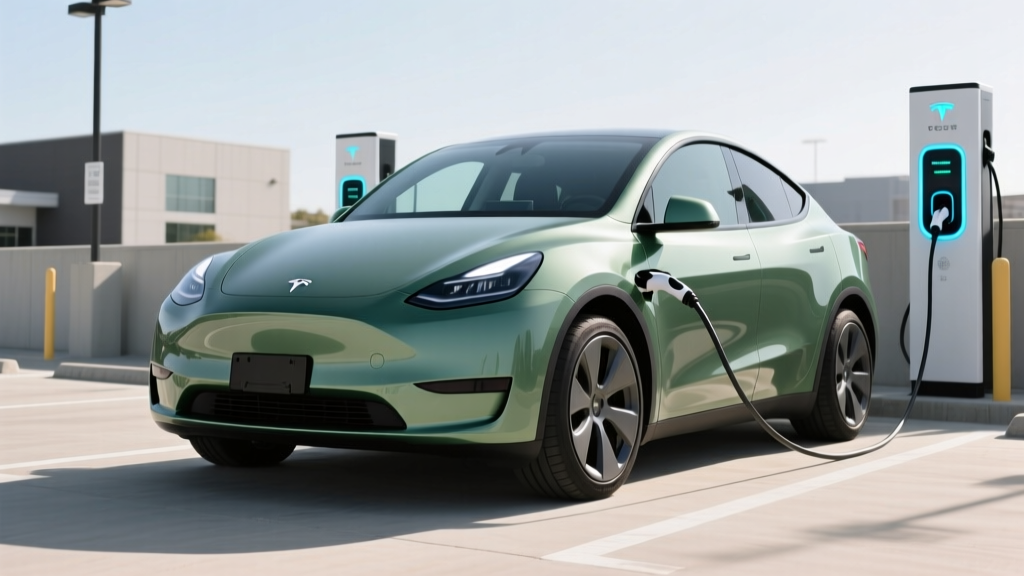
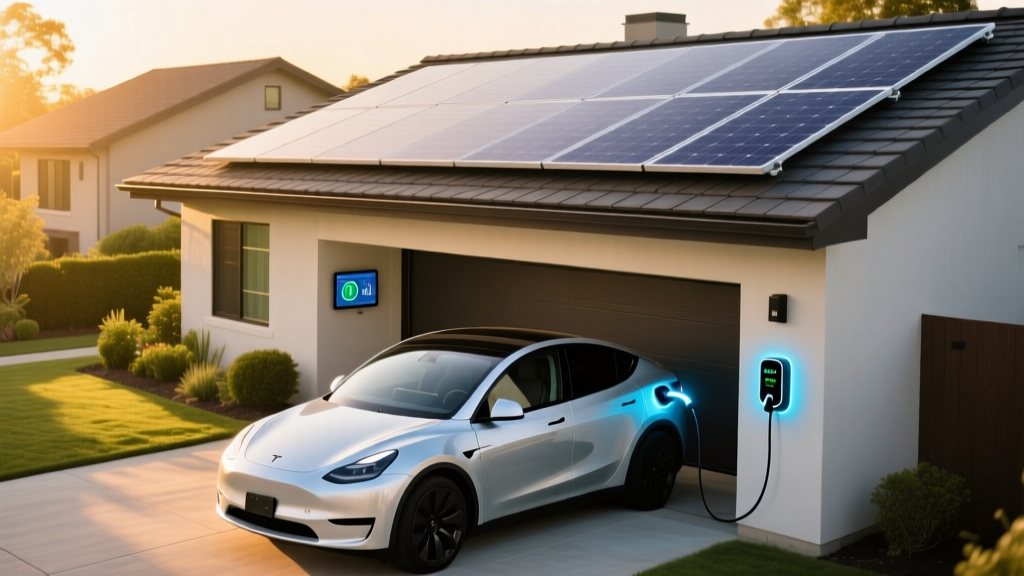
If you own a Tesla vehicle, a Tesla Wall Connector (Level 2, up to 11.5 kW / 48A), a Powerwall 3, and Tesla solar panels, the integration is native. The Tesla app shows solar production, battery state of charge, home consumption, and vehicle charging in a single dashboard. You can configure "Charge on Solar" mode, which throttles your Wall Connector's output to match real-time excess solar production — meaning your car charges only when the panels are producing more than the house is consuming. This is genuinely useful: it prevents you from pulling grid power during peak-rate hours.
The Powerwall 3's 11.5 kW continuous output means it can sustain a full-speed Level 2 charge session, though you'll deplete its 13.5 kWh capacity in roughly 70 minutes at that rate. Most owners charge at lower amperage (24A–32A, adding ~20–30 miles per hour), which extends the battery's contribution across a longer overnight window.
Sunrun: Open Ecosystem with Enphase Intelligence
Sunrun doesn't manufacture its own EV charger, which means you can pair it with any Level 2 charger — ChargePoint Home Flex, Emporia Vue, Wallbox Pulsar Plus, or a Tesla Wall Connector with a J1772 adapter. The Enphase IQ System Controller and the Sunrun app manage battery dispatch and can prioritize stored energy for EV charging during time-of-use (TOU) peak windows.
The trade-off: without a single-vendor ecosystem, the automation isn't as seamless as Tesla's "Charge on Solar" mode. You may need to configure schedules in both the Enphase app and your charger's app to optimize for solar self-consumption. However, Sunrun's open approach means you're not locked into one automaker's hardware — a significant advantage if your next EV isn't a Tesla.
Who Should Choose Tesla Solar?
- Tesla vehicle owners who want a single-app experience for solar, battery, and charging.
- Buyers who prefer ownership over leasing — Tesla only offers purchase or loan.
- Homes with minimal shading where string inverters perform well.
- Those considering Solar Roof for a simultaneous roof replacement (budget accordingly: $40,000–$70,000+).
- Tech-forward users who value the Tesla app's energy dashboard and OTA updates to Powerwall firmware.
Who Should Choose Sunrun?
- Homeowners who want a $0-down lease with no upfront capital outlay and a production guarantee.
- Homes with partial shading where Enphase microinverters outperform string inverters.
- Non-Tesla EV owners (or multi-EV households with mixed brands) who want charger flexibility.
- Those who value a 25-year service contract with included maintenance, monitoring, and panel replacement.
- Buyers who plan to stay in the home long-term — lease transfer on sale can complicate real estate transactions.
Frequently Asked Questions
Can Sunrun or Tesla solar fully offset my EV's electricity consumption?
Yes, if the system is sized correctly. A typical EV driven 12,000 miles/year at 3 mi/kWh needs ~4,000 kWh annually. An 8–10 kW solar system in most U.S. regions produces 8,000–13,000 kWh/year, covering EV charging plus substantial household load. The constraint is roof space, shading, and local net-metering rules — not the provider.
Does adding a Powerwall or Brightbox make sense if I already have solar?
It depends on your utility's rate structure. If you have 1:1 net metering (your utility credits exported solar at the full retail rate), a battery provides limited financial benefit — the grid acts as your "battery." But if your utility has moved to time-of-use rates with low export compensation (common in California under NEM 3.0, and increasingly in Hawaii, Nevada, and parts of the Southeast), a home battery lets you store cheap daytime solar and discharge it during expensive evening peaks, saving $50–$150/month depending on rate spreads.
Is the Tesla Solar Roof worth it compared to standard panels?
Rarely, on pure economics. Tesla's Solar Roof costs roughly $40–$70 per square foot installed, versus $3–$5 per watt for conventional rack-mounted panels. A 2,000 sq ft roof might cost $80,000–$140,000 for Solar Roof versus $20,000–$30,000 for standard panels on the same home. The Solar Roof makes financial sense only if you need a full roof replacement anyway and value the integrated aesthetic. Source: EnergySage Tesla Solar Roof analysis.
What happens to my Sunrun lease if I sell my house?
The buyer must qualify for and assume the lease, or you can buy out the remaining contract (typically at a negotiated price based on the system's remaining value). Lease transfers can slow real estate transactions — some buyers are reluctant to inherit a 20-year obligation. Sunrun has a dedicated transfer team, but plan for 30–60 days of processing time. Owned systems (Tesla or purchased Sunrun) transfer with the home like any other fixture and typically appraise at $10,000–$20,000 in added home value.
Can I charge my non-Tesla EV using Tesla's solar and Powerwall system?
Yes. The Powerwall discharges to your home's electrical panel, not directly to a charger. Any Level 2 charger plugged into a 240V circuit in your home will draw from whatever power source is active — solar, Powerwall, or grid. The Tesla Wall Connector works with non-Tesla EVs using the NACS-to-J1772 adapter that most automakers now include or sell. The only limitation is that the Tesla app's "Charge on Solar" feature is currently optimized for Tesla vehicles; non-Tesla EVs won't auto-throttle to match solar surplus.
Which system charges my EV faster during a grid outage?
Neither system charges your EV "faster" during an outage — both are limited by battery capacity. A single Powerwall 3 (13.5 kWh, 11.5 kW output) can sustain a 48A Level 2 charge for about 70 minutes before depletion. Two Enphase IQ 5P units (10 kWh combined, 7.68 kW output) sustain a 32A charge for roughly 80 minutes. During extended outages, your priority should be essential loads (refrigerator, lighting, communications), not EV charging — unless you've oversized your battery bank significantly.