The Short Answer: No Production WRX Electric Exists Yet
As of the 2026 model year, Subaru does not sell a WRX electric. The current WRX remains a turbocharged 2.4-liter flat-four gas sedan (271 hp, 25/31 mpg EPA). Subaru has shown EV concepts — notably the STI E-RA — and has committed to offering EVs across its lineup by the late 2020s, but no electrified WRX or STI-badged EV is currently on sale, priced, or available to order. If you want rally-bred AWD performance with a plug today, you'll need to look at alternatives or wait for Subaru's next EV platform announcement.
Where Subaru's EV Lineup Actually Stands in 2026
Subaru's only battery-electric vehicle available in the U.S. remains the Solterra, developed jointly with Toyota (which sells the near-identical bZ4X). The 2026 Solterra offers up to an EPA-estimated 228 miles of range on the Limited trim with its 72.8 kWh (usable ~64 kWh) lithium-ion NMC battery, 215 hp dual-motor AWD, and a peak DC fast-charge rate of around 150 kW (10–80% in roughly 30 minutes under ideal conditions). Pricing starts near $38,000 before incentives.
That's a competent compact crossover, but it's not a WRX. The Solterra prioritizes efficiency, ground clearance, and Subaru's traditional AWD-weather credibility over the low center of gravity, aggressive tuning, and 271+ hp output that WRX buyers expect.
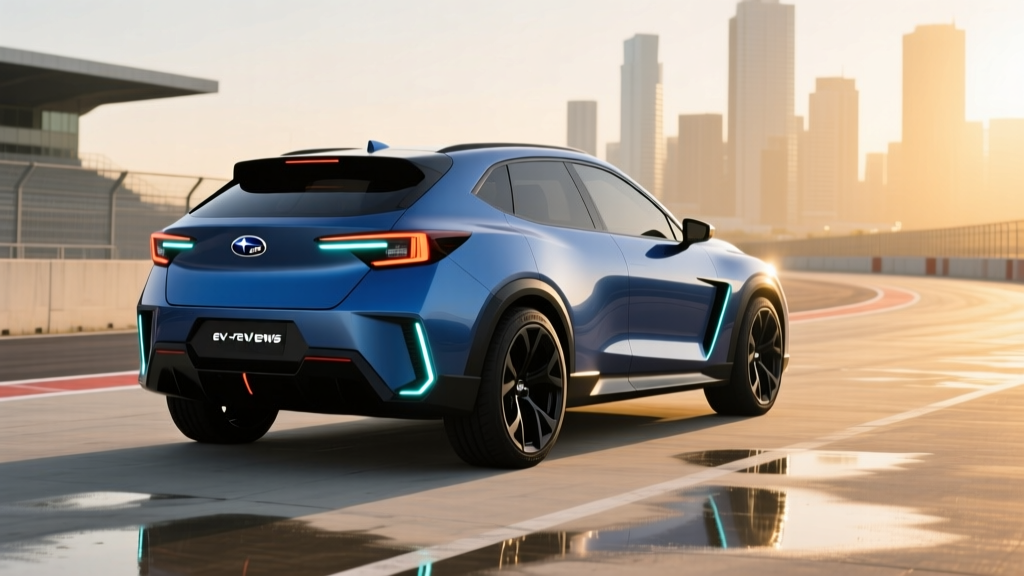
Subaru's official roadmap references multiple next-generation EVs on a new dedicated platform arriving later this decade, and the STI sub-brand has been repositioned toward electrified performance (the STI E-RA concept with four motors and ~1,150 hp hinted at the direction). But concepts are not production cars, and Subaru has not announced a WRX EV, an STI sedan, or pricing/specs for either. Treat any "WRX EV coming next year" headline with skepticism until Subaru issues an official press release.
EV Sport Sedans That Fill the WRX-Shaped Hole
If your search for "WRX electric" is really a search for an AWD performance sedan with a plug, several 2026 models deliver the spirit — if not the badge. Here's how the realistic contenders stack up:
| Model | Powertrain | HP | 0-60 mph | EPA Range / MPG | Starting MSRP |
|---|---|---|---|---|---|
| 2026 Subaru WRX (gas baseline) | 2.4L turbo flat-4, AWD | 271 | ~5.5s | 25/31 mpg | ~$32,000 |
| Tesla Model 3 Long Range AWD | BEV, dual motor | ~346 | 4.2s | 341 mi | ~$47,000 |
| Hyundai Ioniq 6 Limited AWD | BEV, dual motor, 77.4 kWh | 320 | 5.1s | 316 mi | ~$49,000 |
| Polestar 2 Long Range Dual Motor | BEV, 78 kWh NMC | 421 | 4.1s | 276 mi | ~$53,000 |
| BMW i4 xDrive40 | BEV, 81.5 kWh | 396 | 4.6s | 282 mi | ~$57,000 |
None of these carry the WRX's rally heritage or manual-transmission option, but on pure performance-per-dollar metrics, the Tesla Model 3 Long Range AWD is the closest analog: lower center of gravity than the WRX, faster to 60, substantially more cargo space, and access to the Supercharger network. The Ioniq 6 is the efficiency king with its teardrop shape and 800V architecture enabling 10–80% DC charges in roughly 18 minutes at a 350 kW-capable station.
The Real Cost Comparison: EV Sport Sedan vs Gas WRX
The WRX's base price is hard to beat. But the five-year ownership picture changes once you factor in fuel, maintenance, and available incentives. Below is a realistic 5-year/60,000-mile cost model comparing a 2026 WRX Premium against a Tesla Model 3 LR AWD, assuming 12,000 miles/year, $3.50/gallon regular fuel, $0.14/kWh home electricity (national average), and 80% home / 20% public DC charging for the EV.
| Category | 2026 WRX Premium (gas) | Tesla Model 3 LR AWD (BEV) |
|---|---|---|
| Base MSRP | $35,000 | $47,000 |
| Federal §30D tax credit | $0 | Up to $7,500 (eligibility varies) |
| Effective purchase price | $35,000 | ~$39,500 |
| 5-year fuel/energy cost | ~$7,560 | ~$2,520 |
| 5-year maintenance | ~$3,200 (oil, brakes, filters) | ~$900 (cabin filter, wipers, tires) |
| 5-year insurance (est.) | ~$9,000 | ~$11,500 |
| Estimated 5-yr total cost | ~$54,760 | ~$54,420 |
The EV closes the gap largely through fuel and maintenance savings — roughly $7,300 combined over five years. Insurance is the offset: EV performance sedans typically cost 15–30% more to insure due to higher repair costs and parts pricing. Your actual numbers depend heavily on local electricity rates, driving profile, and whether you qualify for the §30D federal tax credit, which is subject to MSRP caps ($55,000 for sedans), buyer income limits ($150k single / $300k joint), and battery-sourcing requirements that change annually. Point-of-sale transfer is now available at participating dealers, reducing the effective purchase price at signing rather than at tax time.
Ownership Realities That Brochures Don't Mention
Before you commit to any EV as a WRX replacement, honestly assess these four factors. They determine whether an EV is a joy or a compromise in your specific life.
Home charging access is the single biggest variable
Owners with a Level 2 home charger (240V, 32–48A, adding roughly 25–44 miles of range per hour) report near-universal satisfaction. The car is "full" every morning, and public charging becomes a road-trip concern only. A typical Level 2 home install runs $800–$2,200 all-in (charger + electrician + permit), but can climb to $4,000+ if your panel needs a 200A upgrade. If you live in an apartment, rely on street parking, or your HOA restricts charger installation, daily EV life is materially harder — and a PHEV or the gas WRX may be the more honest choice.
Cold weather steals range — plan for 20–30% loss
Lithium-ion batteries are chemically sluggish below freezing, and cabin heating is a significant energy draw. Expect a 341-mile Model 3 to deliver roughly 240–270 miles in sustained sub-30°F highway driving. Models with heat pumps (standard on most 2026 Teslas, Hyundai/Kia 800V cars) mitigate this loss compared to resistive heaters, but physics is physics. If your commute is 80 miles round trip in Minnesota winter, you'll want at least 300 miles of rated range as buffer.
Performance EVs reward preconditioning
Like the WRX's turbo wanting warm oil, an EV's battery wants to be in its thermal sweet spot (roughly 30–40°C) before a DC fast charge or hard acceleration. Navigation-based preconditioning — where the car warms the pack as you route to a charger — can cut a 10–80% charge from 35 minutes to 18 minutes. If a model you're considering lacks this feature, your road-trip charging will be slower than the spec sheet implies.
The charge curve matters more than peak kW
A car advertising "250 kW peak charging" may sustain that rate only between 10–30% state of charge, then taper sharply. Hyundai/Kia's 800V E-GMP platform sustains high rates longer than most competitors, which is why an Ioniq 6's real-world 10–80% time often beats cars with nominally higher peak kW. Ask for the full charge curve, not the headline number.
Common Myths About a WRX Electric, Addressed
| Myth | Fact |
|---|---|
| "Subaru is releasing a WRX EV next year." | No official announcement, pricing, or EPA certification exists. Treat rumors as rumors. |
| "An EV can't feel like a WRX without a manual transmission." | EVs don't use multi-speed gearboxes, but instant torque and torque-vectoring AWD produce cornering dynamics the WRX can't match. The feel is different, not inferior. |
| "EV batteries need replacement every few years." | Modern NMC and LFP packs are warrantied for 8 years/100,000 miles minimum (10 years/150,000 in CARB states). Real-world degradation data from Tesla and Hyundai shows ~85–90% capacity retention at 150,000 miles. |
| "I'll never be able to take an EV on rally-stage dirt roads." | EVs have no air intake to hydrolock, fewer fluids to leak, and low centers of gravity. Ground clearance and tire choice remain the limiting factors — same as the gas WRX. |
| "The tax credit makes any EV cheaper than a WRX." | §30D has MSRP, income, and battery-sourcing limits. Many EVs over $55,000 (sedans) or $80,000 (SUVs/trucks) don't qualify. Verify on fueleconomy.gov before counting on it. |
Decision Framework: Should You Wait, Cross-Shop, or Buy Gas?
Buy the gas WRX now if: You want a manual transmission, your budget is firm under $38,000, you lack reliable home charging, or you regularly drive remote backroads where DC fast-charger density is low.
Cross-shop a performance EV now if: You have home Level 2 access, your commute is under 150 miles round trip, you value instant torque and lower per-mile running costs, and you're open to a $45,000–$55,000 purchase price offset by the tax credit and fuel savings.
Wait for a Subaru performance EV if: The WRX badge and Subaru's AWD tuning philosophy are non-negotiable, you're willing to sit out 2–4 years with no guarantee of pricing or specs, and your current car has usable life left.
Consider a PHEV bridge if: You want some electrified driving but aren't ready to commit to a BEV — though Subaru doesn't currently offer a PHEV sedan, the Toyota Prius Prime (44 miles electric-only, 48 mpg combined) or a plug-in performance SUV may fill the gap.
Frequently Asked Questions
Will Subaru ever make a WRX electric or an STI EV?
Subaru has signaled electrified STI performance through concepts like the E-RA, and the company plans multiple dedicated EVs by the end of the decade. However, no WRX-badged EV has been announced with pricing, specs, or a production timeline as of early 2026. Follow Subaru's official newsroom for verified updates rather than rumor sites.
What's the closest EV to a WRX in spirit and price?
The Tesla Model 3 Long Range AWD is the closest on performance, AWD capability, and (after the potential §30D credit) effective price. The Hyundai Ioniq 6 AWD is a strong alternative if you prioritize charging speed and efficiency over the Supercharger ecosystem. Neither offers a manual or rally heritage.
Does the WRX have any hybrid variant?
No. The 2026 WRX is exclusively a 2.4-liter turbocharged gasoline engine paired with a 6-speed manual or optional CVT. Subaru offers mild-hybrid systems in some global Crosstrek markets, but not in the U.S. WRX.
If a WRX EV arrives, will it qualify for the federal tax credit?
It depends on final pricing and battery sourcing. Under current §30D rules, sedans must have an MSRP at or below $55,000, the buyer must fall under income caps, and the battery must meet critical-mineral and component sourcing thresholds that tighten annually. Subaru's historical battery supply chain suggests eligibility is not guaranteed — verify on the IRS clean-vehicle page at time of purchase.
Is an EV actually more fun to drive than a turbo WRX?
Different, not universally better. An EV delivers instant torque with zero turbo lag and a lower center of gravity for flatter cornering. But it's also heavier (often 4,200–4,500 lbs vs the WRX's ~3,400 lbs), lacks the mechanical engagement of a manual gearbox, and doesn't produce the turbo whoosh and flat-four burble that are core to the WRX experience. Test-drive both before deciding which "fun" you prefer.