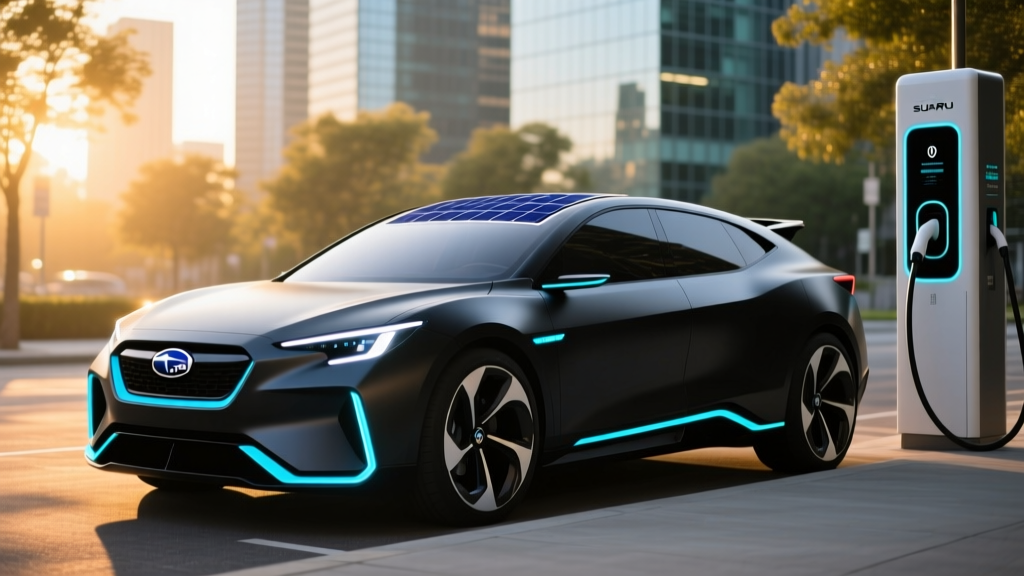
The Subaru Uncharted is an all-new electric subcompact crossover built on the Toyota/Subaru shared e-TNGA platform, positioned below the Solterra in Subaru's lineup. Announced in late 2024 with deliveries expected to begin in 2026, the Uncharted targets urban EV buyers who want Subaru's signature all-wheel drive in a smaller, more affordable package. Because the vehicle is still pre-launch, the specs below reflect Subaru's preliminary disclosures and platform-shared data from its Toyota sibling (the upcoming compact EV also on e-TNGA). Treat all figures as estimated until Subaru publishes final EPA certifications.
Quick Answer: Is the Subaru Uncharted Worth Waiting For?
The Uncharted is projected to start around $32,000–$35,000 MSRP with an estimated EPA range of 220–250 miles, standard AWD, and DC fast charging up to ~150 kW. It undercuts the Solterra by roughly $8,000–$10,000 and targets buyers who want a small, city-friendly EV with genuine all-weather capability. If you can wait for 2026 deliveries and have home Level 2 charging access, it's one of the most compelling upcoming entries in the subcompact EV segment. If you need a car now or lack home charging, the Hyundai Kona Electric or Volvo EX30 may be better immediate options.
What We Know About the Subaru Uncharted EV Specs
Subaru has confirmed the Uncharted will ride on the same e-TNGA architecture co-developed with Toyota, which currently underpins the Solterra and Toyota bZ4X. However, the Uncharted is a shorter, lighter vehicle — think of it as a subcompact crossover closer in size to the Crosstrek than the Outback. That smaller footprint has direct implications for battery size, range, and efficiency.
| Spec | Estimated Value |
|---|---|
| Battery (usable) | ~58–65 kWh, NMC lithium-ion |
| EPA Range (est.) | 220–250 miles |
| Drivetrain | Dual-motor AWD (standard) |
| Horsepower | ~214 hp (combined) |
| 0–60 mph | ~6.5–7.5 seconds (est.) |
| DC Fast Charge (peak) | ~150 kW (CCS1/NACS TBD) |
| 10–80% DC Charge Time | ~28–32 minutes (est.) |
| Level 2 (AC) Charge Rate | ~7.2–11 kW onboard charger |
| Starting MSRP (est.) | $32,000–$35,000 |
| Battery Warranty | 8 years / 100,000 miles (expected, per Subaru Solterra precedent) |
Sources: Subaru Uncharted announcement page; platform specs cross-referenced with fueleconomy.gov for comparable e-TNGA vehicles.
⚠ Real-World Range Expectation
The estimated EPA sticker of 220–250 miles assumes moderate temperatures and mixed driving. On sustained highway trips at 70+ mph, expect ~180–210 miles of usable range. In sub-freezing winter conditions (below 32°F / 0°C), range can drop an additional 20–30%, putting real-world cold-weather range at roughly 155–200 miles. If your daily round-trip commute exceeds 80 miles in cold climates, you'll want reliable Level 2 home charging to avoid range stress.
Uncharted EV vs. Gas and Hybrid: What Does Ownership Actually Cost?
For buyers cross-shopping the Uncharted against a gas-powered Subaru Crosstrek or the Crosstrek Hybrid (if still available in your market), the financial picture depends heavily on your driving volume, local electricity rates, and whether you qualify for federal incentives.
| Category | Uncharted EV (est.) | Crosstrek Gas (2026) |
|---|---|---|
| Base MSRP | $33,000 | $27,500 |
| Federal Tax Credit (§30D) | Up to $7,500 (if eligible*) | $0 |
| Effective Purchase Price | ~$25,500 | $27,500 |
| Fuel/Energy (60,000 mi / 5 yr) | ~$2,700 (home L2 at $0.14/kWh) | ~$7,200 (29 MPG avg, $3.50/gal) |
| Maintenance (5 yr) | ~$1,200 | ~$3,000 |
| Insurance (5 yr avg) | ~$8,500 | ~$7,200 |
| 5-Year Total Cost | ~$37,900 | ~$44,900 |
*Federal §30D credit eligibility depends on MSRP caps (SUVs/crossovers: $80,000), buyer income limits ($150K single / $300K joint AGI), critical-mineral and battery-component sourcing requirements, and point-of-sale transfer availability. Always verify current-year rules at IRS.gov and consult a tax professional.
The math is clear: if you qualify for the full $7,500 credit and charge primarily at home, the Uncharted EV can be cheaper to own over five years than the gas Crosstrek despite its higher sticker price. The savings come from dramatically lower energy costs (electricity at $0.14/kWh vs. gasoline at $3.50/gallon) and minimal maintenance (no oil changes, no transmission fluid, fewer brake replacements due to regenerative braking). The main offset is higher EV insurance premiums, which run 15–25% above comparable gas vehicles on average.
Charging the Uncharted: Home, Public, and What You'll Actually Pay
Charging access is the single biggest determinant of EV satisfaction. Before committing to the Uncharted — or any EV — honestly assess your situation:
Home Charging (Where 80%+ of EV Charging Happens)
A Level 2 home charger (240V, 32–48 amps) will fully replenish the Uncharted's ~60 kWh battery overnight in roughly 6–9 hours, depending on your charger's kW output. Professional installation of a Level 2 circuit typically costs $500–$2,000 if your electrical panel has spare capacity. If you need a panel upgrade (100A to 200A), add $1,500–$3,500. Level 1 charging (120V standard outlet) adds only ~3–5 miles of range per hour — adequate for low-mileage drivers but frustrating for anyone exceeding 40 miles daily.
Public DC Fast Charging
At a 150 kW DC fast charger, the Uncharted should add ~120–150 miles of range in 20 minutes (10–80% in ~30 minutes). However, peak kW is never sustained across the full session — charging speed tapers significantly above 80% State of Charge (SoC) to protect the battery. Real-world road-trip charging will involve 25–35 minute stops at 150+ kW stations. Public DC charging costs roughly $0.30–$0.48/kWh on networks like Electrify America and EVgo, making it 2–3× more expensive than home charging.
Connector Question: NACS or CCS?
Subaru has not yet confirmed whether the Uncharted will ship with the newer NACS (Tesla-style) connector or the legacy CCS1. Given that Toyota has committed to NACS for its North American EVs starting in 2025, there's a strong likelihood the Uncharted will adopt NACS, granting access to Tesla Supercharger stations. If it ships with CCS1, a NACS adapter (typically $200–$250) will be necessary for Supercharger access.
Federal Tax Credit: Will the Uncharted Qualify?
The §30D federal clean vehicle credit can reduce your effective purchase price by up to $7,500 — but eligibility is anything but automatic. Here's what will determine whether the Uncharted qualifies:
- MSRP Cap: The Uncharted is expected to be classified as an SUV/crossover, subject to the $80,000 MSRP cap. At ~$32K–$35K, it clears this easily.
- Buyer Income Cap: Modified AGI must not exceed $150,000 (single filer), $225,000 (head of household), or $300,000 (joint). Income is checked against either the current or prior tax year — whichever is lower.
- Battery Sourcing: The credit splits into two halves — $3,750 for critical-minerals sourcing and $3,750 for battery-component manufacturing. As of 2026, the sourcing requirements are stringent: critical minerals must be extracted or processed in the U.S. or a free-trade-agreement partner, and battery components must be manufactured or assembled in North America. Subaru's e-TNGA battery supply chain (largely Panasonic/Toyota) has been working to meet these thresholds, but final certification is vehicle-specific and subject to change.
- Point-of-Sale Transfer: If eligible, you can transfer the credit to the dealer at purchase, reducing your out-of-pocket cost immediately rather than waiting for a tax refund.
- FEOC Restriction: Vehicles with battery components from a "foreign entity of concern" (primarily Chinese-linked suppliers) are disqualified. This is the most volatile rule and has disqualified several models in prior years.
Bottom line: The Uncharted's price point and Subaru/Toyota's supply chain make it a strong candidate for at least a partial credit ($3,750), with full $7,500 eligibility possible but not guaranteed. Check the fueleconomy.gov credit lookup tool once the vehicle is officially certified.
Common Misconceptions About the Subaru Uncharted EV
| Myth | Fact |
|---|---|
| "It's a self-driving Subaru." | The Uncharted will feature Subaru's EyeSight driver-assist suite (adaptive cruise, lane centering, emergency braking), which is an SAE Level 2 system. The driver must remain fully engaged at all times. This is not autonomous driving. |
| "The battery will need replacing in 5 years." | Modern NMC batteries in e-TNGA vehicles show ~8–12% degradation over 100,000 miles based on Solterra/bZ4X fleet data. Subaru is expected to warrant the battery at 8 years/100,000 miles with a minimum 70% capacity retention threshold. Full replacements are rare and covered under warranty if premature. |
| "AWD EVs can't handle snow." | Dual-motor AWD provides instant torque to all four wheels independently. Combined with Subaru's X-MODE traction software and winter tires, the Uncharted should match or exceed the Crosstrek's snow performance. EVs also have a low center of gravity (battery pack under the floor), improving stability. |
| "I'll save $7,500 no matter what." | The §30D credit has income caps, MSRP caps, and battery-sourcing rules that change annually. Not every buyer qualifies for the full amount. Always verify eligibility before assuming the credit in your budget. |
| "Public charging is as cheap as home charging." | Public DC fast charging costs $0.30–$0.48/kWh on average — roughly 2–3× the cost of home Level 2 at $0.14/kWh. If you rely exclusively on public charging, your per-mile energy cost can approach or exceed that of a fuel-efficient gas car. |
Who Should Buy the Subaru Uncharted EV — and Who Shouldn't
Decision Framework: Is the Uncharted Right for You?
✅ Choose the Subaru Uncharted EV if:
- You have home Level 2 charging (or can install it) and a daily commute under 80 miles round-trip.
- You live in a snow-belt or rainy climate and value standard AWD with Subaru's X-MODE traction system.
- You want an EV under $35,000 that qualifies for at least a partial federal tax credit.
- You prefer a subcompact crossover footprint (easy parking, good visibility) over a larger SUV.
- You're willing to wait for 2026 deliveries and can plan around preliminary specs.
❌ Look elsewhere if:
- You lack home charging access and your nearest reliable public charger is more than 5 miles away. Public-only charging erodes cost savings and adds daily friction.
- You regularly drive more than 200 miles in a single trip in cold weather. The Uncharted's ~220–250 mile range (and ~155–200 in winter) will require frequent DC fast-charging stops.
- You need more than 25 cubic feet of cargo space behind the rear seats. Subcompact crossovers prioritize maneuverability over hauling capacity.
- You need a vehicle right now. The Uncharted is still pre-launch; consider the Hyundai Kona Electric, Kia Niro EV, or Volvo EX30 as available alternatives.
What First-Time EV Buyers Must Know Before Ordering
If the Uncharted would be your first electric vehicle, these ownership realities are worth internalizing before you put down a deposit:
1. Home charging is non-negotiable for satisfaction. Surveys consistently show that EV owners without home charging report significantly lower satisfaction. A Level 2 home charger transforms EV ownership from a logistics challenge into a "plug in at night, wake up full" convenience. Budget $500–$2,000 for installation on top of the vehicle cost.
2. kW and kWh are different things. This is the most common confusion for new EV buyers. kWh (kilowatt-hours) measures battery capacity — how much energy the car stores, like the size of a gas tank. kW (kilowatts) measures power — how fast energy flows into the car during charging, like the flow rate of a gas pump. A 60 kWh battery charged at 150 kW fills fast; charged at 1.4 kW (Level 1), it takes days.
3. The charging curve tapers above 80%. When manufacturers advertise "10–80% in 30 minutes," that's because charging speed drops significantly in the final 20% to protect battery longevity. Plan road trips around 80% charge stops — don't try to fill to 100% at a DC fast charger unless you have time to wait.
4. Winter reduces range, not just comfort. Cold temperatures slow battery chemistry and increase cabin heating demand. Expect 20–30% range loss below freezing. Preconditioning the battery while still plugged in (a feature the Uncharted should include via the Subaru app) mitigates some of this loss and improves charging speed.
5. Insurance costs more for EVs. EV insurance premiums average 15–25% higher than comparable gas vehicles due to higher repair costs (specialized body shops, battery replacement risk). Get quotes from your insurer before purchasing — the difference can be $200–$500/year.
Frequently Asked Questions
When will the Subaru Uncharted EV be available to buy?
Subaru has indicated the Uncharted will begin arriving at U.S. dealerships in 2026. Exact timing has not been confirmed, and initial availability may be limited to certain states before a full national rollout. Reservations or pre-order availability will depend on your local dealer.
Will the Subaru Uncharted qualify for the $7,500 federal tax credit?
The Uncharted is a strong candidate for at least a partial §30D credit due to its sub-$35,000 MSRP and Toyota/Panasonic battery supply chain. However, final eligibility depends on critical-mineral sourcing certifications and battery-component origin rules that are evaluated per vehicle and can change. Check IRS.gov and fueleconomy.gov once the vehicle is officially listed.
How does the Uncharted compare to the Subaru Solterra?
The Solterra is a midsize SUV with a ~71.4 kWh battery and ~222–228 miles of EPA range, starting around $44,995. The Uncharted is smaller, lighter, and less expensive (~$32K–$35K), with a smaller battery (~58–65 kWh) but potentially similar or slightly better range due to lower weight. Think of the Uncharted as the EV equivalent of the Crosstrek, while the Solterra fills the Forester/Outback-sized slot.
Can I charge the Uncharted at Tesla Superchargers?
This depends on the connector Subaru ships with. If the Uncharted uses the NACS connector (likely, given Toyota's 2025+ NACS commitment), it will have native Supercharger access. If it ships with CCS1, a NACS adapter ($200–$250) will be needed. Subaru has not yet confirmed the connector choice for the Uncharted.
What is the expected battery replacement cost?
Based on current e-TNGA platform battery pricing, a full traction battery replacement for a ~60 kWh NMC pack would likely cost $10,000–$14,000 out of warranty. However, wholesale battery replacements are rare — most degradation-related claims involve individual module service. The 8-year/100,000-mile warranty (expected) should cover premature capacity loss below 70%.
Is the Subaru Uncharted good for road trips?
For trips within the ~220–250 mile range envelope or along well-served DC fast-charging corridors, yes. A 150 kW charge rate means ~25–30 minute stops every 150–180 highway miles. For cross-country trips in winter or through charging deserts (rural stretches with sparse infrastructure), you'll need to plan carefully. Use apps like PlugShare or A Better Routeplanner to map charging stops before departure.