The New Subaru Electric SUV in 60 Seconds
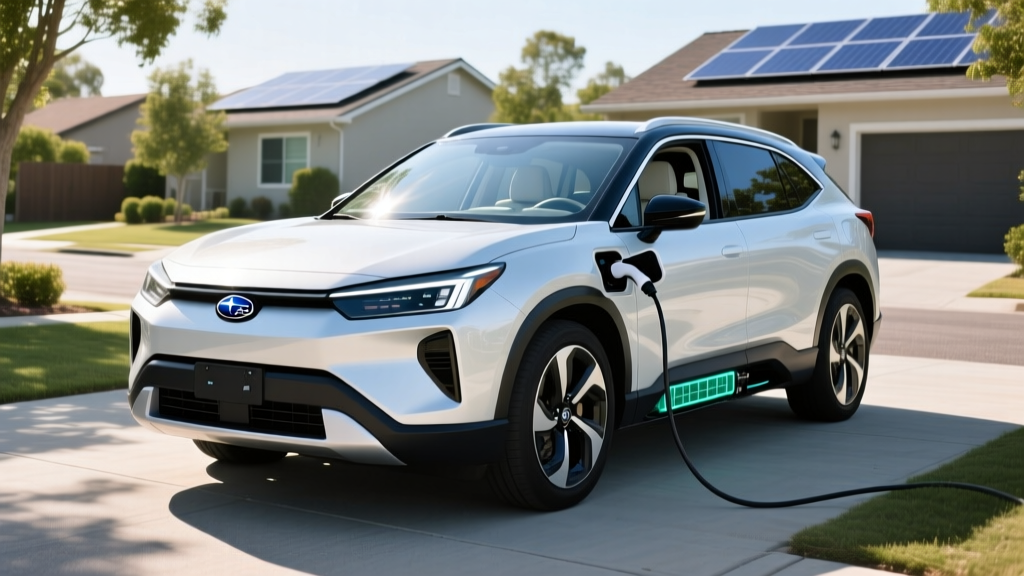
The 2026 Subaru Solterra is Subaru's only fully electric vehicle, co-developed with Toyota (which sells it as the bZ4X). It starts at $39,995 (Premium trim), delivers an EPA-estimated 227 miles of range on the FWD model, and packs a 71.4 kWh (usable) NMC lithium-ion battery. AWD trims drop range to roughly 222 miles but retain Subaru's hallmark symmetrical all-wheel drive. DC fast charging peaks near 100 kW, adding 10–80% in about 56 minutes — slower than rivals. Federal tax credit eligibility under IRS §30D depends on your income, the vehicle's MSRP cap compliance, and battery-sourcing requirements that shift yearly. It's a capable, safe, off-road-ready compact EV SUV — but buyers prioritizing range or charging speed should cross-shop the Hyundai Ioniq 5 and Tesla Model Y.
2026 Solterra Specs: The Numbers That Matter
| Spec | FWD (Premium) | AWD (Limited / Touring) |
|---|---|---|
| EPA Range | ~227 mi | ~222 mi |
| Battery (Usable) | 71.4 kWh, NMC chemistry | |
| Peak DC Fast Charge | ~100 kW (CCS1) | |
| 10–80% DC Charge Time | ~56 minutes | |
| Level 2 (240V) Rate | 6.6 kW onboard charger | |
| Level 2 Full Charge | ~11 hours (0–100%) | |
| Motor Output | 201 hp / 196 lb-ft | 215 hp / 248 lb-ft (dual motor) |
| 0–60 mph | ~7.1 sec | ~6.5 sec |
| MPGe (Combined) | ~114 MPGe | ~104 MPGe |
| Ground Clearance | 8.3 inches | |
| Cargo Volume (rear seats up) | 23.8 cu ft | |
| Towing Capacity | Not rated (no tow rating) | |
| Base MSRP (incl. dest.) | $39,995 | $43,995 (Limited) |
| Battery Warranty | 8 yr / 100,000 mi (≥70% capacity) | |
Sources: fueleconomy.gov, Subaru of America specifications.
Real-World Range: What to Actually Expect
EPA Sticker: 227 miles (FWD) / 222 miles (AWD)
Real-World Highway (65–75 mph, 70°F): Expect 185–200 miles usable before needing a buffer.
Cold Weather (below 32°F): Budget 150–175 miles; NMC chemistry loses 20–30% at freezing temps without aggressive preconditioning.
Mountain/Headwind: Sustained climbs can push consumption above 3.5 mi/kWh, dropping effective range further.
The Solterra's efficiency (~3.0–3.3 mi/kWh) trails segment leaders like the Ioniq 5 (~3.7 mi/kWh). Subaru prioritized AWD traction, ground clearance, and off-road capability (X-MODE with Grip Control) over aerodynamic efficiency. If your typical one-way commute is under 70 miles and you charge at home nightly, 227 EPA miles is plenty. If you regularly drive 250+ miles between charges on road trips, the limited range combined with a ~100 kW peak charge rate becomes a genuine friction point.
Charging: Home Setup, Public Networks, and the Curve Reality
The Solterra uses a CCS1 connector (not NACS). Subaru does not currently include a NACS adapter, so Tesla Supercharger access is limited unless you source a third-party CCS-to-NACS adapter (verify compatibility and safety ratings before purchasing).
| Level | Power (kW) | Miles Added per Hour | Typical Use |
|---|---|---|---|
| Level 1 (120V) | ~1.4 kW | ~4 mi/hr | Overnight trickle; emergency top-off |
| Level 2 (240V, 32A) | ~6.6 kW (onboard limit) | ~20 mi/hr | Home daily charging; full charge ~11 hrs |
| DC Fast (CCS1) | Peak ~100 kW | ~180 mi/hr at peak | Road trips; 10–80% in ~56 min |
The Charging Curve Reality
The Solterra's peak 100 kW rate only holds between roughly 10–40% State of Charge. Above 60%, the rate tapers to ~50 kW, and above 80% it drops below 20 kW to protect battery health. This is why the 10–80% time is 56 minutes — competitive chargers rated at 150–250 kW won't speed this up because the vehicle, not the station, limits the rate. Plan road-trip stops around 30–40 minute sessions rather than quick 15-minute dashes.
Home Charging Installation Costs
| Item | Typical Cost Range |
|---|---|
| Level 2 EVSE (ChargePoint, Emporia, Wallbox) | $350–$700 |
| Electrician labor (240V/40A circuit run) | $600–$2,500 |
| Permit / inspection | $50–$300 |
| Electrical panel upgrade (if needed, 100A→200A) | $1,500–$4,000 |
| Total (no panel upgrade) | $1,000–$3,500 |
Always hire a licensed electrician; get a load calculation before assuming your panel can handle a 40A continuous circuit. Consult IRS.gov for the Residential Clean Energy Credit (30% of equipment + install, up to $1,000 cap on hardware) which can offset home charger costs.
Solterra vs. Gas Outback: The Real Cost Comparison
Many Subaru shoppers cross-shop the Solterra against the gas-powered Outback. Here's a 5-year / 75,000-mile cost snapshot assuming $0.14/kWh home electricity, $3.50/gal regular, 25 MPG combined (Outback), and 3.1 mi/kWh (Solterra AWD).
| Category | 2026 Solterra AWD (Limited) | 2026 Outback Premium (AWD) |
|---|---|---|
| Base MSRP | $43,995 | $34,495 |
| Est. Federal Tax Credit (§30D)* | Up to $7,500 (see caveats) | $0 |
| Effective Purchase Price | ~$36,495 | $34,495 |
| Fuel / Energy (75k mi) | ~$3,380 (home charging) | ~$10,500 |
| Maintenance (5 yr) | ~$1,200 (no oil, fewer brakes w/ regen) | ~$3,800 |
| Insurance (est. avg) | ~$9,500 | ~$7,800 |
| 5-Year Total Cost (pre-depreciation) | ~$50,575 | ~$56,595 |
*§30D eligibility requires buyer income below $150K single / $300K joint, vehicle MSRP under $80K (SUVs), and battery critical-mineral + component sourcing thresholds that tighten yearly. Verify at IRS qualified vehicle list. Credit may transfer at point of sale.
The Solterra narrows the price gap via fuel and maintenance savings — roughly $9,700 saved on energy and maintenance over 5 years — but higher insurance premiums and uncertain resale value offset part of that advantage. If you lack home charging and rely on public DC stations at $0.35–$0.50/kWh, your energy cost nearly triples and the gas Outback wins on operating cost.
Common Misconceptions: Myth vs. Fact
| Myth | Fact |
|---|---|
| "The Solterra can use Tesla Superchargers natively." | It uses CCS1. Without a verified adapter, Supercharger access is unavailable. Confirm Subaru's official adapter status before purchase. |
| "100 kW charging is slow because the stations can't deliver more." | The vehicle's onboard charge curve caps at ~100 kW regardless of station capacity. A 350 kW Electrify America stall won't charge it faster than a 150 kW unit. |
| "EV batteries need replacing every few years." | Subaru warrants the pack for 8 yr / 100,000 mi at ≥70% capacity. NMC packs typically degrade 10–15% over 150,000 miles with normal use. |
| "AWD EVs don't work in snow." | The Solterra's dual-motor AWD with X-MODE delivers torque-vectoring traction that outperforms many gas AWD systems. Ground clearance (8.3 in) matches the Outback. |
| "Everyone gets the $7,500 tax credit." | Credit depends on income caps, MSRP caps, and battery sourcing rules. Many buyers qualify; some don't. Always check IRS.gov before assuming. |
Ownership Realities: Climate, Commute, and Charging Access
The Solterra makes sense for a specific buyer profile. Be honest about yours:
- Home charging access: If you can install a Level 2 charger in a garage or driveway, daily ownership is effortless — plug in at night, wake up to 200+ miles. If you live in an apartment or rely solely on public charging, the 56-minute 10–80% time and 227-mile range become weekly inconveniences.
- Climate: In mild climates (California, Southeast), you'll see close to EPA range. In Minnesota, Maine, or mountain regions, budget 25–30% winter range loss. The Solterra's heat pump (standard) mitigates this better than resistive heating, but physics is physics.
- Driving pattern: Commutes under 80 miles round-trip with weekend errands? Ideal. Frequent 300+ mile road trips? The Solterra's charging speed will frustrate — you'll stop more often and wait longer than Ioniq 5 or Model Y drivers.
- Off-pavement use: The Solterra's 8.3-inch ground clearance, X-MODE, and underbody cladding make it the most trail-capable compact EV SUV. If you take forest service roads to trailheads, this is a genuine differentiator.
Decision Framework: Should You Buy the 2026 Solterra?
Choose the Subaru Solterra if:
- You have home Level 2 charging and a commute under 80 miles.
- You want AWD with real off-road capability in an EV.
- You value Subaru's safety reputation (EyeSight driver assist, IIHS Top Safety Pick history on the platform).
- You qualify for the §30D credit, bringing effective price near $36K–$38K.
- You don't road-trip more than 3–4 times a year.
Look elsewhere if:
- Range is your top priority — the Ioniq 5 (305+ mi) and Model Y (310+ mi) significantly outperform.
- You need fast DC charging for frequent highway travel — the Solterra's ~100 kW peak is below segment average.
- You rely on Tesla Superchargers and don't want adapter uncertainty.
- You need a tow rating — the Solterra is not rated for towing.
- You want three rows — look at the Kia EV9 or Hyundai Ioniq 9.
Frequently Asked Questions
Is the Subaru Solterra the same as the Toyota bZ4X?
Mechanically, yes — both ride on the e-TNGA platform with the same 71.4 kWh battery, motor options, and charge rates. Subaru tunes the AWD system, suspension, and X-MODE software differently for off-road bias. Interior materials and styling also differ. Pricing is similar, though trim structures vary.
What's the real cost to charge a Solterra at home?
A full 71.4 kWh charge at $0.14/kWh costs roughly $10.00, yielding ~220 real-world miles. That's about $0.045 per mile — compared to ~$0.14/mile in a 25-MPG gas SUV at $3.50/gallon. Over 15,000 miles/year, home charging saves roughly $1,400 annually versus gasoline.
Does the Solterra qualify for the federal tax credit in 2026?
It may, but eligibility is not automatic. Under IRS §30D, you must meet income caps ($150K single / $300K joint), the vehicle must be under the $80,000 SUV MSRP cap, and the battery must meet critical-mineral and component-sourcing thresholds that have tightened since 2023. Subaru has worked to secure compliant supply chains, but the IRS qualified-vehicle list updates regularly. Verify current status at irs.gov before purchase, and ask the dealer about point-of-sale transfer.
How does the Solterra handle in winter?
Very well, mechanically — dual-motor AWD, X-MODE, and 8.3 inches of ground clearance give it legitimate snow and light-trail capability comparable to an Outback. The trade-off is range: expect 25–30% loss in sustained sub-freezing temperatures. Preconditioning the battery while plugged in (via the Subaru app) preserves range by warming the pack before departure.
Is the Solterra's EyeSight system self-driving?
No. EyeSight with driver-assist features is an SAE Level 2 system — it provides adaptive cruise control, lane centering, and emergency braking, but the driver must remain fully engaged with hands on the wheel and eyes on the road at all times. It does not navigate autonomously or handle complex urban scenarios without supervision.
What happens if the battery degrades out of warranty?
Out-of-warranty NMC battery replacement currently runs $12,000–$18,000 depending on labor and pack availability. However, real-world data from similar NMC packs shows 85–90% capacity retention at 150,000 miles with normal charging habits (avoiding frequent 100% charges and DC fast-charging in extreme heat). Most owners will never need a replacement.