Quick Verdict: Where the 2026 Subaru Solterra Fits
The Subaru Solterra remains the only all-electric SUV wearing a rally-bred badge, and for 2026 it arrives with faster DC charging and slightly improved range over the launch-year model. If you need standard all-wheel drive, genuine off-road credibility, and a starting price that undercuts most dual-motor rivals, the Solterra makes a compelling case. Its Achilles' heel continues to be efficiency and highway range — physics that no amount of X-MODE tuning can fully overcome.
Below is a complete breakdown of the 2026 Subaru Solterra MSRP by trim, real-world range expectations, charging performance, and federal tax-credit eligibility so you can decide whether this electric Subaru belongs on your shortlist.
2026 Subaru Solterra MSRP by Trim
| Trim | MSRP (incl. $1,395 dest.) | Drivetrain | EPA Range |
|---|---|---|---|
| Premium | $39,940 | Dual-Motor AWD | 227 mi |
| Limited | $43,440 | Dual-Motor AWD | 227 mi |
| Touring | $47,040 | Dual-Motor AWD | 222 mi |
The Premium trim anchors the lineup just under the psychologically important $40,000 mark — significant because it keeps the Solterra below the IRS §30D MSRP cap for SUVs ($80,000). The Touring trim adds 20-inch alloy wheels, a panoramic sunroof, and ventilated front seats, but those larger wheels reduce EPA range by roughly five miles compared to the 18-inch wheels on Premium and Limited trims.
| Trim | MSRP | Max §30D Credit | Effective Price* |
|---|---|---|---|
| Premium | $39,940 | $7,500 | $32,440 |
| Limited | $43,440 | $7,500 | $35,940 |
| Touring | $47,040 | $7,500 | $39,540 |
*Effective price assumes full $7,500 §30D credit eligibility. Actual credit depends on battery-sourcing, critical-mineral requirements, buyer income caps (≤$300k joint / ≤$150k single), and tax liability. The credit can now be transferred at the point of sale as a down-payment reduction. Verify current-year rules at IRS.gov §30D.
Range, Battery, and Efficiency
Real-World Expectation: ~190–210 mi mixed highway; ~150–170 mi sustained 75 mph in freezing temps
The Solterra shares the Toyota/Co-developed e-TNGA platform and a 72.8 kWh usable lithium-ion battery pack (NMC chemistry — nickel-manganese-cobalt). That capacity is competitive with rivals like the Hyundai Ioniq 5 (77.4 kWh), but the Solterra's boxy shape, standard dual-motor AWD, and 4,365-lb curb weight work against efficiency.
The EPA rates the Solterra at 111 MPGe combined (Premium/Limited) and 107 MPGe for the Touring. In kWh/100 mi, that translates to roughly 30 kWh/100 mi — noticeably thirstier than the Ioniq 5 AWD at 28 kWh/100 mi or the Tesla Model Y Long Range at 26 kWh/100 mi.
Cold-weather reality check: Like all NMC packs, expect 20–30% range reduction in sustained sub-freezing driving. The Solterra's heat pump (standard on all trims) mitigates cabin-heating losses, but battery resistance still limits both range and charging speed until the pack warms. On a 20°F winter highway run at 75 mph, plan for roughly 150–170 miles of usable range before needing a charge stop.
Charging Speed: DC Fast and Home Level 2
| Charging Level | Max Rate | Time / Miles Added |
|---|---|---|
| Level 1 (120V / 12A) | ~1.4 kW | ~4 mi/hr |
| Level 2 (240V / 32A) | 7.6 kW | ~23 mi/hr · ~9.5 hr (10–100%) |
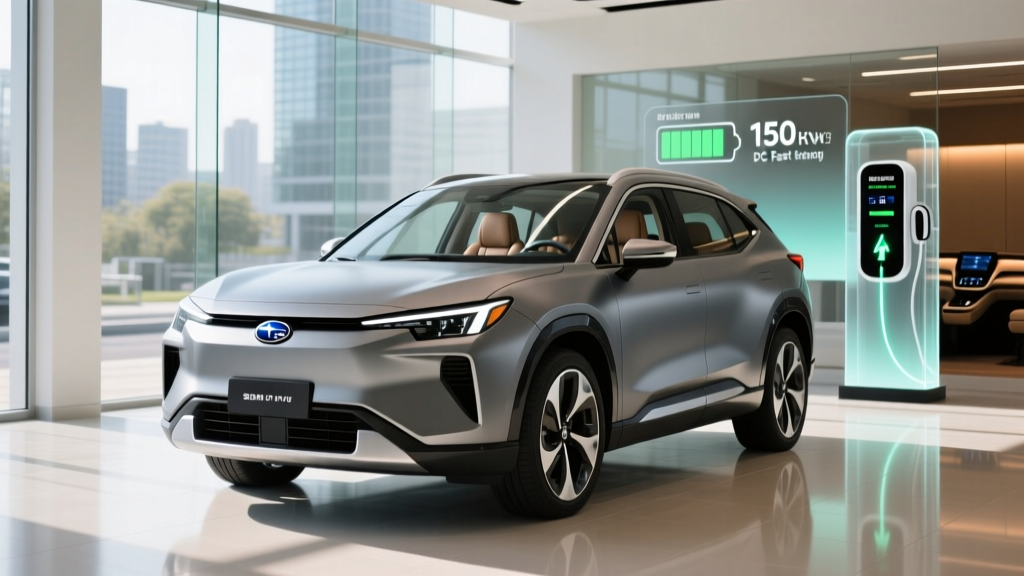
| DC Fast Charge (CCS) | 150 kW peak | 10–80% in ~35 min |
For 2026, Subaru improved the Solterra's DC charging curve — earlier model years were limited to roughly 100 kW, making road trips tedious. The current 150 kW peak is a welcome bump, but it still trails the Ioniq 5's 800-volt architecture (240 kW peak, 10–80% in ~18 minutes).
Charge-curve reality: The Solterra holds close to peak rate between 10–50% SoC, then tapers progressively. Expect roughly 35 minutes from 10–80% at a 150+ kW CCS station. Above 80%, the rate drops sharply to protect battery health — a 10–90% session will take closer to 55 minutes. Plan road-trip stops accordingly: staying below 80% is faster than topping off.
At home on a Level 2 (240V) circuit, the onboard 7.6 kW charger adds about 23 miles per hour of charging. A full overnight session (8–10 hours) easily replenishes a depleted pack. Most owners charging nightly from 30–80% will need only 3–4 hours on a home Level 2 unit. Installation costs for a 240V/40A circuit typically run $800–$2,000 depending on panel proximity and local permitting — budget for a licensed electrician to assess your panel capacity.
Performance and Drivetrain
| Spec | Value |
|---|---|
| Drivetrain | Dual-Motor AWD (standard all trims) |
| Horsepower | 215 hp combined |
| Torque | 248 lb-ft |
| 0–60 mph | 6.5 seconds |
| Top Speed | 106 mph (electronically limited) |
| Towing Capacity | 2,000 lbs (braked) |
The dual-motor AWD setup is standard across every Solterra trim — there is no single-motor, RWD option. This is a distinctly Subaru decision: AWD is the brand's signature, and the Solterra delivers it without an upcharge.
The 215 hp output is adequate rather than thrilling. The 6.5-second 0–60 time puts it behind the Ioniq 5 AWD (5.1 sec) and the Tesla Model Y Long Range (4.8 sec), but on par with the Toyota bZ4X (its platform twin). Where the Solterra distinguishes itself is off-pavement: X-MODE with Grip Control provides genuine low-speed traction management for snow, mud, and gravel. It's the most capable electric SUV this side of a Rivian for light trail use.
Interior, Cargo, and Technology
The cabin seats five with generous rear legroom (35.7 inches) — competitive with the compact EV SUV segment. Cargo volume measures 23.8 cu ft behind the second row and approximately 56.9 cu ft with the rear seats folded. Notably, the Solterra does not have a front trunk (frunk); the space under the hood houses power electronics.
Infotainment: The Limited and Touring trims feature a 12.3-inch touchscreen with wireless Apple CarPlay and Android Auto. The Premium trim uses a smaller 8.0-inch display. Physical climate knobs persist below the screen — a welcome ergonomic choice that many EV competitors have abandoned.
Driver Assistance (SAE Level 2): Subaru's EyeSight suite is standard and includes adaptive cruise control, lane-centering assist, pre-collision braking, and blind-spot monitoring. Touring trims add a 360-degree camera and reverse automatic braking. This is a Level 2 driver-assist system — the driver must remain attentive with hands on the wheel at all times. It is not autonomous or "self-driving."
Battery Warranty and Longevity
Subaru covers the high-voltage battery pack for 8 years / 100,000 miles (whichever comes first) against defects and capacity loss below 70% of original capacity. The powertrain warranty matches at 8 years / 100,000 miles. The limited vehicle warranty is 3 years / 36,000 miles.
NMC chemistry in the Solterra's pack is proven across the industry, and Subaru's thermal management system (liquid-cooled and heated) should keep degradation moderate. Expect roughly 8–12% capacity loss over the first 100,000 miles based on industry averages for similar packs. Subaru also includes 2 years of complimentary DC fast charging (up to 1,000 kWh) through the Electrify America network.
Pros and Cons
Pros
- Standard dual-motor AWD on every trim — no upcharge
- Genuine off-road capability via X-MODE / Grip Control
- Strong ground clearance (8.3 inches)
- Physical climate controls and intuitive switchgear
- Below $40k starting MSRP for a dual-motor EV SUV
- Complimentary Electrify America charging (2 years)
Cons
- Below-average efficiency (~30 kWh/100 mi)
- 227-mile max EPA range trails most rivals
- DC fast-charging still slower than 800V competitors
- No front trunk (frunk)
- Rear visibility compromised by thick C-pillars
- 2,000-lb tow rating limits utility for boat/trailer owners
Who Should Buy the Subaru Solterra?
Choose the Solterra if: You live in a snow-belt or mountain state where AWD is non-negotiable, you value off-pavement capability, your daily commute is under 150 miles round-trip, and you want a sub-$40k AWD EV SUV from a brand known for long-term durability.
Look elsewhere if: You regularly drive 300+ mile highway trips (the Ioniq 5 or Model Y charge faster and go farther), you need maximum cargo space or a frunk, you tow more than 2,000 lbs, or you prioritize acceleration and sporty handling over all-weather confidence.
Frequently Asked Questions
What is the real-world range of the Subaru Solterra?
The EPA rates the Solterra at 227 miles (18-inch wheels) or 222 miles (20-inch wheels). In real-world mixed driving at highway speeds, expect 190–210 miles. In freezing weather at sustained highway speed, plan for 150–170 miles. Preconditioning the battery before fast-charging stops helps recover some of this loss.
Does the Subaru Solterra qualify for the $7,500 federal EV tax credit?
The Solterra is eligible for up to $7,500 under IRS §30D, provided the buyer meets income caps (≤$300,000 joint / ≤$150,000 single) and the vehicle's battery meets critical-mineral and component-sourcing requirements, which are subject to annual updates. The credit can be applied at the point of sale as a down-payment reduction. Always confirm current-year eligibility at fueleconomy.gov and consult a tax professional.
How fast does the Solterra charge at home and on the road?
On a home Level 2 (240V / 32A) charger, the Solterra charges at 7.6 kW, adding roughly 23 miles per hour — a full overnight charge takes about 9.5 hours. At a DC fast charger, it peaks at 150 kW and charges from 10–80% in approximately 35 minutes. Expect longer sessions in cold weather due to reduced charge acceptance.
Is the Subaru Solterra worth buying over the Hyundai Ioniq 5 or Tesla Model Y?
It depends on priorities. The Solterra wins on standard AWD pricing, off-road capability, and ground clearance. The Ioniq 5 wins on charging speed (18 min 10–80%), efficiency, and interior space. The Model Y wins on range (320+ mi), Supercharger network access, and acceleration. If snow, trails, and Subaru loyalty matter most, the Solterra is the right pick. If road-trip efficiency is paramount, the Ioniq 5 or Model Y serve better.
What battery chemistry does the Solterra use?
The Solterra uses NMC (nickel-manganese-cobalt) lithium-ion cells in a 72.8 kWh usable pack with liquid thermal management. NMC offers strong energy density but is more sensitive to extreme cold than LFP (lithium iron phosphate) chemistry. Subaru covers the pack for 8 years / 100,000 miles with a 70% capacity retention guarantee.
Can I use a Tesla Supercharger with the Solterra?
The Solterra uses a CCS1 connector natively. As of 2026, Subaru has not announced a factory NACS (Tesla-style) port for the Solterra. You can access Tesla Superchargers equipped with a Magic Dock (CCS adapter) where available, or use a third-party NACS-to-CCS adapter for V3 Superchargers — though charge speed may be limited. The broader CCS public network (Electrify America, EVgo, ChargePoint) remains the Solterra's primary fast-charging ecosystem.