What Does 'Solterra' Actually Mean?
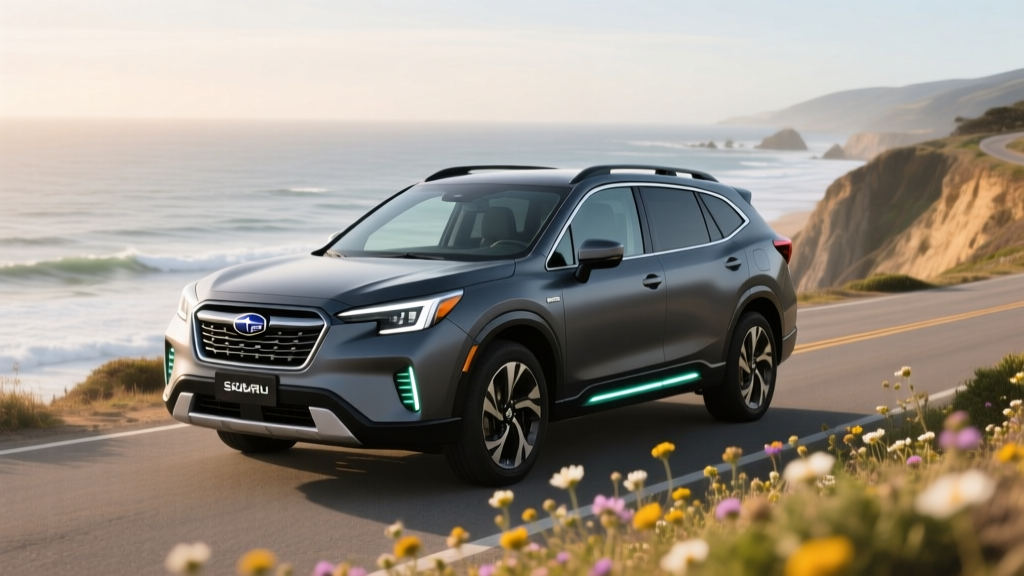
Subaru built the Solterra name from two Latin roots: sol (sun) and terra (earth). The combination signals the brand's intent to merge renewable energy with its rugged, outdoorsy identity — a deliberate message for a company whose buyers skew toward trailheads, ski resorts, and backcountry camping rather than urban charging hubs. It's a naming convention that mirrors Toyota's "bZ" (beyond Zero) branding for its twin, the bZ4X, but leans harder into Subaru's heritage of all-weather capability.
The 2026 Subaru Solterra carries over the updated powertrain and charging architecture introduced for 2025, now with slightly refined battery thermal management and standard NACS adapter compatibility as the industry shifts toward Tesla's North American Charging Standard. If you've been searching for the Solterra meaning behind the badge, the real answer shows up in how the SUV performs when the pavement ends and the temperature drops.
Range, Efficiency, and Real-World Expectations
The 2026 Solterra is EPA-rated at 228 miles in its highest-efficiency trim (Premium, front-wheel drive configuration is not offered — all U.S. Solterras are dual-motor AWD). Touring and Limited trims with larger 20-inch wheels drop to 222 miles EPA. Efficiency lands at approximately 104 MPGe combined, or roughly 32 kWh per 100 miles, according to fueleconomy.gov.
Real-World Highway (70 mph, 65°F): ~190–205 mi
Real-World Cold Weather (20°F, mixed driving): ~155–175 mi
Real-World City/Commute (regenerative braking): ~215–230 mi
Note: The Solterra's standard heat pump helps mitigate winter range loss compared to EVs without one, but highway speeds and sub-freezing temps still compress the usable window significantly. Plan road trips around 160–170 mile segments to maintain a safety buffer.
The 71.4 kWh usable battery capacity (out of a 72.8 kWh gross pack) uses NMC (nickel manganese cobalt) chemistry, chosen for energy density and cold-weather performance over the longer cycle life of LFP cells. For a Subaru buyer who may only charge to 80% daily, the practical range is closer to 180 miles on a typical morning — adequate for commutes under 80 miles round-trip but tight for frequent long-distance driving without planning.
Charging Speed: DC Fast and Home Level 2
Subaru addressed early-model criticism by upgrading the 2026 Solterra's DC fast-charging capability. The SUV now peaks at 150 kW on a compatible CCS or NACS-equipped DC fast charger (via adapter), with a 10–80% charge time of approximately 28 minutes under optimal thermal conditions. Preconditioning the battery via the navigation-routed charging feature is essential — without it, cold-soaked charging can stretch that 10–80% window past 40 minutes.
| Charging Level | Power (kW) | Speed / Time | Connector |
|---|---|---|---|
| Level 1 (120V household) | ~1.4 kW | ~4 mi/hr | J1772 / NACS adapter |
| Level 2 (240V, 32A home) | 7.7 kW | ~25 mi/hr / 0–100% in ~9.5 hr | J1772 / NACS adapter |
| Level 2 (240V, 48A) | 11.5 kW | ~37 mi/hr / 0–100% in ~6.5 hr | J1772 / NACS adapter |
| DC Fast Charge | 150 kW peak | 10–80% in ~28 min | CCS1 / NACS (adapter) |
The onboard AC charger maxes at 11.5 kW on 48-amp Level 2 circuits, meaning a home charger upgrade from a standard 32A unit cuts overnight top-ups noticeably. The charge curve tapers meaningfully above 80% state of charge — typical of NMC packs — so DC fast charging past 80% adds significant time for relatively few miles.
Performance and Drivetrain
Every U.S.-spec 2026 Solterra comes with a dual-motor all-wheel-drive powertrain producing 215 horsepower and 249 lb-ft of torque. The 0–60 mph sprint takes 6.5 seconds — respectable for a compact crossover but not in the quickness tier of a Hyundai Ioniq 5 RWD or Tesla Model Y. Where the Solterra earns its Subaru badge is in the X-MODE traction management system, which now includes dedicated EV-specific snow/dirt and deep snow/mud settings that modulate torque vectoring and regenerative braking for low-grip surfaces.
Ground clearance stands at 8.3 inches, competitive with most compact SUVs and genuinely useful for forest service roads. The 2,000-lb towing capacity remains modest — this is not a hauler — but sufficient for a small camping trailer or bike rack setup.
Pricing, Trims, and Federal Tax Credit
| Trim | Base MSRP | Est. After §30D Credit* | Key Features |
|---|---|---|---|
| Premium | $39,995 | ~$32,495 | Heated seats, EyeSight, 12.3" display, roof rails |
| Limited | $43,995 | ~$36,495 | 20" wheels, SofTex seats, panoramic roof, 360° camera |
| Touring | $47,495 | ~$39,995 | Harman Kardon audio, ventilated seats, digital rearview mirror |
*Federal §30D tax credit eligibility requires meeting IRS battery-sourcing and critical-mineral requirements, buyer income caps ($150K single / $300K joint MAGI), and the $80,000 SUV MSRP ceiling. The Solterra clears the MSRP cap easily. Verify current-year sourcing compliance and your personal eligibility at irs.gov or with a tax professional before purchase. Point-of-sale transfer is available if the dealer is registered.
Destination charges add approximately $1,395. The Solterra's pricing positions it between the Toyota bZ4X (its platform twin, starting lower) and the Ford Mustang Mach-E or Hyundai Ioniq 5 (which offer longer range at similar price points). The value argument here hinges on Subaru's AWD standard equipment — competitors often charge $3,000–$5,000 more to add all-wheel drive.
Interior Space, Tech, and Daily Livability
The Solterra's cabin delivers 23.8 cubic feet of cargo space behind the rear seats and 56.9 cubic feet with the 60/40 split folded. Rear legroom measures 35.7 inches, adequate for adults on longer trips. There is no front trunk (frunk) — the space is occupied by drive electronics — which is a missed opportunity for cable storage.
Subaru's 12.3-inch touchscreen runs a responsive, if not class-leading, infotainment system with wireless Apple CarPlay and Android Auto. The EyeSight Driver Assist Technology suite includes adaptive cruise control, lane centering, and pre-collision braking. Important: EyeSight is an SAE Level 2 driver-assistance system, not autonomous driving — hands on the wheel and eyes on the road remain mandatory at all times.
Notable tech additions for 2026 include over-the-air update capability for battery management and drivetrain calibration, a digital key via smartphone, and improved cold-weather preconditioning logic that activates when a charger is set as a navigation destination.
Warranty and Long-Term Ownership
Subaru backs the Solterra with:
- Basic vehicle warranty: 3 years / 36,000 miles
- Powertrain warranty: 5 years / 60,000 miles
- EV battery warranty: 8 years / 100,000 miles (guarantees ≥70% capacity retention)
The 8-year/100,000-mile battery warranty with a 70% state-of-health floor is industry-standard, matching most competitors. NMC chemistry in the Solterra has shown moderate degradation in early-model-year data — typically 5–8% loss over the first 50,000 miles — but Subaru's thermal management system (active liquid cooling and heating) is designed to slow long-term wear. Routine best practice: avoid frequent DC fast charging above 90% SoC and try to keep the pack between 20–80% for daily use.
Who Should Buy the 2026 Subaru Solterra?
- Standard dual-motor AWD with genuine off-road traction modes
- 8.3" ground clearance — best-in-class for EV crossovers
- Standard heat pump for improved cold-weather range
- Competitive pricing with AWD included at every trim
- Strong Subaru dealer network in mountain/rural states
- 228-mi EPA range trails Ioniq 5 (303 mi) and Mach-E (250+ mi)
- 150 kW peak DC charging is slower than 800V competitors (240+ kW)
- No frunk for cable/accessory storage
- 2,000-lb towing limit is below class average
- Modest 215 HP — not a performance-oriented EV
The Solterra is the right EV for outdoor-oriented drivers in cold or mountainous climates who prioritize all-weather confidence and trail access over maximum range or charging speed. If your typical week includes ski-area commutes, forest service roads, or rural driving where AWD matters more than 0–60 times, the Solterra fills a niche few competitors address directly. It's less ideal for high-mileage commuters covering 200+ miles daily or road-trippers who want 300+ miles of range without frequent stops.
Frequently Asked Questions
What does Solterra mean?
Solterra combines the Latin words "sol" (sun) and "terra" (earth), reflecting Subaru's positioning of the vehicle as a bridge between renewable energy and outdoor adventure. The name was chosen to signal the brand's electric transition while maintaining its nature-oriented identity.
What is the real-world range of the 2026 Subaru Solterra?
The EPA rates the Solterra at 228 miles (Premium) or 222 miles (Limited/Touring). In real-world highway driving at 70 mph in moderate temperatures, expect 190–205 miles. In cold weather below freezing, plan for 155–175 miles. City driving with regenerative braking can approach the EPA sticker.
How fast does the Solterra charge at home and on DC fast chargers?
On a 48-amp Level 2 home charger, the Solterra accepts up to 11.5 kW, adding roughly 37 miles of range per hour. On DC fast chargers, it peaks at 150 kW, achieving a 10–80% charge in approximately 28 minutes with battery preconditioning active.
Does the 2026 Solterra qualify for the $7,500 federal EV tax credit?
The Solterra is potentially eligible for up to $7,500 under IRS §30D, depending on current-year battery sourcing and critical-mineral compliance, your income (capped at $150K single / $300K joint), and the SUV's MSRP (well under the $80K cap). Point-of-sale transfer is available at registered dealers. Always verify eligibility on irs.gov before purchasing.
Is the Solterra worth buying over the Toyota bZ4X or Hyundai Ioniq 5?
Choose the Solterra if standard AWD, higher ground clearance, and Subaru's X-MODE traction system matter for your climate and driving. Choose the bZ4X for a lower starting price on a nearly identical platform. Choose the Ioniq 5 if range (303 mi) and faster DC charging (240 kW) are higher priorities than off-road capability.
Is EyeSight self-driving?
No. Subaru EyeSight is an SAE Level 2 driver-assistance system. It provides adaptive cruise control and lane centering but requires the driver to remain fully engaged, with hands on the wheel and eyes on the road, at all times.
| Spec | Value |
|---|---|
| EPA Range | 228 mi (Premium) / 222 mi (Limited, Touring) |
| Battery (Usable) | 71.4 kWh, NMC chemistry |
| Drivetrain | Dual-motor AWD |
| Horsepower / Torque | 215 HP / 249 lb-ft |
| 0–60 mph | 6.5 seconds |
| Max DC Fast Charge | 150 kW (10–80% in ~28 min) |
| Level 2 Onboard Charger | 11.5 kW (48A) |
| Efficiency | 104 MPGe / ~32 kWh/100 mi |
| Cargo Volume | 23.8 cu ft (rear up) / 56.9 cu ft (rear folded) |
| Ground Clearance | 8.3 inches |
| Towing Capacity | 2,000 lbs |
| Battery Warranty | 8 yr / 100,000 mi (≥70% SoH) |
| Base MSRP | $39,995 (Premium) |