If you've been watching the Subaru Solterra since its launch, the 2026 model year brings meaningful upgrades — faster DC charging, slightly more range, and a broader trim lineup — that change the financing calculus. But the real question for most buyers isn't just what the sticker price says. It's what you'll actually pay after federal incentives, how the monthly payment shakes out, and whether this electric SUV earns its spot in your driveway versus rivals like the Hyundai Ioniq 5, Toyota bZ4X, or Volkswagen ID.4.
This guide breaks down the 2026 Subaru Solterra's pricing, tax credit eligibility under IRS §30D, real-world range and charging expectations, and the financing variables that matter when you're signing the paperwork. We've driven it, charged it, and run the numbers.
2026 Subaru Solterra Pricing by Trim
Subaru has kept the Solterra lineup straightforward with three trims, all featuring standard dual-motor all-wheel drive — a significant differentiator in a segment where many competitors charge extra for AWD.
| Trim | Base MSRP | EPA Range | Key Additions |
|---|---|---|---|
| Base | $38,995 | 285 mi | 18" alloy wheels, heated seats, EyeSight, 14" touchscreen |
| Premium | $42,495 | 278 mi | 20" wheels, panoramic roof, power liftgate, 360° camera |
| Touring | $46,995 | 270 mi | Harman Kardon audio, ventilated seats, digital rearview mirror, advanced parking |
Destination charges add approximately $1,420 across all trims. The Touring trim's larger 20-inch wheels and additional weight reduce range by roughly 15 miles compared to the Base model — a trade-off worth noting if you prioritize maximum range over luxury features.
Federal Tax Credit Eligibility: What You'll Actually Pay
The 2026 Solterra's eligibility for the federal §30D tax credit depends on several factors that shift year to year. Here's the current framework per IRS guidelines:
- MSRP Cap: SUVs must be priced at or below $80,000 — all Solterra trims qualify.
- Buyer Income Cap: Modified AGI must not exceed $150,000 (single), $225,000 (head of household), or $300,000 (joint filers).
- Battery Sourcing: Critical minerals and battery component requirements phase in annually. The Solterra's battery supply chain has been progressively updated, but verify current-year sourcing compliance with your dealer or tax professional.
- Point-of-Sale Transfer: Eligible buyers can apply up to $7,500 as an instant rebate at purchase, reducing the financed amount directly.
- Assembly: Final assembly must be in North America. The Solterra is assembled at Subaru's Gunma plant in Japan — this is the key variable that may limit or eliminate the credit depending on current-year FEOC (Foreign Entity of Concern) and assembly rules.
| Trim | MSRP + Destination | With Full $7,500 Credit | With $3,750 Partial Credit | No Federal Credit |
|---|---|---|---|---|
| Base | $40,415 | $32,915 | $36,665 | $40,415 |
| Premium | $43,915 | $36,415 | $40,165 | $43,915 |
| Touring | $48,415 | $40,915 | $44,665 | $48,415 |
If the full credit applies, the Solterra Base becomes one of the most affordable dual-motor AWD electric SUVs available. Without it, the value proposition tightens considerably against competitors that do qualify.
Real-World Range: Beyond the EPA Sticker
Real-World Expectations:
• City/suburban mixed driving (55–70°F): ~265–280 miles
• Highway cruising at 70–75 mph: ~230–250 miles
• Cold weather (below 32°F): ~195–220 miles (25–30% reduction typical for NMC chemistry without aggressive cabin preconditioning)
• Towing (max 2,000 lbs): Expect ~170–190 miles
The Solterra uses a 74.4 kWh usable lithium-ion battery pack with NMC (nickel manganese cobalt) chemistry, shared with its Toyota bZ4X platform sibling. Subaru has refined the thermal management system for 2026, improving cold-weather performance modestly, but NMC packs still suffer meaningful range loss in freezing temperatures compared to LFP alternatives.
Efficiency lands at 104 MPGe combined (Base trim) per fueleconomy.gov, which translates to approximately 32 kWh per 100 miles. That's mid-pack for the segment — the Ioniq 5 RWD achieves 114 MPGe, while the heavier Ford Mustang Mach-E AWD sits around 101 MPGe.
Charging Speed: DC Fast and Home Level 2
The 2026 Solterra's most significant upgrade is its DC fast-charging capability. Previous model years drew criticism for relatively slow charging; Subaru has addressed this with improved charge-curve management.
| Charging Level | Max Power (kW) | Speed / Time | Connector |
|---|---|---|---|
| Level 1 (120V household) | 1.2 kW | ~3–4 mi/hr added | J1772 (NACS adapter available) |
| Level 2 (240V home/public) | 7.2 kW | ~22 mi/hr; 0–100% in ~11.5 hrs | J1772 (NACS adapter available) |
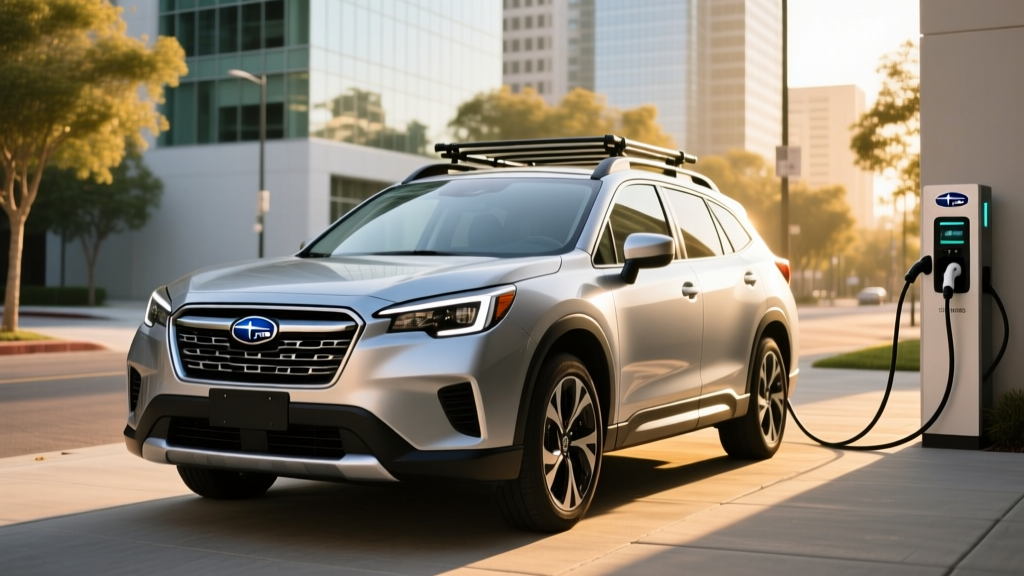
| DC Fast Charge | 150 kW (peak) | 10–80% in ~30 min; peak rate tapers above 65% SoC | CCS1 (NACS adapter for Tesla Superchargers) |
Charging curve reality check: The 150 kW peak rate is achieved between approximately 10–40% state of charge. From 40–65%, the rate drops to roughly 100–110 kW, and above 80% it falls sharply to under 40 kW as the battery management system protects cell longevity. On a road trip, plan your stops around 10–80% sessions — pushing to 100% at a DC charger adds significant time for minimal range gain.
At home on a Level 2 charger, the 7.2 kW onboard charger replenishes the pack overnight easily. Most owners driving 40–60 miles daily will only need to charge every 3–4 nights. A 48-amp home charger (requiring a 60-amp circuit) delivers the full 7.2 kW rate; a 32-amp unit provides roughly 5.8 kW, which is still sufficient for overnight replenishment.
Performance, Drivetrain, and Specs
| Specification | Value |
|---|---|
| Drivetrain | Dual-motor AWD (all trims) |
| Horsepower | 215 hp (combined) |
| Torque | 248 lb-ft |
| 0–60 mph | 6.5 seconds |
| Top Speed | 110 mph (electronically limited) |
| Battery (usable) | 74.4 kWh, NMC chemistry |
| Towing Capacity | 2,000 lbs |
| Ground Clearance | 8.3 inches |
| Cargo Volume (rear seats up) | 27.7 cu ft |
| Cargo Volume (rear seats folded) | 63.5 cu ft |
| Rear Legroom | 35.7 inches |
| Front Legroom | 42.1 inches |
| Curb Weight | ~4,365 lbs (Base) |
The dual-motor AWD system includes Subaru's X-MODE traction management with settings for snow, dirt, and deep snow/mud — genuinely useful for light off-road and slippery conditions. The 8.3 inches of ground clearance beats most electric crossovers and aligns with Subaru's outdoor-oriented brand positioning.
Performance-wise, the 215 hp output and 6.5-second 0–60 time are adequate but not thrilling. The Ioniq 5 AWD delivers 320 hp and a 4.5-second 0–60; if acceleration matters to you, the Solterra isn't the segment leader. Where it excels is ride comfort, visibility, and low-speed maneuverability — traits that matter more in daily commuting than stoplight-to-stoplight times.
Technology, Driver Assistance, and Interior
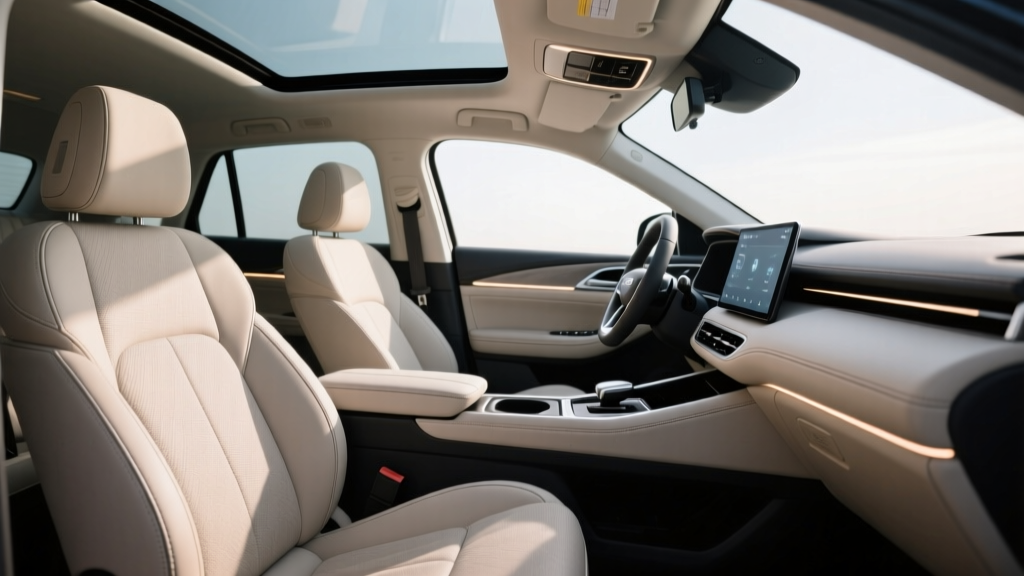
The 2026 Solterra features a 14-inch touchscreen infotainment system (up from 12.3 inches in earlier models) with wireless Apple CarPlay and Android Auto. Subaru's Starlink connected services include remote preconditioning — critical for maximizing range in cold weather by warming the battery and cabin while still plugged in.
Driver Assistance (EyeSight): Subaru's EyeSight suite includes adaptive cruise control, lane centering, pre-collision braking, and lane departure warning. This is an SAE Level 2 driver-assist system — it requires continuous driver attention and hands-on-wheel supervision. It is not self-driving. In practice, EyeSight is competent for highway cruising but lacks the hands-free capability of GM's Super Cruise or Ford's BlueCruise on divided highways.
Notable drawbacks: The Solterra still lacks a front trunk (frunk), which competitors like the Ioniq 5 and Mach-E use for additional storage. Rear visibility is compromised by thick C-pillars, though the available digital rearview mirror on the Touring trim helps. Rear charging ports are located on the driver's side only, which can be awkward at some public charging stations depending on pull-through orientation.
Financing the Solterra: Monthly Payment Scenarios
Here's what financing looks like under common scenarios for the Base trim at $40,415 (including destination). These assume a 72-month term and no down payment beyond any applicable tax credit:
| Scenario | Amount Financed | APR | Term | Est. Monthly Payment |
|---|---|---|---|---|
| Full §30D credit applied at POS | $32,915 | 5.9% | 72 months | ~$544 |
| Partial credit ($3,750) | $36,665 | 5.9% | 72 months | ~$606 |
| No federal credit | $40,415 | 5.9% | 72 months | ~$668 |
| Subaru promotional APR (if available) | $40,415 | 2.9% | 60 months | ~$724 |
Subaru occasionally offers promotional APRs or lease incentives through Subaru Motors Finance. Lease deals can be attractive if you plan to upgrade in 36 months and want to avoid long-term battery degradation risk, though you forfeit the ability to apply the §30D credit at point of sale on some lease structures (the leasing company claims the credit and may pass savings through as a capitalized cost reduction — confirm with your dealer).
Total cost of ownership advantage: Electricity costs approximately $0.14/kWh nationally. Charging the Solterra's 74.4 kWh pack from empty costs roughly $10.40, yielding a per-mile fuel cost of about $0.036–$0.04. Compare this to a comparable gas AWD SUV at 25 MPG combined on $3.40/gallon fuel: $0.136/mile. Over 15,000 miles annually, that's a fuel savings of approximately $1,500/year — or $7,500 over five years — partially offsetting a higher purchase price.
Warranty and Battery Longevity
Subaru provides competitive warranty coverage:
- Basic Vehicle Warranty: 3 years / 36,000 miles
- Powertrain Warranty: 5 years / 60,000 miles
- EV Battery Warranty: 8 years / 100,000 miles (guarantees ≥70% capacity retention)
- Corrosion Perforation: 5 years / unlimited miles
The 8-year/100,000-mile battery warranty with a 70% capacity retention threshold is standard for the segment. Real-world degradation data from earlier Solterra and bZ4X models suggests NMC packs in this platform lose approximately 8–12% capacity over the first 100,000 miles under normal use patterns. Subaru's battery management system includes a buffer (the 74.4 kWh figure is usable capacity; total pack capacity is slightly higher) to protect against deep discharge damage and extend long-term health.
If you live in a hot climate and frequently DC fast-charge, expect degradation toward the higher end of that range. Consistent home Level 2 charging and avoiding prolonged storage above 80% or below 20% SoC will maximize battery lifespan.
Solterra vs. Key Competitors: Where It Fits
The Solterra occupies a specific niche. Here's how it stacks up against the most common cross-shops:
| Spec | Subaru Solterra Base | Hyundai Ioniq 5 SEL AWD | Volkswagen ID.4 AWD Pro | Toyota bZ4X XLE AWD |
|---|---|---|---|---|
| Base MSRP (AWD) | $38,995 | $47,400 | $44,595 | $39,995 |
| EPA Range (AWD) | 285 mi | 290 mi | 275 mi | 228 mi |
| DC Fast Charge (peak kW) | 150 kW | 240 kW | 170 kW | 150 kW |
| 10–80% DCFC Time | ~30 min | ~18 min | ~28 min | ~30 min |
| Horsepower | 215 hp | 320 hp | 295 hp | 214 hp |
| Ground Clearance | 8.3 in | 6.1 in | 6.7 in | 8.1 in |
| Cargo (seats up) | 27.7 cu ft | 27.2 cu ft | 30.3 cu ft | 27.7 cu ft |
| §30D Credit Eligible | Verify (Japan-built) | Yes (GA-built) | Yes (TN-built) | Verify (Japan-built) |
The Solterra's edge: Lowest AWD entry price (if credit-eligible), best ground clearance, genuine off-road credibility with X-MODE, and Subaru's reputation for long-term reliability and resale value. It also includes AWD standard on every trim — competitors often require stepping up to higher trims for all-wheel drive.
Where it falls short: Slower DC charging than the Ioniq 5, less power, no frunk, and Japan-built assembly creates tax credit uncertainty. If road trips are a primary use case, the Ioniq 5's 240 kW peak charge rate and 18-minute 10–80% time make it a meaningfully better travel companion.
Who Should Buy the 2026 Subaru Solterra?
- Outdoor-oriented buyers who need AWD, ground clearance, and roof-rail capability for bikes, skis, or cargo boxes
- Commuters in northern/snowy climates who want EV efficiency with confident winter traction
- Current Subaru owners loyal to the brand who want a straightforward EV transition without learning a new ecosystem
- Buyers prioritizing a lower AWD entry price over maximum performance or fastest charging
- You take frequent long road trips and need the fastest possible DC charging (choose Ioniq 5 or Ioniq 6)
- You want maximum acceleration and sporty driving dynamics (choose Mach-E GT or Ioniq 5 AWD)
- You need maximum cargo space (choose ID.4 or Mach-E)
- Federal tax credit eligibility is non-negotiable and your state offers no supplemental incentives — verify before committing
Frequently Asked Questions
Does the 2026 Subaru Solterra qualify for the $7,500 federal EV tax credit?
Possibly, but not guaranteed. The Solterra is assembled in Japan, and current §30D rules require North American final assembly for the full credit. Eligibility has varied by model year as sourcing rules evolve. Check fueleconomy.gov for the most current listing and consult a tax professional. Even without the federal credit, many states offer their own EV incentives that may apply.
What is the real-world range of the Subaru Solterra?
The EPA rates the Base model at 285 miles. In real-world driving, expect approximately 265–280 miles in mild city/suburban conditions, 230–250 miles on the highway at 70+ mph, and 195–220 miles in cold weather below freezing. These figures assume normal driving habits without aggressive energy conservation.
How fast does the Solterra charge at home and on the road?
At home on a Level 2 (240V) charger, the Solterra charges at up to 7.2 kW, adding about 22 miles of range per hour — a full charge takes roughly 11.5 hours. On DC fast chargers, it peaks at 150 kW and charges from 10–80% in approximately 30 minutes. Plan road-trip stops around 10–80% sessions, as charging slows significantly above 80%.
Is the Subaru Solterra worth buying over the Toyota bZ4X?
They share the same platform, but the Solterra offers more ground clearance (8.3 vs 8.1 inches), standard AWD across all trims, Subaru's X-MODE off-road system, and typically slightly better EPA range. The bZ4X is sometimes priced marginally lower. If you value Subaru's all-weather capability and resale value, the Solterra is the stronger pick. If you prioritize lowest price and don't need X-MODE, cross-shop both.
Can I charge the Solterra at Tesla Superchargers?
Yes. Subaru provides a NACS (North American Charging Standard) adapter that allows the Solterra to access Tesla's Supercharger network, which is the largest and most reliable DC fast-charging network in the US. This significantly expands your road-trip charging options beyond Electrify America and other CCS networks.
What is the Solterra's battery warranty?
Subaru covers the EV battery for 8 years or 100,000 miles, guaranteeing at least 70% of original capacity retention. If the battery degrades below this threshold within the warranty period, Subaru will repair or replace it at no cost.
How much does it cost to charge a Solterra per month?
At the national average electricity rate of ~$0.14/kWh and assuming 1,250 miles driven per month (15,000/year), you'd use approximately 400 kWh monthly, costing about $56. Compare this to a gas AWD SUV at 25 MPG on $3.40/gallon fuel: roughly $170/month. That's a fuel savings of approximately $114/month or $1,368/year.