The Subaru Solterra EV SUV at a Glance
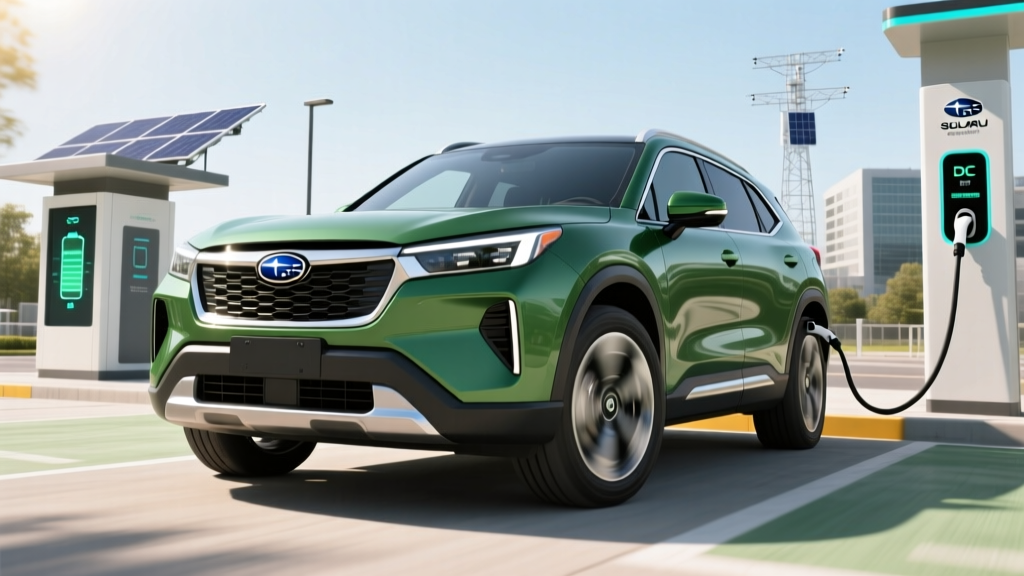
The Subaru Solterra is the brand's all-electric compact SUV, built on the shared e-TNGA platform developed with Toyota (its sibling, the bZ4X). For the 2026 model year, the Solterra continues to offer standard all-wheel drive, a 71.4 kWh lithium-ion battery pack, and the rugged styling Subaru buyers expect — but it enters an increasingly competitive segment where rivals like the Hyundai Ioniq 5, Volkswagen ID.4, and Tesla Model Y push further on range and charging speed.
This review breaks down every number that matters: real-world range expectations, DC fast-charging curves, home charging practicality, tax credit math, and whether the Solterra's trade-offs make sense for your driving profile.
| Spec | Value |
|---|---|
| EPA Range | 227 miles (Premium/Limited trims) |
| Battery Capacity | 71.4 kWh (usable), NMC chemistry |
| Drivetrain | Dual-motor AWD (standard all trims) |
| Horsepower / Torque | 215 hp / 248 lb-ft |
| 0–60 mph | 6.5 seconds |
| DC Fast Charge (peak) | 150 kW (CCS1) |
| 10–80% DC Charge Time | ~35 minutes |
| Level 2 Home Charge Rate | 6.6 kW (~22 mi/hr) |
| EPA Efficiency | 104 MPGe combined / 32 kWh/100 mi |
| Cargo Volume | 23.8 cu ft (rear seats up) / 56.9 cu ft (folded) |
| Battery Warranty | 8 years / 100,000 miles |
| Base MSRP | $38,495 (Premium) |
Real-World Range: What to Actually Expect
EPA Sticker: 227 miles (Premium & Limited trims, 18" wheels)
Real-World Highway: Expect ~180–200 miles at sustained 70–75 mph
Cold-Weather (below 32°F): Expect ~150–175 miles, depending on cabin heating demands
City/Mixed Driving: Closer to EPA figure, ~210–225 miles with regen use
The Solterra's 227-mile EPA rating trails segment leaders. The Hyundai Ioniq 5 Long Range AWD posts 290 miles; the VW ID.4 Pro S AWD hits 275 miles. The gap comes down to a combination of factors: the Solterra's standard dual-motor AWD system (which adds weight and drivetrain losses), its boxy crossover aerodynamics, and Subaru's choice to prioritize off-road capability over efficiency.
In practical terms, 227 miles means comfortable daily commuting and suburban errands with plenty of buffer. For road trips, plan charging stops every 160–180 miles to keep the battery in the 10–80% sweet spot where DC charging is fastest. If you live in a region with harsh winters — exactly the demographic Subaru targets — budget for 25–30% range loss when temperatures drop below freezing. The Solterra uses a resistive PTC heater rather than a heat pump, which draws more energy from the pack to warm the cabin.
Subaru does include a battery preconditioning feature for DC fast charging, activated when you navigate to a charger via the built-in navigation system. This warms the pack to an optimal temperature for faster charging, though preconditioning does consume some range en route.
Charging Speed: DC Fast Charging and Home Setup
Charging speed is one of the Solterra's weaker metrics compared to rivals. The peak DC fast-charge rate is 150 kW via the CCS1 connector. In real-world testing, the Solterra typically sustains around 100–120 kW through the 10–50% state of charge, then tapers significantly above 80% — a characteristic of its NMC battery management strategy that prioritizes long-term battery health over charging speed.
| Charging Level | Power / Voltage | Miles Added per Hour | Notes |
|---|---|---|---|
| Level 1 (120V household) | ~1.2 kW | ~4 mi/hr | Emergency/trickle only; ~57 hours for full charge |
| Level 2 (240V home) | 6.6 kW | ~22 mi/hr | Full charge in ~11 hours; ideal overnight |
| DC Fast Charge | 150 kW peak (CCS1) | ~140 mi in 30 min | 10–80% in ~35 min; tapers sharply above 80% |
For home charging, the Solterra's onboard charger is limited to 6.6 kW. That means even if you install a 48-amp (11.5 kW) Level 2 wall connector, the car will only accept 6.6 kW — roughly 22 miles of range per hour of charging. A full charge from near-empty takes about 11 hours. For most owners plugging in overnight, this is perfectly adequate: a typical daily commute of 30–40 miles requires only 1.5–2 hours of Level 2 charging.
Home Level 2 installation typically costs $800–$2,000 for the charger unit and electrician labor, assuming your electrical panel has capacity. If a panel upgrade from 100A to 200A is needed, add $1,500–$3,000. Consult a licensed electrician for a site-specific quote.
Performance and Driving Dynamics
The 2026 Solterra uses a dual-motor all-wheel-drive layout standard across all trims — no single-motor FWD option exists. Combined output is 215 horsepower and 248 lb-ft of torque, with the front motor contributing 107 hp and the rear motor 108 hp.
The 0–60 mph time of 6.5 seconds is adequate for merging and passing but trails competitors: the Ioniq 5 AWD does it in 5.1 seconds, and the Model Y Long Range in 4.8 seconds. Where the Solterra earns its keep is low-speed traction and off-pavement confidence. Subaru's X-Mode traction management system, carried over from its ICE lineup, modulates torque distribution for snow, mud, and gravel. The 8.3 inches of ground clearance exceeds most EV crossovers.
Regenerative braking offers multiple levels selectable via paddle shifters behind the steering wheel. There is no true one-pedal driving mode — the Solterra will creep forward at low speeds rather than coming to a complete stop via regen alone. This is a deliberate Subaru choice to mimic conventional driving behavior, but EV enthusiasts accustomed to one-pedal operation may find it a missed opportunity for efficiency recapture in stop-and-go traffic.
Interior, Tech, and Cargo Practicality
The Solterra seats five with 38.1 inches of front legroom and 35.3 inches in the rear. The cabin materials are durable if not luxurious — expect hard plastics on the lower door panels and center console, consistent with Subaru's utilitarian brand positioning.
Cargo space measures 23.8 cubic feet behind the rear seats and 56.9 cubic feet with the 60/40 split rear seats folded. That trails the Ioniq 5 (27.2 / 59.3 cu ft) and the Model Y (30.2 / 72.1 cu ft) but is sufficient for a family's weekly groceries or two large suitcases for a weekend trip.
The infotainment system uses a 12.3-inch touchscreen (Limited and Touring trims) with wireless Apple CarPlay and Android Auto. A notable quirk: the Solterra uses a knob-style shifter rather than a traditional gear lever, which some drivers find unintuitive at first. The digital gauge cluster sits high on the dash, designed to keep eyes near the road line — a carryover from the bZ4X platform design philosophy.
On the driver-assistance front, Subaru's EyeSight suite is standard and includes adaptive cruise control, lane-centering assist, pre-collision braking, and lane departure warning. This is an SAE Level 2 system — it requires continuous driver supervision and hands-on-wheel attention. It is not autonomous driving. EyeSight is well-regarded for its smooth, conservative calibration, though it lacks the hands-free highway capability of GM's Super Cruise or Ford's BlueCruise.
Pricing, Trims, and Federal Tax Credit Eligibility
| Trim | MSRP (incl. destination) | Est. Federal Credit | Effective Price* |
|---|---|---|---|
| Premium | $38,495 | Up to $7,500 | ~$30,995 |
| Limited | $41,995 | Up to $7,500 | ~$34,495 |
| Touring | $46,495 | Up to $7,500 | ~$38,995 |
*Effective price assumes full $7,500 §30D credit eligibility. Actual credit varies by buyer income, battery sourcing, and tax liability. See eligibility checklist below.
All 2026 Solterra trims fall under the $80,000 MSRP cap for SUVs under IRS §30D rules. However, the full $7,500 credit is not guaranteed for every buyer. Eligibility depends on several factors:
- Battery sourcing requirements: A percentage of critical minerals and battery components must be sourced from the U.S. or free-trade-agreement countries. These thresholds increase annually. The Solterra's battery supply chain has historically qualified for the partial or full credit — verify current-year status at fueleconomy.gov.
- Buyer income caps: Modified AGI must not exceed $150,000 (single), $225,000 (head of household), or $300,000 (joint filers).
- Point-of-sale transfer: As of 2024, buyers can transfer the credit to the dealer at purchase, receiving it as an immediate price reduction rather than waiting to claim it on their tax return.
- Tax liability: If you claim the credit on your return (not at point of sale), it is non-refundable — it can only reduce your tax liability to zero, not generate a refund beyond that.
For the most reliable, up-to-date eligibility information, consult irs.gov or a qualified tax professional before purchasing.
Warranty and Long-Term Ownership
Subaru backs the Solterra's battery pack with an 8-year / 100,000-mile warranty, guaranteeing the battery will retain at least 70% of its original capacity during that period. The broader powertrain warranty is 5 years / 60,000 miles, and the basic vehicle warranty is 3 years / 36,000 miles.
The NMC (nickel manganese cobalt) battery chemistry in the Solterra offers high energy density but is more sensitive to sustained high-state-of-charge storage and extreme heat than LFP (lithium iron phosphate) packs found in some competitors. Best practices for long-term battery health:
- Avoid routinely charging to 100% — set a daily charge limit of 80% when possible.
- Minimize prolonged exposure to extreme heat (e.g., parking in direct sun at full charge).
- Use DC fast charging for road trips, not as a daily routine — Level 2 is gentler on the pack.
Insurance costs for the Solterra tend to run 10–20% higher than equivalent gas-powered Subarus, reflecting higher repair costs and EV-specific parts pricing. Get quotes from your provider before purchasing.
How the Solterra Stacks Up Against Key Rivals
| Spec | Subaru Solterra (AWD) | Hyundai Ioniq 5 (AWD LR) | VW ID.4 (AWD Pro S) | Tesla Model Y (LR AWD) |
|---|---|---|---|---|
| EPA Range | 227 mi | 290 mi | 275 mi | 311 mi |
| Battery | 71.4 kWh NMC | 77.4 kWh NMC | 82 kWh NMC | ~75 kWh NMC |
| Peak DC Charge | 150 kW | 240 kW | 175 kW | 250 kW |
| 10–80% Time | ~35 min | ~18 min | ~29 min | ~20 min |
| 0–60 mph | 6.5 sec | 5.1 sec | 5.4 sec | 4.8 sec |
| AWD Standard | Yes | Optional | Optional | Yes (LR AWD) |
| Base MSRP (AWD) | $38,495 | $51,100 | $49,995 | $47,990 |
The Solterra's advantages are clear: it is the least expensive AWD EV SUV in this comparison and the only one with standard AWD at the base trim. Its X-Mode traction system and 8.3 inches of ground clearance give it genuine light-off-road capability that the Ioniq 5 and Model Y cannot match.
Its disadvantages are equally clear: range and charging speed. The Ioniq 5 adds 63 more miles of EPA range and charges from 10–80% in roughly half the time. For road-trippers covering 300+ miles regularly, that difference is meaningful — fewer stops, shorter stops, and more flexibility in charging-desert regions.
Choose the Subaru Solterra if: You want standard AWD at the lowest price point, you drive primarily in snow/rain/gravel conditions, your daily commute is under 60 miles round-trip, and you rarely road-trip beyond 200 miles without overnight charging access.
Look at the Ioniq 5, ID.4, or Model Y if: You regularly drive 200+ miles between charges, you want the fastest possible DC charging for road trips, or you prioritize cargo space and interior tech refinement.
Pros, Cons, and Final Verdict
Pros
- Standard dual-motor AWD on every trim — no upcharge
- Competitive base price ($38,495) before tax credits
- X-Mode traction system and 8.3" ground clearance for snow/gravel
- Strong EyeSight safety suite standard
- 8-year / 100,000-mile battery warranty
- Practical, intuitive controls with physical buttons for climate
Cons
- 227-mile EPA range is well below segment leaders
- 150 kW peak DC charging is slow; 35-min 10–80% time
- No heat pump — cold-weather range loss is significant
- No true one-pedal driving mode
- No front trunk (frunk) — lost cargo utility
- 6.6 kW onboard charger limits home charging speed
The 2026 Subaru Solterra EV SUV is a capable, honest electric crossover for the Subaru-loyal buyer who values all-weather confidence over range bragging rights. It is not the EV that wins spec-sheet comparisons. But at ~$31,000 after the federal credit (if eligible), it is one of the most affordable new AWD electric SUVs on the market — and for drivers whose daily routine stays within 150 miles and who have reliable home charging, its limitations are manageable.
Frequently Asked Questions
What is the real-world range of the Subaru Solterra EV SUV?
The EPA rates the Solterra at 227 miles. In real-world highway driving at 70+ mph, expect 180–200 miles. In freezing temperatures with cabin heat, plan for 150–175 miles. City driving with regenerative braking recapture can approach the EPA figure.
How fast does the Solterra charge at home and on the road?
At home on a 240V Level 2 charger, the Solterra accepts up to 6.6 kW — adding about 22 miles per hour, or a full charge in roughly 11 hours. On DC fast chargers, it peaks at 150 kW and reaches 10–80% in approximately 35 minutes, though charging slows considerably above 80%.
Does the 2026 Subaru Solterra qualify for the $7,500 federal EV tax credit?
The Solterra's MSRP is under the $80,000 SUV cap, making it potentially eligible. However, the full $7,500 credit under IRS §30D depends on battery-component and critical-mineral sourcing thresholds (which tighten annually), your income (capped at $150K single / $300K joint), and your tax liability. The credit can be transferred to the dealer at point of sale for an immediate price reduction. Verify current-year eligibility at irs.gov or consult a tax professional.
Is the Solterra worth buying versus the Hyundai Ioniq 5 or Tesla Model Y?
If your priority is the lowest-cost AWD electric SUV with genuine all-weather capability, the Solterra is a strong value — especially after the tax credit. If range (290–311 miles) and fast DC charging (18–20 min 10–80%) matter more for your driving pattern, the Ioniq 5 or Model Y are superior, though both cost $10,000+ more at AWD trim levels.
Does the Solterra have a heat pump for cold weather?
No. The Solterra uses a PTC (positive temperature coefficient) resistive heater, which draws more energy from the battery pack than a heat pump would. This contributes to its more pronounced cold-weather range loss compared to EVs equipped with heat pumps like the Ioniq 5 or Model Y.
Can the Subaru Solterra tow?
Subaru does not rate the Solterra for towing. If towing is a priority, look at the Rivian R1S, Ford Mustang Mach-E (select trims), or the Hyundai Ioniq 5, which offers limited towing capacity.