Does Subaru Make an Electric Vehicle?
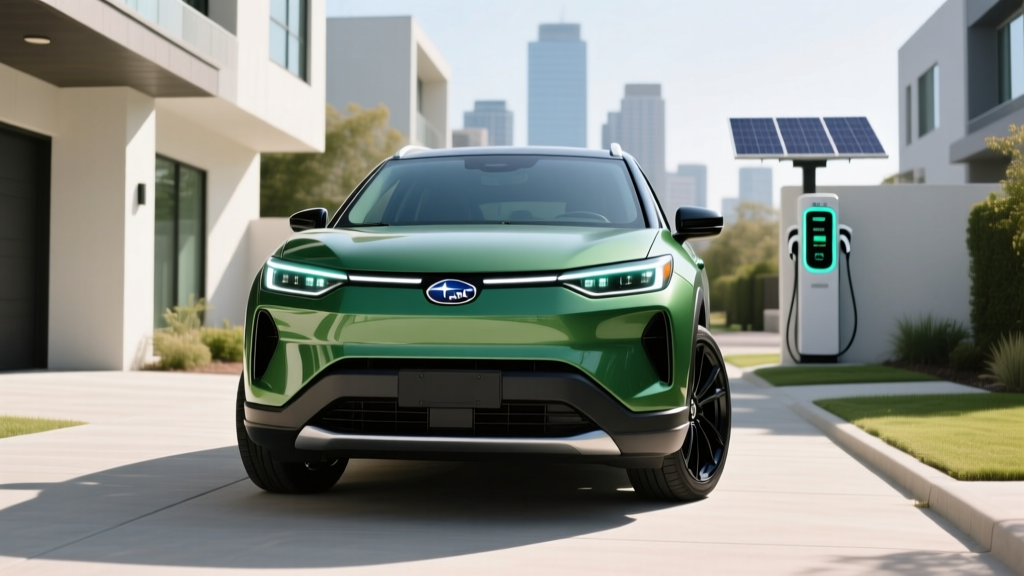
Yes. Subaru currently sells one fully electric vehicle: the Subaru Solterra, a compact all-wheel-drive SUV developed jointly with Toyota (its twin is the Toyota bZ4X). For the 2026 model year, the Solterra delivers an EPA-estimated 227 miles of range on the Limited trim, a 71.4 kWh usable battery, and a peak DC fast-charge rate of 150 kW. Pricing starts around $39,995 before destination, and depending on your income and the vehicle's battery-sourcing compliance, it may qualify for a portion or all of the $7,500 federal §30D tax credit.
If you're a current Subaru owner loyal to the brand's AWD reputation and outdoor ethos, the Solterra is the only electrified path forward — but it comes with real trade-offs in range and charging speed versus rivals. Let's break down exactly what you're getting.
Solterra Specs at a Glance: What the Numbers Actually Mean
| Specification | 2026 Subaru Solterra (Limited) | 2026 Subaru Solterra (Touring) |
|---|---|---|
| EPA Range | 227 miles | 222 miles |
| Battery (usable) | 71.4 kWh, NMC lithium-ion | 71.4 kWh, NMC lithium-ion |
| Drivetrain | Dual-motor AWD, 215 hp, 249 lb-ft | Dual-motor AWD, 215 hp, 249 lb-ft |
| 0–60 mph | ~6.5 seconds | ~6.5 seconds |
| Peak DC Fast Charge | 150 kW (CCS1) | 150 kW (CCS1) |
| 10–80% DC Charge Time | ~35 minutes | ~35 minutes |
| Level 2 (240V) Rate | ~7.2 kW (~23 mi/hr) | ~7.2 kW (~23 mi/hr) |
| MPGe (city/hwy/combined) | 114 / 94 / 104 | 111 / 93 / 102 |
| Cargo Volume | 23.8 cu ft (rear seats up) | 23.8 cu ft (rear seats up) |
| Base MSRP | $39,995 | $46,495 |
| Battery/Powertrain Warranty | 8 years / 100,000 miles | 8 years / 100,000 miles |
A few things jump out from this spec sheet. First, the 215 horsepower output is modest — Subaru prioritized efficiency and AWD traction over performance. Second, the 150 kW peak charge rate is adequate but behind the 250+ kW rates found on Hyundai/Kia E-GMP vehicles or the Tesla Model Y. Third, the Touring trim's larger 20-inch wheels cost you about 5 miles of range — a common trade-off across the EV market.
Real-World Range: What to Actually Expect
The EPA's 227-mile figure assumes a mix of city and highway driving at moderate temperatures. In practice:
- Highway-only at 70 mph (summer): Expect ~190–205 miles before needing to charge.
- Highway-only at 70 mph (winter, 30°F): Expect ~155–175 miles — cold reduces battery efficiency and increases cabin heating load.
- City/suburban mixed driving: You'll see close to the EPA sticker, sometimes slightly more thanks to regenerative braking.
For context, the Solterra's range trails the Hyundai Ioniq 5 (303 mi), Tesla Model Y Long Range (310 mi), and Kia EV6 (310 mi). If your typical weekly driving exceeds 200 miles round-trip, you'll need reliable home charging or a predictable fast-charging route.
Solterra vs. Gas Subaru: The Real Cost Comparison
Many Subaru shoppers cross-shop the Solterra against the Outback or Forester. Here's how a 5-year ownership cost comparison stacks up between the Solterra Limited and a comparably priced 2026 Outback Premium (MSRP ~$36,500).
| Cost Category (5 Years) | 2026 Solterra Limited | 2026 Outback Premium (Gas) |
|---|---|---|
| Purchase Price (MSRP) | $39,995 | $36,500 |
| Est. Federal Tax Credit (§30D) | –$3,750 to –$7,500* | $0 |
| Effective Purchase Price | ~$32,495–$36,245 | $36,500 |
| Fuel / Electricity (75,000 mi) | ~$3,200 (home L2, $0.14/kWh) | ~$8,100 (28 MPG avg, $3.40/gal) |
| Maintenance (5 yr) | ~$1,200 | ~$3,400 |
| Insurance (est. avg) | ~$9,500 | ~$7,800 |
| 5-Year Total (approx.) | ~$46,400–$50,100 | ~$55,800 |
*Federal §30D credit eligibility depends on your modified adjusted gross income, the vehicle's battery critical-mineral sourcing, and MSRP caps. For 2026, SUVs must be under $80,000 MSRP (the Solterra qualifies). Income caps: $150K single / $300K joint filers. Credit can be transferred to the dealer at point of sale. Verify current rules at IRS.gov and consult a tax professional.
The Solterra's fuel and maintenance savings are substantial — nearly $5,000 in fuel alone over five years if you charge primarily at home. However, EV insurance premiums run 15–25% higher on average, which eats into those gains. The tax credit is the swing factor: at the full $7,500, the Solterra's effective purchase price undercuts the Outback.
Charging the Solterra: Home, Public, and What You Need to Know
The Solterra uses the CCS1 connector for DC fast charging and a J1772 inlet for Level 1/Level 2 AC charging. Subaru has not adopted the Tesla NACS port as of the 2026 model year, though adapters may become available through third-party suppliers.
| Charging Level | Power | Miles Added per Hour | Typical Use Case |
|---|---|---|---|
| Level 1 (120V household) | ~1.2 kW | ~3–4 mi/hr | Overnight top-up, emergencies |
| Level 2 (240V home/public) | ~7.2 kW | ~23 mi/hr | Daily home charging, full charge in ~10 hr |
| DC Fast Charge | Up to 150 kW | ~150 mi in 30 min (10–80%) | Road trips, highway corridors |
Home Charging Setup Costs
| Component | Cost Range |
|---|---|
| Level 2 EVSE (charger unit, 32–48A) | $350–$700 |
| Electrician labor (240V/50A circuit) | $500–$2,000 |
| Permit and inspection | $50–$300 |
| Electrical panel upgrade (if needed, 200A) | $1,500–$4,000 |
| Total (no panel upgrade) | $900–$3,000 |
For the Solterra's 7.2 kW onboard charger, a 32-amp Level 2 circuit is sufficient. There's no benefit to installing a 48-amp charger — the car can't accept more than 7.2 kW on AC. A licensed electrician should evaluate your panel capacity before installation; older homes with 100-amp service may need an upgrade.
Public charging reality: The Solterra's 150 kW peak rate means you'll spend roughly 35 minutes at a DC fast charger going from 10% to 80%. That's 10–15 minutes longer than a Hyundai Ioniq 5 on a 350 kW charger. On Electrify America or EVgo networks, expect to pay $0.30–$0.48/kWh for DC charging, making road-trip fueling more expensive than home charging and sometimes comparable to gas.
EV vs. Hybrid vs. Gas: Which Subaru Buyer Are You?
Subaru doesn't currently offer a plug-in hybrid (the Crosstrek PHEV was discontinued), so your choices are the Solterra BEV or a conventional gas model. Here's a decision framework:
Choose the Solterra EV If:
- You have home charging access (garage, driveway, or landlord-approved outlet).
- Your daily commute is under 60 miles round-trip.
- You drive fewer than 15,000 miles per year and rarely take 300+ mile road trips.
- You qualify for the federal tax credit (income under $150K single / $300K joint).
- You want the lowest per-mile fuel cost and minimal maintenance.
Choose a Gas Subaru (Outback/Forester) If:
- You cannot charge at home (apartment, street parking, no outlet access).
- You regularly drive 300+ miles in a single day or travel through rural charging deserts.
- You live in an extreme cold climate (below 10°F regularly) and can't garage the vehicle.
- Your household income exceeds §30D caps, eliminating the tax credit advantage.
- You tow more than 2,000 lbs (the Solterra is rated for 2,000 lbs; the Outback handles 2,700–3,500 lbs).
Common Solterra Misconceptions — Separating Myth from Fact
| Myth | Fact |
|---|---|
| "The Solterra is just a rebadged Toyota bZ4X." | They share the e-TNGA platform and battery, but Subaru tunes the AWD system, suspension, and X-MODE off-road software independently. The driving character and capability differ. |
| "227 miles of range isn't enough for any real trip." | With DC fast-charging infrastructure on major interstates, a 300-mile trip requires one ~30-minute charge stop. It's manageable for occasional road trips — just not as seamless as a 310-mile rival. |
| "EV batteries need replacing every few years." | Subaru warranties the battery for 8 years/100,000 miles against capacity loss below 70%. Industry data from fueleconomy.gov and long-term fleet studies show modern NMC packs retain 85–90% capacity after 100K miles. |
| "I can charge on any Tesla Supercharger." | As of 2026, the Solterra uses CCS1. Tesla Superchargers with Magic Dock adapters are expanding, but not all stalls are equipped. Check the Tesla app or PlugShare for CCS-compatible Supercharger locations before relying on them. |
| "AWD on an EV doesn't work as well as Subaru's symmetrical AWD." | Dual-motor AWD provides instant torque vectoring to each axle. In snow and low-traction testing, the Solterra's AWD system performs comparably to gas Subaru models, with the advantage of a lower center of gravity from the floor-mounted battery. |
What First-Time EV Buyers Should Know Before Purchasing
If the Solterra would be your first electric vehicle, here are the ownership realities that spec sheets don't highlight:
1. Preconditioning matters for fast charging. The Solterra can precondition its battery when you navigate to a DC fast charger in the infotainment system. This warms the battery to optimal temperature and can shave 5–10 minutes off your charge time, especially in cold weather. Always use this feature on road trips.
2. The charge curve tapers above 80%. The advertised 150 kW peak rate only applies between roughly 10–50% state of charge. Above 80%, charging slows dramatically to protect the battery — often dropping to 30–40 kW. Plan your road-trip stops around 10–80% charges rather than filling to 100%.
3. Regenerative braking takes adjustment. The Solterra offers adjustable regen via steering-wheel paddles. At the highest setting, you can approach one-pedal driving in city traffic, but it's not as aggressive as a Nissan LEAF or Tesla. Expect a learning curve of about a week.
4. Insurance costs more. EV insurance premiums average 15–25% higher than comparable gas vehicles due to higher repair costs and battery replacement risk. Get quotes from your insurer before purchasing — the difference could be $300–$600 per year.
5. Winter range loss is real and predictable. Budget 25–35% range reduction in sustained sub-freezing temperatures. A 227-mile Solterra becomes a ~160-mile car in a Minnesota January. If this doesn't cover your daily needs, an EV may not be your best primary vehicle.
Frequently Asked Questions
Does Subaru make any other electric vehicles besides the Solterra?
No. As of the 2026 model year, the Solterra is Subaru's only fully electric vehicle. Subaru has announced plans to introduce additional EV models later in the decade, including a larger three-row SUV, but these remain in development with no confirmed specs or pricing.
Does the Subaru Solterra qualify for the $7,500 federal tax credit?
Eligibility depends on several factors under IRS §30D rules: your income must be under $150,000 (single) or $300,000 (joint), the vehicle MSRP must be under $80,000 for SUVs (the Solterra qualifies), and the battery must meet critical-mineral and component-sourcing thresholds that change annually. The credit can be applied at the point of sale as a discount. Confirm current-year eligibility with your dealer and a tax professional before purchasing.
How does the Solterra compare to the Toyota bZ4X?
Both share the same platform, 71.4 kWh battery, and similar range. Key differences: Subaru includes standard X-MODE for off-road traction, tunes the suspension for a slightly firmer ride, and prices the Solterra a few thousand dollars higher. The bZ4X offers a FWD base model at a lower entry price. If you want Subaru's AWD reputation and off-road credibility, the Solterra is the pick; if price is the priority, the bZ4X FWD at ~$37,000 is a value alternative.
Can I charge the Solterra at Tesla Superchargers?
Not natively. The Solterra uses the CCS1 connector. Some Tesla Supercharger stations now feature the Magic Dock CCS adapter, but availability is limited and expanding gradually. For reliable road-trip charging, plan around Electrify America, EVgo, and ChargePoint DC fast-charging networks, which all support CCS1 natively.
What does it cost to charge the Solterra at home vs. public chargers?
At home on a Level 2 charger with the US average electricity rate of ~$0.16/kWh, a full 71.4 kWh charge costs roughly $11.40 — about $0.05 per mile. On public DC fast chargers at $0.35–$0.48/kWh, that same charge costs $25–$34, or roughly $0.11–$0.15 per mile. Compare this to a 28 MPG gas SUV at $3.40/gallon: about $0.12 per mile. Home charging is where the EV savings materialize; exclusive public charging narrows the cost gap significantly.
How long will the Solterra's battery last?
Subaru warranties the high-voltage battery for 8 years or 100,000 miles, guaranteeing it will retain at least 70% of original capacity. Based on industry degradation data for similar NMC packs, expect 85–92% capacity retention at 100,000 miles under normal use. Battery replacement, if needed out of warranty, currently costs $12,000–$18,000 including labor — though prices are trending downward as the supply chain matures.
The Bottom Line: Who Should Buy the Subaru Solterra?
The Solterra is a competent, comfortable compact EV SUV that faithfully translates Subaru's AWD and outdoor DNA into an electric package. Its 227-mile range and 150 kW charging aren't class-leading, but they're sufficient for the majority of drivers who can charge at home and don't regularly exceed 200 miles in a day.
If you're a Subaru loyalist ready to go electric and your driving profile fits — home charging, moderate daily miles, occasional road trips — the Solterra delivers the brand's character with dramatically lower fuel and maintenance costs. If you need maximum range, the fastest charging, or you can't install a home charger, competitors like the Hyundai Ioniq 5 or a Subaru gas model may serve you better. Test-drive both, get an insurance quote, and run your personal numbers before deciding.