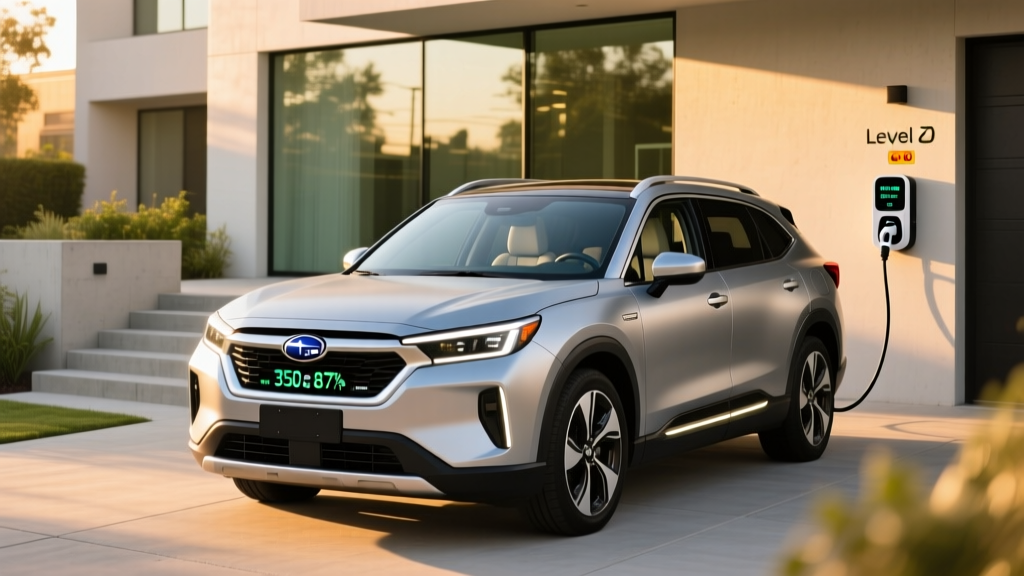
Is a Subaru all-electric vehicle worth it in 2026? The Subaru Solterra delivers 227 miles of EPA range, 228 miles in the Onyx Edition with 19-inch wheels, standard Symmetrical All-Wheel Drive, and a starting MSRP around $44,995. Expect roughly 190–210 real-world miles on the highway and 155–175 miles in freezing weather. DC fast charging peaks at roughly 100 kW (10–80% in ~35 minutes) on 2024+ models with the updated thermal management. The Solterra makes sense if you need Subaru's signature AWD and ground clearance for light off-road or snow driving, can charge at home, and drive under 200 miles daily. It is less ideal for frequent long road trips or buyers without reliable home charging access.
Subaru's All-Electric Lineup: The Solterra in 2026
Subaru's entry into the battery-electric market centers on one vehicle: the Solterra, developed jointly with Toyota (which sells the mechanically similar bZ4X). For 2026, Subaru has continued incremental improvements to the Solterra's thermal management and charging capability since its 2023 launch, though the fundamental 72.8 kWh (usable) lithium-ion battery pack and dual-motor AWD powertrain remain the core of the platform.
Subaru has not announced additional all-electric models for the U.S. market as of early 2026. If your search for "Subaru all electric" is driven by a desire for a larger electric SUV or an electric Outback successor, you are currently limited to the compact Solterra or Subaru's plug-in hybrid Crosstrek as a bridge option.
| Spec | Value |
|---|---|
| EPA Range (Limited/ Touring, 20" wheels) | 222 miles |
| EPA Range (Premium/Onyx, 18" wheels) | 227 miles |
| Battery (usable capacity) | 72.8 kWh, NMC chemistry |
| Powertrain | Dual motor, Symmetrical AWD |
| Horsepower / Torque | 215 hp / 248 lb-ft |
| 0–60 mph | ~6.5 seconds |
| Peak DC Fast Charge Rate | ~100 kW (updated models) |
| 10–80% DC Charge Time | ~35 minutes |
| Level 2 AC Charging (7.2 kW) | ~11 hours (0–100%) |
| Ground Clearance | 8.3 inches |
| Cargo Volume (rear seats up) | 23.8 cu ft |
| Base MSRP (Premium trim) | ~$44,995 |
| Battery Warranty | 8 years / 100,000 miles |
| Efficiency (combined) | 102–104 MPGe |
EPA Range vs. Reality: The Solterra's 227-mile EPA figure assumes a mix of city and highway driving at moderate temperatures. In real-world highway driving at 70+ mph, expect 190–210 miles. In sub-freezing conditions (20°F and below), plan for 155–175 miles due to battery heating demands and cabin climate use. The Solterra includes a heat pump on higher trims, which partially mitigates cold-weather range loss compared to resistive heating, but the compact battery means cold-weather margins are tight for trips over 150 miles.
Charging the Solterra: Home, Public, and the Curve Reality
The Solterra uses the CCS1 connector standard for DC fast charging and J1772 for Level 2 AC. Subaru has not adopted the Tesla NACS connector for the Solterra as of 2026, though adapters are available for Tesla Supercharger access on some CCS vehicles (verify compatibility with your model year before purchasing an adapter).
| Level | Power (kW) | Miles Added per Hour | Typical Use Case |
|---|---|---|---|
| Level 1 (120V household) | ~1.2 kW | ~4–5 mi/hr | Emergency / overnight trickle |
| Level 2 (240V home/public) | 7.2 kW | ~22–25 mi/hr | Daily home charging |
| DC Fast Charge | Up to ~100 kW | ~130–150 mi/hr (peak) | Road trips, quick top-ups |
The charging curve matters more than peak kW. The Solterra's ~100 kW peak rate applies only between roughly 10% and 40% state of charge. Above 60%, the rate tapers significantly, dropping below 50 kW past 80%. This means a 10–80% session takes approximately 35 minutes, but a 10–100% session could stretch past 65 minutes. For road-trip efficiency, plan stops to charge from 10–80% and move on rather than waiting for a full battery.
Earlier 2023 Solterra models had a notably slower DC charge rate (~50 kW peak) before Subaru issued software and thermal management updates. If you are considering a used 2023 model, confirm whether the charging update has been applied at a dealership — the difference is substantial on road trips.
Solterra vs. Gas Outback: Real Cost Comparison
The most common cross-shopping question for Subaru buyers is whether the Solterra saves money compared to the gasoline Outback. Here is a five-year cost breakdown assuming 15,000 miles per year, $3.50/gallon regular fuel, $0.14/kWh home electricity, and 80% home / 20% public DC charging:
| Cost Category | 2026 Solterra (AWD) | 2026 Outback (AWD, 2.5L) |
|---|---|---|
| Base MSRP | ~$44,995 | ~$32,995 |
| Estimated Federal Tax Credit (§30D) | Up to $7,500* | $0 |
| Effective Purchase Price | ~$37,495 | $32,995 |
| Fuel / Electricity (5 years) | ~$4,725 | ~$9,190 |
| Maintenance (5 years) | ~$1,800 | ~$3,600 |
| Insurance (5-year estimate) | ~$9,500 | ~$7,500 |
| Total 5-Year Operating Cost | ~$16,025 | ~$20,290 |
| Total (Purchase + Operating) | ~$53,520 | ~$53,285 |
*Federal §30D tax credit eligibility depends on MSRP caps (SUVs: $80,000), buyer income limits ($150K single / $300K joint), battery critical-mineral and component sourcing requirements, and point-of-sale transfer availability. Always verify current-year eligibility on IRS.gov and consult a tax professional. The Solterra's credit eligibility has varied by model year and sourcing rule changes.
The takeaway: at current pricing, the Solterra reaches near cost-parity with a gas Outback over five years when the full tax credit applies and you charge primarily at home. Without the tax credit or with heavy reliance on expensive public DC charging ($0.35–$0.50/kWh), the Outback retains a cost advantage. The Solterra's fuel and maintenance savings are real — EVs eliminate oil changes, have fewer brake replacements thanks to regenerative braking, and cost roughly half as much per mile to "fuel" on home electricity.
Federal Tax Credit & Incentive Details for the Solterra
§30D Clean Vehicle Credit Requirements (2026 rules):
- MSRP Cap: Vehicle MSRP must not exceed $80,000 for SUVs/vans/pickups, $55,000 for sedans. The Solterra qualifies on MSRP.
- Buyer Income Limits: Modified AGI must not exceed $150,000 (single), $225,000 (head of household), or $300,000 (joint). Exceed these thresholds and the credit phases out.
- Battery Sourcing: The credit splits into two halves — $3,750 for critical minerals and $3,750 for battery components, each with escalating domestic/free-trade-agreement sourcing percentages that tighten annually. The Solterra's eligibility for the full $7,500 vs. a partial $3,750 depends on the model year's supply chain compliance.
- Point-of-Sale Transfer: As of 2024, buyers can transfer the credit to the dealer at purchase, reducing the out-of-pocket price immediately rather than waiting for tax filing. The dealer must be IRS-registered.
- Final Assembly: Vehicle must undergo final assembly in North America. The Solterra is assembled at Toyota's Motomachi plant in Japan — this has been a disqualifying factor for the §30D credit for the Solterra in prior model years. Always verify current assembly-location eligibility on fueleconomy.gov.
This final-assembly requirement is critical: because the Solterra is built in Japan alongside the Toyota bZ4X, it has historically not qualified for the §30D new-vehicle credit. Subaru and Toyota would need to shift production or qualify under a commercial-vehicle leasing loophole (the §45W credit for leases) for the credit to apply. Some dealers may offer the Solterra under a lease structure that passes through a $7,500 lease credit — ask specifically about this option.
Real-World Ownership: What First-Time EV Buyers Need to Know
If the Solterra is your first EV, several ownership realities differ sharply from the Subaru you may be replacing:
Home charging is essential for convenience. Level 1 (120V) charging adds only 4–5 miles per hour — adequate only if you drive under 30 miles daily. A Level 2 home charger (240V, 32–48 amp) is the practical baseline for EV ownership. Expect to invest $800–$2,500 in a quality Level 2 unit (ChargePoint Home Flex, Emporia Level 2, or similar) plus $500–$2,000 for professional electrician installation, depending on your panel capacity and wiring run distance. Homes with older 100-amp electrical panels may need a $1,500–$3,000 panel upgrade to support a 48-amp charger.
Public charging is improving but inconsistent. Networks like Electrify America, EVgo, and ChargePoint offer DC fast charging for road trips, but uptime and maintenance vary. Download multiple network apps before a trip and always have a backup charging location identified. The Solterra's CCS1 connector is compatible with most non-Tesla DC fast chargers.
Cold weather demands planning. Subaru buyers often live in snow-belt states. The Solterra's AWD system excels in winter traction, but cold batteries lose 20–30% of range. Preconditioning the battery while plugged in (using the Subaru app to warm the cabin and battery before departure) preserves range and improves charging speed. Always precondition before a DC fast charge in cold weather — a cold battery may charge at half its rated speed.
Insurance costs more. EV insurance premiums run 15–30% higher than comparable gas vehicles due to higher repair costs and battery replacement values. Get a quote before purchasing to avoid surprises.
| Myth | Fact |
|---|---|
| "The Solterra gets the full $7,500 tax credit." | Japan assembly has disqualified the Solterra from §30D in most model years. Lease structures may offer a pass-through credit. |
| "227 miles of range means I can drive 227 miles." | Highway driving at 75 mph yields ~190–210 miles. Cold weather drops this to ~155–175 miles. Plan with a 20% buffer. |
| "It charges as fast as a Tesla or Hyundai." | The Solterra peaks at ~100 kW (post-update). Competitors like the Ioniq 5 or Model Y charge at 150–250 kW, cutting road-trip stops by 10–15 minutes. |
| "I don't need a home charger." | Level 1 (120V) adds ~40 miles overnight — insufficient for most drivers. Level 2 home charging is the practical minimum for daily use. |
| "EV batteries need replacing every few years." | The Solterra's battery carries an 8-year/100,000-mile warranty against degradation below 70% capacity. Industry data shows NMC batteries typically retain 85–90% capacity after 100,000 miles with proper care. |
Solterra vs. the Competition: Where It Fits
The Solterra competes in a crowded compact electric SUV segment. Here is how it stacks up against key rivals on the metrics that matter:
| Vehicle | EPA Range | Peak DC kW | 10–80% Time | AWD | Base MSRP |
|---|---|---|---|---|---|
| Subaru Solterra | 227 mi | ~100 kW | ~35 min | Standard | ~$44,995 |
| Hyundai Ioniq 5 (AWD) | 290 mi | 240 kW | ~18 min | Optional | ~$47,600 |
| Tesla Model Y (Long Range) | 308 mi | 250 kW | ~15 min | Standard | ~$48,990 |
| Toyota bZ4X (AWD) | 228 mi | ~100 kW | ~35 min | Standard | ~$43,070 |
| Ford Mustang Mach-E (AWD) | 290 mi | 150 kW | ~28 min | Optional | ~$43,995 |
The Solterra's advantages are its 8.3 inches of ground clearance (best in class for light off-pavement use), Subaru's X-MODE traction system for snow and mud, and the brand's safety reputation. Its weaknesses are clear: shorter range, slower charging, and a smaller cargo area than the Ioniq 5 or Model Y. If road-trip charging speed and maximum range are priorities, the Ioniq 5 and Model Y are objectively superior. If you need a genuine all-weather, light-trail-capable EV for mountain or rural living, the Solterra occupies a niche no competitor fully matches.
Should You Buy the Subaru Solterra?
Choose the Solterra if:
- You live in a snow-belt or mountain region and need genuine AWD traction with high ground clearance.
- Your daily driving is under 180 miles round-trip and you can charge at home with Level 2.
- You value Subaru's EyeSight safety suite, build quality, and dealer network.
- You do light off-pavement driving (forest roads, ski areas, camping) where ground clearance matters.
Look elsewhere if:
- You regularly drive 250+ miles between charging stops on road trips (the Ioniq 5 or Model Y will save you 15–20 minutes per stop).
- You cannot install a Level 2 charger at home and rely entirely on public charging.
- The federal tax credit is essential to your budget — the Solterra's Japan assembly complicates eligibility.
- Cargo space is a priority — the Solterra's 23.8 cu ft is smaller than most competitors.
Frequently Asked Questions
Is Subaru making an electric Outback or larger all-electric SUV?
As of 2026, Subaru has not announced an electric Outback or a larger electric SUV for the U.S. market. The Solterra remains Subaru's sole all-electric offering. Subaru has indicated it will introduce additional EVs later this decade, but no specific models, timelines, or specs have been confirmed. If you need a larger Subaru with electric capability, the Crosstrek plug-in hybrid (256 miles of total range, ~17 miles electric-only) is the current bridge option.
Does the Subaru Solterra qualify for the $7,500 federal tax credit?
Historically, the Solterra has not qualified for the §30D new clean vehicle credit because it is assembled in Japan, not North America. However, some dealers may structure a lease that passes through a $7,500 commercial clean vehicle credit (§45W), effectively reducing your lease cost. Verify current eligibility on fueleconomy.gov and ask your dealer about lease-credit pass-through options before assuming the credit applies to a purchase.
How long does it take to charge the Solterra at home?
On a 7.2 kW Level 2 home charger, a full 0–100% charge takes approximately 11 hours. In practice, most owners charge from 20–80% overnight, which takes roughly 6–7 hours. A standard 120V outlet (Level 1) adds about 40–50 miles of range in a 10-hour overnight session — workable only for very low-mileage drivers.
What is the Solterra's real-world range in winter?
In sustained temperatures below 30°F, expect 155–175 miles of range from a full charge, depending on driving speed, terrain, and cabin heating use. Using seat heaters and a heated steering wheel instead of cranking cabin heat can recover 10–15 miles. Preconditioning while plugged in is the single most effective way to preserve winter range.
How does the Solterra compare to the Toyota bZ4X?
The Solterra and bZ4X share the same e-TNGA platform, battery, and powertrain. Differences are primarily cosmetic and in suspension tuning — Subaru emphasizes off-road capability with X-MODE and higher ride height, while Toyota focuses on on-road comfort. Range and charging specs are nearly identical. The bZ4X starts slightly lower in price, but both face the same Japan-assembly tax credit limitation. Choose based on which brand's dealer network, styling, and feature set you prefer.
Is the Solterra's battery reliable long-term?
Subaru warranties the Solterra's battery for 8 years or 100,000 miles against degradation below 70% of original capacity. The NMC chemistry used in the Solterra has a well-established track record across the industry. Based on fleet data from similar platforms, owners can expect 85–90% capacity retention at 100,000 miles under normal use. Avoiding frequent DC fast charging in extreme heat, not regularly charging to 100% for storage, and preconditioning in cold weather all help maximize longevity.