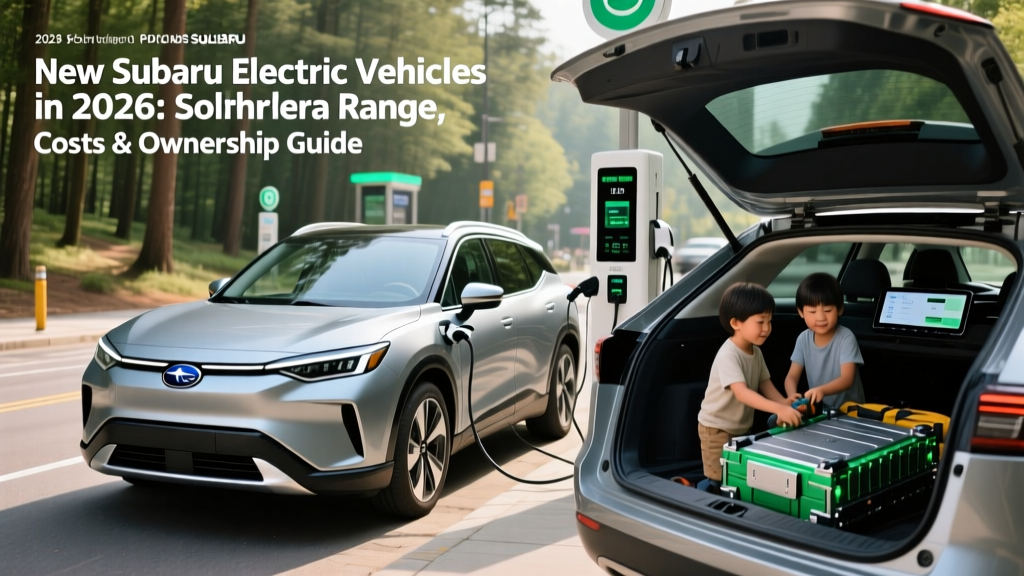
The Quick Answer: Is a New Subaru EV Right for You?
Bottom line: The 2026 Subaru Solterra is the brand's only all-electric vehicle currently on sale. It offers an EPA-estimated 222 to 227 miles of range (depending on trim), standard all-wheel drive, and a starting MSRP around $44,995. It's best suited for buyers who need Subaru's trademark AWD capability in an EV package, can charge at home, and primarily drive under 180 miles round-trip. If you regularly drive long highway stretches in cold climates or lack home charging access, a Subaru PHEV (like the Crosstrek Hybrid) or a longer-range EV competitor may serve you better.
Subaru's electric strategy has been cautious. Unlike competitors with sprawling EV lineups, Subaru has committed to a single battery-electric model — the Solterra, co-developed with Toyota on the e-TNGA platform (it's the mechanical twin of the Toyota bZ4X). For 2026, Subaru continues to refine the Solterra with modest updates, but the core proposition remains the same: a compact electric crossover with genuine all-weather capability wrapped in a familiar Subaru package. If you're researching new Subaru electric vehicles, this is the model to evaluate — and the ownership realities you need to understand before signing a purchase agreement.
2026 Subaru Solterra: Range, Battery & Efficiency
The Solterra is equipped with a 72.8 kWh lithium-ion battery pack (NMC chemistry). Here are the exact figures that matter for your purchase decision:
| Spec | Solterra Premium | Solterra Limited / Touring |
|---|---|---|
| EPA Range | 227 miles | 222 miles |
| Battery (usable) | ~67 kWh | ~67 kWh |
| Combined MPGe | 104 MPGe | 102 MPGe |
| Efficiency (kWh/100 mi) | 32 kWh/100mi | 33 kWh/100mi |
| Drivetrain | Dual-motor AWD (215 hp) | Dual-motor AWD (215 hp) |
| 0-60 mph | ~6.5 seconds | ~6.5 seconds |
Real-World Range Reality: The EPA sticker says 222-227 miles, but plan for less in practice. In highway driving at 70+ mph, expect approximately 180-195 miles. In cold weather (below freezing), range can drop 20-30%, putting realistic winter range at roughly 155-175 miles. The Solterra's efficiency of 32-33 kWh/100mi is competitive with the Hyundai Ioniq 5 AWD but trails the Tesla Model Y Long Range (~28 kWh/100mi). For daily commuting under 80 miles round-trip, range is a non-issue. For 300-mile road trips, you'll need at least one DC fast-charge stop.
Charging Speeds: Home & DC Fast Charging
Charging speed is where the Solterra draws the most criticism relative to competitors. Here are the exact numbers:
| Charging Level | Power | Speed / Time | Notes |
|---|---|---|---|
| Level 1 (120V) | ~1.4 kW | ~4 mi/hr added | Emergency/top-up only; full charge in ~48 hours |
| Level 2 (240V, 32A) | 7.7 kW | ~25 mi/hr added | 0-100% in ~9 hours; ideal overnight home charging |
| DC Fast Charge | Peak ~100 kW (150 kW capable on updated models) | 10-80% in ~35 minutes | Charge curve tapers significantly above 80%; peak rate not sustained |
A critical distinction new EV buyers must understand: kW (kilowatts) measures charging power — how fast energy flows into the battery. kWh (kilowatt-hours) measures battery energy capacity — the size of the "tank." The Solterra's 72.8 kWh battery charged at a peak of 100 kW means you're adding roughly 1 kWh per minute at peak rate, but the charge curve tapers substantially after 60-70% state of charge (SoC). Don't expect sustained 100 kW throughput for the entire session.
Compared to the Hyundai Ioniq 5 (which peaks at ~240 kW on a 350 kW charger and does 10-80% in ~18 minutes) or the Tesla Model Y (peak ~250 kW, 10-80% in ~15-20 minutes), the Solterra's DC fast-charging speed is a clear weakness for frequent road-trippers. If you take multiple long trips per year, this is a meaningful differentiator.
Solterra vs Gas Subaru: Cost & Efficiency Comparison
How does the Solterra stack up against a comparably equipped gas Subaru? We'll compare it against the 2026 Subaru Outback Wilderness, a popular AWD crossover in a similar price range:
| Metric | 2026 Solterra Touring | 2026 Outback Wilderness (AWD) |
|---|---|---|
| Base MSRP | ~$51,995 | ~$41,995 |
| Fed. Tax Credit (§30D) | Up to $7,500 (eligibility varies — see below) | $0 |
| Effective Price (after max credit) | ~$44,495 | $41,995 |
| Fuel/Energy Cost per Mile | ~$0.045/mi (at $0.14/kWh national avg, home charging) | ~$0.15/mi (at $3.40/gal, 24 MPG combined) |
| Annual Fuel/Energy (12,000 mi) | ~$540 | ~$1,700 |
| Annual Maintenance Estimate | ~$300 (no oil changes, fewer wear items) | ~$650 |
| 5-Year Fuel + Maintenance | ~$4,200 | ~$11,750 |
| EPA Range / Tank Range | 222 mi (EPA) | ~425 mi (17.2-gal tank) |
The math: Over five years and 60,000 miles, the Solterra saves roughly $7,550 in fuel and maintenance compared to the Outback Wilderness. If you qualify for the full $7,500 federal tax credit, the effective purchase price gap nearly closes. However, insurance premiums on the Solterra tend to run 10-15% higher than the Outback (EV insurance averages ~$1,800-$2,200/year depending on state and driving record), which partially offsets those savings. Source: fueleconomy.gov.
Federal Tax Credit & Incentive Eligibility
The Solterra's eligibility for the federal §30D Clean Vehicle Credit depends on several factors that change frequently. As of 2026, here are the requirements under current IRS rules:
- MSRP Cap: SUVs/vans/pickups must have an MSRP at or below $80,000. The Solterra qualifies (all trims are under this cap).
- Buyer Income Cap: Modified adjusted gross income (MAGI) must not exceed $150,000 (single), $225,000 (head of household), or $300,000 (married filing jointly).
- Battery Sourcing: A percentage of critical minerals and battery components must be sourced from the U.S. or free-trade-agreement countries. These thresholds increase annually — verify current-year requirements on the IRS site or with your dealer before purchase.
- Point-of-Sale Transfer: You can transfer the credit to the dealer at purchase, reducing your out-of-pocket cost immediately rather than waiting for tax filing.
- Final Assembly: Vehicle must undergo final assembly in North America. The Solterra is assembled in Japan, which has been a point of contention — verify current assembly-status with your dealer, as this can affect eligibility.
Critical caveat: Because the Solterra is manufactured in Japan (at Toyota's Motomachi plant), its eligibility for the full $7,500 credit has fluctuated with sourcing and assembly rule updates. Always confirm eligibility with your dealer and cross-reference the fueleconomy.gov tax credit database before committing. Never assume you'll receive the full credit without verification. Consult a tax professional for your specific situation.
Real-World Ownership: What First-Time Subaru EV Buyers Need to Know
Home Charging Is Nearly Essential
Public charging infrastructure has expanded significantly, but relying solely on public DC fast chargers is expensive ($0.30-$0.48/kWh at most networks, roughly 3-4x home electricity rates) and time-consuming. A Level 2 home charger installation typically costs $800-$2,500 (equipment + electrician + permit), depending on whether your electrical panel needs an upgrade. For a 200-amp panel with capacity, expect the lower end. A panel upgrade to 200A can add $1,500-$3,000. Budget accordingly and get a quote from a licensed electrician before purchasing.
Cold Weather Hits Range Hard
Subaru buyers often live in northern climates. Be aware: the Solterra's battery thermal management system is adequate but not class-leading. In sustained sub-freezing temperatures, expect 20-30% range reduction. A 222-mile EPA Solterra may deliver 155-175 miles in January in Minnesota. Preconditioning the battery while plugged in (using the Subaru app to warm the cabin and battery before departure) mitigates this, but only if you're plugged into a charger. If you park on the street without plug access, winter range loss is unavoidable.
The AWD Advantage Is Real
The Solterra's dual-motor AWD system provides genuine traction in snow and rain, consistent with Subaru's brand reputation. With 215 hp and 249 lb-ft of torque, it's not a performance EV, but the instant torque delivery and low center of gravity (battery pack mounted under the floor) make it confident in slippery conditions. Ground clearance is 8.3 inches — less than an Outback but adequate for most winter roads. Subaru's X-MODE traction management system is included with EV-specific tuning.
Battery Warranty & Longevity
Subaru warranties the Solterra's battery pack for 8 years / 100,000 miles against defects and capacity loss below 70% of original capacity. This is industry-standard. NMC chemistry batteries in similar EVs have shown degradation of roughly 8-12% over 5 years / 60,000 miles based on fleet data — meaning you'd likely retain 88-92% capacity at the 5-year mark. Full battery replacement (out of warranty) is estimated at $12,000-$18,000, though this cost is expected to decline as battery manufacturing scales.
Decision Framework: Should You Buy the Solterra?
Buy the 2026 Solterra if:
- You need AWD for snow/rain and want an EV
- Your daily driving is under 150 miles round-trip
- You have access to Level 2 home charging (garage or driveway with 240V outlet)
- You're loyal to the Subaru brand and value EyeSight safety tech
- You qualify for the federal tax credit (verify sourcing/assembly status)
- You take 1-2 road trips per year (manageable with one charge stop)
Consider alternatives if:
- You regularly drive 250+ miles in a day — the Ioniq 5, Model Y, or EV6 charge far faster and offer 270-330 miles of range
- You live in an apartment or lack home charging access — public-only charging is costly and inconvenient with the Solterra's slower DC rate
- You live in an extreme cold climate and need maximum winter range — consider a larger-battery EV or a PHEV like the Subaru Crosstrek Hybrid
- You want the lowest cost per mile of range — competitors offer more range per dollar
- Fast-charging speed is a priority — the Solterra's ~35-minute 10-80% time lags behind class leaders at ~18 minutes
Common Misconceptions About the Solterra
| Myth | Fact |
|---|---|
| "The Solterra can't handle real winter driving." | Dual-motor AWD with X-MODE provides legitimate snow traction. Range drops 20-30% in cold, but traction and safety systems perform well. |
| "EV batteries need replacing every few years." | NMC batteries in modern EVs show ~8-12% degradation over 5 years. The 8yr/100k-mile warranty covers capacity below 70%. Most EV batteries outlast the vehicle. |
| "Charging an EV is more expensive than gas." | At $0.14/kWh (national residential average), the Solterra costs ~$0.045/mile to fuel. The Outback costs ~$0.15/mile at $3.40/gal. Home charging is roughly 3x cheaper. |
| "The $7,500 tax credit applies to everyone." | Eligibility depends on buyer income, MSRP caps, battery sourcing, and final assembly location. The Solterra's Japan assembly has affected eligibility — always verify with your dealer and the IRS before purchase. |
| "I can charge at any public station." | The Solterra uses the CCS1 connector for DC fast charging. Tesla Superchargers (NACS) require an adapter — Subaru has been working on NACS compatibility, but confirm your specific model-year's adapter availability. |
Frequently Asked Questions
Is Subaru releasing any other electric vehicles besides the Solterra?
As of 2026, the Solterra is Subaru's only battery-electric vehicle on sale. Subaru has announced plans for additional EVs later in the decade, including a larger three-row SUV expected around 2027, but these remain in the announced/preliminary stage with no confirmed specs or pricing. For now, the Solterra is the sole option for a new Subaru electric vehicle.
How does the Solterra compare to the Toyota bZ4X?
The Solterra and bZ4X share the e-TNGA platform, battery pack, and powertrain. The Solterra comes standard with dual-motor AWD on all trims (the bZ4X offers FWD on its base trim) and includes Subaru's X-MODE and 8.3 inches of ground clearance vs the bZ4X's slightly lower ride height. Pricing is comparable, but Subaru's AWD standard equipment gives it an edge for buyers in snowy climates. Both share the same charging-speed limitations.
Can I tow with the Solterra?
The 2026 Solterra has a towing capacity of approximately 2,000 pounds when properly equipped. This is adequate for a small utility trailer or a pair of dirt bikes but insufficient for most boat trailers or campers. Towing also significantly reduces range — expect a 30-40% reduction when towing near maximum capacity.
What is the total 5-year cost of ownership?
Estimated 5-year / 60,000-mile costs for the Solterra Touring: Purchase (after estimated $3,750 average credit): ~$48,245. Electricity (home charging): ~$2,700. Insurance: ~$10,000. Maintenance: ~$1,500. Total: approximately $62,445. For comparison, the Outback Wilderness over the same period: Purchase: $41,995. Fuel: ~$8,500. Insurance: ~$8,500. Maintenance: ~$3,250. Total: approximately $62,245. The figures are remarkably close — the EV's fuel and maintenance savings largely offset its higher purchase price and insurance, making the decision more about driving experience and environmental priorities than pure economics.
Does the Solterra support one-pedal driving?
Yes, the Solterra offers adjustable regenerative braking with paddle shifters behind the steering wheel, allowing you to increase regen for near-one-pedal driving in city traffic. However, it does not come to a complete stop without touching the brake pedal — it's "one-pedal-ish" rather than full one-pedal driving like some competitors offer.
What safety ratings does the Solterra have?
The Solterra comes equipped with Subaru's EyeSight driver-assistance suite, including adaptive cruise control, lane-keeping assist, pre-collision braking, and blind-spot detection. The vehicle has earned strong marks from the IIHS. Note that EyeSight is a Level 2 driver-assist system under SAE classification — you must remain fully engaged and keep your hands on the wheel. It is not autonomous or self-driving.