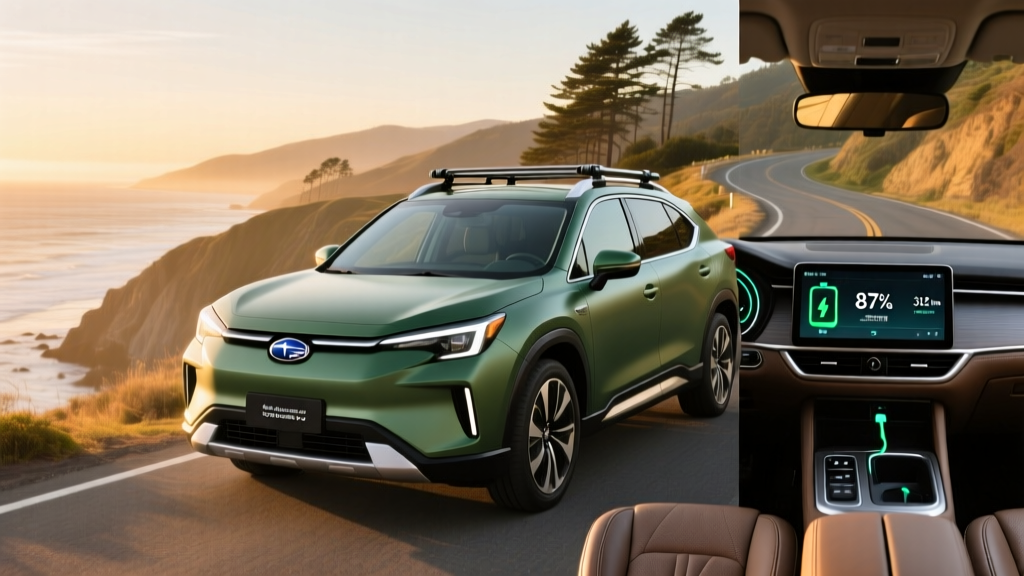
Quick Answer: The 2026 Subaru Solterra is a fully electric compact SUV with 228 miles of EPA-estimated range, standard all-wheel drive, and a starting MSRP of $44,995. Real-world highway range drops to roughly 200–210 miles, and cold weather can push it closer to 175–190 miles. With a home Level 2 charger, daily ownership is practical for most commuters. Federal tax credit eligibility under IRS §30D depends on battery sourcing, your income, and MSRP caps — it is not guaranteed for every buyer.
What the 2026 Solterra Actually Delivers
The 2026 Subaru Solterra is the brand's dedicated battery-electric vehicle, co-developed with Toyota on the e-TNGA platform (it's the mechanical twin of the Toyota bZ4X). Subaru's version differentiates itself with standard Symmetrical All-Wheel Drive across all trims, X-MODE off-road software, and 8.3 inches of ground clearance — making it the most trail-capable electric compact SUV in its class.
Under the floor sits a 71.4 kWh lithium-ion battery pack (NMC chemistry), powering dual electric motors that produce a combined 215 horsepower and 248 lb-ft of torque. The Solterra hits 0–60 mph in approximately 6.5 seconds — adequate for merging and passing, though not thrilling by EV standards.
| Spec | 2026 Subaru Solterra |
|---|---|
| EPA Range | 228 miles (Premium/Higher trims with 20" wheels: 222 mi) |
| Battery Capacity | 71.4 kWh usable, NMC chemistry |
| Drivetrain | Dual-motor AWD (standard) |
| Horsepower / Torque | 215 hp / 248 lb-ft |
| 0–60 mph | ~6.5 seconds |
| DC Fast Charge (peak) | 150 kW (CCS) |
| 10–80% DC Charge | ~35 minutes |
| Level 2 Charge Rate | 6.6 kW onboard charger |
| EPA Efficiency | 107 MPGe combined |
| Cargo Volume | 23.8 cu ft (rear seats up), 56.9 cu ft (folded) |
| Towing Capacity | Not rated for towing |
| Battery Warranty | 8 years / 100,000 miles |
| Starting MSRP | $44,995 (before incentives) |
Sources: EPA Fueleconomy.gov, Subaru.com Solterra
Real-World Range: What the EPA Sticker Doesn't Tell You
EPA Estimate: 228 miles
Real-World Highway (70–75 mph): ~200–210 miles
Cold Weather (below 30°F, highway): ~175–190 miles
Mixed Commute (city/suburban with regen): ~215–230 miles
The Solterra's efficiency rating of 107 MPGe combined is respectable but not class-leading. The Hyundai Ioniq 5 achieves 114 MPGe combined, and the Tesla Model Y hits 122 MPGe. Subaru prioritized ground clearance, AWD traction, and a robust thermal management system over aerodynamic optimization, and you feel that trade-off at highway speeds.
The battery's thermal management system includes a heat pump (standard on all trims for 2026), which helps mitigate cold-weather range loss compared to earlier model years. However, the Solterra still loses roughly 15–25% of range in sustained sub-freezing temperatures — a reality for buyers in the Northeast, Midwest, and Mountain states. If your one-way commute exceeds 85 miles in winter, you'll want to plan midday charging or install a Level 2 charger at home.
On the positive side, Subaru's regenerative braking system with paddle-selectable regen levels lets you recapture energy in stop-and-go traffic effectively. City driving with one-pedal-style regen can actually push you close to or slightly above the EPA estimate.
Charging Speeds, Connectors, and the 80% Taper Reality
The 2026 Solterra uses a CCS1 connector for DC fast charging and a J1772 inlet for Level 1 and Level 2 AC charging. Subaru has not adopted the Tesla NACS connector for this model year, though an adapter may become available. This means you'll rely on Electrify America, EVgo, ChargePoint, and other CCS networks for road-trip charging — not Tesla Superchargers.
| Charging Level | Power (kW) | Connector | Miles Added per Hour | Best For |
|---|---|---|---|---|
| Level 1 (120V household) | ~1.4 kW | J1772 | ~4–5 miles | Emergency top-up only |
| Level 2 (240V home/public) | 6.6 kW (max onboard) | J1772 | ~22–25 miles | Daily home charging |
| DC Fast Charge | Up to 150 kW peak | CCS1 | ~150+ miles in 30 min | Road trips |
A critical point about the DC fast-charging curve: the Solterra peaks at roughly 150 kW only between approximately 10% and 30% state of charge. From 30–60%, it sustains around 100–120 kW. Above 80%, charge speed tapers sharply to protect battery health — dropping below 30 kW. This means that 10–80% takes approximately 35 minutes, but 10–90% could take 55+ minutes. Plan your road-trip stops around the 80% mark unless you genuinely need the extra range to reach the next charger.
At home on a Level 2 charger (a 32-amp or 40-amp wallbox on a 240V circuit), a full 0–100% charge takes roughly 11 hours. Most owners plug in overnight and wake to a full battery every morning — which is how EV ownership works best in practice.
Solterra vs. Gas Subaru: The 5-Year Cost Breakdown
How does the Solterra stack up against a comparably equipped gas Subaru, like the Outback or Forester? Let's model a realistic 5-year ownership scenario assuming 12,000 miles per year, national average electricity rates ($0.16/kWh), and national average gas prices ($3.50/gallon).
| Cost Category (5 Years) | 2026 Solterra (EV) | 2026 Subaru Outback (Gas AWD) |
|---|---|---|
| Base MSRP | $44,995 | $34,995 (Premium trim) |
| Federal Tax Credit (§30D) | Up to $7,500 (eligibility varies) | $0 |
| Effective Purchase Price | ~$37,495 (if full credit) | $34,995 |
| Fuel/Energy (60,000 mi) | ~$2,880 (at 3.0 mi/kWh) | ~$7,875 (at 28 MPG combined) |
| Maintenance (5 yr) | ~$1,200 (tire rotations, cabin filter, wipers) | ~$3,500 (oil, brakes, filters, fluids) |
| Insurance (estimated avg) | ~$9,500 ($1,900/yr avg) | ~$7,500 ($1,500/yr avg) |
| Estimated Depreciation | ~$18,000 | ~$14,000 |
| Total 5-Year Cost | ~$69,075 | ~$67,870 |
The numbers are close. The Solterra saves roughly $5,000 in fuel and $2,300 in maintenance over five years, but those savings are partially offset by higher insurance premiums (~$2,000 more over 5 years) and steeper depreciation. If you qualify for the full $7,500 federal tax credit, the Solterra pulls ahead on total cost. If you don't qualify (due to income caps or battery-sourcing requirements), the Outback wins on pure economics.
Your actual results depend heavily on local electricity rates, whether you charge at home (much cheaper) or rely on public DC fast chargers ($0.35–$0.55/kWh at many networks), and your insurance profile. Run your own numbers using the DOE EV cost calculator.
Federal Tax Credit: What You Actually Qualify For
IRS §30D Clean Vehicle Credit — Key Requirements for 2026:
- MSRP Cap: SUVs must be priced at or below $80,000 (Solterra qualifies on MSRP)
- Buyer Income Cap: Modified AGI ≤ $150,000 (single), $225,000 (head of household), $300,000 (joint)
- Battery Sourcing: Critical minerals and battery components must meet phased-in domestic/free-trade-partner thresholds — this is where eligibility gets complicated year to year
- Point-of-Sale Transfer: You can transfer the credit to the dealer at purchase to reduce the sale price directly, or claim it on your tax return
- New Vehicle Only: Must be new, purchased for personal use, primarily used in the U.S.
Source: IRS.gov — Clean Vehicle Credits
The Solterra's battery sourcing has been a moving target since launch. Subaru has worked to shift supply chains to meet §30D critical-mineral and component requirements. As of early 2026, certain Solterra configurations may qualify for the full $7,500, while others may qualify for $3,750 (critical minerals portion only), and some may not qualify at all depending on the specific battery batch. Always verify with your dealer and cross-check against the IRS clean vehicle list at the time of purchase. Do not assume eligibility — confirm it in writing before signing.
Common Misconceptions — Myth vs. Fact
| Myth | Fact |
|---|---|
| "228 miles of range isn't enough for road trips." | With DC fast charging adding ~150 miles in 30 minutes, the Solterra handles 300–400 mile trips with one planned stop. The constraint is charging infrastructure density, not the car itself. |
| "The battery will need expensive replacement in a few years." | The Solterra's battery is warrantied for 8 years/100,000 miles against degradation below 70% capacity. Real-world data from similar NMC packs shows 10–15% degradation at 100,000 miles — well within warranty thresholds. |
| "I can charge on any Tesla Supercharger." | The 2026 Solterra uses CCS1, not NACS. Without a manufacturer-approved adapter, you cannot use Tesla Superchargers. You'll use Electrify America, EVgo, ChargePoint, and other CCS networks. |
| "AWD on an EV doesn't work off-road." | The Solterra's dual-motor AWD with X-MODE and 8.3" ground clearance handles snow, mud, and gravel competently. It's not a Wrangler, but it matches or exceeds the Outback's light-trail capability. |
| "EVs cost more to insure — always." | EV insurance is typically 15–25% higher than comparable gas cars due to repair complexity and battery replacement cost. However, some insurers offer EV-specific discounts. Shop multiple quotes. |
Who Should Buy the Solterra — Decision Framework
Buy the 2026 Solterra if:
- You want AWD and light off-road capability in an EV (it's genuinely the best in its class for snow/trail use)
- Your daily commute is under 80 miles round-trip (comfortably within range even in winter)
- You can install a Level 2 home charger (this makes EV ownership dramatically more convenient and cheaper per mile)
- You value Subaru's safety reputation — the Solterra earned IIHS Top Safety Pick+ with standard EyeSight driver assistance
- You qualify for the §30D tax credit, bringing effective price closer to $37,500
Consider an alternative if:
- You regularly drive 300+ miles between stops — the Hyundai Ioniq 5 (303 mi range, 350 kW charging) or Tesla Model Y (310+ mi) are better road-trip EVs
- You need NACS/Supercharger access for your region's charging infrastructure
- You don't qualify for the federal tax credit and your state offers no additional EV incentives — the price premium over a gas Outback becomes harder to justify
- You need towing capacity — the Solterra is not rated for towing; consider the Ford F-150 Lightning or Rivian R1S if towing is essential
First-Time EV Buyer: What You Need to Know Before Signing
If the Solterra is your first EV, here's what nobody tells you at the dealership:
Home charging is the foundation. Budget $800–$2,500 for a Level 2 home charger installation (equipment: $400–$700 for a quality 40-amp unit like the ChargePoint Home Flex or Emporia Vue; electrician labor and permit: $400–$1,800 depending on panel capacity and run distance). If your home has a 100-amp electrical panel that's already near capacity, a panel upgrade to 200 amps can add $1,500–$3,000. Get an electrician's assessment before you buy the car.
Tires wear faster on EVs. The Solterra's instant torque and ~4,300 lb curb weight accelerate tire wear. Expect to replace tires every 30,000–40,000 miles rather than the 50,000+ miles typical of gas Subarus. Budget $800–$1,200 for a set of EV-rated all-season or winter tires.
Preconditioning matters. Use the Subaru app to precondition the battery while plugged in before a DC fast-charge stop. A warm battery charges significantly faster — preconditioning can shave 5–10 minutes off your 10–80% charge time, especially in cold weather.
Public charging costs more than you think. While home charging at $0.16/kWh costs roughly $0.05/mile, DC fast charging at $0.45/kWh pushes that to $0.15/mile — approaching the fuel cost of a 28 MPG gas car at $3.50/gallon. Home charging is where the real savings live.
Frequently Asked Questions
Does the 2026 Subaru Solterra qualify for the $7,500 federal tax credit?
It depends on battery sourcing requirements, your income, and the MSRP cap. The Solterra's MSRP is well under the $80,000 SUV cap, but §30D critical-mineral and battery-component thresholds change year to year. Verify current eligibility on IRS.gov and confirm with your dealer before purchase.
Can I tow with the Subaru Solterra?
No. The 2026 Solterra is not rated for towing. If you need to tow, consider the Ford F-150 Lightning (up to 7,700 lbs) or Rivian R1S (up to 7,700 lbs).
How does the Solterra compare to the Toyota bZ4X?
They share the e-TNGA platform, battery, and powertrain. The Solterra comes standard with AWD on all trims, while the bZ4X offers FWD as a base option. Subaru also tunes the suspension and X-MODE for better off-road capability. Interior layouts and tech differ slightly. The bZ4X starts at a lower MSRP but doesn't match the Solterra's standard AWD value.
What happens if the battery degrades?
Subaru warranties the battery for 8 years or 100,000 miles against capacity loss below 70%. If degradation exceeds 30% within that period, Subaru will repair or replace the battery at no cost. Real-world data from similar NMC packs suggests 10–15% degradation at 100,000 miles is typical — well within the warranty threshold.
Is the Solterra good in snow?
Yes. Standard dual-motor AWD, X-MODE traction software, 8.3 inches of ground clearance, and available winter tires make the Solterra one of the most capable EVs in snow and ice. The low center of gravity from the floor-mounted battery also improves stability.
Can I use Tesla Superchargers with the Solterra?
Not natively. The 2026 Solterra uses the CCS1 connector. Tesla's NACS connector is not compatible without an approved adapter, and as of this writing, Subaru has not announced an official NACS adapter for the current-generation Solterra.